Specifying the incorrect impact test grade for a structural beam isn’t merely a technical oversight. It’s a significant liability that can jeopardize the regulatory approval and safety of a multi-million dirham infrastructure project. Engineering and procurement teams frequently find themselves at a crossroads when attempting to reconcile European standards with the specific demands of the local industrial sector. It’s understandable why the distinction between sub-grades like JR, J0, and J2 causes persistent confusion during the design phase. You need more than just a list of numbers; you require a framework that ensures every section of steel meets the rigorous benchmarks of the 2026 construction landscape.
This guide empowers you to master the technical specifications and application criteria of EN 10025 steel grades UAE projects demand for long-term endurance. We provide the clarity necessary to specify the correct yield strength and impact resistance for heavy-duty load-bearing applications. By the end of this reference, you’ll understand the critical nomenclature of the EN 10025:2019 standard and how to identify a reliable national supplier capable of supporting your large-scale industrial contracts with precision and operational excellence.
Key Takeaways
- Master the 2026 technical nomenclature of the EN 10025:2019 standard to ensure your material specifications align with current Eurocode-based design frameworks.
- Differentiate between the structural capabilities of S235, S275, and S355 to accurately specify EN 10025 steel grades UAE projects require for safety and performance.
- Identify the critical environmental factors, such as high salinity and thermal expansion, that dictate the selection of specific steel sub-grades in the Middle East.
- Understand the role of impact testing and sub-grade designations like JR, J0, and J2 in maintaining strict compliance with national building codes.
- Streamline procurement by evaluating national suppliers that offer integrated value-added services, including precision cut-to-size and industrial surface treatments.
Understanding the EN 10025 Standard for UAE Infrastructure
EN 10025 is the definitive technical foundation for hot-rolled structural steel across the European continent and, increasingly, within the Gulf region. As the United Arab Emirates continues to align its building regulations with international benchmarks, understanding EN 10025 steel grades UAE requirements has become mandatory for every lead engineer and procurement officer. This standard specifies the technical delivery conditions for hot-rolled products, ensuring that the mechanical properties and chemical compositions meet the rigorous demands of modern load-bearing structures. It’s the primary language of steel quality in 2026, providing a unified framework for safety and performance.
The EN 10025 Standard isn’t a single document but a comprehensive six-part framework. While Part 1 covers general technical delivery conditions, the subsequent parts address specific steel types with surgical precision. Part 2 focuses on non-alloy structural steels like S235, S275, and S355, which are the most prevalent in the regional market. Parts 3 through 6 provide specifications for specialized materials, including fine-grain steels and those with high yield strength in the quenched and tempered condition. This multi-part structure allows for a high degree of technical accuracy when matching material capabilities to project-specific stress factors.
The Scope of EN 10025 in Modern Engineering
Heavy industrial warehouses and complex high-rise frameworks rely on these standards to guarantee structural integrity. JABAL AL NOOR Steel recognizes that hot-rolled steel remains the backbone of national infrastructure because it offers a predictable response to heavy loads and environmental stress. By adhering to this global standard, local projects ensure material consistency regardless of the source mill. A critical component of this process is the Mill Test Certificate (MTC). This document serves as the definitive proof that the delivered steel matches the specified grade’s chemical and mechanical properties, providing the transparency required for high-stakes engineering.
Regulatory Compliance in the UAE Market
Compliance isn’t optional for large-scale infrastructure. National building codes in 2026 have deeply integrated Eurocode 3 principles, making the selection of certified EN 10025 steel grades UAE a prerequisite for project approval. These regulations prioritize public safety and structural longevity, especially in the energy and logistics sectors. For a deeper analysis of how these benchmarks apply to local procurement, refer to our comprehensive guide on Structural Steel Quality Standards UAE. JABAL AL NOOR Steel ensures that all supplied materials meet these mandatory quality benchmarks, contributing to the overall stability and endurance of the nation’s built environment.
Decoding the EN 10025 Nomenclature: Symbols and Meaning
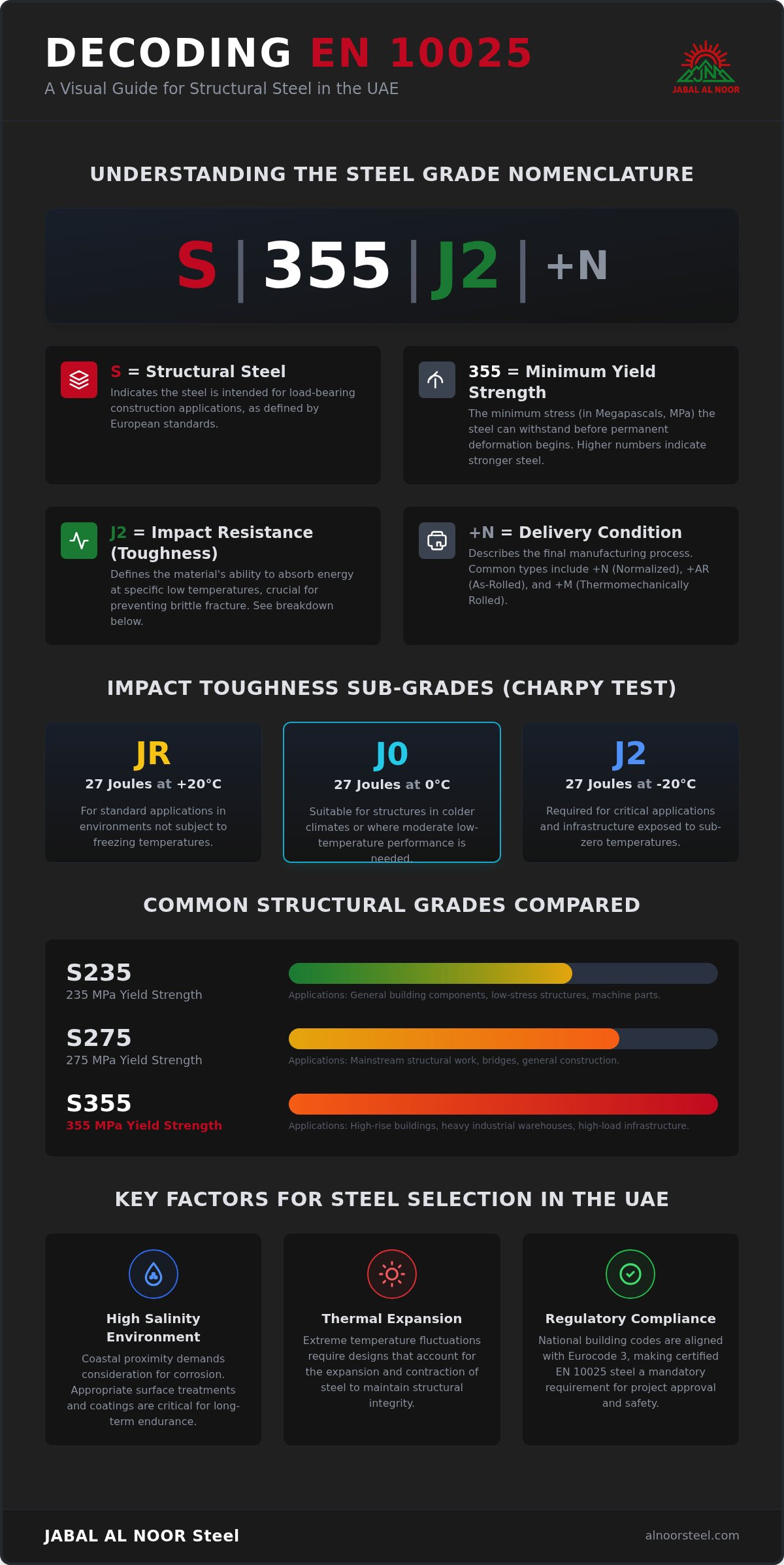
Interpreting the technical shorthand of structural steel requires a precise understanding of its alphanumeric codes. A grade such as S355J2+N isn’t just a label; it’s a condensed data sheet detailing the material’s performance limits. The “S” prefix is the first identifier, explicitly denoting that the material is intended for structural applications rather than general engineering or pressure vessel use. This distinction is fundamental for ensuring that EN 10025 steel grades UAE suppliers provide align with global steel construction standards and local safety mandates.
The numeric value following the prefix indicates the minimum yield strength (Reh) measured in Megapascals (MPa). In the case of S355, the steel must maintain a minimum yield of 355 MPa. Finally, the delivery condition symbols like +AR (as-rolled), +N (normalized or normalized rolled), and +M (thermomechanically rolled) describe the thermal processing the steel underwent at the mill. These conditions dictate the material’s internal grain structure and, consequently, its reliability under stress. You can explore our inventory of certified MS beams and channels to see how these designations are applied to real-world inventory.
Yield Strength vs. Tensile Strength
Yield strength is the specific stress level at which a material begins to exhibit permanent deformation. While tensile strength (Rm) measures the maximum stress a material can withstand before fracture, engineers focus on yield strength to determine the load-bearing capacity of a framework. Selecting a higher yield grade, such as S355 over S235, allows for the use of lighter sections to support the same load. This reduction in material weight can lead to significant logistical efficiencies and lower overall structural mass in complex UAE infrastructure projects.
Impact Energy Designations (JR, J0, J2)
The secondary suffix in a steel grade refers to its toughness, specifically its resistance to brittle fracture as determined by the Charpy V-notch impact test. This test measures the energy (in Joules) the steel absorbs during a sudden impact at a specific temperature. The designations are structured as follows:
- JR: Tested at 27 Joules at room temperature (+20°C).
- J0: Tested at 27 Joules at 0°C.
- J2: Tested at 27 Joules at -20°C.
While the UAE’s climate rarely reaches freezing, specifying J0 or J2 grades is common for critical infrastructure where the risk of fatigue or sudden stress is high. These sub-grades provide an additional layer of safety, ensuring the steel remains ductile even under unforeseen mechanical shocks or specialized industrial cooling environments.
Comparing Common Structural Grades: S235, S275, and S355
Selecting the appropriate material for a project requires a balanced evaluation of load-bearing requirements and fabrication constraints. The spectrum of EN 10025 steel grades UAE engineers typically specify ranges from the highly formable S235 to the high-strength S355. S235 serves as the baseline for light structural applications, including general fabrication and secondary framing where high stress isn’t the primary concern. Its low carbon content provides excellent weldability and ductility, making it a staple for projects requiring complex shaping or intricate welding patterns. While it offers less strength than its counterparts, its cost-efficiency for non-critical components remains unmatched.
S275 acts as a versatile mid-range solution, bridging the gap between light and heavy engineering. It’s frequently utilized in the construction of medium-load structures, such as commercial warehouses and bridge components. For high-stakes infrastructure and high-rise developments, S355 is the definitive choice. This grade provides the necessary yield strength to support massive vertical and lateral loads while allowing for a reduction in the overall weight of the steel framework. Because of its higher carbon equivalent, S355 requires more precise welding procedures than S235, but it remains the industry standard for durability in heavy engineering.
Mechanical Property Benchmarks
The mechanical integrity of these grades is defined by three primary metrics: yield strength, tensile strength, and elongation. These properties dictate how the steel reacts under tension and when it will reach the point of permanent deformation. For those specifying Universal Beams and Columns in S355JR, the following benchmarks are critical for structural calculations:
| Steel Grade | Min. Yield Strength (MPa) | Tensile Strength (MPa) | Min. Elongation (%) |
|---|---|---|---|
| S235JR | 235 | 360 – 510 | 26 |
| S275JR | 275 | 410 – 560 | 23 |
| S355JR | 355 | 470 – 630 | 22 |
International Equivalents (ASTM and JIS)
Global procurement often necessitates the substitution of grades when specific regional standards aren’t immediately available. In the UAE market, understanding how EN 10025 steel grades UAE suppliers stock compare to American (ASTM) or Japanese (JIS) standards is essential for maintaining project timelines. S235JR is largely considered the equivalent of ASTM A36, though A36 has a slightly higher yield point of approximately 250 MPa. For heavy-duty applications, S355JR aligns closely with ASTM A572 Grade 50 steel UAE engineers frequently specify. Both offer a 355 MPa (50 ksi) yield strength, making them interchangeable in most structural designs. When substituting, it’s vital to verify that the impact test requirements of the equivalent grade match the original design’s safety parameters.
Technical Considerations for Steel Grade Selection in the Middle East
Environmental variables in the Gulf region demand a more nuanced approach to material selection than standard European climates require. When specifying EN 10025 steel grades UAE contractors must account for the dual challenges of extreme thermal cycles and high-salinity coastal air. While the yield strength determines the load capacity, the sub-grade and surface condition dictate the long-term endurance of the asset. Large-scale steel frameworks in this region undergo significant expansion and contraction daily. This constant movement necessitates materials with high ductility and consistent grain structures to prevent fatigue-related issues over decades of service.
The decision between a JR and a J2 sub-grade often puzzles procurement teams, given that the UAE doesn’t experience sub-zero temperatures. However, the J2 designation implies a more rigorous testing protocol and a cleaner steel chemistry with fewer impurities. In heavy industrial environments, such as oil and gas refineries or power plants, the superior toughness of J2 provides a critical safety margin against sudden mechanical shocks and vibration-induced fatigue. Choosing the right grade is the first step toward structural integrity, but it must be paired with industrial-grade protection to withstand the local atmosphere. You can view our full range of certified structural sections to find the ideal match for your project’s stress profile.
Environmental Stress and Material Longevity
Offshore and marine structures represent the most demanding applications for structural steel in the region. For these high-stakes projects, S355J2 is frequently the baseline specification due to its balanced weldability and enhanced toughness. To combat the aggressive corrosion typical of coastal zones, the synergy between the steel grade and its initial treatment is vital. Most national infrastructure projects now mandate shot blasting and priming at the point of supply. This process removes mill scale and provides a clean profile for protective coatings. For a detailed breakdown of these processes, refer to our guide on Surface Treatments for Harsh Environments.
Procurement Strategy for National Contractors
Effective procurement requires balancing the upfront material cost against the long-term structural weight savings. While S355 grades carry a higher per-ton cost than S235, the ability to use thinner, lighter sections often reduces the total project expenditure. This efficiency extends to logistics and foundation requirements, providing a net benefit for large industrial contracts. Partnering with a knowledgeable UAE steel stockist for contractors ensures that every piece of steel is accompanied by a comprehensive Mill Test Certificate (MTC). This level of documentation is mandatory for 2026 regulatory compliance, guaranteeing full traceability from the furnace to the construction site.
Procuring Certified EN 10025 Structural Steel in the UAE
Procuring the specific EN 10025 steel grades UAE designers mandate requires more than a simple transaction; it’s a partnership rooted in technical precision and logistical reliability. JABAL AL NOOR Steel understands that the success of a 2026 infrastructure project hinges on the seamless integration of supply and certification. We don’t just deliver metal; we provide a verified link in the structural chain. Our inventory is strictly maintained to ensure that every beam, channel, and angle meets the specific technical delivery conditions discussed in the preceding sections of this guide, from chemical composition to mechanical toughness.
Efficiency on a high-stakes construction site is often won or lost in the preparation phase. JABAL AL NOOR Steel addresses this by offering in-house value-added processing, including precision cut-to-size customization and industrial surface treatments. By delivering sections that are already shot-blasted and primed, we help national contractors bypass the delays associated with third-party finishing. Our logistical capabilities are designed for the scale of national industrial sites, ensuring that bulk orders of structural steel arrive in a methodical sequence that mirrors the building’s planned pace. This structured approach allows project managers to grasp the full scope of their material readiness with unwavering confidence.
JABAL AL NOOR Steel’s Long Product Inventory
We maintain a comprehensive stock of S235, S275, and S355 across all primary structural profiles to accommodate the diverse engineering requirements of the regional market. Whether your design calls for standard MS Channels or heavy-duty Universal Beams in S355J2, our inventory is positioned to meet immediate demand. You can explore the full range at the JABAL AL NOOR Steel Shop to find the exact sections required for your framework. This availability is coupled with a rigorous documentation process, ensuring that every piece of steel is accompanied by the necessary certification to satisfy local building codes and safety regulations.
Partnering for Industrial Excellence
Selecting the right material is a critical decision that impacts both the safety and the economics of a project. JABAL AL NOOR Steel offers the technical support necessary to navigate grade selection and material substitution, providing a steady hand for procurement teams. Our commitment to transparency and ethical industrial trading means we prioritize long-term value over short-term gains. When you request a quote for bulk EN 10025 steel supply, you aren’t just getting a price; you’re gaining access to a seasoned veteran of the industry that values precision and operational excellence. We stand as a foundational pillar for the nation’s most ambitious energy and infrastructure collaborations.
Securing Structural Integrity for the 2026 Industrial Landscape
Mastering the technical nuances of the EN 10025 standard transforms material selection from a logistical hurdle into a strategic advantage. You’ve seen that the distinction between sub-grades like JR and J2 is fundamental to ensuring your framework withstands the specific mechanical stresses and environmental conditions of the Gulf region. By decoding the nomenclature and prioritizing yield strength, you ensure every beam and channel aligns with the latest 2026 building codes and safety mandates.
Reliability in procurement is the final pillar of a successful project. Jabal Al Noor Steel maintains a comprehensive inventory of EN 10025 steel grades UAE contractors trust for high-stakes infrastructure, including S235, S275, and S355. With our expert cut-to-size and surface treatment services available nationwide, we streamline your supply chain and provide the certified quality required for industrial excellence. Browse our EN 10025 structural steel inventory to secure the foundational components for your next development. We’re here to support your construction goals with precision and unwavering stability.
Frequently Asked Questions
What is the main difference between S235JR and S355JR?
The primary distinction lies in the minimum yield strength, which is the point where the steel begins to deform permanently. S235JR offers 235 MPa, whereas S355JR provides a significantly higher 355 MPa. This difference allows engineers to use thinner, lighter sections of S355JR to support the same load as thicker S235JR sections, effectively reducing the total structural mass of a building without compromising its load-bearing capacity.
Can EN 10025 S275JR be used as a substitute for ASTM A36?
S275JR is generally considered a superior substitute for ASTM A36 in most structural applications. While ASTM A36 requires a minimum yield strength of approximately 250 MPa, S275JR guarantees 275 MPa. This higher yield point provides an added safety margin. However, it’s essential to verify that the elongation and chemical composition requirements of the specific project are met before finalizing the substitution in the procurement phase.
Why is impact testing (J0, J2) important for structural steel in the UAE?
Impact testing designations like J0 and J2 indicate the steel’s toughness and resistance to brittle fracture under sudden stress. Even in the warm climate of the Gulf, specifying these EN 10025 steel grades UAE requirements is vital for high-stakes industrial projects. These sub-grades ensure the material can absorb energy during mechanical shocks or vibration-induced fatigue, which is critical for the long-term safety of oil and gas infrastructure.
What delivery conditions are common for EN 10025 steel in the Middle East?
The most common delivery conditions are +AR (as-rolled) and +N (normalized or normalized rolled). As-rolled steel is suitable for general fabrication where standard mechanical properties suffice. Normalized steel, however, undergoes a controlled cooling process to refine its grain structure. This refinement provides more consistent mechanical properties and improved toughness, making it the preferred choice for critical structural components that must endure extreme daily thermal cycles.
Which EN 10025 grade is best for high-rise building frameworks?
S355JR or S355J2 is typically the optimal choice for high-rise frameworks due to its high strength-to-weight ratio. By utilizing S355, designers can minimize the weight of the steel framework, which in turn reduces the load on the foundations. This efficiency is particularly valuable for the ambitious architectural designs found in the region, where reducing dead weight is a primary concern for structural stability and economic feasibility.
How do I verify the grade of the steel I receive on-site?
Verification is performed by cross-referencing the unique heat number embossed or stenciled on the steel section with the provided Mill Test Certificate (MTC). The MTC details the chemical analysis and mechanical testing results for that specific production batch. It’s a mandatory step in 2026 quality control protocols to ensure that the material delivered matches the engineering specifications and maintains full traceability for regulatory inspections.
Does JABAL AL NOOR Steel provide test certificates for EN 10025 products?
JABAL AL NOOR Steel provides comprehensive Mill Test Certificates (MTC) for all structural sections supplied to our clients. Every batch of EN 10025 steel grades UAE projects require is accompanied by documentation that confirms compliance with the specified technical delivery conditions. This level of transparency is a cornerstone of our service, ensuring that procurement teams and engineers have the verified data needed for project approval and safety compliance.
Are EN 10025 grades suitable for galvanization?
Most structural grades within this standard are suitable for hot-dip galvanization, provided the chemical composition is carefully managed. Specifically, the levels of silicon and phosphorus must be within certain ranges to ensure a uniform and durable zinc coating. If your project requires galvanized sections, it’s important to communicate this during procurement so that the material selected has a chemistry that facilitates a high-quality, corrosion-resistant finish.
No Comments yet!