Category: Uncategorized

IPE and HEB Beams: A Comprehensive Comparison for Structural Engineering

IPE and HEB Beams: A Comprehensive Comparison for Structural Engineering

Selecting the heaviest steel profile available might seem like a shortcut to structural safety, but it often leads to unnecessary material costs and logistical complications. Most engineers and procurement specialists understand the pressure of balancing rigid safety standards with strict project budgets. It’s common to feel overwhelmed by the subtle geometric differences between European sections or the nuances of the latest EN 10365:2026 updates. Mastering the critical differences between IPE and HEB beams is essential to ensure you select the profile that guarantees both structural integrity and maximum cost-efficiency for your specific application.

In this comprehensive comparison, we provide a clear framework for choosing between these two profiles based on bending versus compression needs. You’ll gain a reliable understanding of how geometry influences performance and how to align technical delivery conditions, such as the updated EN 10025-2:2024 standards, with your procurement strategy. We will also address common confusion regarding regional terminology and the upcoming EN 10034:2026 tolerance requirements. This methodical overview serves as an authoritative guide for large-scale infrastructure and energy projects that demand precision, durability, and long-term value.

Key Takeaways

  • Differentiate between IPE and HEB profiles by understanding how their specific web and flange dimensions dictate performance under bending and axial stress.
  • Evaluate technical properties like Section Modulus and Moment of Inertia to prevent over-specification and reduce overall material expenditure.
  • Identify the most efficient applications for each profile, from specifying IPE for horizontal rafters to utilizing HEB for heavy-duty foundations and bridge girders.
  • Ensure compliance with international standards by mastering the selection of S235JR and S355JR grades and the verification of Mill Test Certificates.
  • Streamline your procurement of IPE and HEB beams by partnering with established national suppliers capable of providing cut-to-size customization and specialized surface treatments.

Understanding IPE and HEB Beams in Structural Frameworks

Structural steel serves as the foundational skeleton for large-scale infrastructure and energy projects. Selecting the specific profile for a project isn’t merely a technicality; it’s a strategic decision that impacts the long-term stability and financial viability of the build. Engineering professionals frequently evaluate IPE and HEB beams to determine which section provides the necessary load-bearing capacity without inflating material costs. These profiles are strictly governed by the EN 10025 standard, which ensures that mechanical properties and chemical compositions meet rigorous industrial benchmarks. Choosing the correct profile is critical. It prevents the common pitfall of over-specification, which increases project expenses and logistical complexity.

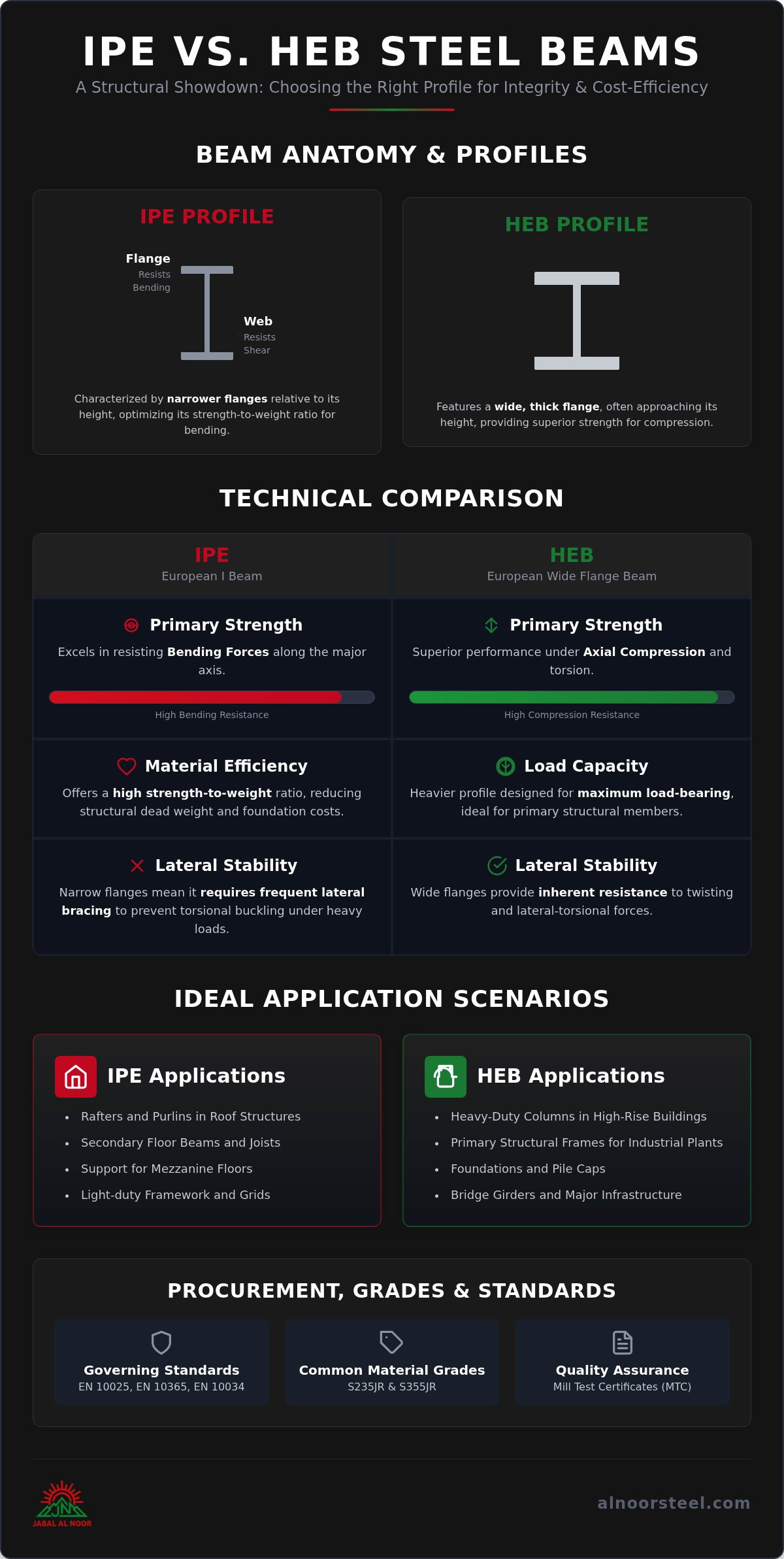
The mechanical performance of an I-beam depends on its geometric distribution of steel. The section consists of two horizontal plates, known as flanges, connected by a vertical component called the web. In structural mechanics, the web primarily resists shear forces, while the flanges counteract the majority of the bending moment. By understanding these roles, you can optimize your design for specific stress types. You can find the full range of these structural components at the Al Noor Steel shop, where international grade compliance is a standard requirement for every section.

The Anatomy of an IPE Beam

The IPE profile, or European I Beam, is characterized by its narrow flanges relative to the height of its web. Modern IPE sections utilize parallel flange designs that simplify connections compared to older tapered versions. These beams are exceptionally material-efficient when resisting bending forces in horizontal applications. Because the mass is concentrated away from the neutral axis, IPE sections offer a high strength-to-weight ratio. They’re ideal for rafters and secondary floor supports where vertical loads are the primary concern. Using IPE sections helps reduce the dead weight of the structure, which can lead to significant savings in the foundation and support columns.

The Anatomy of an HEB Beam

In contrast, the HEB beam is a European Wide Flange Beam where the flange width often approaches the total height of the section. These profiles feature a significantly thicker web and flanges than their IPE or HEA counterparts. This robust geometry makes the HEB profile the superior choice for handling axial compression and torsion. They’re foundational elements in heavy-duty columns and bridge girders where multi-directional stress is a constant factor. While they’re heavier and more expensive than IPE beams, their ability to withstand massive vertical loads makes them indispensable for the primary structural members of high-rise buildings and industrial plants.

Technical Comparison: IPE vs HEB Design Properties

Technical specifications dictate the structural efficiency of any industrial build. When comparing IPE and HEB beams, the most significant variance lies in their Section Modulus (W) and Moment of Inertia (I). IPE profiles are engineered to maximize bending resistance along the major axis while using the least amount of steel possible. This makes IPE the lighter champion for horizontal applications where weight reduction is a priority. Conversely, HEB profiles possess a much higher Moment of Inertia on the minor axis. This geometric property provides the lateral stability required for heavy load-bearing members. Detailed technical data on these ArcelorMittal I sections confirms that while IPE is efficient for simple bending, HEB is necessary when lateral forces are present.

Flange width directly impacts a beam’s resistance to lateral-torsional buckling. IPE beams have relatively narrow flanges, meaning they require frequent lateral bracing to prevent twisting under heavy loads. HEB profiles feature wide flanges that provide inherent resistance to these torsional forces. This geometric stability is why engineers prefer HEB sections for multi-story columns and primary structural frames. The upcoming EN 10034:2026 standard will introduce even tighter tolerances for flange parallelism, further enhancing the reliability of these wide-flange sections in precision engineering.

Load-Bearing Capacity and Stress Distribution

HEB beams distribute heavy vertical loads across a significantly wider surface area than IPE sections. This distribution reduces the localized stress on connecting plates and foundations. While IPE beams perform exceptionally well under uniform distributed loads (UDL) in flooring systems, they lack the cross-sectional area to handle concentrated axial compression effectively. The wide flange design provides a substantial footprint that minimizes the risk of local buckling under extreme compression. This makes HEB the standard for foundational columns in high-stakes infrastructure projects.

Weight and Logistics Considerations

The weight difference between these profiles has a massive impact on project logistics. For instance, an IPE 300 weighs approximately 42.2 kg per meter, whereas an HEB 300 weighs roughly 117 kg per meter. This means an HEB section is nearly 2.7 times heavier than an IPE section of the same height. Such a drastic increase in mass affects everything from transportation costs to the capacity of the cranes required on-site. When planning your logistics, it’s also worth researching Hollow Section Steel Suppliers in UAE to see how different profiles can complement your beam selection. For a reliable supply of these components, you can browse the full inventory selection to match your specific engineering requirements.

Application Scenarios: When to Specify IPE vs HEB

Mapping IPE and HEB beams to specific structural roles requires a deep understanding of load paths and architectural constraints. While both profiles are essential in modern construction, they serve fundamentally different purposes within a building skeleton. IPE beams excel as horizontal members. Their high depth-to-width ratio makes them the industry standard for roof purlins and rafters where the primary stress is bending. In residential construction, they provide a sleek, narrow profile that architects often prefer for exposed steel features or secondary floor supports where vertical clearance is a priority.

HEB sections function as the workhorse of vertical load paths. Their massive cross-sectional area and thick flanges make them indispensable for primary columns and heavy-duty foundations. In bridge engineering, HEB girders handle the complex torsional and axial stresses that would cause lighter sections to fail. These beams are designed to remain stable under the immense pressure of multiple stories, providing the foundational strength required for high-rise infrastructure and industrial warehouses.

Pre-Engineered Buildings (PEB) frequently utilize a hybrid approach to optimize both safety and cost. Engineers might specify HEB for the main frame columns to ensure axial stability while using IPE for the roof rafters to minimize the total tonnage of the project. This strategic mix ensures structural integrity while maintaining budget efficiency. By selecting the right profile for each specific load case, you avoid the unnecessary expense of over-designing secondary members.

Horizontal vs. Vertical Structural Roles

IPE is the preferred choice for spanning long distances with minimal weight. It’s often used in floor systems where the goal is to resist gravity loads across a wide bay without adding excessive dead weight. HEB is indispensable for high-rise vertical supports because its wider flanges resist buckling over long vertical spans. For project managers, selecting a reliable Structural Steel Supplier UAE ensures that both profiles are available in the required grades to meet these distinct structural roles.

Environmental and Industrial Factors

Industrial machinery platforms often face high-frequency vibrations that can lead to fatigue in thinner sections. In these environments, the mass and damping capacity of HEB beams provide superior performance and operational safety. Conversely, IPE is the better choice for architectural features where a slimmer, more refined profile is desired. In the oil and gas sector, where infrastructure must withstand extreme conditions and heavy equipment loads, HEB sections provide the necessary durability and resistance to harsh industrial environments.
IPE and HEB Beams: A Comprehensive Comparison for Structural Engineering

Procurement Factors: Material Grades and Customization

Procurement of IPE and HEB beams involves more than selecting a profile height. You must specify the correct steel grade to match the structural calculations of your project. S235JR is a standard non-alloy structural steel with a yield strength of 235 MPa; it’s suitable for many secondary IPE applications. In contrast, S355JR provides a higher yield strength of 355 MPa, which is often mandatory for the heavy-duty HEB columns used in infrastructure. Using S355JR can sometimes allow for a lighter profile while maintaining the same load capacity, which helps reduce the total weight of the structure. This grade is particularly effective for large-scale energy projects where endurance and high standards are the primary metrics.

Every beam must be accompanied by a Mill Test Certificate (MTC). This document verifies the chemical composition and mechanical properties of the steel, ensuring it meets the rigorous EN 10025 standards. Without this verification, you risk introducing non-compliant materials into high-stakes projects. It’s a foundational step in maintaining operational excellence and ensuring long-term structural safety. Reliable procurement requires a transparent view of these certificates to guarantee that the materials match the engineer’s specifications exactly.

Sourcing International Standard Steel

Compliance with Structural Steel Quality Standards UAE is a non-negotiable requirement for government and energy sector contracts. Large-scale projects require a partner with stockist capabilities rather than just a middleman supplier. A true stockist maintains an extensive inventory of various grades and sizes, which ensures that project timelines aren’t delayed by manufacturing lead times. This regional expertise allows for a steady flow of materials that meet both EN 10025 and ASTM standards, providing the logistical efficiency necessary for complex construction schedules.

Value-Added Services for Contractors

On-site efficiency is significantly improved through a Cut-to-Size Steel Service in the UAE. This logistical service reduces on-site welding and material waste, allowing for immediate assembly upon delivery. Additionally, surface treatments like shot blasting and priming are essential for beams exposed to harsh industrial environments. These processes remove mill scale and apply a protective layer that prevents corrosion during transport and installation. For contractors, these services provide industrial stability by ensuring every component arrives ready for immediate use. To ensure your next project utilizes only high-standard materials, you can view our full range of structural steel sections.

Strategic Sourcing from JABAL AL NOOR Steel

Securing a reliable supply of IPE and HEB beams is a critical factor in maintaining the momentum of large-scale infrastructure and energy projects. JABAL AL NOOR Steel maintains a comprehensive inventory of MS beams, including IPE, HEB, and HEA sections, ensuring that structural requirements are met with precision and speed. Our commitment to international quality benchmarks means every section complies with the latest EN 10025 standards. This dedication to operational excellence provides contractors and engineers with the industrial stability needed to execute complex builds. We prioritize long-term partnership over transactional sales, offering expert consultation to help you align beam profiles with specific load-bearing requirements.

National delivery capabilities ensure that heavy structural components reach project sites across the UAE without delay. Managing the logistics of high-tonnage steel requires a sophisticated supply chain and a deep understanding of regional industrial pressures. We provide the transparency and reliability expected from a seasoned industry veteran. Our inventory isn’t limited to standard sizes; we offer the specialized support needed for high-stakes projects that demand rigorous quality benchmarks and verified material origins.

A Trusted Partner for Long Products

With decades of experience in the regional steel distribution sector, we’ve established ourselves as a foundational pillar for the construction industry. We understand that time-sensitive infrastructure projects don’t have room for supply chain interruptions. Our role as a leading entity among Steel Suppliers in UAE allows us to offer consistent availability even for rare or high-demand profiles. This seasoned expertise ensures that every client receives materials that are not only compliant with international standards but also optimized for logistical efficiency.

Ready to Support Your Next Project

Every construction project has unique requirements, and we’re prepared to provide the specific solutions your engineering team demands. Whether you need to request a quote for bulk IPE and HEB beams or require access to our full range of hollow sections and flat products, our procurement process is designed for clarity and speed. We address the common industry gap in value-added services by providing specialized cut-to-size customization and surface treatments like shot blasting and priming. These services reduce on-site waste and ensure your steel arrives ready for immediate structural integration. To secure the materials for your next build, explore our structural steel inventory and partner with a supplier that values precision and long-term value.

Optimizing Structural Integrity with Precise Beam Selection

Mastering the technical nuances of IPE and HEB beams is the first step toward achieving industrial stability in your next project. We’ve established that while IPE sections offer unmatched efficiency for horizontal bending, the wide-flange HEB profile remains the standard for vertical load-bearing members. Selecting the correct steel grade, such as S355JR, ensures your structure meets the rigorous safety benchmarks required for large-scale infrastructure. These decisions directly impact both the safety of the build and the project’s overall cost-efficiency.

Partnering with a dependable supplier transforms these technical choices into operational reality. JABAL AL NOOR Steel provides the regional expertise and logistical efficiency needed to keep complex projects on schedule. With an EN 10025 Compliant Inventory and In-house Cut-to-Size Services, we help you minimize on-site waste and streamline the assembly process. Our National UAE Distribution Network ensures that high-standard materials are delivered directly to your site with unwavering reliability and professionalism.

Request a Quote for Structural Beams to secure the precision and long-term value your project deserves. We’re ready to provide the foundational strength for your engineering success.

Frequently Asked Questions

What is the main difference between IPE and HEB beams?

The primary distinction lies in their cross-sectional geometry and intended structural role. IPE sections feature narrower flanges and are optimized for resisting bending moments in horizontal applications like floor joists. HEB profiles possess wider flanges and thicker webs, providing the axial stability required for vertical columns. This design difference makes HEB sections significantly heavier and more capable of handling multi-directional stress in large-scale infrastructure projects.

Can I use an IPE beam for a column in a multi-story building?

While technically possible for light loads, IPE beams aren’t the standard choice for primary columns in multi-story structures. Their narrow flanges make them susceptible to lateral buckling under heavy axial compression. HEB profiles are specifically engineered for vertical support because their wide-flange design provides the necessary stability to prevent twisting. For secondary supports or light-duty frames, IPE might suffice, but primary structural integrity usually demands the robust cross-section of an HEB beam.

Which is more cost-effective: IPE or HEB?

IPE beams are generally more cost-effective for horizontal spans because they provide high strength with minimal steel weight. This reduces material costs and transportation expenses for roof rafters and secondary floor beams. However, for heavy vertical loads, using an HEB beam is more economical than attempting to reinforce multiple lighter IPE sections. True cost-efficiency is achieved by matching the beam profile to the specific stress requirements of the engineering design.

What do the numbers after the beam type (e.g., IPE 200) signify?

The numerical value following the profile designation indicates the nominal height of the beam in millimeters. For instance, an IPE 200 has a total height of approximately 200mm. These dimensions are standardized under EN 10365:2026 to ensure consistency across the industrial supply chain. Engineers use these numbers to quickly identify the section properties required for their calculations, allowing for precise procurement and structural alignment during the design phase.

Are HEB beams the same as Wide Flange Beams (W-Beams)?

HEB beams are the European version of Wide Flange beams, but they’re not identical to American W-beams. While both share the “H” shape and wide-flange characteristics, HEB profiles follow European EN standards, whereas W-beams adhere to American ASTM standards. There are subtle differences in dimensions and weight per meter. For projects in the UAE, specifying IPE and HEB beams ensures compliance with the European standards most commonly utilized in regional infrastructure.

Which steel grade is most common for IPE and HEB beams in the UAE?

Structural steel in the UAE most commonly utilizes S235JR and S355JR grades in accordance with the EN 10025 standard. S235JR is a standard grade suitable for many general construction applications. S355JR is frequently specified for HEB beams in high-stress environments because it offers a higher yield strength of 355 MPa. Choosing the correct grade is essential for ensuring that the structural framework can withstand the operational pressures of heavy industry.

Do you offer surface treatments for beams used in outdoor environments?

JABAL AL NOOR Steel provides specialized surface treatments to protect structural components from harsh outdoor conditions. We offer shot blasting to remove mill scale and priming to create a corrosion-resistant barrier. These treatments are vital for maintaining the durability of steel in the humid and saline environments often found across the UAE. Proper surface protection extends the lifecycle of your structural framework and reduces long-term maintenance requirements for industrial infrastructure.

What are the standard lengths for IPE and HEB beams in stock?

Standard stock lengths for these profiles are typically 6 meters or 12 meters to facilitate efficient transport and handling. However, project requirements often demand precise dimensions to minimize on-site waste and welding. We provide in-house cut-to-size customization for our entire inventory of long products. This service allows contractors to receive beams that are ready for immediate installation, significantly improving the logistical efficiency and safety of high-stakes construction projects.
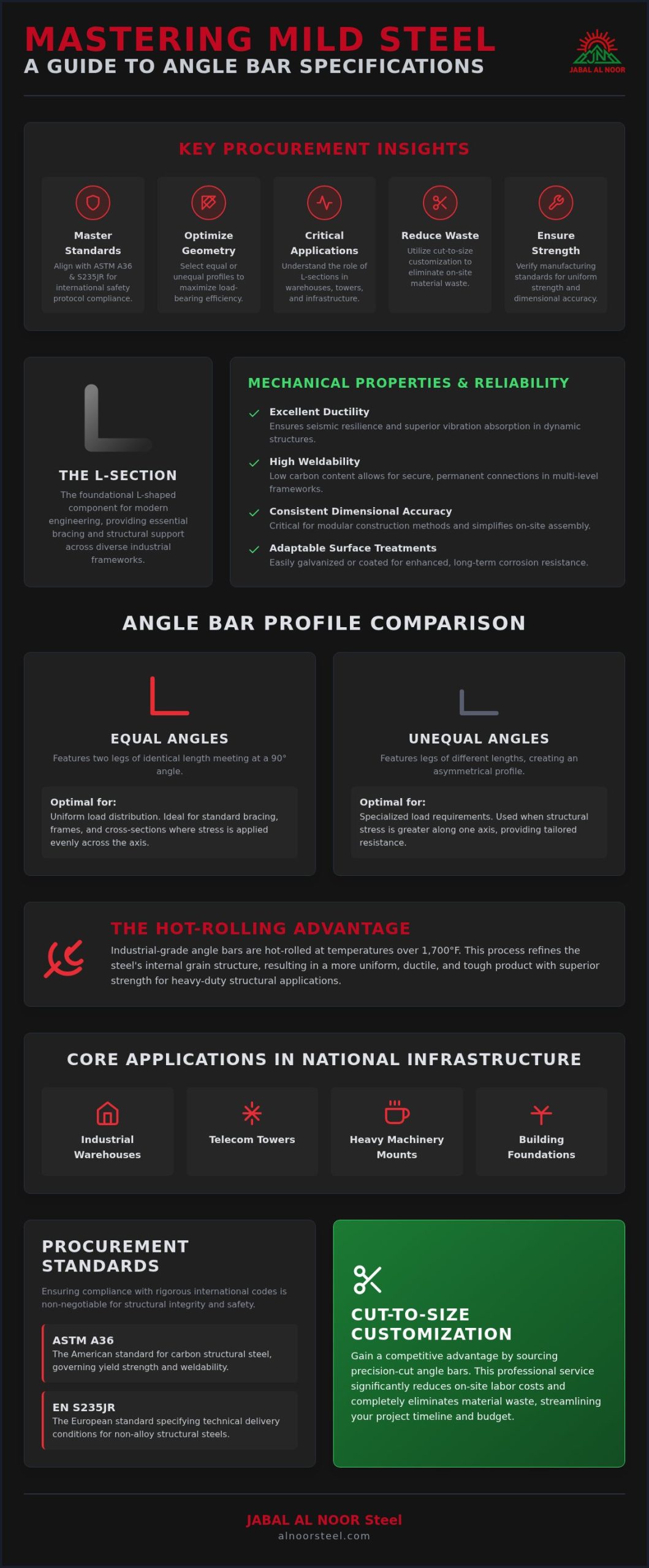
Mild Steel Angle Bars: Engineering & Procurement Guide 2026

Mild Steel Angle Bars: Engineering & Procurement Guide 2026

A single oversight in material grade compliance can compromise the structural integrity of an entire national infrastructure project before the first bolt is even tightened. In the high-stakes environment of heavy industry, the reliability of your supply chain is the only safeguard against catastrophic failure and costly project delays. You likely recognize that sourcing mild steel angle bars involves much more than comparing basic dimensions; it requires a rigorous alignment with ASTM or EN standards to ensure long-term durability and safety.

This comprehensive guide provides the technical clarity needed to master specifications and procurement standards for 2026. By following these benchmarks, you can secure high-quality structural steel that meets international codes while utilizing cut-to-size customization to eliminate on-site waste. We’ll examine the critical differences between equal and unequal profiles, the operational advantages of specialized surface treatments, and the logistical frameworks required to maintain precision in large-scale industrial supply. This methodical approach ensures your procurement strategy remains a foundational pillar for engineering excellence.

Key Takeaways

  • Master the technical distinctions between ASTM A36 and S235JR to ensure your structural steel aligns with rigorous international safety and engineering protocols.
  • Learn how to select the optimal geometry between equal and unequal mild steel angle bars to maximize load-bearing efficiency in specialized frameworks.
  • Identify the critical role of high-strength, hot-rolled L-sections in national infrastructure, ranging from industrial warehouses to telecommunication towers.
  • Discover how utilizing professional cut-to-size customization reduces on-site labor and eliminates material waste in large-scale procurement.
  • Gain clarity on the manufacturing standards that ensure uniform strength and dimensional accuracy for long-term structural stability in heavy-duty projects.

Understanding Mild Steel Angle Bars in Modern Engineering

Mild steel angle bars are foundational components in structural engineering, defined by their distinctive L-shaped cross-section with two perpendicular legs. These sections provide essential bracing and support across diverse industrial frameworks, serving as the skeletal structure for everything from heavy machinery mounts to building foundations. Their primary appeal lies in the balance between structural rigidity and manufacturing precision, making them indispensable for large-scale infrastructure projects that demand high endurance.

The versatility of these components stems from their low carbon content, which ensures exceptional weldability and ease of fabrication. For a deeper context on how these materials fit into broader construction standards, Understanding Structural Steel provides a comprehensive overview of the material science involved. Engineers rely on these bars not only for their load-bearing capacity but also for their predictable performance under stress. It’s this reliability that makes them the industry standard for permanent structural connections.

To visualize the manufacturing and appearance of these structural elements, watch this brief overview:

The Manufacturing Process: Hot-Rolled vs. Cold-Formed

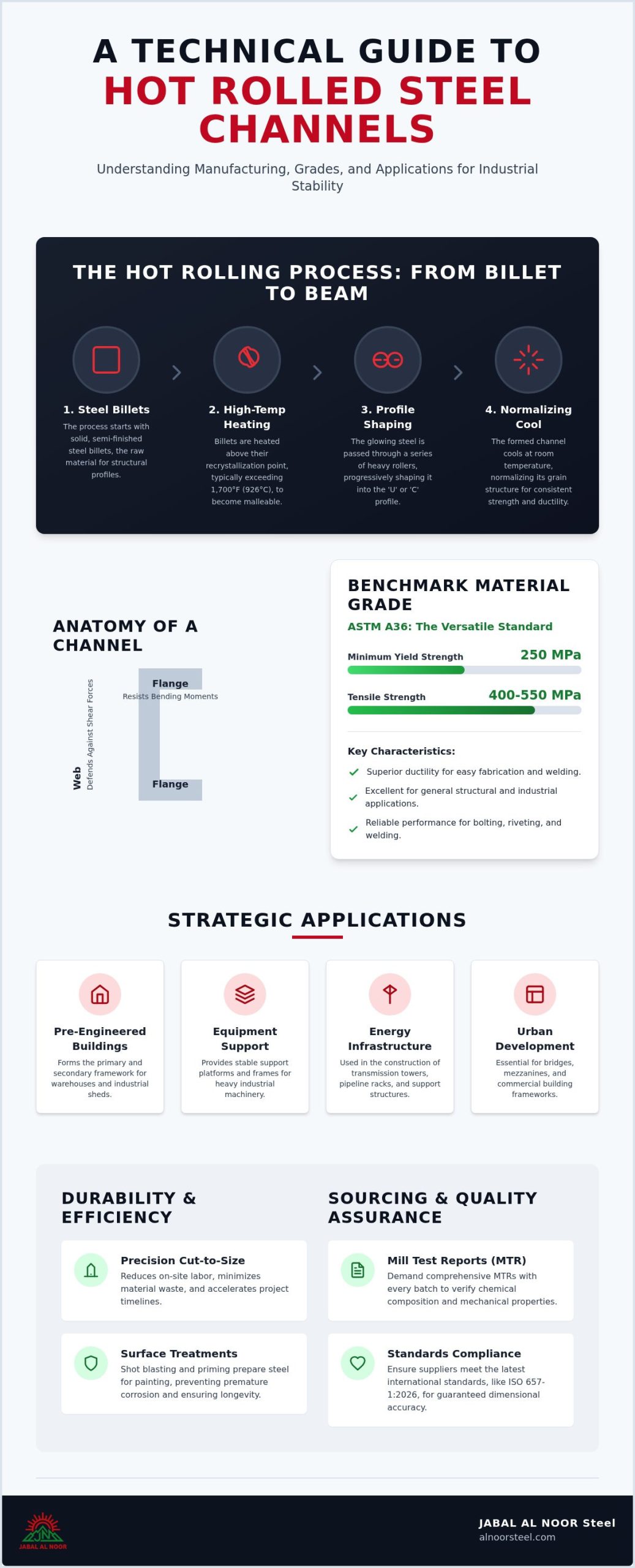
Most industrial-grade mild steel angle bars are produced through the hot-rolling process. This involves passing the steel through rollers at temperatures exceeding 1,700°F, which is above the material’s recrystallization point. This high-temperature shaping improves the internal grain structure, resulting in a more uniform and ductile product. While cold-formed sections offer tighter tolerances for smaller applications, hot-rolled angles provide the superior strength and toughness required for heavy-duty structural frames. The cooling process typically leaves a characteristic blue-grey mill scale on the surface, which serves as a protective layer and a base for further surface treatments. You can explore a wide range of these long products at alnoorsteel.com/shop to find sections that meet your specific project requirements.

Mechanical Properties and Structural Reliability

The structural reliability of MS angles is governed by their mechanical properties, specifically tensile strength and yield point. These bars offer a high weight-to-strength ratio, allowing engineers to design rigid frameworks without adding excessive mass. Their geometric 90-degree shape provides high resistance to bending in multiple directions, which is critical for maintaining the integrity of trusses and support columns. Because they don’t easily deform under heavy loads, they contribute significantly to the overall rigidity of a framework. This structural stability is enhanced by several core characteristics:

  • Excellent ductility for seismic resilience and vibration absorption
  • High weldability for secure, permanent connections in multi-level structures
  • Consistent dimensional accuracy for modular construction and easy assembly
  • Adaptability to various surface treatments, such as galvanization, for corrosion resistance

Comparing Equal and Unequal Angle Bar Profiles

Engineering precision requires a deliberate choice between equal and unequal geometries. While both variants share the same foundational L-shaped profile, their behavior under structural stress differs significantly based on leg symmetry. Procurement teams must identify these differences early to ensure that the mild steel angle bars delivered to the site align perfectly with the specific load-bearing requirements of the project blueprints.

Equal Angles: Symmetry for Uniform Load Distribution

Equal angles feature two legs of identical length, meeting at a precise 90-degree angle. This symmetry makes them the industry standard for bracing and cross-sections where the load is distributed evenly across the axis. Engineers prefer equal sections for simple frames because the identical leg dimensions simplify calculations for moment of inertia and radius of gyration. These components are commonly utilized in light-to-medium construction for roof trusses, gate frames, and general support brackets. Because the weight is distributed symmetrically, they provide a predictable and stable performance in standard structural grids.

Unequal Angles: Solutions for Eccentric Loading

In contrast, unequal angles consist of one leg longer than the other. This asymmetrical design is specifically engineered to resist bending or twisting forces in applications where the load is not centered, often referred to as eccentric loading. By utilizing a section with varying leg dimensions, engineers can optimize material usage, placing more steel exactly where the highest stress occurs. This efficiency is particularly valuable in the construction of lintels, specialized machinery supports, and complex ship-building frames where space constraints or specific loading paths dictate the geometry.

Selecting the correct leg ratio is not merely a matter of strength; it’s a strategy for logistical efficiency. For instance, using an unequal angle for a structural lintel can provide the necessary horizontal support without the unnecessary weight of a larger equal-leg section. This precision helps in managing total project mass and reducing material costs over large-scale procurement cycles. Standard identification in engineering blueprints follows a consistent nomenclature that must be strictly adhered to during the ordering process:

  • Equal Sections: L (Leg Width) x (Leg Width) x (Thickness), such as L 100x100x10.
  • Unequal Sections: L (Long Leg) x (Short Leg) x (Thickness), such as L 125x75x8.

Understanding these designations ensures that procurement remains transparent and error-free. To find the exact dimensions required for your next infrastructure project, you can browse our comprehensive range of structural steel. Each section is sourced to meet rigorous dimensional tolerances, providing the stability and endurance your engineering designs demand.

Core Applications Across National Infrastructure Projects

While small-scale retail applications often focus on simple shelving or residential gates, the true utility of mild steel angle bars is realized within the rigorous demands of national infrastructure. These sections serve as the critical connective tissue in heavy-duty engineering, providing the necessary bracing and structural reinforcement for projects that define a nation’s industrial capacity. Their ability to resist both tension and compression makes them the primary choice for engineers designing systems that must endure decades of operational stress and environmental exposure.

Industrial Warehousing and PEB Structures

In the construction of industrial warehouses and pre-engineered buildings (PEB), angle bars provide essential lateral stability. These structures often span vast areas and require robust bracing systems to resist environmental wind loads and seismic forces. By integrating these angles with larger MS Beams, engineers create a comprehensive support network that prevents frame distortion. The angles are typically utilized as “X-bracing” or “K-bracing” along the wall and roof planes, ensuring the building remains rigid even under extreme pressure. This synergy between different long products creates a foundational pillar for modern logistics hubs and manufacturing plants.

Energy and Telecommunication Infrastructure

The energy and telecommunications sectors rely heavily on the geometric efficiency of mild steel angle bars for lattice tower construction. Whether supporting high-tension power lines or housing advanced microwave equipment, these towers must maintain perfect verticality while exposed to high-altitude wind speeds. MS angles are the preferred profile here because their open L-shape prevents the accumulation of water and debris, which simplifies long-term maintenance in remote sites. Compliance with national standards for high-tension environments ensures these structures can support heavy cabling and equipment without risking fatigue or structural collapse. Their ease of assembly allows for rapid deployment across diverse geographical terrains, supporting the steady expansion of national utility networks.

Beyond these primary structures, angle bars are indispensable for industrial safety and mechanical support systems. You’ll find them in the fabrication of:

  • Industrial Staircases and Walkways: Providing the structural frame and nosing for heavy-duty steel gratings in oil and gas refineries.
  • Mechanical Support Brackets: Securing HVAC systems, piping networks, and electrical conduits in large-scale commercial complexes.
  • Safety Guardrails: Offering high-impact resistance along elevated platforms and industrial perimeter fencing.

This wide-ranging utility underscores the importance of sourcing material that meets precise technical proficiency. When procurement teams prioritize high-grade MS angles, they aren’t just buying steel; they’re ensuring the long-term endurance of the nation’s most vital assets.

Mild Steel Angle Bars: Engineering & Procurement Guide 2026

Procurement Standards: ASTM A36 and S235JR Compliance

In the context of large-scale infrastructure, procurement precision starts with material grade compliance. Selecting the correct standard for mild steel angle bars ensures that the structural integrity of the project matches the engineer’s design intent. While several international standards exist, ASTM A36 and S235JR remain the most prevalent benchmarks for structural carbon steel. ASTM A36 is the North American standard, valued for its excellent weldability and balanced mechanical properties. Conversely, S235JR, governed by the European EN 10025 standard, is a general-purpose construction grade with a minimum yield strength of 235 MPa.

Choosing between these grades often depends on the specific project requirements and the regional engineering codes in effect. Material certification is not merely a formality; it’s a critical component of project safety and insurance underwriting. Verification of chemical composition and mechanical testing results protects the asset owner from material fatigue or catastrophic failure. Rigorous documentation ensures that every section used in the framework can withstand the calculated loads and environmental pressures.

Navigating International Steel Grades

Engineers must distinguish between ASTM, EN, and JIS standards to ensure global compatibility. For instance, while ASTM A36 is a standard for carbon steel, the S235JR grade includes a specific “JR” designation indicating longitudinal Charpy V-notch impact strength. Understanding how Structural Steel Quality Standards impact procurement allows teams to select the appropriate grade for specific load-bearing requirements. This technical proficiency reduces confusion during the sourcing phase and ensures that the materials delivered to the site perform as expected under the nation’s unique environmental conditions.

Dimensional Tolerances and Quality Certification

Beyond material grade, dimensional accuracy is paramount for seamless on-site assembly. Quality control involves checking for straightness, leg length, and thickness accuracy against specified tolerances. Every batch of mild steel angle bars must be accompanied by a Mill Test Certificate (MTC). This document serves as the official record of the steel’s origin, verifying its chemical properties and mechanical performance. A comprehensive MTC will detail the following critical parameters:

  • Chemical Composition: Precise levels of carbon, manganese, phosphorus, and sulfur.
  • Mechanical Performance: Verified tensile strength, yield strength, and elongation percentages.
  • Heat Number: Traceability back to the specific furnace batch.

Ensuring compliance with national building codes and safety regulations is impossible without this documentation. Rigorous certification processes protect the supply chain from inconsistent material quality. To secure certified structural materials that meet these exacting benchmarks, you can source your industrial steel inventory here. By prioritizing documented quality, procurement managers maintain the high standards required for national energy and infrastructure projects.

Sourcing Precision-Cut Angle Bars from JABAL AL NOOR Steel

JABAL AL NOOR Steel has served as a foundational pillar for national infrastructure since 2010. We maintain a comprehensive inventory of long products designed to meet the high-volume demands of the construction and energy sectors. Our robust supply chain ensures that premium mild steel angle bars are readily available for complex projects, providing the material consistency required for rigorous engineering benchmarks. This steady availability allows project managers to plan with confidence, knowing their structural requirements are backed by a reliable regional expert.

Value-Added Services: Cut-to-Size and Finishing

Operational efficiency in heavy industry is often achieved by reducing on-site labor and minimizing material waste. Utilizing Cut-to-Size Steel Services allows procurement managers to receive sections that are prepared for immediate structural integration. This level of customization lowers transport costs and removes the logistical burden of managing excess material at the project site. It’s a methodical approach that prioritizes precision over traditional, wasteful fabrication methods.

To combat the corrosive effects of high-humidity environments, we offer industrial surface treatments such as shot blasting and priming. Shot blasting effectively removes mill scale and surface contaminants, providing an ideal profile for protective finishes. Applying an industrial-grade primer immediately after this process ensures that the mild steel angle bars remain protected during transport and on-site storage. This proactive approach to material maintenance is essential for preserving the long-term endurance of structural frameworks in challenging climates.

Streamlining Procurement for National Contracts

Reliable partnerships are the bedrock of successful national infrastructure and energy projects. JABAL AL NOOR Steel supports these large-scale initiatives through methodical logistics and a commitment to technical proficiency. We function as a seasoned veteran of the industry, offering transparent sourcing and a steady supply of structural materials for national contracts. Our logistics network is optimized for delivery to major industrial hubs, ensuring that bulk orders arrive on schedule and in accordance with project milestones.

Engineering and procurement teams can access our online inventory to facilitate real-time sourcing of essential structural sections. This digital platform streamlines the ordering process and ensures that project timelines are maintained without the risk of material shortages. By integrating a vast physical stock with in-house industrial processing, we provide a reliable and professionally curated service for our national collaborators. This commitment to operational excellence ensures that every project we support is built on a foundation of quality and logistical efficiency.

Securing the Future of National Infrastructure

Precision in structural engineering begins with the rigorous selection of material grades and geometric profiles. By mastering the technical distinctions between ASTM and EN standards, procurement teams ensure that every framework meets the highest safety benchmarks for 2026. Integrating value-added services like cut-to-size customization and industrial surface treatments further optimizes project timelines while reducing on-site waste.

JABAL AL NOOR Steel remains a foundational pillar for the industry. Since our establishment in 2010, we’ve focused on providing a consistent supply of premium mild steel angle bars backed by full material certification. Our national supply capacity ensures that even the most complex infrastructure projects receive the technical support and logistical efficiency they require. We prioritize transparency and reliability in every partnership, ensuring your material needs are met with professional expertise.

When you prioritize verified quality and professional processing, you secure the long-term endurance of your engineering assets. We invite you to Request a Quote for Bulk Mild Steel Angle Bars to streamline your next procurement cycle. Your commitment to precision today builds the resilient infrastructure of tomorrow.

Frequently Asked Questions

What is the difference between hot-rolled and cold-rolled mild steel angle bars?

Hot-rolled sections are forged at high temperatures, which creates a more ductile and uniform internal structure suitable for heavy loads. Cold-rolled bars are shaped at room temperature to achieve precise dimensions and a polished surface finish. For industrial-scale projects, hot-rolled mild steel angle bars are the standard choice due to their superior structural toughness. These sections are specifically designed to withstand the compressive stresses found in large-scale frames and infrastructure.

Which steel grade is better for structural construction: ASTM A36 or S235JR?

The choice between ASTM A36 and S235JR depends on the specific engineering code governing your project. ASTM A36 is the North American benchmark for carbon steel, offering a minimum yield strength of 36,000 psi and excellent weldability. S235JR is the European equivalent (EN 10025), providing a minimum yield of 235 MPa. Both grades provide reliable performance, but A36 is often preferred for its slightly higher tensile properties in heavy-duty structural applications.

Can mild steel angle bars be used in marine or highly corrosive environments?

Yes, but mild steel angle bars require specialized protective coatings to endure marine or high-salinity environments. Without protection, the low carbon content of the steel remains vulnerable to rapid oxidation. We recommend using hot-dip galvanization or high-build epoxy primers to create a physical barrier against salt and moisture. These treatments ensure the structural integrity of the steel remains intact even when exposed to the harsh conditions of national coastal sites.

What are the standard lengths for MS angle bars available in the national market?

Standard stock lengths for MS angle bars in the national market are typically 6 meters or 12 meters. These lengths facilitate efficient transport and align with standard architectural modules. However, many projects require unique dimensions to minimize on-site labor and material waste. We provide precision cut-to-size services to deliver sections that match your exact specifications, ensuring that your procurement strategy supports a more streamlined and efficient construction timeline.

How do I calculate the weight of a mild steel angle bar for my project?

To calculate the weight of an angle bar, use the formula: Weight (kg) = [Leg 1 + Leg 2 – Thickness] * Thickness * Length * 0.00785. This calculation uses the standard density of carbon steel (7,850 kg/m³). For instance, an equal angle measuring 75x75x6 mm at a length of 6 meters weighs approximately 41.5 kg. Accurate weight calculations are essential for managing logistics, crane lifting capacities, and the overall load-bearing design of the framework.

What is the primary difference between equal and unequal angle profiles?

The fundamental difference is the symmetry of the legs. Equal angles feature two legs of identical length, which simplifies load-bearing calculations and provides uniform strength along both axes. Unequal angles consist of one leg longer than the other, allowing engineers to place more material exactly where it’s needed to resist bending or twisting. This geometry is particularly useful in lintels or machinery supports where the load is not centered on the section.

Does JABAL AL NOOR Steel provide material certification for all long products?

Yes, JABAL AL NOOR Steel provides comprehensive Mill Test Certificates (MTC) for all long products in our inventory. These documents verify the material’s chemical composition and mechanical properties, ensuring every section meets international standards like ASTM or EN. Our commitment to providing full material certification ensures that procurement teams can satisfy rigorous quality benchmarks and national building codes, maintaining the high safety standards required for heavy industrial projects.

What surface treatments are recommended for MS angle bars used outdoors?

For outdoor use, we recommend a combination of shot blasting and industrial priming or hot-dip galvanization. Shot blasting removes mill scale and creates an ideal surface profile for paint adhesion, which is critical for long-term protection. Galvanization provides a sacrificial zinc layer that prevents rust even if the surface is scratched. These treatments are vital for preserving the endurance of structural steel in the national climate, ensuring the framework remains secure for decades.

Steel Plate Cutting Services Sharjah: Industrial Processing and UAE Standards

Steel Plate Cutting Services Sharjah: Industrial Processing and UAE Standards

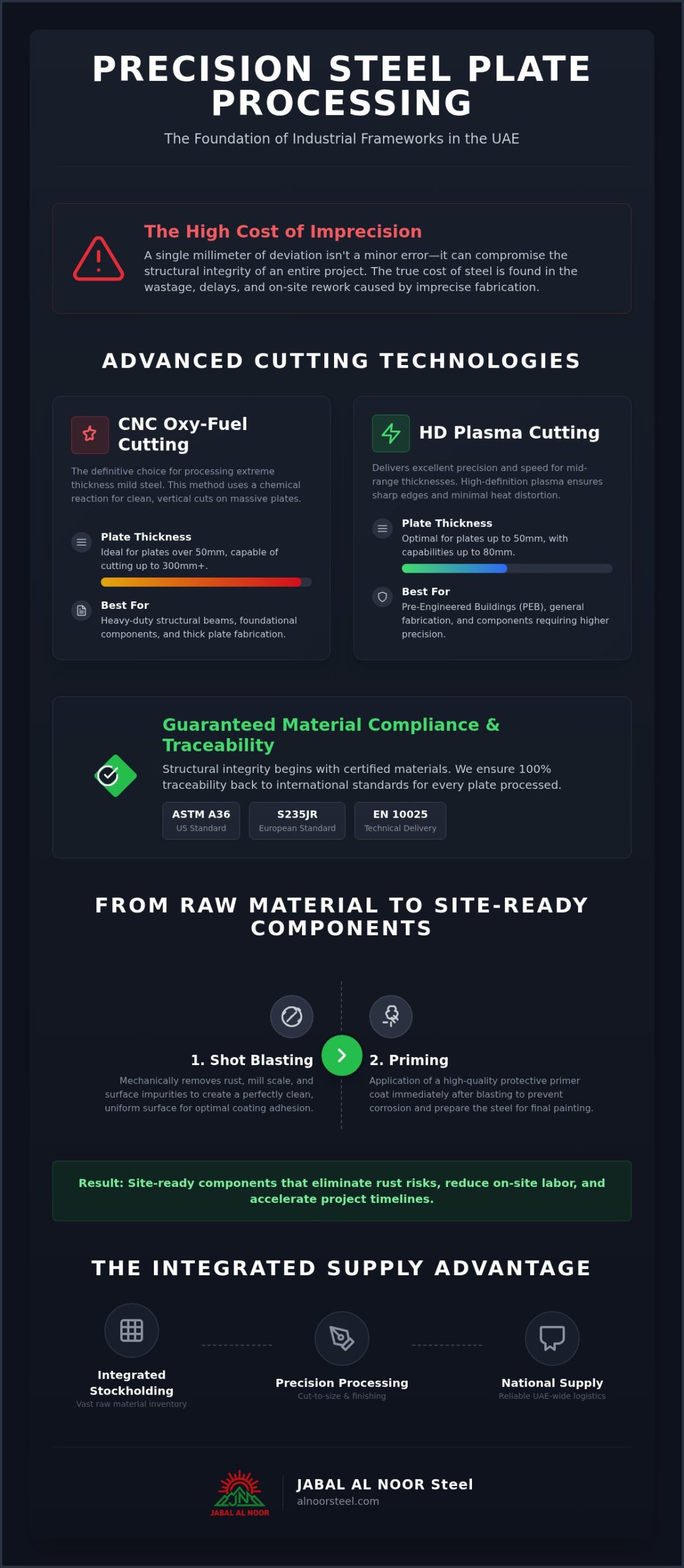
A single millimeter of deviation in a heavy-duty steel plate doesn’t just represent a minor error; it can compromise the structural integrity of an entire industrial framework. Most project managers understand that the true cost of material isn’t found in the initial purchase but in the wastage and delays caused by imprecise fabrication. When you’re managing large-scale infrastructure or energy projects, finding reliable steel plate cutting services Sharjah is essential to maintaining your timeline and budget. You’ve likely dealt with the frustration of non-compliant structural grades or components that arrive at the site requiring further work, which pushes back your assembly schedule.

We recognize that precision and material traceability are the foundational pillars of any successful engineering project. This guide provides a comprehensive look at industrial steel plate processing, detailing how advanced cut-to-size customization and surface treatments like shot blasting can streamline your operations. You’ll learn how to ensure 100% material traceability back to international standards like ASTM A36 and EN 10025. We’ll also examine the national supply logistics that ensure your site-ready components arrive exactly when needed, effectively reducing on-site fabrication time and eliminating the risks associated with manual processing.

Key Takeaways

  • Understand how professional steel plate cutting services Sharjah provide the precision and material traceability required for complex industrial frameworks.
  • Compare CNC Oxy-Fuel and Plasma cutting technologies to select the optimal fabrication method for various plate thicknesses and project specifications.
  • Master the requirements of international structural grades, including ASTM A36 and S235JR, to guarantee material compliance for heavy-duty engineering.
  • Discover how value-added surface treatments like shot blasting and priming eliminate rust risks and prepare steel for immediate on-site installation.
  • Learn the logistical advantages of partnering with a foundational supplier that offers integrated stockholding and national-scale processing solutions.

Industrial Steel Plate Processing in the UAE: A 2026 Overview

The UAE industrial sector is currently witnessing a period of intensive growth and modernization. With the federal budget for 2026 set at AED 92.4 billion, a substantial portion of which is dedicated to manufacturing and transport infrastructure, the demand for high-precision steel components has reached a critical peak. Industrial steel plate processing is no longer viewed as a simple resizing task. Instead, it is a specialized discipline that serves as the backbone for the heavy infrastructure and energy sectors. Utilizing professional steel plate cutting services Sharjah enables contractors to secure material that meets the rigorous demands of large-scale engineering without the overhead of maintaining in-house fabrication facilities.

The economic impact of precision cutting on construction budgets is substantial. As the UAE steel market continues its projected CAGR of 3.05% through 2034, efficiency in material usage has become a primary driver of profitability. Precise industrial processing minimizes scrap and reduces the total volume of raw material required. This efficiency is vital in an era where the industry is shifting toward high-strength steel to reduce structural weight while maintaining endurance and safety standards.

The Role of Processed Plates in Modern Engineering

Structural integrity is established long before a component reaches the construction site. It begins with the initial cutting process. In sectors like oil and gas or the development of Pre-Engineered Buildings (PEB), even a minor deviation in plate dimensions can lead to significant assembly failures. By employing Advanced Cutting Technologies: CNC Oxy-Fuel and Plasma Methods, fabricators ensure that every plate features clean edges and precise tolerances. These pre-processed components are essential for reducing lead times. When plates arrive site-ready, the need for secondary grinding or corrective cutting is eliminated, allowing projects to remain on schedule despite the increasing complexity of modern architectural designs.

From Raw Material to Site-Ready Components

The evolution of the UAE’s industrial landscape, supported by initiatives like “Operation 300bn,” has transformed traditional steel trading into a value-added service model. It’s no longer sufficient to simply stock raw materials. The industry now demands integrated solutions where material supply and technical fabrication are handled by a single, reliable partner. This transition optimizes on-site labor, as workers can focus on assembly rather than basic preparation. Accessing a comprehensive shop of MS plates and sheets that are already cut to project specifications allows engineering firms to maintain a leaner operational footprint. This methodical approach to sourcing ensures that every component is a foundational pillar of the final structure, backed by technical proficiency and global quality benchmarks.

Advanced Cutting Technologies: CNC Oxy-Fuel and Plasma Methods

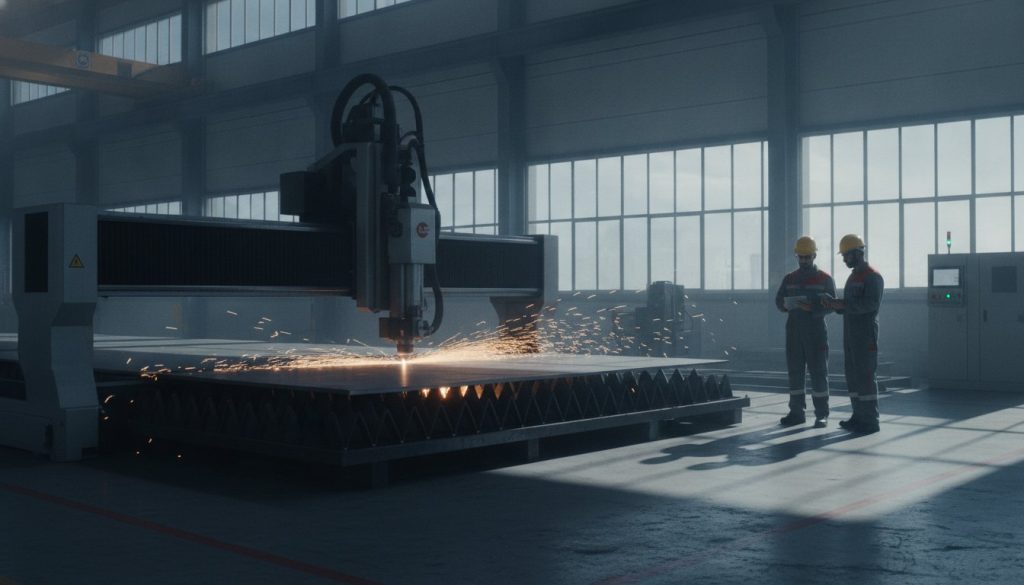
Industrial-scale fabrication requires a strategic approach to material separation. While many vendors focus on light-gauge laser cutting for decorative work, heavy engineering demands the robust capabilities of CNC oxy-fuel and high-definition plasma. Selecting the right method is a matter of technical necessity, as the structural integrity of a project depends on the precision of the initial cut. Utilizing professional steel plate cutting services Sharjah ensures that your project benefits from computer-controlled accuracy, which is vital for reducing material waste and staying within budget. Precision benchmarks in 2026 are higher than ever. It’s not just about the cut; it’s about the repeatability across thousands of components. This is why steel plate cutting services Sharjah have moved toward fully automated systems that offer a level of endurance and consistency that manual shearing simply cannot match.

CNC Oxy-Fuel Cutting for Heavy-Duty Plates

Oxy-fuel remains the definitive choice for processing extreme thicknesses in mild steel, often exceeding 50mm. This method relies on a chemical reaction between oxygen and the metal, allowing for clean, vertical edges on massive MS plates. It’s particularly effective for creating structural beams and foundational components where dimensional accuracy is paramount. For high-volume industrial projects, oxy-fuel provides a cost-effective solution that doesn’t sacrifice the quality of the finish. The reliability of this process makes it a foundational pillar for heavy construction and large-scale infrastructure.

High-Definition Plasma Cutting for Precision

When speed and versatility are the priorities, high-definition plasma cutting offers a distinct advantage. This technology is optimized for medium-thickness plates, including stainless steel and GI variants. One of the primary benefits is the minimization of the heat-affected zone (HAZ). By concentrating the energy beam, plasma systems prevent the surrounding metal from warping or losing its structural properties. This precision ensures that components are site-ready upon delivery. You can explore our range of materials and processing options in our comprehensive inventory.

Modern CNC controllers have revolutionized these processes by integrating UAE standards for trade and international benchmarks directly into the fabrication workflow. These systems eliminate human error, ensuring that every component matches the CAD drawings exactly. This level of accuracy is essential for modular construction and high-rise projects where every millimeter counts. By prioritizing advanced cutting technologies, you secure long-term value and operational excellence for your engineering ventures.

Material Grades and Standards: Ensuring Structural Compliance

Industrial safety is a matter of strict metallurgical adherence. Utilizing professional steel plate cutting services Sharjah involves more than just mechanical separation; it requires a deep understanding of how various alloys respond to thermal processing. When sourcing material for high-rise buildings or heavy machinery, the specific steel grade dictates the welding procedures and the final load-bearing capacity. Selecting a partner that prioritizes material compliance ensures that every plate functions as a foundational pillar of the final structure. This technical proficiency is essential for maintaining the high standards required by regional engineering benchmarks.

ASTM A36 vs. S235JR: Standards Upheld by JABAL AL NOOR Steel

ASTM A36 remains a cornerstone of construction, valued for its 250 MPa yield strength and superior weldability. It’s often the primary choice for structural frames and general-purpose engineering. In contrast, S235JR, governed by the EN 10025 standard, is frequently specified for projects following European engineering protocols. While these grades are often used for similar applications, their chemical compositions require distinct handling. JABAL AL NOOR Steel ensures grade-specific processing accuracy to prevent material degradation during thermal cutting, ensuring that the mechanical properties of the steel remain intact after fabrication.

Quality Benchmarks in Steel Procurement

Material traceability is the only way to guarantee structural safety in large-scale infrastructure and energy projects. Every batch of MS plates and sheets must be accompanied by a Mill Test Certificate (MTC). This document verifies the chemical and physical properties of the steel, confirming it meets international JIS or ASTM standards. Material purity directly impacts cutting quality. Lower-grade steel with high inclusion levels can cause irregular edges or excessive slag buildup during CNC processing. For a detailed breakdown of these requirements, consult our Structural Steel Quality Standards UAE.

Projects located in marine or high-corrosion environments require specialized grades like S355JR or various stainless steel options. These materials offer enhanced resistance to atmospheric oxidation and salt-spray exposure. Reliable steel plate cutting services Sharjah must be capable of handling these tougher alloys without compromising the precision of the final component. By integrating strict material standards with advanced fabrication, we provide site-ready plates that are fit for the most demanding regional conditions. This methodical approach to sourcing and processing creates long-term value for every collaborator.

Steel Plate Cutting Services Sharjah: Industrial Processing and UAE Standards

Value-Added Customization: Surface Treatments and Finishing

Industrial processing doesn’t end at the cutting table. For structural components to survive the UAE’s environmental pressures, surface treatments are vital. Professional steel plate cutting services Sharjah provide more than just dimensional accuracy; they offer the necessary preparation to ensure long-term durability. When steel is destined for large-scale infrastructure or energy projects, the quality of its finish determines its resistance to corrosion and its readiness for immediate on-site assembly. This methodical approach to finishing transforms raw plates into precision-engineered components that meet the highest industrial standards.

Shot Blasting and Surface Preparation

Shot blasting is a critical step for removing mill scale and surface contaminants from MS plates and sheets. In the UAE’s high-humidity regions, untreated steel is susceptible to rapid oxidation. By utilizing high-velocity abrasives, we clean the metal surface to a specific profile, which is essential for superior paint and primer adhesion. This process significantly extends the lifespan of structural components in harsh environments. It’s a foundational pillar of quality control that ensures your materials don’t degrade before they’re even installed. For those seeking a deeper look at procurement, see our guide on Cut-to-Size Steel Service in the UAE.

Precision Bevelling and Finishing

Beyond surface cleanliness, the physical geometry of the plate edge is paramount for heavy-duty welding. Precision bevelling creates the necessary V, U, or J profiles required for full-penetration welds in universal beams and columns. This ensures that when components reach the site, they’re ready for immediate assembly without further grinding or preparation. Dimensional consistency across bulk orders is a hallmark of our industrial processing capability. By integrating these services, we reduce on-site labor costs and minimize maintenance requirements over the building’s lifecycle. We focus on technical proficiency to deliver results that exceed standard expectations.

Custom length profiling for universal beams and columns allows for exact fitment within modular frames. This integration of steel plate cutting services Sharjah with specialized finishing ensures that every piece of steel is optimized for its specific role in the project. It’s about providing a steady and dependable supply chain that values consistency and ethical conduct. Ready to source? Explore our inventory of MS plates and surface-treated sections to find the right materials for your next project. We provide the operational excellence required for your most demanding engineering ventures.

Strategic Steel Sourcing: National Supply and Processing Solutions

The logistical complexity of national-scale infrastructure projects requires a move away from fragmented procurement. Securing bulk materials alongside precision processing is a strategic necessity for project managers aiming to control costs and maintain tight assembly schedules. Utilizing integrated steel plate cutting services Sharjah allows for a streamlined workflow where material selection and technical fabrication occur under a single umbrella of quality control. This approach effectively eliminates the logistical friction of transporting heavy MS plates between stockists and third-party fabricators. It ensures that the structural integrity established in the design phase is preserved through to the final site delivery.

Optimizing the Steel Supply Chain

Reliability in the supply chain is the most effective safeguard against project risk. When a partner maintains an extensive national inventory, it removes the vulnerability to international shipping delays or local stock shortages. Engaging with an established UAE trading partner facilitates the management of bulk supply contracts that are essential for the 2026 industrial requirements. This integrated model provides the material traceability required for high-stakes projects, allowing for immediate verification of mill certificates across every component. For a deeper look at these strategies, consult our Steel Suppliers in UAE: 2026 Strategic Procurement Guide.

Why Partner with JABAL AL NOOR Steel?

Founded in 2010, JABAL AL NOOR Steel has evolved into a foundational pillar of the regional industrial landscape. We offer a comprehensive inventory of MS beams, channels, angles, and specialized plates, all backed by a commitment to transparency and long-term value. Our professional steel plate cutting services Sharjah are designed to provide site-ready components that meet the exact demands of the energy and construction sectors. We prioritize ethical conduct and technical proficiency, ensuring that our collaborators receive more than just raw material. They receive a steady, dependable partnership rooted in operational excellence and national logistical reach that supports the most demanding engineering ventures.

Securing Precision for Future Infrastructure

The success of the UAE’s large-scale construction projects depends on the technical proficiency and material reliability of its supply chain. By prioritizing advanced CNC technology and strict adherence to international standards like ASTM, EN, and JIS, project managers can significantly reduce on-site wastage and fabrication delays. Professional steel plate cutting services Sharjah offer more than just basic processing; they provide the material traceability and structural compliance necessary for high-stakes engineering ventures. Since 2010, we’ve functioned as a foundational pillar for the industrial sector, ensuring that every component is site-ready and delivered with logistical efficiency.

Strategic sourcing is about establishing a long-term partnership with a supplier that values consistency and operational excellence. Whether your project requires heavy-duty oxy-fuel cuts or high-definition plasma finishing, choosing a partner with national delivery coverage ensures your timeline remains secure. We invite you to browse our full range of industrial steel products and processing services to find the exact specifications your next project demands. We’re committed to supporting your vision with the durability and technical precision required for the region’s evolving industrial landscape.

Frequently Asked Questions

What is the maximum thickness of steel plate you can cut using CNC methods?

Our CNC oxy-fuel systems are specifically designed to process heavy-duty MS plates with thicknesses exceeding 50mm, reaching up to 200mm for specific industrial applications. This capability is essential for creating foundational components for the energy and infrastructure sectors. By utilizing computer-controlled precision, we maintain dimensional accuracy even at extreme thicknesses, ensuring that every component is site-ready and meets the rigorous demands of national engineering projects and structural benchmarks.

How do you ensure the steel plates meet ASTM A36 or S235JR standards?

We maintain structural compliance by sourcing materials exclusively from reputable mills that provide comprehensive Mill Test Certificates (MTC). These documents verify the chemical and physical properties of the steel, confirming it meets international ASTM A36 or EN 10025 S235JR standards. Our quality control team inspects every batch to ensure material purity, which is vital for high-performance steel plate cutting services Sharjah and long-term structural endurance in harsh regional environments.

What is the difference between plasma and oxy-fuel cutting for industrial plates?

The primary difference lies in the thickness and material type being processed. High-definition plasma cutting is optimized for speed and precision on medium-thickness plates, including stainless steel and GI variants. CNC oxy-fuel cutting is the definitive choice for heavy-gauge mild steel, utilizing a chemical reaction to produce clean, vertical edges on much thicker sections. Both methods are foundational pillars of our industrial processing, providing technical proficiency for diverse engineering requirements.

Do you provide surface treatments like shot blasting and priming after cutting?

Yes, we provide integrated surface treatments such as shot blasting and priming to prepare steel for immediate on-site use. Shot blasting removes mill scale and contaminants, creating a superior surface profile for paint adhesion, which is critical in the high-humidity environment. These value-added services extend the lifespan of structural components and reduce maintenance costs for contractors, ensuring every piece of steel is a dependable asset for large-scale infrastructure projects.

Can you handle bulk cut-to-size orders for large-scale construction projects?

We are fully equipped to manage bulk cut-to-size orders for national-scale infrastructure and energy projects. Our extensive inventory of MS plates and sheets, combined with high-volume CNC processing capacity, allows us to fulfill large orders with consistent precision. This integrated supply model reduces logistical complexity for our partners, providing a steady and reliable flow of site-ready components that align with demanding 2026 project timelines and rigorous industrial requirements.

What is the typical turnaround time for industrial steel plate processing in the UAE?

Turnaround times are determined by the project’s scale and the complexity of the required customization. We prioritize logistical efficiency and timely delivery across the UAE by utilizing our extensive in-house inventory and automated CNC systems. Our methodical approach to production planning allows us to provide reliable lead times that help contractors avoid on-site delays. We focus on maintaining a steady pace that mirrors the planned nature of the construction and engineering sectors.

Are Mill Test Certificates (MTC) provided with the processed steel plates?

Every batch of processed steel plates is accompanied by a Mill Test Certificate (MTC) to ensure 100% material traceability. This documentation is essential for verifying that the steel complies with global quality benchmarks and specific project requirements. Providing these certificates is a standard part of our commitment to transparency and ethical conduct, reassuring our collaborators that the materials used in their infrastructure projects are foundational pillars of safety, reliability, and long-term structural endurance.

How does cut-to-size steel help in reducing on-site fabrication costs?

Utilizing steel plate cutting services Sharjah significantly reduces on-site fabrication costs by delivering components that are already site-ready. This eliminates the need for manual cutting, grinding, or edge preparation at the construction site, which lowers labor requirements and minimizes material wastage. By receiving precision-engineered plates that fit perfectly into structural frames, contractors can reduce their overall assembly time and focus their resources on the critical phases of large-scale engineering and infrastructure projects.

MS Plate Suppliers Dubai: 2026 Guide to Checkered Steel Procurement

MS Plate Suppliers Dubai: 2026 Guide to Checkered Steel Procurement

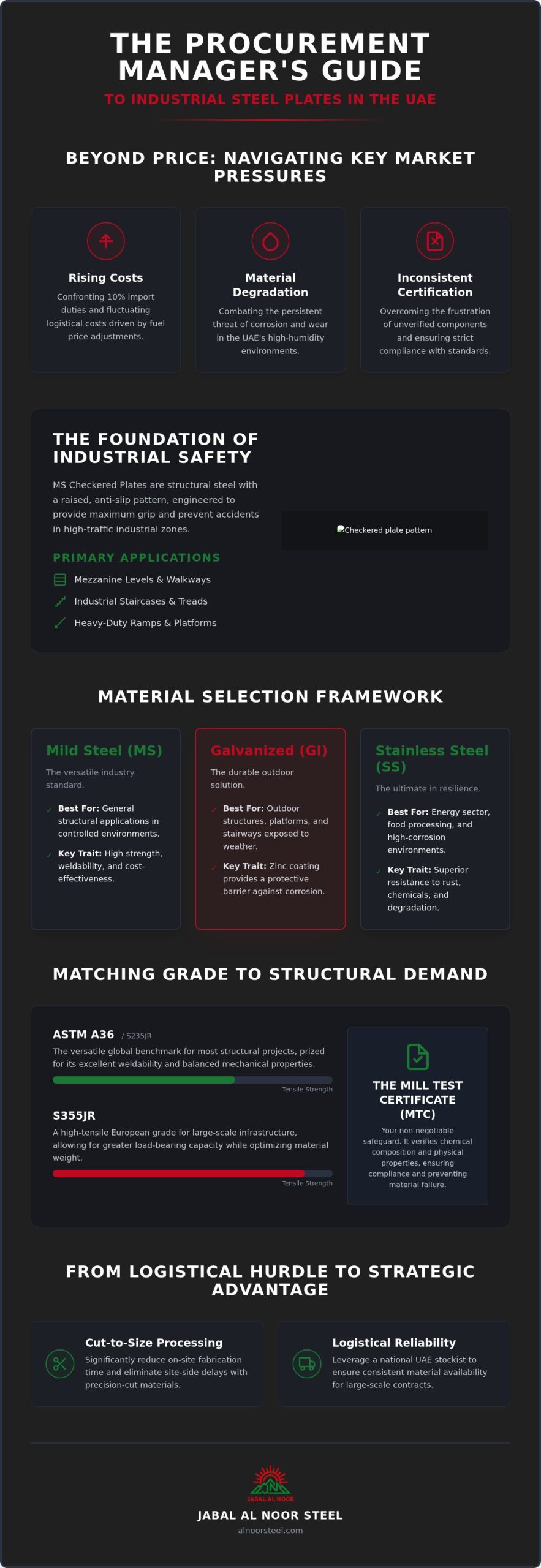
Relying on standard dimensions for your facility’s flooring is no longer a viable procurement strategy in a market where 10% import duties and rising logistical costs redefine project margins every month. Procurement managers across the UAE understand that sourcing structural steel is no longer just about finding the lowest price per tonne. You’re likely dealing with the persistent threat of material degradation in high-humidity environments and the frustration of inconsistent certification for structural components. As a leading partner among MS plate suppliers in the UAE, JABAL AL NOOR Steel recognizes these operational pressures and the necessity for unwavering material integrity.

This 2026 guide provides the technical roadmap you need to secure certified ASTM A36 or SS 316 stock while leveraging cut-to-size services to eliminate site-side delays. We’ll examine the critical role of high skid-resistance in industrial safety, the impact of recent fuel price adjustments on national logistics, and how specialized processing ensures your steel meets the rigid standards of the UAE’s heavy infrastructure sectors. By aligning metallurgical selection with environmental finishing, your next procurement cycle can move from a logistical hurdle to a strategic advantage.

Key Takeaways

  • Understand the critical role of raised tread patterns in meeting industrial safety protocols and ensuring high skid-resistance in heavy-duty environments.
  • Distinguish between ASTM A36, S235JR, and S355JR standards to match specific load-bearing and high-tensile requirements for your structural projects.
  • Learn to evaluate environmental stressors to determine whether mild steel, stainless, or galvanized checkered plates offer the best longevity for your specific site conditions.
  • Identify how partnering with established MS plate suppliers Dubai for cut-to-size processing and surface treatments can significantly reduce on-site fabrication time.
  • Leverage the logistical reliability of a national UAE steel stockist to ensure consistent material availability for large-scale infrastructure and energy contracts.

What are MS Checkered Plates and Why are They Essential for Safety?

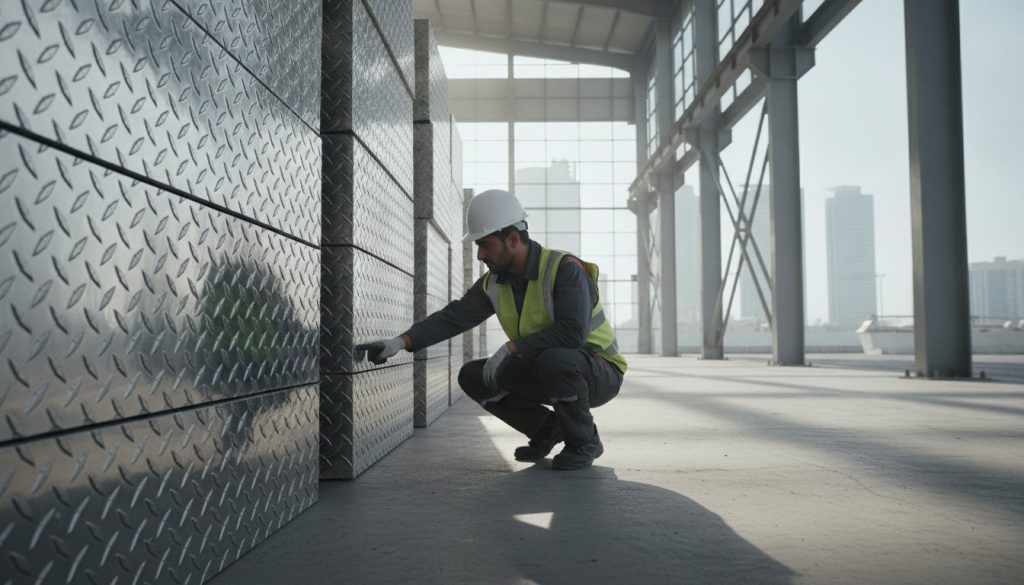
Mild steel (MS) checkered plates represent a specialized category of structural steel essential for maintaining operational safety in the UAE’s high-intensity industrial environments. These plates are characterized by a raised pattern on one surface, designed specifically to increase friction and prevent slippage in areas prone to moisture or oil accumulation. For project managers coordinating with MS plate suppliers Dubai, selecting the correct tread profile is a matter of technical compliance with rigorous safety protocols. A Tread plate (checker plate) serves as the primary flooring solution for mezzanine levels, industrial staircases, and heavy-duty ramps where pedestrian and vehicular stability is paramount.

The versatility of these plates extends across three primary material types: Mild Steel (MS), Stainless Steel (SS), and Galvanized Iron (GI). While mild steel remains the standard for general structural applications, stainless steel offers superior corrosion resistance for energy sector projects, and galvanized options provide a middle ground for outdoor environments. Understanding these material distinctions is vital for ensuring long-term endurance in the UAE’s unique climatic conditions.

To better understand this concept, watch this helpful video:

The Anatomy of a Tread Plate Pattern

The geometry of the raised pattern, typically available in diamond or tear-drop shapes, isn’t merely aesthetic; it’s engineered for maximum grip. Unlike some cold-pressed alternatives that may lose their profile under heavy wear, high-quality industrial plates are formed during the hot-rolling process. This method ensures the pattern is an integral part of the steel’s structure, providing consistent skid resistance over years of use. Standard thicknesses for heavy-duty applications typically range from 3.0 mm to over 12.0 mm, depending on the required load-bearing capacity for the specific infrastructure site.

Key Benefits for National Infrastructure Projects

The primary advantage of using checkered plates in large-scale projects is their exceptional structural durability. They’re designed to withstand high-traffic vehicular conditions without compromising surface integrity. These plates also require minimal maintenance in controlled industrial settings, which reduces long-term operational costs for facilities. Beyond their functional utility, they offer significant versatility in architectural engineering. Reliable procurement from MS plate suppliers Dubai ensures that these materials meet international standards for every national project. You can explore our current stock at shop.

Material Grades and Technical Specifications for 2026

Procurement success depends on precision in material grading. As the UAE steel market evolves under new tariff structures and fluctuating logistics costs, MS plate suppliers Dubai must provide more than just dimensions; they must provide metallurgical certainty. The global benchmark remains ASTM A36, a versatile carbon structural steel favored for its exceptional weldability and balanced mechanical properties. However, large-scale infrastructure projects in 2026 increasingly demand high-tensile European grades like S355JR. This shift allows engineers to handle greater structural loads while optimizing material weight, a critical factor when transportation costs are influenced by rising diesel prices.

Reliability in the supply chain is anchored by the Mill Test Certificate (MTC). This document serves as a verified record of the chemical composition and physical properties of the steel batch. It ensures that the carbon, manganese, and silicon levels align with international standards. For high-stakes energy contracts, an MTC isn’t optional; it’s the primary safeguard against material failure and non-compliance with regional building codes.

Structural Steel Standards (ASTM & EN)

Yield strength is the defining metric for load-bearing applications. ASTM A36 provides a minimum yield strength of 250 MPa, which is sufficient for many general fabrication tasks. In contrast, S355JR offers 355 MPa, allowing for thinner plates to support the same weight as thicker A36 alternatives. This efficiency is vital when adhering to OSHA safety standards for steel surfaces, especially in elevated platforms. Engineers must carefully evaluate whether the cost-efficiency of S235JR or the superior performance of S355JR aligns better with their project’s lifecycle goals. Choosing the wrong grade can lead to structural sagging or premature wear under heavy pedestrian traffic.

Corrosion Resistance and Material Longevity

Environmental stressors in the UAE dictate material longevity. While standard mild steel is robust, it’s vulnerable to the high salinity of coastal air. Galvanized Iron (GI) checkered plates offer a sacrificial zinc layer that effectively halts oxidation, making them ideal for outdoor walkways. For more aggressive marine or chemical zones, Stainless Steel 316 is the mandatory choice. Its molybdenum content provides a defense against pitting that SS 304 cannot match. While mild steel maintains a density of approximately 7,850 kg/m³, the long-term value of stainless steel often outweighs the initial investment in corrosive environments. You can consult our inventory of specialty grades to ensure your procurement meets these rigorous site demands.

Selection Framework: MS vs SS vs GI Checkered Plates

Selecting the optimal checkered plate involves a rigorous assessment of environmental exposure and mechanical load. For procurement teams vetting MS plate suppliers Dubai, the choice between Mild Steel (MS), Stainless Steel (SS), and Galvanized Iron (GI) represents a balance between immediate capital expenditure and lifecycle maintenance costs. Inland industrial zones with controlled humidity often favor the structural integrity of mild steel. Conversely, infrastructure projects located near the coastline require materials that can withstand high salinity and aggressive oxidation. This decision affects not only the longevity of the structure but also the safety of the personnel operating within the facility.

Safety remains the primary driver for these material specifications. Adhering to OSHA general requirements for walking-working surfaces ensures that industrial flooring provides sufficient traction even in the presence of oils or moisture. Beyond functionality, modern industrial design often incorporates these plates for their rugged aesthetic, though functional performance must always dictate the final specification. A failure to match the material grade to the environment can lead to premature structural degradation and increased liability.

Environmental Suitability Matrix

  • Mild Steel: The foundational standard for indoor mezzanine levels and dry structural frameworks where moisture is minimal.
  • Galvanized Steel: Optimized for outdoor ramps and loading docks where moderate humidity and exposure to the elements are present.
  • Stainless Steel: The premium choice for chemical processing plants and marine infrastructure requiring maximum corrosion resistance.

Standard Dimensions and Custom Requirements

Efficiency in procurement is often tied to stock availability and logistical speed. Common dimensions like 1220x2440mm and 1500x3000mm are maintained as national stock for immediate dispatch across the UAE. Thickness is the critical variable for load-bearing capacity. Pedestrian walkways typically utilize 3.0mm to 4.5mm plates, while vehicular traffic zones require 6.0mm or higher to prevent surface deformation under weight. You can explore our full range of flat steel products to find the exact thickness and grade required for your specific industrial application. Partnering with MS plate suppliers Dubai who offer comprehensive processing ensures that these plates arrive ready for immediate integration into your project.

MS Plate Suppliers Dubai: 2026 Guide to Checkered Steel Procurement

Procurement Efficiency: Customization and Processing

Procurement efficiency in the current market is dictated by the ability to minimize waste and streamline logistics. With diesel prices reaching AED 4.30 per litre in September 2026, the cost of transporting unprocessed materials has a direct impact on project overheads. Partnering with MS plate suppliers Dubai who provide in-house processing allows contractors to bypass the inefficiencies of on-site fabrication. This strategic approach ensures that every plate arrives ready for immediate installation, reducing the labor hours required for manual cutting and shaping. Precision is a structural requirement. By integrating these services at the source, you ensure that your materials meet the high-stakes requirements of national infrastructure and energy projects.

Value-Added Customization Services

The integration of precision cutting techniques is essential for complex plate geometries, such as non-standard stair treads or specialized machinery bases. By utilizing computerized cutting systems, we ensure that every dimension aligns perfectly with your engineering specifications. This level of accuracy is particularly beneficial for large-scale national projects where tight tolerances are mandatory. Custom lengths don’t just improve site logistics; they also significantly enhance installation speed by eliminating the need for secondary adjustments. For a deeper understanding of these processes, you can review our comprehensive guide to cut-to-size steel services. Custom pattern orientations also allow for specialized engineering designs that require specific grip directions for heavy machinery.

Surface Finishing for Harsh Environments

Achieving long-term durability in the UAE’s climate requires more than just high-grade steel; it requires superior surface preparation. Shot blasting serves as a critical mechanical process that removes mill scale and contaminants, creating an ideal profile for anti-corrosive coatings. Shot blasting effectively prepares the steel surface to ensure maximum adhesion for industrial primers and protective paints, which is fundamental to the material’s longevity. When plates are intended for exposed outdoor infrastructure, applying an anti-corrosive primer immediately after shot blasting prevents flash rusting and extends the material’s service life. Ensuring coating adhesion on the raised peaks of a checkered pattern is technically challenging, yet it remains vital for preventing localized oxidation in humid environments. You can view our available surface treatment options to ensure your materials are fully protected against the elements.

Strategic Sourcing with a National UAE Steel Stockist

Strategic procurement in the heavy industrial sector requires moving beyond transactional purchasing toward long-term partnerships with established national stockists. While many procurement officers initially search for MS plate suppliers Dubai to fulfill immediate project gaps, the sustainable value lies in a partner capable of maintaining the massive inventory depths required for multi-year energy and infrastructure contracts. A national supplier provides the industrial stability needed to navigate global market fluctuations, ensuring that material requirements are met without compromising on metallurgical standards or lead times. This logistical proficiency is foundational for maintaining the momentum of large-scale developments across the country.

Reliability in the supply chain is anchored by technical support and transparent documentation that accompanies every dispatch. For the high-stakes oil, gas, and energy sectors, the assurance provided by a veteran industry partner is indispensable. Partnering with MS plate suppliers Dubai who prioritize these rigorous standards allows your engineering teams to focus on execution, knowing that the structural integrity of the steel is fully verified and compliant with international benchmarks.

Reliability in the National Supply Chain

Maintaining consistent stock levels of foundational grades like ASTM A36 and S235JR is a core operational priority for a national supplier. For large-scale infrastructure projects, the ability to execute bulk delivery across multiple sites simultaneously is what distinguishes a standard vendor from a strategic partner. Our logistical network is engineered to navigate the complexities of national distribution, ensuring that material availability never becomes a bottleneck for your project timeline. You can explore more about these dynamics in our strategic procurement guide for steel suppliers. This steady flow of material is essential for projects that demand unwavering consistency in both grade and thickness.

Quality Assurance and Certification

Every checkered plate in our inventory undergoes rigorous compliance checks to ensure it meets international quality benchmarks. JABAL AL NOOR Steel supports complex engineering requirements by providing transparent documentation, including Mill Test Certificates (MTCs), for every batch. This commitment to metallurgical integrity is particularly critical for the energy sector, where material failure is not an option. Our technical team provides the necessary guidance to ensure your grade selection aligns with both structural needs and regulatory standards. It’s this dedication to precision that fosters trust and long-term value for our collaborators. To finalize your procurement planning, you can request a customized quote for bulk checkered plates and secure the materials required for your next industrial milestone.

Securing the Future of Your Industrial Infrastructure

Navigating the technical landscape of 2026 requires a procurement strategy that prioritizes metallurgical integrity and logistical precision. By aligning your material selection with international standards like ASTM A36 and EN 10025, you ensure that every floor plate and staircase meets the rigorous safety demands of the UAE’s energy and infrastructure sectors. Operational efficiency is no longer just about stock availability; it’s about leveraging value-added services such as in-house precision cut-to-size processing to eliminate costly site-side delays. As a trusted partner among MS plate suppliers Dubai, we remain committed to providing the national delivery and logistics network necessary to support your most ambitious industrial projects. This comprehensive approach transforms steel procurement from a simple logistical challenge into a foundational pillar of long-term operational excellence. Our extensive inventory and commitment to technical support provide the stability your facility needs to thrive in a competitive regional market.

Request a Quote for Bulk Checkered Plates to secure your project’s material requirements today. We look forward to supporting your next structural milestone with precision and reliability.

Frequently Asked Questions

What is the standard thickness for MS checkered plates in the UAE?

Standard thicknesses for these plates typically range from 3.0 mm to over 12.0 mm, depending on the specific load-bearing requirements of the site. For pedestrian walkways, thicknesses of 3.0 mm to 4.5 mm are standard; however, vehicular traffic zones require 6.0 mm or higher to prevent surface deformation. Selecting the correct thickness is vital for structural integrity and meeting safety standards across various national infrastructure projects.

What is the difference between ASTM A36 and S235JR for tread plates?

ASTM A36 and S235JR are both structural mild steel grades, but they originate from different international standards. ASTM A36 is the American benchmark with a minimum yield strength of 250 MPa, while S235JR is the European equivalent under EN 10025-2 with a yield strength of 235 MPa. While they’re often interchangeable for general fabrication, engineers must verify specific project requirements to ensure compliance with national building codes and structural load calculations.

Which material is best for outdoor ramps in a coastal environment?

Galvanized Iron (GI) or Stainless Steel 316 are the most effective materials for outdoor ramps in high-salinity environments. GI plates offer a sacrificial zinc layer that prevents oxidation, providing a cost-effective solution for medium-humidity zones. For more aggressive marine or chemical exposures, Stainless Steel 316 is the mandatory choice due to its superior resistance to pitting. These materials ensure long-term durability and safety where standard mild steel would suffer from rapid degradation.

Can checkered plates be customized to specific sizes for my project?

Checkered plates can be customized to exact dimensions through specialized in-house processing. As prominent MS plate suppliers Dubai, we provide precision cut-to-size services using advanced equipment to meet complex project geometries. This customization reduces on-site fabrication time and minimizes material waste. Whether you require non-standard stair treads or custom-sized industrial flooring, these value-added services ensure your materials arrive ready for immediate installation across national project sites.

Are checkered plates slip-resistant when exposed to oil or water?

Checkered plates are specifically engineered to provide high skid resistance in environments where oil, water, or moisture are present. The raised tread pattern, typically in diamond or tear-drop shapes, increases friction and grip for both footwear and vehicular tires. This functionality is essential for maintaining safety protocols in industrial facilities and energy sector projects. Consistent pattern depth, formed during the hot-rolling process, ensures the surface remains slip-resistant even after extensive heavy-duty use.

How do I calculate the weight of a checkered steel plate?

Calculating the weight of a checkered steel plate involves multiplying the plate’s volume by the density of steel, which is approximately 7,850 kg/m³. You must account for the base thickness and add a percentage factor for the raised pattern, usually between 2% and 5% depending on the tread profile. Accurate weight calculations are critical for structural load assessments and logistical planning, especially when managing bulk deliveries for large-scale infrastructure and energy sector contracts.

What surface treatments are recommended for mild steel checkered plates?

Shot blasting followed by anti-corrosive priming is the recommended surface treatment for mild steel checkered plates. Shot blasting removes mill scale and contaminants, creating a clean profile that ensures maximum adhesion for protective coatings. Applying an industrial primer immediately after processing prevents flash rusting and significantly extends the material’s service life in humid UAE conditions. These treatments are essential for plates used in exposed outdoor infrastructure where long-term durability is a primary project requirement.

Does JABAL AL NOOR Steel provide mill test certificates for all orders?

JABAL AL NOOR Steel provides comprehensive Mill Test Certificates (MTC) for all structural steel orders to ensure full material traceability and compliance. These certificates verify the chemical composition and mechanical properties of the steel, confirming it meets international standards like ASTM A36 or EN 10025. Providing transparent documentation is a core part of our commitment to quality assurance, supporting the rigorous technical requirements of national infrastructure, oil, gas, and energy sector projects.

Hot Rolled Steel Channels: Technical Guide 2026

Hot Rolled Steel Channels: Technical Guide 2026

With the release of ISO 657-1:2026 in April, the global standards for structural steel dimensions have undergone their most significant refinement in years. You likely recognize that even a minor deviation from these updated international benchmarks can compromise the safety and longevity of a high-stakes infrastructure project. Sourcing hot rolled steel channels that meet exact cut-to-size specifications while resisting corrosion in aggressive industrial environments remains a persistent challenge for procurement teams and structural engineers. It’s a high-stakes environment where material non-compliance isn’t just a logistical error; it’s a fundamental structural risk.

This technical guide provides the authoritative expertise you need to master material grades like ASTM A36 and A572, ensuring your projects are built with unwavering industrial stability. We’ll examine the latest 2026 specification updates, the critical role of specialized surface treatments, and the logistical frameworks required to secure a dependable long-term supply partner. By the end of this analysis, you’ll have the technical proficiency to identify the precise channel dimensions and grades necessary to maintain operational excellence across any large-scale application. Whether you’re managing energy infrastructure or urban development, understanding these specifications is the key to enduring structural integrity.

Key Takeaways

  • Understand the fundamental manufacturing mechanics of hot rolled sections and how the recrystallization process improves material ductility for complex industrial fabrication.
  • Learn to identify the correct material grades, such as ASTM A36, to ensure your hot rolled steel channels provide the necessary load-bearing reliability for structural frameworks.
  • Examine the strategic application of MS channels in Pre-Engineered Buildings (PEB) and heavy equipment support systems to optimize structural stability and operational safety.
  • Discover how utilizing precision cut-to-size services and specialized surface treatments like shot blasting can significantly reduce on-site labor and prevent premature corrosion.
  • Master the procurement process by evaluating national suppliers based on transparent certification standards and the provision of comprehensive Mill Test Reports.

Understanding Hot Rolled Steel Channels: Geometry and Manufacturing Excellence

Hot rolled steel channels are fundamental components in the construction of large-scale infrastructure and industrial frameworks. These sections, often referred to as MS channels, are structural profiles with a distinctive “U” or “C” shape. They are manufactured by passing steel through heavy rollers at extreme temperatures, a process that ensures high load-bearing capacity and structural predictability. Jabal Al Noor Steel maintains a rigorous focus on these geometric standards to ensure every profile provides the stability required for heavy-duty engineering.

The defining characteristic of hot rolled steel channels is the temperature at which they are formed. When steel is heated above its recrystallization threshold, typically exceeding 1,700°F, it enters a malleable state. This allows for the creation of large, complex shapes without the internal stresses associated with cold-forming. Consequently, Structural steel produced this way exhibits superior ductility. This makes the material easier to weld, cut, and fabricate on-site, which is essential for projects with demanding timelines.

Unlike the smooth, oily surface of cold-finished steel, these channels possess a characteristic blue-grey, scaled finish. This mill scale is a natural byproduct of the high-temperature cooling process. While it provides a degree of initial protection, it often requires surface treatments like shot blasting before painting or galvanizing. Understanding this finish is vital for engineers who must account for surface preparation costs in their project budgets.

The Hot Rolling Process: From Billets to Structural Profiles

The journey starts with solid steel billets. These are heated until they glow, ensuring they can be shaped by successive rolling stands. Each pass through the rollers refines the dimensions until the precise “U” or “C” profile is achieved. Once the desired geometry is reached, the steel is allowed to cool at room temperature. This controlled cooling phase is essential; it normalizes the grain structure, providing the consistent mechanical properties that Jabal Al Noor Steel guarantees for every batch. This methodical approach results in a finished product that resists cracking under heavy stress.

Anatomy of a Channel: Web and Flange Dynamics

Every channel consists of a vertical web and two horizontal flanges. The web is the primary defender against shear forces, maintaining the section’s height under load. In contrast, the flanges provide the necessary resistance against bending moments. Standard channels often feature a slight taper on the inner flange surfaces, which is a hallmark of traditional hot rolling. However, modern engineering also utilizes parallel flange channels for easier bolting and connection. You can explore these variations within the Jabal Al Noor Steel inventory to find the exact fit for your structural requirements.

Material Grades and International Standards for Structural Integrity

Selecting the appropriate material grade is a critical decision that dictates the load-bearing reliability and long-term safety of any industrial structure. It’s not merely about dimensions; it’s about the chemical and mechanical properties that allow hot rolled steel channels to withstand specific environmental and physical stresses. Jabal Al Noor Steel prioritizes material compliance to ensure that every section integrated into a project meets the rigorous demands of modern engineering.

ASTM A36: The Versatile Standard

ASTM A36 remains the industry benchmark for general-purpose structural steel. This grade provides a minimum yield strength of 250 MPa and a tensile strength ranging from 400 to 550 MPa. Because of its relatively low carbon content, A36 steel channels are exceptionally well-suited for welding, bolting, and riveting. These characteristics make them a staple in the manufacturing of agricultural equipment, heavy-duty trailers, and architectural framing where ease of fabrication is as vital as structural support.

EN 10025 Grades: S235JR vs. S355JR

European standards offer a different categorization based on specific yield points. While S235JR is frequently used for lighter structural work, S355JR provides a significantly higher yield strength, making it the superior choice for heavy-duty infrastructure and large-scale energy projects. The “JR” suffix is a technical designation indicating that the material has undergone impact testing at room temperature (20°C) to verify its toughness. S355JR is the preferred grade for high-stress structural members that must maintain integrity under immense weight and pressure.

International Grade Equivalency Framework

Navigating the transition between ASTM, EN, and JIS standards requires a precise cross-reference framework. While ASTM A36 is often compared to EN S235JR or JIS SS400, they are not always identical in their chemical composition or permissible tolerances. Engineering teams must ensure that the selected material aligns perfectly with national building codes and project-specific safety factors. For a deeper understanding of regional requirements, you can consult our Structural Steel Quality Standards UAE: A 2026 Reference Guide.

The balance between strength and weldability is maintained through strict control of carbon and manganese levels within the steel. This precision prevents the material from becoming brittle during the cooling process or subsequent fabrication. To ensure your project utilizes only the highest quality certified sections, we invite you to explore the Jabal Al Noor Steel inventory for comprehensive material options.

Strategic Applications of MS Channels in Modern Engineering

The utility of hot rolled steel channels extends far beyond basic framing. In heavy industry, these sections provide a specialized geometry that balances weight efficiency with high torsional rigidity. This makes them indispensable for large-scale projects where structural integrity is a non-negotiable requirement. Jabal Al Noor Steel supplies these profiles to sectors ranging from energy production to logistics, ensuring that every application benefits from the material’s inherent durability and compliance with international standards.

Structural Frameworks and PEB Construction

In Pre-Engineered Buildings (PEB) and industrial warehouses, MS channels serve as the primary secondary structural members. They are typically utilized as purlins and girts, providing the necessary support for wall and roof panels. Their “C” or “U” shape allows for efficient nesting and bolting, which accelerates the construction timeline without sacrificing strength. These sections are often integrated with other Long Products: The Foundation of Modern Infrastructure to create a cohesive, high-performance skeleton for large-span structures. The exceptional weight-to-strength ratio of these channels reduces the overall dead load of the building, allowing for more expansive interior spaces and optimized foundation designs.

Industrial Support Systems and Framework

Beyond building envelopes, hot rolled steel channels are foundational to industrial infrastructure. In the oil and gas sector, they form the backbone of complex pipe racks and equipment skids, where they must withstand both mechanical stress and environmental exposure. Their structural predictable nature is equally valued in several other specialized applications:

  • Machinery Support: Creating robust frames for heavy industrial equipment to minimize vibration and ensure alignment.
  • Access and Safety: Fabricating stair stringers, handrails, and mezzanine floor supports in manufacturing facilities.
  • Renewable Energy: Serving as the primary mounting structures for solar panel arrays, where long-term endurance is critical.

The transportation and infrastructure sectors also rely heavily on these profiles. In truck chassis and rail car manufacturing, channels provide the necessary stiffness to handle dynamic loads during transit. Similarly, in bridge construction and infrastructure repairs, they are often used as bracing members or for reinforcing existing concrete structures. By selecting the correct grade and dimensions, engineers ensure that these components contribute to a lifetime of service in even the most demanding environments.

Hot Rolled Steel Channels: Technical Guide 2026

Enhancing Durability: Cut-to-Size and Surface Treatment Protocols

Raw structural steel is rarely ready for immediate installation upon leaving the rolling mill. To achieve the rigorous quality benchmarks required for national infrastructure and energy projects, hot rolled steel channels must undergo precise secondary processing. Jabal Al Noor Steel provides integrated value-added services to ensure that every section delivered is optimized for durability and logistical efficiency. These protocols don’t just prepare the steel for use; they are essential for ensuring the long-term stability of the entire structural assembly.

The Advantages of Cut-to-Size Customization

Standard mill lengths of 6 or 12 meters often result in substantial on-site waste and require intensive manual labor for field modifications. Jabal Al Noor Steel utilizes advanced industrial sawing and shearing technology to provide precision cut-to-size services that adhere to tight dimensional tolerances. This capability is detailed extensively in our Cut-to-Size Steel Service in the UAE: A Comprehensive Procurement Reference. By sourcing pre-cut sections, contractors can significantly reduce their logistical burden. Precision cutting also ensures that joints and connections fit perfectly during the first assembly, which is critical for maintaining the structural integrity of large-span frameworks. This methodical approach to material preparation reflects our commitment to operational excellence and long-term value for our partners.

Surface Treatments: Shot Blasting and Priming

The blue-grey mill scale described in our discussion of manufacturing geometry is a brittle layer that can flake off, taking any paint or coating with it. Shot blasting is the definitive mechanical process used to propel abrasive media against the steel at high velocity. This removes all contaminants and creates a specific surface roughness, known as a “profile,” which is necessary for high-performance industrial coatings. Following this, the application of a primer is non-negotiable for structural longevity. We offer several treatment options to meet specific environmental demands:

  • Red Oxide Primers: A dependable and cost-effective base for general industrial and architectural applications.
  • Zinc-Rich Primers: Provides cathodic protection, making it the superior choice for high-salinity coastal zones or humid environments.
  • Compatibility: Treated channels remain fully compatible with subsequent hot-dip galvanization or specialized epoxy coatings.

These surface treatments ensure that your hot rolled steel channels maintain their structural capacity for decades, even in the harshest industrial climates. If your project requires high-precision sections ready for immediate deployment, explore our customized steel channel options today.

Strategic Procurement: Sourcing Quality Structural Steel for Large-Scale Projects

Procuring structural steel for large-scale infrastructure is a strategic undertaking that demands meticulous attention to material provenance and logistical reliability. Sourcing hot rolled steel channels for high-volume industrial applications involves more than comparing unit costs; it requires verifying that every section possesses the transparent certification necessary to meet stringent building codes. Jabal Al Noor Steel understands that in the heavy industry sector, a supplier’s capability is measured by their ability to provide consistent, high-grade material without compromising project timelines. This focus on reliability is what transforms a vendor into a foundational partner for national development.

Evaluating Supplier Inventory and Compliance

A dependable steel stockist must maintain an extensive and diverse inventory of MS channels, beams, and angles to accommodate the fluctuating needs of complex projects. This depth of stock ensures that contractors don’t face delays due to material shortages or limited size availability. Beyond mere volume, the value of a partner lies in their technical expertise and adherence to international standards. Prioritizing partners with a deep understanding of the Steel Suppliers in UAE: A 2026 Strategic Procurement Guide ensures that your procurement strategy is aligned with the latest market requirements and quality benchmarks. Jabal Al Noor Steel provides comprehensive Mill Test Reports (MTRs) for all products, offering the transparency required for engineering audits and quality assurance protocols. This commitment to compliance guarantees that every component integrated into your structure is a verified asset that supports long-term structural integrity.

Logistics and Support for Industrial Contracts

The success of a project often hinges on the logistical efficiency of the supply chain. Timely delivery is essential for maintaining the methodical pace of construction and engineering sectors. A supplier must demonstrate a robust national delivery network capable of reaching diverse project sites with precision and predictability. At Jabal Al Noor Steel, we prioritize logistical excellence to ensure your structural components arrive exactly when they are needed. You can view our current availability and specifications through the Jabal Al Noor Steel Shop, which serves as a vital resource for planning your material requirements. We also encourage direct consultation for projects requiring specialized surface treatments or precision customization. This collaborative approach allows us to tailor our support to the specific pressures and high-stakes requirements of your most ambitious energy and infrastructure projects. Choosing a partner who values consistency and ethical conduct ensures long-term value and operational excellence for all collaborators.

Securing Structural Excellence for Future Infrastructure

The 2026 technical landscape demands a level of precision that leaves no room for material non-compliance. Mastering the nuances of geometry, grade selection, and surface preparation is the only way to ensure structural integrity in high-stakes projects. By prioritizing certified standards and utilizing precision processing, you protect your infrastructure against premature failure and environmental degradation. Jabal Al Noor Steel remains committed to supporting these standards through our extensive national inventory of long products and specialized in-house capabilities. Our specialized shot blasting and priming services ensure that your hot rolled steel channels are delivered ready for immediate, long-term deployment. We invite you to partner with a veteran of the industry who values precision and ethical conduct as much as you do. Explore our full range of MS channels and structural steel at Jabal Al Noor Steel to secure a dependable foundation for your next industrial project. We look forward to supporting your vision with unwavering quality and logistical efficiency.

Frequently Asked Questions

What is the difference between a hot rolled channel and a cold rolled channel?

Hot rolled channels are formed at temperatures exceeding 1,700°F, which makes the steel more malleable and cost-effective for large structural sections. In contrast, cold rolled channels are processed at room temperature to achieve superior dimensional precision and a smoother surface finish. While cold rolling increases strength through strain hardening, hot rolled steel channels remain the industry standard for heavy-duty infrastructure due to their excellent ductility and ease of welding in demanding environments.

Which steel grade is best for heavy industrial MS channels?

For heavy industrial applications, high-strength low-alloy grades like ASTM A572 Grade 50 or EN 10025 S355JR are generally considered the best options. These grades offer a higher yield strength compared to standard carbon steel, allowing for reduced material weight without sacrificing structural integrity. Choosing a high-strength grade is essential for high-stress members in oil and gas pipe racks or large-span warehouse frames where load-bearing reliability is the primary concern for engineering teams.

Do hot rolled steel channels require surface treatment before installation?

While not strictly mandatory for every indoor application, surface treatment is highly recommended for any structural steel exposed to the elements. The mill scale on hot rolled steel channels is brittle and can trap moisture, leading to rapid corrosion over time. Shot blasting to a specific profile followed by the application of a zinc-rich or red oxide primer ensures long-term durability. This is especially vital in the humid or saline climates typical of national infrastructure projects.

Can hot rolled steel channels be easily welded?

Yes, hot rolled channels are exceptionally easy to weld using standard industrial techniques such as MIG, TIG, or arc welding. The high-temperature manufacturing process normalizes the grain structure and reduces internal stresses, which minimizes the risk of cracking or warping during the welding process. This weldability is one of the primary reasons why ASTM A36 and S235JR grades are favored for fabricating complex machinery frames and secondary structural supports in the construction sector.

What are the standard lengths available for MS channels in the UAE?

Standard mill lengths for MS channels in the national market are typically 6 meters and 12 meters. However, relying solely on standard lengths often leads to excessive material waste and increased on-site labor costs. JABAL AL NOOR Steel provides specialized cut-to-size customization to meet exact project specifications. This service allows contractors to receive precision-engineered components that are ready for immediate installation, effectively streamlining the construction timeline for large-scale industrial contracts and energy infrastructure.

How does the “U” shape of a channel contribute to its load-bearing capacity?

The “U” or “C” geometry of a channel is specifically engineered to optimize the distribution of stress across the section. The vertical web provides the necessary resistance against shear forces, while the horizontal flanges offer stability against bending moments. This configuration makes channels ideal for use as purlins or girts in Pre-Engineered Buildings. When properly oriented, the shape provides a high strength-to-weight ratio, allowing for lighter structures that don’t compromise on overall safety or endurance.

Is ASTM A36 equivalent to S235JR for structural applications?

ASTM A36 and EN S235JR are often treated as functional equivalents in general structural applications, though they belong to different regulatory frameworks. ASTM A36 is the American benchmark for carbon structural steel, while S235JR is the European standard defined under EN 10025. While their yield strengths are comparable, engineers must verify specific chemical requirements and impact testing results for each project. JABAL AL NOOR Steel ensures all supplied material meets the precise international grade compliance requested for your contract.

What industries typically use hot rolled steel channels?

Hot rolled steel channels are utilized across a diverse range of heavy industries, including construction, energy, and logistics. They are foundational components in Pre-Engineered Buildings, oil and gas pipe racks, and solar mounting structures. Additionally, the transportation sector relies on these sections for manufacturing truck chassis and rail cars. Their versatility and structural predictability make them indispensable for any application requiring robust, long-term support in high-stakes engineering environments across the country.

Bulk Steel Supply: 2026 Industrial Procurement Guide

Bulk Steel Supply: 2026 Industrial Procurement Guide

In the 2026 industrial landscape, a single deviation in material grade or a minor logistical bottleneck can jeopardize the entire fiscal viability of a multi-million dollar infrastructure project. You likely understand that securing a reliable bulk steel supply is no longer just about finding the lowest price per ton. It’s about mitigating the risks of material non-compliance and site delays that quickly erode your margins. It’s a high-stakes environment where the quality of your structural sections and the precision of your delivery schedule define your project’s success.

This guide provides the strategic framework you need to master the complexities of high-volume steel procurement. We’ll show you how to guarantee compliance with ASTM and EN standards while leveraging pre-processing services to reduce onsite labor costs. You’ll gain a clear understanding of the current regulatory environment, including the impact of new import frameworks and the shift toward digitalized fabrication. By the end of this article, you’ll have a blueprint for a streamlined supply chain that prioritizes durability, technical proficiency, and operational excellence.

Key Takeaways

  • Transitioning from transactional purchasing to a strategic bulk steel supply model ensures project continuity and long-term cost-efficiency for large-scale infrastructure.
  • Understanding the technical nuances of international grades for MS beams, channels, and angles is critical for maintaining structural integrity and meeting rigorous project specifications.
  • Successful procurement requires evaluating suppliers on three fundamental pillars: their operational capacity, logistical reach, and unwavering compliance with global quality benchmarks.
  • Implementing a methodical logistics framework for heavy structural sections prevents site bottlenecks and ensures materials are delivered on schedule and ready for installation.
  • Leveraging value-added services such as cut-to-size customization and specialized surface treatments can significantly reduce onsite processing time and labor costs.

Understanding the Dynamics of Bulk Steel Supply for Large-Scale Projects

Large-scale infrastructure projects require a fundamental shift in how materials are acquired. Moving away from transactional, retail-based purchasing toward a strategic bulk steel supply model is essential for maintaining the fiscal and structural integrity of major works. This transition involves more than simply increasing order volumes; it necessitates a comprehensive understanding of supply chain variables that impact long-term project viability. Strategic procurement allows contractors to lock in material availability at a time when global steel demand is forecast to reach 1.72 billion tonnes in 2026. By establishing a foundational partnership with a national supplier, industrial buyers can ensure a consistent flow of MS beams, channels, and hollow sections. This stability is the cornerstone of operational excellence in the construction and energy sectors.

Volume vs. Value: Defining Bulk Procurement in 2026

Tonnage alone is a poor metric for success in high-volume industrial contracts. A robust bulk steel supply requires inventory depth that can absorb market volatility and sudden shifts in project requirements. For instance, with iron ore prices hovering around $99 per ton in late 2026, suppliers with deep stock reserves provide a critical buffer against price fluctuations. Industrial buyers must prioritize inventory that includes a wide range of structural sections. This includes everything from universal columns to specialized hollow sections. You can view our current range of available materials at our inventory portal. True value in bulk procurement is found in the intersection of material availability and scheduled delivery. It’s about having the right grade of steel on-site exactly when the assembly phase begins, rather than letting raw tonnage sit idle.

The Impact of Global Standards on National Supply Chains

National supply chains are increasingly sensitive to international trade frameworks. The implementation of Regulation (EU) 2026/1384 and the “Melt and Pour” traceability requirements have made technical transparency a non-negotiable standard. Industrial procurement teams must work with suppliers who can document the exact origin of their materials. This level of precision is vital for understanding steel properties and production history, which directly affects the performance of structural frameworks in harsh environments. Maintaining material consistency across massive projects requires a supplier who understands regional engineering demands. Whether it is managing the 50% duty on excess imports in certain jurisdictions or ensuring compliance with ASTM standards, the technical proficiency of your supply partner is paramount. A steady, dependable partner acts as a guide through these regulatory complexities, ensuring that your structural components remain compliant and your project timelines remain intact.

Essential Material Grades and Structural Sections in Bulk Inventory

Efficient bulk steel supply is predicated on a comprehensive inventory that aligns with exact engineering specifications. In the industrial sector, material selection is a rigorous process where the specific mechanical properties of the steel must match the intended load-bearing requirements of the project. Whether the environment demands the corrosion resistance of GI and stainless steel or the foundational strength of mild steel, having immediate access to a diverse range of sections is vital for project continuity. A steady supplier ensures that these materials aren’t just available in volume, but are compliant with the technical benchmarks that define modern infrastructure.

Long Products: The Foundation of Structural Frameworks

Structural integrity begins with the selection of primary load-bearing components. We maintain an extensive stock of MS Beams, H-Beams, and I-Beams, which serve as the skeletal framework for large-scale industrial facilities. These sections are complemented by the versatility of MS Channels and Angles, which provide essential support and bracing in diverse structural applications. For modern infrastructure projects requiring high strength-to-weight ratios, sourcing high-quality MS bars and hollow sections (RHS, SHS, and CHS) is necessary to ensure the endurance of the framework under stress. You can review the technical specifications of our long products to ensure they meet your project’s rigorous demands.

Navigating International Grades: ASTM vs. EN Standards

Compliance with global benchmarks is a prerequisite for any national infrastructure project. Procurement teams often find themselves comparing ASTM A36 and EN S235JR for general construction, as both offer reliable weldability and strength. However, for high-strength applications where weight reduction is a priority, ASTM A572 Grade 50 is frequently specified due to its higher yield point. Adhering to these international standards, including JIS and other regional benchmarks, is a critical factor in maintaining U.S. steel manufacturing competitiveness and ensuring global quality across supply chains. A knowledgeable supplier acts as a technical consultant, helping you navigate these standards to ensure every component in your bulk order meets the required safety and performance metrics.

Evaluating Bulk Steel Suppliers: Capability, Capacity, and Compliance

Selecting a partner for industrial procurement is a decision that dictates the operational efficiency of your entire project. While price is always a factor, high-stakes infrastructure demands a deeper evaluation focused on capability and technical compliance. A reliable bulk steel supply isn’t merely a commodity exchange; it’s a commitment to maintaining project momentum through rigorous quality assurance and logistical precision. You need a partner that understands the specific pressures of large-scale structural contracts and possesses the physical infrastructure to support them.

Inventory Depth vs. Just-in-Time Delivery

Many procurement teams fall into the trap of relying on trading partners who maintain minimal physical stock. This “thin-inventory” model creates significant risks when market demand spikes or global shipping lanes face disruption. According to the latest steel production data, fluctuations in output can lead to immediate shortages for those without a robust stocking strategy. A true stockist maintains a massive, ready-to-ship inventory of structural components. When evaluating a steel stockist in UAE, look for a partner with national reach and the financial capacity to hold high volumes of MS beams, channels, and hollow sections. This depth ensures project continuity even during periods of extreme market volatility.

Industrial Processing: Cut-to-Size and Surface Treatments

Technical expertise extends beyond simple distribution into specialized value-added services. For modern contractors, the logistical advantages of cut-to-size steel services are transformative. Pre-processed steel arrives on-site ready for immediate assembly, which significantly reduces labor costs and minimizes waste. Surface treatments, such as shot blasting and priming, are equally critical for ensuring long-term corrosion resistance in harsh industrial environments. These pre-processing capabilities streamline the supply chain, allowing your team to focus on construction rather than material preparation. It’s a methodical approach that prioritizes precision and long-term value over short-term savings.

Ultimately, the right partner acts as an authoritative guide through the complexities of high-volume structural contracts. They provide the technical documentation, material traceability, and logistical reliability that general brokers simply can’t match. By prioritizing capacity and compliance over the lowest initial bid, you secure a foundational pillar that supports the long-term value of your infrastructure. This steady and dependable approach is what separates successful industrial projects from those plagued by delays and material failures.

Bulk Steel Supply: 2026 Industrial Procurement Guide

Strategic Procurement: Managing Logistics and Quality Assurance

Managing a large-scale project requires a methodical approach to procurement that prioritizes long-term value over short-term savings. It’s a step-by-step framework that begins with precise material forecasting and concludes with rigorous on-site verification. A reliable bulk steel supply chain integrates quality control at every stage, from initial warehouse selection to the final offloading of heavy structural sections. This systematic oversight prevents the costly logistical bottlenecks that often occur when delivery schedules aren’t aligned with construction milestones. It’s about maintaining project momentum through unwavering operational excellence.

Logistical efficiency for heavy sections, such as universal beams and large hollow sections, demands specialized handling and planning. It is not enough to simply order the required tonnage. You must coordinate the transport of oversized loads to ensure they arrive when the site is prepared to receive them. This synchronization minimizes double-handling and reduces the risk of material damage during transit. By treating logistics as a core component of the procurement strategy, industrial buyers can protect their margins and ensure the structural integrity of the final framework.

Streamlining On-Site Logistics with Custom Steel Profiles

Precision customization is a primary driver of assembly speed in modern engineering. By utilizing steel profiles for engineering projects, contractors can significantly reduce material waste and on-site labor costs. Pre-processed sections arrive cut to exact lengths, allowing for immediate installation upon delivery. This optimization of the supply chain ensures that the delivery of complex structural components matches the planned pace of the construction sector. It allows for a predictable flow of materials that keeps the project on schedule and within budget.

Certification and Compliance in Industrial Steel Supply

Total traceability is the bedrock of industrial safety and ethical conduct. Every component in a bulk order must be accompanied by a Mill Test Certificate (MTC) that documents its chemical composition and mechanical properties. Adhering to structural steel quality standards is a non-negotiable requirement for high-stakes infrastructure. You must verify material grades and manufacturing origins to ensure compliance with project-specific engineering demands. Third-party inspections provide an additional layer of security, confirming that the bulk steel supply meets the rigorous benchmarks expected of a foundational pillar in the industry. This transparency builds the trust necessary for long-term partnerships.

You can browse our full inventory of certified structural components to secure the materials required for your next national infrastructure project.

Partnering with JABAL AL NOOR Steel for National Infrastructure Excellence

JABAL AL NOOR Steel has operated as a foundational pillar of the national industrial landscape since 2010. We prioritize the rigorous quality benchmarks required for high-stakes energy and infrastructure projects. Our commitment to operational excellence ensures that every structural component we deliver meets the highest standards of endurance. We understand that your project’s success relies on a transparent and reliable entity that values precision above all else. This professional approach has allowed us to build long-term partnerships rooted in trust and technical proficiency.

Our role in the industry is defined by a sense of stability and unwavering confidence. We don’t just act as a middleman; we function as a seasoned veteran that understands the specific pressures of large-scale construction. By maintaining a grounded and reliable presence, we reassure our clients of our capability to handle the most complex industrial requirements. This established voice is deeply rooted in the local industrial landscape, providing a sense of security for every collaborator we serve.

Comprehensive Inventory of Structural Long Products

We maintain a massive national inventory that serves as a strategic reserve for the construction sector. Our stock includes a comprehensive range of Universal Beams, Columns, and Channels, all compliant with international engineering standards. For projects in harsh environments, we source specialized GI, PPGI, and stainless steel products to prevent corrosion and ensure structural longevity. This logistical capability allows us to support massive frameworks without the delays associated with smaller, less-equipped trading partners. We focus on providing the specific material grades required for the most demanding engineering projects.

Industrial Processing and Surface Treatment Solutions

A successful procurement strategy requires the seamless integration of material supply and industrial processing. We provide advanced cut-to-size customization to meet the precision requirements of complex engineering designs. Our facility also offers specialized surface treatments, including shot blasting and priming, which enhance the durability of structural sections before they reach the site. These value-added services are essential for streamlining assembly and reducing on-site labor. If you are preparing for a high-volume project, our team is available for bulk steel supply consultations to help you navigate the technical and logistical requirements of your contract.

Our legacy is built on reliability and a deep understanding of the regional industrial landscape. We provide the technical proficiency and dependable support necessary for national infrastructure excellence. By choosing a partner that prioritizes stability and global quality, you ensure your project remains a benchmark of industrial achievement. Our methodical and steady approach mirrors the planned pace of the engineering sectors we serve, ensuring a secure and professionally curated experience.

Advancing Industrial Excellence Through Strategic Partnership

Mastering the complexities of 2026 procurement requires a transition from transactional buying to a strategic partnership model. You’ve seen that a reliable bulk steel supply depends on more than just volume; it’s a commitment to technical precision and logistical synchronization. By prioritizing material grades that meet ASTM and EN standards and leveraging pre-processing services like cut-to-size customization, you can eliminate site delays and ensure the structural integrity of your framework. These methodical steps protect your project’s fiscal health and long-term durability.

JABAL AL NOOR Steel has served as a foundational pillar for industrial success since 2010. We maintain a massive inventory and provide national supply coverage to support high-stakes infrastructure across the country. Our team ensures full compliance with international standards, providing the technical documentation and reliability your project demands. We invite you to explore our industrial steel inventory and request a quote today. Let’s build a legacy of operational excellence together.

Frequently Asked Questions

What are the primary benefits of bulk steel supply for construction projects?

Securing a bulk steel supply provides significant cost-efficiency through economies of scale and protects projects from market price volatility. It ensures project continuity by maintaining a consistent inventory of essential structural components on-site, ready for immediate assembly. This procurement model allows contractors to lock in specific material grades, preventing delays caused by sudden global shortages. By centralizing supply, you streamline the administrative process and maintain a high standard of operational excellence.

Which international steel grades are most common in the UAE market?

The national industrial market primarily utilizes ASTM and EN standards to ensure structural integrity across various environments. Common grades include ASTM A36 for general construction and EN S235JR or S355JR for projects requiring specific European technical benchmarks. For high-strength applications where weight reduction is a priority, ASTM A572 Grade 50 is frequently specified. These grades are essential for maintaining the high standards required for large-scale infrastructure and energy projects throughout the country.

How do I ensure the quality and traceability of bulk steel orders?

Total traceability is achieved through the mandatory provision of Mill Test Certificates (MTC) for every component in your order. These documents verify the chemical composition and mechanical properties of the steel, ensuring they match your engineering specs. You should also verify manufacturing origins and consider third-party inspections for high-stakes contracts. This level of oversight confirms that the materials meet rigorous international safety requirements before they are integrated into the final structural framework.

What value-added processing services are available for bulk structural steel?

We provide specialized industrial processing designed to reduce on-site labor and improve assembly speed. Available services include advanced cut-to-size customization for all long and flat products, ensuring sections arrive ready for immediate installation. We also offer surface treatments like shot blasting and priming to enhance corrosion resistance and material longevity. These value-added services streamline the procurement process, allowing your team to focus on construction rather than material preparation at the project site.

How does JABAL AL NOOR Steel manage logistical delivery for large-scale contracts?

JABAL AL NOOR Steel manages logistical delivery through a dedicated infrastructure that prioritizes national reach and project synchronization. We coordinate the transport of heavy structural sections and oversized loads to ensure they arrive according to your specific construction milestones. This methodical approach minimizes double-handling and protects your project’s fiscal margins by preventing site bottlenecks. Our steady and dependable logistics network mirrors the planned pace of the engineering sector, providing a professionally curated delivery experience.

Can I customize the lengths of structural beams and channels in a bulk order?

Precision customization is a core service that allows you to specify exact lengths for all structural beams, channels, and hollow sections. Our cut-to-size services utilize industrial-grade equipment to ensure every section meets your engineering profiles with absolute accuracy. This customization significantly reduces material waste and eliminates the need for extensive on-site modifications. It’s a critical component of a modern procurement strategy that prioritizes efficiency and reduces the total labor costs associated with large-scale frameworks.

What is the difference between ASTM and EN standards in structural steel?

The primary difference lies in the regional origin and specific technical benchmarks defined by the American Society for Testing and Materials (ASTM) versus European Standards (EN). While both ensure high quality, they have slight variations in chemical composition and yield strength requirements. For example, ASTM A36 is a common standard for mild steel, while EN S235JR is its European equivalent often used in similar applications. Understanding these nuances is vital for selecting the correct material grade for your project.

How do surface treatments like shot blasting benefit structural steel?

Surface treatments are essential for protecting structural steel from aggressive environmental factors in industrial settings. Shot blasting removes mill scale and rust, creating a clean surface that ensures superior adhesion for protective coatings. Priming then provides an initial layer of defense against oxidation and corrosion. These processes significantly extend the service life of structural components, reducing long-term maintenance requirements and ensuring the endurance of the foundational framework in harsh or corrosive environments.

Industrial Steel Suppliers in the UAE: 2026 Market Trends & Sourcing Analysis

Industrial Steel Suppliers in the UAE: 2026 Market Trends & Sourcing Analysis

In 2026, the value of industrial steel suppliers UAE is no longer defined by inventory volume alone, but by the precision of their technical transparency and integrated processing capabilities. Procurement professionals and engineers across the Emirates recognize that supply chain volatility and the rigorous demands of material grade compliance in harsh environments are the most significant threats to large-scale project timelines. You likely feel the pressure of maintaining operational excellence while managing a 10% import duty on rebar and wire rod that remains in effect through October 2026.

This article provides the strategic framework required to evaluate partners that can serve as foundational pillars for national infrastructure. You will gain insights into identifying the shifts in the Middle East distribution landscape and selecting partners who offer verified material traceability. We will analyze how the transition toward modular construction and high-tech surface treatments is reshaping the industry. This guide explores how to optimize on-site logistics through pre-processed structural steel and secure a long-term supply partnership that prioritizes industrial stability and technical proficiency.

Key Takeaways

  • Analyze the transition from traditional steel trading to complex supply chain management necessitated by the scale of 2026 national infrastructure projects.
  • Identify the critical role of high-strength Long Products, such as MS beams and universal columns, in maintaining structural integrity for heavy industrial frameworks.
  • Evaluate industrial steel suppliers UAE based on their digital transparency and ability to provide real-time inventory tracking for large-scale procurement.
  • Establish a rigorous audit framework to verify supplier reliability, focusing on stockyard depth and adherence to international material standards like ASTM and EN.
  • Leverage integrated value-added services, including shot blasting and cut-to-size customization, to optimize on-site logistics and reduce project timelines.

The Evolution of Steel Distribution in the Middle East

The landscape of Middle East steel distribution is undergoing a fundamental transformation. In 2026, the region has transitioned from a market dominated by simple commodity trading to one defined by complex, data-driven supply chain management. This shift is primarily driven by the massive scale of national infrastructure projects and the UAE’s strategic position as a resilient logistics hub. Industrial steel suppliers UAE now serve as critical technical consultants rather than mere vendors. Procurement teams have recognized that traditional spot-buying is no longer sufficient to support the rigorous timelines of modern giga-projects. Consequently, there’s a decisive move toward long-term stockist partnerships that offer guaranteed material availability and fixed quality benchmarks.

To better understand the operational scale and procurement process within the regional market, watch this helpful video:

Market Dynamics and Supply Chain Resilience

The UAE steel market is projected to grow at a CAGR of 3.05% between 2026 and 2034, reaching a valuation of approximately AED 23.55 billion. Managing this growth requires mitigating global volatility through localized, high-volume inventory buffers. National suppliers are currently navigating a 10% import duty on rebar and wire rod, effective until October 12, 2026, which reinforces the need for domestic stock depth. Supply chain resilience in 2026 steel procurement is defined as the strategic capacity of a supplier to maintain material flow and price stability despite fluctuating global trade policies and regional demand surges. Professional procurement officers now prioritize partners who hold extensive stocks of universal beams and columns to ensure energy projects remain on schedule.

The Move Toward Integrated Logistical Partnerships

Engineering firms are increasingly abandoning the “price-per-tonne” mindset in favor of analyzing the total cost of procurement. This comprehensive approach accounts for logistical efficiency, material traceability, and the reduction of on-site waste. Integrated partnerships provide a synergy between raw material supply and specialized services that traditional traders cannot match. Established industrial steel suppliers UAE provide structural stability for engineering firms by offering:

  • Customization: Precise cut-to-size services that eliminate the need for on-site fabrication.
  • Surface Treatments: Shot blasting and priming that enhance the endurance of structural steel in harsh coastal environments.
  • Just-in-Time Delivery: Coordination of large-scale deliveries to match project phases, reducing the need for extensive on-site storage.

By shifting from transactional interactions to these integrated models, contractors can leverage the technical proficiency of their suppliers to optimize structural frameworks and ensure compliance with international grades like ASTM A36 and EN 10025.

The 2026 project landscape in the UAE demands materials that prioritize structural integrity and long-term endurance. Leading industrial steel suppliers UAE are reporting a significant surge in the procurement of high-strength ‘Long Products’ to support the nation’s expanding industrial framework. There’s a critical demand for MS beams, specifically H beams, I beams, and universal columns, which form the primary skeleton of large-scale warehouses and energy facilities. This shift aligns with a broader 2026 Market Trends & Sourcing Analysis that highlights how protectionism and regional demand are influencing material selection. Modern architectural designs also increasingly incorporate specialized hollow sections, which provide a high strength-to-weight ratio for complex geometric structures while maintaining the durability required for the Middle East climate.

Structural Steel Grades and International Standards

Compliance with international standards isn’t optional for national infrastructure projects; it’s the foundation of safety and insurance eligibility. Engineering specifications in 2026 increasingly mandate strict adherence to Structural Steel Quality Standards UAE, with a heavy focus on ASTM A36 and EN 10025. While S235JR remains a staple for general construction, many high-rise and industrial frameworks now require S355JR due to its superior yield strength and load-bearing capacity. Choosing the correct grade ensures that the structural framework can withstand the unique environmental pressures of the region, from thermal expansion to heavy industrial loads. It’s essential to partner with industrial steel suppliers UAE who provide full material traceability and mill test certificates for every batch delivered to the site.

Corrosion Resistance and Surface Durability

The UAE’s high humidity and saline environments require specialized protective measures to prevent premature structural failure. GI and PPGI sheets play a vital role in protecting industrial assets by providing a sacrificial zinc layer or a robust pre-painted coating. For marine and oil & gas infrastructure, the use of stainless steel 316 has become the standard for components exposed to corrosive elements. Procurement teams should consult the GI and PPGI Steel Sheets UAE Guide to understand how different coating thicknesses affect the lifespan of their cladding and roofing systems. Integrating these durable materials early in the design phase reduces long-term maintenance costs and extends the operational life of the facility. Professional contractors can review the latest inventory of structural components to ensure their projects meet these rigorous 2026 benchmarks for endurance and quality.

Technological Integration in Industrial Steel Supply

The industrial steel supply chain in the UAE is no longer just about physical stock; it’s about the data that travels with it. In 2026, leading industrial steel suppliers UAE have adopted comprehensive digital ecosystems to provide real-time inventory tracking and procurement transparency. This digital transformation allows procurement officers to view live stock levels across multiple stockyards, ensuring that massive infrastructure projects never face unexpected shortages. Automated warehouse management systems have become the standard for reducing lead times, as they optimize the picking and loading process for heavy structural components. These systems facilitate better material traceability by digitally tagging each batch at the mill and tracking its movement through the supply chain until it reaches the project site.

Inventory Transparency and Lead Time Optimization

Data-driven stock management is essential for reducing project delays that can cost contractors thousands of dirhams daily. By utilizing integrated digital platforms, suppliers provide immediate access to digital Mill Test Certificates (MTCs). This digital availability accelerates the engineering approval process by eliminating the wait for physical documentation. Procurement teams can now verify grade compliance for ASTM A36 or EN 10025 materials instantly. Real-time inventory visibility prevents on-site downtime by allowing project managers to synchronize their procurement schedules with actual stock availability rather than estimated lead times. This level of precision is particularly vital when sourcing specialized items like universal beams or columns that require specific surface treatments before delivery.

Sustainability and Regional Compliance

The UAE industrial sector is witnessing a significant shift toward sustainable sourcing as 2026 environmental regulations become more stringent. Regional producers are increasingly focusing on “Green Steel” production, utilizing Electric Arc Furnaces and cleaner energy sources to reduce carbon emissions. National suppliers now play a pivotal role in verifying the carbon footprint of structural materials. They provide the necessary documentation for projects seeking LEED or Estidama certifications, ensuring every component meets regional environmental benchmarks. When Evaluating Steel Manufacturers in UAE, it’s crucial to assess their commitment to these green standards alongside their technical capabilities. This focus on sustainability ensures that the materials used in national infrastructure contribute to the UAE’s long-term environmental goals while maintaining the high standards of industrial stability required for heavy engineering.

Industrial Steel Suppliers in the UAE: 2026 Market Trends & Sourcing Analysis

Evaluating Industrial Steel Suppliers: A 2026 Audit Framework

A professional audit of industrial steel suppliers UAE begins with a rigorous assessment of their physical infrastructure and stockholding capacity. In 2026, the reliability of a distribution partner is measured by their ability to maintain operational continuity despite global supply chain fluctuations. Selecting a partner requires a shift from transactional vetting to a comprehensive framework that prioritizes material variety and strict adherence to international quality benchmarks. Trustworthy partners must demonstrate consistent compliance with JIS, ASTM, and EN standards through verifiable documentation. A supplier’s logistical reach is a primary indicator of their national coverage capability; a dedicated delivery fleet ensures that heavy MS beams and channels are transported under strict safety protocols, reducing the risk of material damage during transit.

Inventory Depth vs. Sourcing Agility

Physical stock-on-hand is vastly superior to sourcing through trading networks for high-stakes projects. When a project requires immediate access to specialized components, waiting for a trader to locate stock introduces unacceptable risk and potential project delays. Procurement teams should evaluate a supplier’s range of hollow sections and industrial pipes from a single source to minimize logistical complexity and ensure material consistency. It’s vital to verify that the supplier maintains high-volume inventory buffers to mitigate the impact of market volatility. For a detailed technical breakdown of available structural profiles, refer to the Hollow Section Steel Suppliers in UAE Guide.

Operational Excellence and Technical Support

A supplier’s value is deeply rooted in their ability to provide rigorous technical documentation and engineering support. This includes the immediate provision of Mill Test Certificates and expert guidance on material grade selection for specific industrial environments. When comparing industrial steel suppliers UAE, look for an established history; for instance, a supplier operational since 2010 offers a proven track record of industrial stability and regional expertise. This seasoned perspective is essential for understanding the unique pressures of large-scale infrastructure projects. For more on selecting a partner for national infrastructure, consult the Steel Suppliers in UAE Strategic Guide. You can also view our inventory of structural components to assess our current stock levels and processing capabilities.

Strategic Partnerships: The JABAL AL NOOR Steel Advantage

JABAL AL NOOR Steel has functioned as a cornerstone of the regional industrial landscape since its inception in 2010. While the broader market has shifted toward complex distribution models, the practical application of these trends is best realized through a partner that understands the high-stakes nature of energy and infrastructure projects. As one of the most dependable industrial steel suppliers UAE, the brand provides the industrial stability required for long-term collaborations. This authoritative expertise ensures that every project component meets the rigorous quality benchmarks established for the 2026 national development cycle, prioritizing precision and ethical conduct over flashy innovation.

The logistical advantage of maintaining an integrated inventory of both ‘Long Products’ and ‘Flat Products’ is a critical differentiator for modern procurement. By providing a single source for MS beams, channels, and plates, JABAL AL NOOR Steel simplifies the supply chain for complex structural frameworks. This consolidated approach reduces the administrative burden on procurement teams and ensures that all structural steel follows a unified traceability protocol. National engineering firms benefit from this streamlined supply chain, which allows for more predictable planning and reduces the risk of material discrepancies during the construction phase.

Value-Added Services: Cut-to-Size and Surface Treatments

Moving beyond simple distribution, JABAL AL NOOR Steel operates high-tech processing facilities that transform raw materials into precision-engineered components. Receiving MS beams and channels that are already shot-blasted, primed, and precision-cut to length reduces on-site labor requirements and significantly lowers the volume of material waste. These specialized industrial processes are essential for maintaining the endurance of steel in the UAE’s demanding environment, where humidity and salinity can compromise unprotected assets. For a technical overview of these capabilities, procurement teams can consult the Cut-to-Size Steel Service in the UAE guide.

Bulk Supply for National Infrastructure and PEB

Managing the high-volume material demands of Pre-Engineered Buildings (PEB) requires a partner with significant stockyard depth and logistical agility. JABAL AL NOOR Steel specializes in these large-scale contracts, providing the structural steel necessary for massive industrial warehouses and regional energy hubs. By functioning as a foundational pillar for these projects, the brand ensures that material availability never becomes a bottleneck for national progress. Engineering teams managing complex, high-volume contracts can benefit from reviewing the bulk steel supply 2026 industrial procurement guide for strategic frameworks on mitigating material non-compliance risks and optimizing delivery schedules. Detailed strategies for managing these high-volume requirements are explored in Strategic Procurement: PEB Steel Suppliers in 2026. Professionals can further evaluate specific material availability by visiting the inventory of structural components.

Securing Structural Integrity for the 2026 Industrial Horizon

The integration of sophisticated supply chains and digital transparency has become a non-negotiable standard for the UAE’s national infrastructure. As 2026 projects scale, success relies on moving beyond simple transactions toward partnerships that prioritize technical proficiency and material traceability. Identifying the right industrial steel suppliers UAE involves auditing for stockyard depth and the capacity to deliver international grades like ASTM A36 and EN 10025. This rigorous selection process ensures that structural frameworks are built for endurance and remain compliant with the region’s evolving regulatory landscape.

Since 2010, JABAL AL NOOR Steel has served as a foundational pillar for regional engineering projects by providing industrial stability and unwavering quality. Our integrated facilities offer specialized cut-to-size customization and surface treatments that directly optimize on-site logistics and reduce material waste. We remain committed to supporting the nation’s most ambitious developments through precision and operational excellence. Explore our comprehensive structural steel inventory and shop online to secure the materials required for your next large-scale project. We look forward to building the future of the Emirates together.

Frequently Asked Questions

What are the primary trends in UAE steel distribution for 2026?

The 2026 market is defined by a significant shift toward “Green Steel” production and the adoption of modular construction methods. Producers are increasingly utilizing Electric Arc Furnaces to reduce carbon emissions in alignment with national sustainability goals. Additionally, procurement teams must navigate a 10% import duty on rebar and wire rod imports, which remains in effect through October 12, 2026. This regulatory environment prioritizes suppliers who maintain robust domestic inventory buffers to ensure price stability.

How do I identify a reliable industrial steel supplier in the Middle East?

A reliable partner is identified by their physical stockholding capacity and a proven track record of industrial stability, such as operations established since 2010. Leading industrial steel suppliers UAE must provide full material traceability and immediate access to Mill Test Certificates. You should also evaluate their logistical infrastructure; a dedicated delivery fleet and integrated processing facilities for surface treatments are essential indicators of a supplier’s capability to support large-scale infrastructure projects.

What is the difference between a steel trader and a structural steel stockist?

A steel trader typically operates as a middleman without maintaining physical inventory, which can lead to significant delays during supply chain disruptions. In contrast, a structural steel stockist maintains high-volume inventory buffers of MS beams, channels, and plates in their own stockyards. Stockists provide immediate material availability and integrated services like cut-to-size customization. This physical presence is critical for mitigating volatility and ensuring that national construction timelines remain on schedule.

Which international steel grades are essential for UAE infrastructure projects?

National infrastructure projects primarily mandate compliance with ASTM A36 and EN 10025 standards to ensure structural safety. Grades like S235JR are standard for general construction, while S355JR is preferred for high-load industrial frameworks due to its superior yield strength. For marine or oil and gas applications, stainless steel 316 is the industry benchmark for corrosion resistance. Verifying these grades through official documentation is a non-negotiable requirement for project insurance and regulatory approval.

Do industrial steel suppliers in the UAE provide cut-to-size customization?

Yes, established industrial steel suppliers UAE offer integrated value-added services including precision cut-to-size customization. This industrial processing allows MS beams and hollow sections to arrive at the project site ready for immediate installation. By utilizing these services, engineering firms can significantly reduce on-site labor costs and minimize material waste. It’s a strategic approach that streamlines the fabrication process and ensures that all components meet exact engineering specifications before delivery.

How does digitalization affect the procurement of structural steel in 2026?

Digitalization enhances procurement through real-time inventory tracking and increased transparency across the supply chain. Procurement officers can now access live data on stock levels for universal beams and columns, preventing unexpected shortages. Digital platforms also facilitate the rapid transfer of technical documentation and Mill Test Certificates, which accelerates the engineering approval process. This technological integration reduces administrative overhead and allows for more precise synchronization between material delivery and project phases.

What role does surface treatment play in industrial steel longevity?

Surface treatments are critical for protecting structural steel against the UAE’s high humidity and saline coastal environments. Processes such as shot blasting and priming remove contaminants and provide a protective barrier that prevents premature corrosion. These treatments extend the operational lifespan of industrial assets and reduce long-term maintenance expenditures. Professional application of these coatings ensures that the steel maintains its structural integrity and aesthetic requirements over decades of heavy industrial use.

Why is local inventory depth critical for national construction timelines?

Extensive local inventory depth serves as a vital buffer against global shipping delays and fluctuating international trade policies. Having immediate access to a wide range of long and flat products ensures that contractors can maintain a steady workflow without waiting for overseas shipments. Local stockholding allows for just-in-time delivery, which is essential for managing congested project sites where storage space is limited. It provides the industrial stability required for the nation’s giga-projects.

Strategic Procurement: PEB Steel Suppliers in 2026

Strategic Procurement: PEB Steel Suppliers in 2026

With structural steel prices rising by 11.9% in 2025 and continuing their ascent through the third quarter of 2026, the margin for procurement error has effectively vanished. For project managers and engineers, the challenge isn’t just about managing costs; it’s about ensuring that every MS beam and hollow section meets the strict ASTM and EN standards required for industrial safety. You likely recognize that inconsistent material quality or a simple delay in receiving customized lengths can derail an entire construction timeline. Finding a reliable steel supplier for PEB structures has become a strategic necessity to mitigate these structural risks and logistical bottlenecks.

This article provides the framework you need to master technical requirements and procurement strategies for sourcing high-grade structural steel. You’ll learn how to secure a steady supply of certified materials while optimizing on-site assembly through the use of pre-processed, cut-to-size components. We’ll also explore methods for reducing overall project costs through strategic volume procurement, helping you maintain operational excellence in a market defined by measured volatility and constrained supply.

Key Takeaways

  • Understand why material traceability and strict adherence to international ASTM and EN standards serve as the primary safeguards against structural failure in industrial steel projects.
  • Identify the critical roles of MS beams, channels, and hollow sections in forming both the primary rigid frames and secondary structural members of a durable building.
  • Evaluate a steel supplier for PEB structures based on their inventory of high-strength grades, specifically looking for ASTM A572 Grade 50 and S355JR for demanding applications.
  • Discover how value-added processing, such as cut-to-size customization and shot blasting, improves logistical efficiency and provides essential long-term corrosion resistance.
  • Develop a strategic procurement framework for partnering with national stockists that offer a comprehensive range of long and flat products to support large-scale infrastructure.

The Critical Role of a Steel Supplier for PEB Structures

The efficiency of a pre-engineered building depends entirely on the precision and quality of its constituent parts. In the current industrial climate, where structural steel prices reached $2,660.55 per ton in July 2026 after rising 11.9% in 2025, every procurement decision carries significant financial and safety implications. A steel supplier for PEB structures functions as the logistical backbone of rapid industrial construction, ensuring that every structural member arrives on-site with the precision required for immediate assembly. This role has evolved from a simple material provider to a critical link in the engineering chain. Material traceability now serves as the primary safeguard against structural failure. It provides a documented history of chemical composition and mechanical properties that ensures every MS beam and hollow section meets the rigorous benchmarks set by international regulatory bodies.

Fundamental Advantages of Steel-Based PEB Systems

Steel remains the preferred medium for industrial infrastructure due to its exceptional strength-to-weight ratio. This characteristic allows for clear-span designs that maximize usable floor space without the need for intrusive interior columns. Unlike traditional reinforced concrete structures, steel-based systems offer a speed of execution that significantly reduces project timelines. Components are manufactured off-site and delivered ready for installation, which minimizes on-site labor requirements and waste. Additionally, the inherent recyclability of structural steel aligns with the growing demand for sustainable construction practices in large-scale energy and infrastructure projects.

The Supplier as a Strategic Engineering Partner

In 2026, the relationship between a contractor and their steel supplier for PEB structures has shifted toward a technical partnership. Modern suppliers provide material consultancy that goes beyond typical price lists, helping clients select the optimal steel grades for specific environmental loads and structural requirements. Maintaining consistency across bulk orders is vital; even minor deviations in mechanical properties can compromise the integrity of a rigid frame. By managing localized national inventory, a dependable supplier mitigates the risks associated with global supply chain disruptions and seasonal demand surges. You can browse a comprehensive range of certified materials in the product inventory to ensure your project remains on schedule. This stability allows project managers to plan with confidence, knowing their supply of MS channels and universal beams is secured against the measured volatility of the current market.

Essential Structural Steel Components for PEB Frameworks

A sophisticated PEB system isn’t merely a collection of parts; it’s a precisely engineered assembly where every component must perform under specific load conditions. Selecting a reliable steel supplier for PEB structures ensures that these components meet the exacting tolerances required for rapid on-site bolting. The framework is generally divided into primary frames, secondary members, and bracing systems, each requiring specific long products to maintain the building’s structural equilibrium. Without high-grade materials, the synergy between design and execution is lost, leading to costly modifications during the construction phase.

Beams and Columns: The PEB Backbone

Primary framing members consist of heavy-duty MS beams that form the rigid rafters and columns. Universal Beams (UB) and IPE sections are frequently specified for their optimized depth-to-weight ratios, providing the necessary stiffness for wide-span industrial sheds. HEB and Universal Columns are utilized where axial loads are dominant, such as in multi-story mezzanines or heavy crane runway supports. As an established structural steel supplier UAE, we maintain a robust inventory of these profiles to prevent project delays. Dimensional accuracy in these hot-rolled sections is non-negotiable. Even a slight deviation in flange width or web thickness can lead to misalignment during the assembly of the primary rigid frame.

Hollow Sections and Secondary Members

Secondary structural members provide the necessary lateral support and the surface area required for cladding attachment. MS channels and cold-formed sections are the industry standard for purlins and girts, while square and rectangular hollow sections (SHS/RHS) are preferred for architectural bracing and structural reinforcement. These components must adhere to recognized steel grades and standards to ensure they can withstand wind loads and seismic forces without compromising the primary frame. For projects in corrosive coastal environments, specifying galvanized (GI) or stainless steel components for secondary framing provides an essential layer of protection against oxidation. You can review our full range of structural steel products to identify the specific MS bars and angles required for your building’s stability reinforcement. Using high-grade MS angles for cross-bracing ensures the structure remains plumb and square under dynamic industrial loads.

Evaluating Steel Grades and Standards for PEB Integrity

Metallurgical precision is the foundation of structural safety in modern heavy industry. In the context of pre-engineered construction, selecting the correct material grade isn’t just about meeting a specification; it’s about ensuring the building can handle the environmental and mechanical loads of its specific location. ASTM A36 and S235JR remain the industry workhorses for standard rigid frames. These grades offer excellent ductility and weldability, which are essential for the rapid assembly of pre-engineered components. However, the carbon content in these steels must be strictly monitored. Excessive carbon can lead to brittleness and heat-affected zone cracking during the welding process, which compromises the integrity of the primary framing members.

ASTM vs EN Standards: A Procurement Comparison

Choosing between American and European standards often depends on regional building codes and the original engineering design specifications. While ASTM A36 is common, many large-scale infrastructure projects now require European S235JR or S355JR due to their specific yield strength benchmarks and impact resistance. You should consult a structural steel quality standards UAE reference guide to determine which standard aligns with your project’s eligibility. For high-load environments or structures with wide clear spans, specifying high-strength grades like ASTM A572 Grade 50 or S355JR becomes necessary. These materials allow for thinner sections without sacrificing load-bearing capacity, which reduces the total weight of the structure and lowers logistical costs. The Metal Building Manufacturers Association (MBMA) provides extensive research on how these high-strength steels improve building performance and long-term durability.

Certification and Quality Assurance Protocols

A reputable steel supplier for PEB structures must provide comprehensive documentation to verify that every delivery meets the required technical specifications. Mill Test Certificates (MTC) are the non-negotiable standard for quality assurance in the 2026 industrial landscape. These certificates provide a detailed breakdown of chemical composition and mechanical test results, ensuring that the MS beams and channels you receive are exactly what was ordered. Beyond the mill’s own testing, third-party inspection protocols for long products add an extra layer of security. This level of material traceability, from the initial melt at the mill to the final delivery at the PEB site, is what separates a foundational industrial partner from a mere trader. It ensures that every component, whether it follows JIS or EN 10025 standards, is fit for its intended purpose in the building’s framework.

Value-Added Processing: Customization for PEB Efficiency

The transition from raw material to a structural assembly requires more than just transport; it demands precision processing that aligns with the building’s engineering blueprints. Partnering with a specialized steel supplier for PEB structures allows contractors to receive materials that are already optimized for immediate erection. This approach eliminates the need for extensive on-site fabrication, which is often prone to errors and environmental delays. By delivering ready-to-assemble components, suppliers act as an extension of the project’s engineering team, ensuring that every MS beam and hollow section fits perfectly within the intended framework.

Precision Cut-to-Size Services

On-site labor costs and material waste are two of the most significant drains on an industrial project budget. Utilizing a cut to size steel service UAE ensures that structural members are delivered to exact millimeter tolerances. This precision is vital for the large spans typical of pre-engineered buildings, where even a minor measurement error can lead to structural misalignment. Customizing beam lengths at the warehouse level also minimizes off-cut waste. This is a critical advantage in 2026, as structural steel prices remain high. Precision engineering of steel profiles ensures that every kilogram of purchased material contributes directly to the building’s integrity.

Surface Treatments and Protection

Long-term durability in heavy industry depends heavily on initial surface preparation. Shot blasting to SA 2.5 standards is the recognized benchmark for removing mill scale and rust, providing a clean profile for optimal coating adhesion. Applying industrial primers immediately after blasting protects the steel from oxidation during transport and the often lengthy erection phase. While galvanized finishes offer superior protection in highly corrosive environments, primed steel remains the standard for most PEB frameworks due to its balance of cost-effectiveness and durability. These treatments ensure that the foundational pillars of your project remain resilient against the elements from day one.

Inventory Management for Large Contracts

Managing the supply chain for multi-phase industrial projects requires a methodical approach to logistics. A reliable steel supplier for PEB structures maintains a vast national inventory of long and flat products, allowing for just-in-time delivery strategies that keep the site clear of unnecessary clutter. This steady flow of materials prevents bottlenecks and ensures that secondary members arrive exactly when the primary rigid frames are secured. For contractors managing high-volume orders across multiple project phases, a well-structured bulk steel supply strategy is essential to maintaining cost control and schedule adherence. Warehousing solutions for bulk orders provide an additional layer of security against market fluctuations and seasonal demand surges. You can explore our full range of customizable steel products to streamline your next industrial project and ensure consistent material availability throughout every construction phase.

Strategic Sourcing: Partnering with a National Steel Stockist

The success of an industrial construction project depends on the stability of its supply chain. In a market where structural steel prices reached $2,660.55 per ton in July 2026, choosing the right partner is a critical financial decision. A steel supplier for PEB structures must offer more than just material; they must provide a foundation of reliability that supports the entire project lifecycle. This requires a methodical approach to evaluating steel manufacturers in UAE, focusing on their ability to maintain consistent stock levels of MS beams, channels, and hollow sections. A diversified product range, extending from primary structural members to specialized stainless steel components, ensures that every technical requirement is met under a single procurement umbrella.

Assessing Supplier Capability and Reach

Operational stability is the hallmark of a seasoned industry veteran. When you’re managing large-scale infrastructure or energy projects, you don’t just need a vendor; you need a partner with the financial and logistical capacity to handle bulk material orders over several months. Technical support is equally vital. A knowledgeable supplier helps you navigate complex material specifications, ensuring that the grades you receive are precisely suited for the building’s load-bearing requirements. Leveraging national logistics allows for seamless delivery to industrial zones, preventing the bottlenecks that often occur when relying on fragmented supply chains. Jabal Al Noor Steel serves as this foundational pillar, offering an extensive inventory and the technical proficiency required to support the most demanding industrial applications.

The Future of Steel Procurement for PEBs

The industrial landscape of 2026 is defined by a shift toward high-performance materials and data-driven logistics. Modern steel suppliers in UAE are increasingly integrating digital inventory tracking with construction timelines to facilitate just-in-time delivery. This synchronization minimizes on-site storage needs and optimizes cash flow for contractors. We’re also seeing a move toward higher-grade alloys and more rigorous sustainability goals, as the industry seeks to reduce the carbon footprint of structural components. Understanding the broader shifts in the regional distribution landscape is equally important; a detailed analysis of industrial steel suppliers UAE market trends and sourcing strategies reveals how supply chain volatility and material grade compliance are reshaping procurement decisions across the Emirates. By prioritizing material traceability and operational excellence, a dedicated steel supplier for PEB structures helps you navigate these evolving standards with confidence. You can review our full range of long and flat products in the product inventory to secure the materials necessary for your next project. This strategic alignment ensures that your procurement process remains efficient, transparent, and geared toward long-term value.

Securing the Future of Industrial Infrastructure

The industrial landscape of 2026 demands a level of precision and material traceability that only a seasoned partner can provide. By mastering technical specifications and prioritizing value-added processing like cut-to-size customization, you ensure your project remains resilient against market volatility. Selecting the right steel supplier for PEB structures isn’t merely a transactional choice; it’s a commitment to the long-term durability and safety of your infrastructure. Ensuring that every MS beam and channel meets rigorous ASTM or EN standards is the only way to safeguard your investment in an era of constrained supply and high structural requirements.

Jabal Al Noor Steel has been a foundational pillar of industrial reliability since 2010. We maintain a comprehensive stock of MS beams, channels, and hollow sections, all tailored to meet the exacting requirements of modern engineering. Our national delivery capability ensures that your large-scale infrastructure projects receive high-grade materials exactly when they’re needed, optimizing your assembly timelines. Explore our full inventory of structural steel for PEB projects to secure the high-performance components your next build requires. We look forward to supporting your operational excellence with the technical proficiency and steady partnership your projects deserve.

Frequently Asked Questions

What is the best steel grade for PEB structures in the UAE?

ASTM A36 and S235JR are the standard grades for rigid frames due to their excellent ductility and weldability. For projects requiring higher yield strength or wider spans, specifying ASTM A572 Grade 50 or S355JR is necessary. These materials allow for lighter sections without compromising load-bearing capacity. Choosing the correct grade through a reliable steel supplier for PEB structures ensures the building meets national safety codes and environmental requirements.

How does a steel supplier support the PEB design phase?

A supplier acts as a technical consultant by aligning material availability with engineering blueprints. They provide critical data on the dimensional accuracy of MS beams and the mechanical properties of various alloys. This partnership helps engineers select profiles that are readily available in national inventory, preventing costly redesigns later in the project. Early collaboration ensures that the structural steel for construction is optimized for both performance and procurement efficiency.

What is the difference between hot-rolled and cold-formed steel in PEB?

Hot-rolled steel, including universal beams and columns, forms the primary load-bearing backbone of the building. These sections are produced at high temperatures to achieve high structural integrity. Cold-formed steel is typically used for secondary members such as purlins and girts. These sections are shaped at room temperature and offer a high strength-to-weight ratio, which is ideal for supporting cladding systems while minimizing the overall weight of the framework.

Why is shot blasting necessary for PEB structural components?

Shot blasting to SA 2.5 standards is essential for removing mill scale, rust, and contaminants from the steel surface. This process creates a clean, textured profile that ensures maximum adhesion for industrial primers and protective coatings. Without proper surface treatment, coatings are likely to fail, leading to premature corrosion and structural risks. This is particularly vital for industrial buildings exposed to harsh environmental conditions or chemical processes.

How can cut-to-size steel services reduce PEB construction costs?

Cut-to-size customization lowers expenses by reducing on-site labor and eliminating material off-cut waste. When a steel supplier for PEB structures delivers components to exact millimeter tolerances, the need for dangerous and time-consuming on-site welding or cutting is minimized. This precision engineering speeds up the erection process and ensures that every kilogram of purchased steel is utilized effectively, which is crucial given that structural steel prices remain high in 2026.

What certifications should I demand from my PEB steel supplier?

You should always demand Mill Test Certificates (MTC) that verify the chemical composition and mechanical properties of every delivery. These documents ensure compliance with international standards such as EN 10025, ASTM, or JIS. Additionally, look for suppliers who adhere to third-party inspection protocols. Traceability from the mill to the construction site is the primary safeguard against using substandard materials that could compromise the integrity of heavy industrial infrastructure.

Can stainless steel be used in PEB structures for coastal environments?

Stainless steel is an excellent choice for secondary components and fasteners in coastal or highly corrosive industrial zones. While primary rigid frames often use primed MS beams, stainless steel offers superior resistance to chloride-induced pitting and oxidation. Utilizing stainless steel for critical connection points or specialized tubing ensures the long-term endurance of the structure. It’s a strategic investment that reduces maintenance costs in environments where standard carbon steel would degrade rapidly.

What are the typical lead times for bulk structural steel delivery?

Typical lead times vary based on the scale of the order and current national inventory levels. National stockists with extensive warehouses can often fulfill orders for standard MS beams and channels within a few business days. However, bulk orders for specialized high-strength grades or large-scale infrastructure projects require longer lead times for processing. Planning procurement in the fourth quarter is a common strategy to secure materials before the spring construction surge. A comprehensive bulk steel supply procurement guide can help you anticipate these timelines and build a more resilient ordering schedule.

Evaluating Steel Manufacturers in UAE: A 2026 Procurement Checklist

Evaluating Steel Manufacturers in UAE: A 2026 Procurement Checklist

In the high-stakes environment of heavy industry, treating steel procurement as a simple transaction is a risk that modern infrastructure projects can no longer afford. You likely recognize that inconsistent material quality and hidden logistical delays do more than just inflate budgets; they compromise the structural integrity of national landmarks and energy assets. It’s a frustration shared by many procurement officers who struggle to distinguish between transactional vendors and established steel trading companies in UAE that uphold rigorous international benchmarks. Relying on a partner that lacks a deep understanding of local industrial pressures can lead to costly non-compliance with ASTM or EN standards.

This article provides a repeatable framework to master these complexities, ensuring your supply chain remains resilient against quality fluctuations and rising operational costs. We will examine a comprehensive 2026 checklist for vetting manufacturers and trading partners, focusing on technical proficiency, adherence to global quality benchmarks, and the strategic integration of supply and processing services. By shifting your perspective from simple purchasing to integrated partnership, you can secure the long-term value and industrial stability required for the UAE’s most demanding projects. This methodical approach ensures that every beam, channel, and hollow section meets the exact specifications of your engineering requirements.

Key Takeaways

  • Define a strategic sourcing framework to determine when to procure directly from manufacturers or through established steel trading companies in UAE for diverse inventory needs.
  • Establish a rigorous verification process for Mill Test Certificates (MTC) to ensure total compliance with international structural standards including ASTM, EN, and JIS.
  • Reduce on-site waste and lead times by prioritizing suppliers that offer integrated processing services, such as precision cut-to-size customization and specialized surface treatments.
  • Implement a procurement decision matrix that evaluates potential partners based on long-term financial stability and technical proficiency rather than transactional pricing.
  • Master the logistical requirements for national-scale delivery to maintain industrial stability across large-scale infrastructure and energy projects.

Understanding the Role of Steel Manufacturers in UAE Industrial Projects

The UAE’s industrial trajectory toward 2026 demands a sophisticated understanding of material supply chains. It’s no longer sufficient to view steel as a simple commodity; instead, it’s the foundational element that determines the success of large-scale infrastructure and energy assets. Reliable steel trading companies in UAE act as the critical bridge between global manufacturing standards and local project execution. These entities ensure that the massive scale of national development remains grounded in technical excellence and operational reliability. As procurement managers shift toward integrated supply partners, the focus has moved from simple price points to the long-term value provided by technical proficiency and consistent material availability.

Procurement strategies typically categorize requirements into four primary pillars to maintain organizational clarity. Long products, such as MS beams, channels, and angles, provide the essential skeleton for structural frames. Flat products, including MS plates and sheets, are fundamental for heavy industrial fabrication and vessel manufacturing. Tubular products, encompassing various tubes and pipes, serve the critical energy and fluid transport sectors. Finally, specialized GI, PPGI, and stainless steel options offer the necessary corrosion resistance for projects exposed to harsh environmental conditions.

The Impact of Steel Quality on Structural Integrity

Structural longevity in the UAE is directly tied to material resilience against extreme thermal expansion and aggressive saline environments. High-grade structural steel is engineered to prevent premature fatigue, which is a critical factor for the region’s high-rise developments and energy plants. The specific chemical composition of the steel, particularly the precise balance of carbon and manganese, dictates its weldability and ultimate load-bearing capacity. Maintaining rigorous material traceability through verified Mill Test Certificates is not just a safety requirement; it’s a prerequisite for modern insurance compliance and long-term asset protection.

Economic Drivers of Steel Sourcing in the Region

Managing steel price volatility in 2026 requires a decisive shift from transactional buying to strategic inventory management. National stockists act as a vital buffer against global supply chain disruptions, providing immediate access to critical grades such as S235JR and ASTM A36. By sourcing from partner steel trading companies in UAE that possess established national logistics, contractors can effectively balance lead times with bulk procurement strategies. This integration significantly reduces the capital tied up in on-site inventory while ensuring that project milestones are met with unwavering precision. You can view the current inventory of compliant materials at the Al Noor Steel shop to better align your procurement with these shifting economic drivers.

Manufacturer vs. Stockist: A Framework for Strategic Sourcing

The decision to source from a primary mill or a national stockist depends on the scale and urgency of the project requirements. While mills offer direct production, steel trading companies in UAE provide the agility required to navigate the fast-paced construction environment. Large-scale infrastructure projects often utilize a hybrid approach, securing bulk volumes from manufacturers while relying on stockists for immediate logistical support. This dual strategy ensures that critical path activities are never stalled by production backlogs. It’s a matter of balancing volume with the precision of delivery schedules.

Procurement officers must distinguish between these two entities to optimize their supply chain. Manufacturers focus on high-volume output and standardized rolling schedules, whereas stockists focus on inventory depth and logistical flexibility. Understanding where your project sits on this spectrum is the first step toward a cost-effective procurement strategy. For pre-engineered building projects specifically, identifying a reliable steel supplier for PEB structures that can deliver certified, pre-processed components is equally critical to maintaining construction momentum.

The Manufacturer Advantage: High-Volume Production

Direct mill sourcing is typically reserved for massive, long-lead projects where bespoke rolling requirements justify high minimum order quantities (MOQs). These mill-run minimums can be prohibitive for SME contractors or for specific phases of a project that require varied but smaller quantities. Procurement managers must also account for production cycles; a mill might only roll specific profiles every few months. If your project timeline doesn’t align with these cycles, direct sourcing can introduce significant delays that ripple through the entire construction schedule. Bespoke orders are powerful but they lack the speed needed for urgent structural adjustments.

The Stockist Advantage: Inventory and Customization

National stockists bridge the gap between heavy manufacturing and on-site execution. They maintain a diversified inventory of MS Beams, Channels, and Angles, allowing for immediate dispatch regardless of current mill schedules. This “just-in-time” delivery model is essential for maintaining industrial stability and avoiding the high costs of on-site storage. Beyond simple supply, stockists offer value-added processing that mills often don’t provide. For instance, in-house cut-to-size services ensure that materials arrive ready for immediate installation, significantly reducing on-site waste and labor costs.

Reliable steel trading companies in UAE act as a technical buffer, vetting every batch for quality before it reaches your site. You can evaluate the available inventory of long and flat products to determine if a stockist has the depth required for your specific structural needs. This partnership ensures that you aren’t just buying material, but securing a reliable link in your project’s lifecycle. By leveraging a stockist’s inventory, you gain the flexibility to adapt to design changes without the months-long wait times associated with mill-direct reorders.

The Technical Compliance Checklist: Grades and Standards

Technical compliance represents the non-negotiable foundation of industrial safety in the UAE. It’s the primary metric by which professional procurement teams evaluate steel trading companies in UAE. Without a rigorous verification process, the risk of structural failure or insurance rejection becomes a tangible threat to project viability. Every batch of material must be accompanied by a Mill Test Certificate (MTC). This document serves as the steel’s birth certificate, detailing its chemical composition and mechanical properties. Verifying that the heat number on the MTC matches the physical stamp on the steel is a fundamental step in ensuring material traceability.

Identifying sub-standard or counterfeit steel requires a methodical eye. Sub-standard products often exhibit surface irregularities, inconsistent thicknesses, or documentation that lacks clear mill origin. A robust checklist for structural steel quality standards should include:

  • Verification of MTC Authenticity: Cross-referencing mill stamps with digital records to confirm origin.
  • Dimensional Accuracy: Measuring actual thickness and flange width against specified international tolerances.
  • Surface Finish Inspection: Checking for excessive pitting, laminations, or cracks that compromise structural integrity.
  • Compliance with Regional Regulations: Ensuring materials meet the specific technical requirements of UAE municipal authorities and engineering consultants.

Common Material Grades in UAE Construction

Specifying the correct grade is essential for balancing cost with structural performance. S235JR and S355JR are the dominant European standards; S355JR offers higher yield strength for load-bearing applications in high-rise or industrial builds. Conversely, ASTM A36 remains the benchmark for American-standard carbon steel, while A572 Grade 50 is preferred for its high-strength, low-alloy properties. Understanding these nuances is critical when consulting this guide on structural steel quality standards UAE to ensure your project’s engineering calculations align with the physical properties of the delivered material.

Standard Compliance for Hollow Sections and Pipes

Hollow sections and industrial piping require specific certifications to handle pressure and structural loads. EN 10219 covers cold-formed welded structural hollow sections, while EN 10210 is reserved for hot-finished sections used in more demanding structural environments. For fluid transport and energy projects, ASTM A53 and A106 define the rigorous requirements for seamless and welded carbon steel pipes. Leading steel trading companies in UAE also stock JIS standard products, which are often specified for specialized engineering builds originating from international design firms. This diversity in standards ensures that every component, from a simple support beam to a complex piping system, adheres to global safety benchmarks. To understand how industrial steel suppliers UAE are adapting their compliance frameworks to meet evolving 2026 market demands, reviewing the latest sourcing analysis provides essential context for grade selection decisions.

Operational Excellence: Evaluating Logistics and Processing

Operational efficiency in the steel sector is defined by the seamless transition from inventory to installation. While many steel trading companies in UAE claim logistical proficiency, true operational excellence is marked by the presence of in-house processing and specialized transport infrastructure. A supplier’s ability to provide national steel delivery ensures that project timelines remain synchronized across various sites. Evaluating a partner’s storage capacity and fleet reliability is as important as checking their material grades. This infrastructure acts as a buffer against the logistical bottlenecks that often plague large-scale infrastructure projects. It’s about maintaining industrial stability through every kilometer of the supply chain.

When vetting a partner’s operational capabilities, procurement teams should utilize a formal checklist:

  • In-house Processing: Verification of specialized equipment for precision cut-to-size and surface treatments.
  • Logistical Reach: Assessment of a dedicated national delivery fleet capable of handling long products and heavy plates.
  • Storage Standards: Review of warehouse facilities to ensure materials are protected from environmental degradation and corrosion before dispatch.
  • Quality Control: Evidence of rigorous inspection protocols for all value-added services.

The Value of Cut-to-Size Customization

Precision-cut beams and plates represent a major shift toward leaner construction methodologies. By sourcing materials that are already tailored to engineering drawings, contractors significantly reduce on-site labor costs and eliminate the need for secondary cutting equipment. This approach minimizes material waste, which is a key driver for optimizing project budgets in 2026. It’s about moving from delivery to immediate installation without the traditional downtime associated with site preparation. You can explore the technical advantages of this approach in our detailed reference on cut-to-size steel service UAE. This integration of supply and processing is what distinguishes an expert partner from a simple vendor.

Surface Treatment and Protection Protocols

Surface preparation is a non-negotiable requirement for structural steel exposed to the region’s high humidity and salinity. Shot blasting and priming create a stable foundation for final coatings, preventing the premature corrosion that leads to structural fatigue. While red oxide priming is a standard industrial solution, galvanized finishes offer superior longevity for high-exposure environments. It’s essential to evaluate a supplier’s in-house quality control during these processes. Inconsistent priming or poor shot blasting can compromise the bond between the steel and its protective layers, leading to long-term maintenance issues. To ensure your next project benefits from these integrated services, you can view our full range of processed steel products and technical specifications.

Selecting Your Partner: The Final Procurement Decision Matrix

The transition from technical vetting to final selection requires a structured decision matrix that weighs long-term value over initial cost. While many steel trading companies in UAE can fulfill a single order, few possess the industrial stability to act as a foundational partner for multi-year infrastructure projects. Your final scorecard should prioritize financial resilience, technical proficiency, and the breadth of available inventory. Shifting from a transactional mindset to a strategic partnership model ensures that your supply chain remains robust even during periods of global market volatility. It’s the difference between merely buying steel and securing the future of your structural assets.

A comprehensive decision matrix evaluates potential partners across four critical quadrants. Financial stability ensures the supplier can maintain the high inventory levels required for 2026 demand forecasts. Technical expertise guarantees that every MS beam and hollow section meets the specific yield strengths required by your engineers. Inventory range allows for single-source procurement, reducing the administrative burden of managing multiple vendors. Finally, logistical reliability ensures that national steel delivery remains a consistent reality rather than a periodic promise. Auditing a supplier’s facilities and reviewing their historical performance on similar-scale projects provides the empirical data needed to finalize this scorecard. For those managing pre-engineered building developments, our comprehensive guide on strategic procurement from PEB steel suppliers in 2026 offers additional frameworks for evaluating partners against rising material costs and tightening delivery windows.

The Jabal Al Noor Steel Difference

Jabal Al Noor Steel functions as the national benchmark for structural and industrial excellence. We maintain an unmatched inventory of MS Beams, Channels, Angles, and Hollow Sections, ensuring that your project never stalls due to material shortages. Our commitment to international grades is absolute; every product is backed by full material traceability and verified Mill Test Certificates. We don’t just supply materials; we provide the technical assurance that your build adheres to the highest global safety standards. This focus on precision and reliability has established us as a seasoned veteran in the UAE industrial landscape, capable of supporting the most demanding energy and infrastructure projects with unwavering confidence.

Ready to Secure Your 2026 Steel Supply?

Streamlining your procurement process starts with access to a transparent and reliable inventory. Our digital platform allows you to evaluate current stock levels for essential grades like S235JR and ASTM A36, ensuring your planning is grounded in real-time availability. For complex builds that require bespoke specifications, our technical experts are available to consult on material selection and processing requirements. This collaborative approach reduces lead times and ensures that every component is optimized for its specific structural application. You can browse our full range of structural steel products to begin finalizing your 2026 procurement strategy. Secure a partner that values precision as much as you do.

Advancing Industrial Excellence through Strategic Steel Partnerships

The path to successful project execution in 2026 lies in the rigorous evaluation of technical standards and operational capabilities. By moving beyond simple price comparisons, procurement teams can identify the steel trading companies in UAE that offer the industrial stability required for large-scale energy and infrastructure builds. You’ve seen how essential it’s to prioritize full material traceability and integrated processing services to reduce on-site waste and ensure structural integrity. This methodical approach transforms the supply chain from a logistical hurdle into a strategic asset.

Jabal Al Noor Steel remains committed to these high benchmarks, offering full compliance with ASTM, EN, and JIS standards. Our national delivery capabilities and specialized in-house cut-to-size and surface treatment services are designed to streamline your supply chain and uphold the rigorous quality your projects demand. We invite you to access our comprehensive inventory and request a quote today to secure a partner that values precision and long-term reliability. We look forward to supporting your next major development with the technical expertise and logistical efficiency that define our regional legacy.

Frequently Asked Questions

What are the most common steel manufacturers in the UAE for structural beams?

Emirates Steel Arkan is the primary national manufacturer for heavy structural sections. Other regional mills also contribute significantly to the supply chain. Most contractors secure these beams through established steel trading companies in UAE to access a broader range of profiles and immediate inventory. These trading partners consolidate products from multiple mills to ensure consistent availability for large-scale infrastructure projects across the country.

How do I verify the authenticity of a Mill Test Certificate (MTC)?

Verification begins by cross-referencing the heat number embossed on the physical steel with the number listed on the MTC. You should also check for the mill’s official stamp and a signature from the quality control department. Many modern mills now include QR codes for digital verification. If discrepancies exist, contacting the manufacturer directly or utilizing a third-party metallurgical lab for testing is the safest course of action.

Is it better to buy from a steel manufacturer or a trading company?

The choice depends on your project’s volume and timeline requirements. Manufacturers are ideal for massive, long-lead orders with bespoke rolling needs. Conversely, steel trading companies in UAE offer superior flexibility for immediate requirements and smaller quantities. They provide value-added services like cut-to-size and surface treatments that mills often don’t support. This makes traders the preferred choice for maintaining industrial stability on active construction sites.

What steel grades are mandatory for industrial construction in the UAE?

Industrial construction typically mandates the use of S235JR or S355JR under European standards (EN 10025). American standards like ASTM A36 and A572 Grade 50 are also frequently specified for specific engineering designs. The choice of grade is governed by the structural load requirements and environmental exposure of the project. It’s vital to consult your project’s technical specifications and local municipal building codes to ensure full material compliance.

Can steel companies in the UAE provide custom lengths for MS Beams?

Yes, specialized suppliers provide precision cut-to-size services for MS Beams, channels, and angles. This customization occurs at the stockist level using industrial-grade sawing equipment. Sourcing custom lengths reduces on-site labor costs and significantly minimizes material waste. It’s a critical service for contractors who need to move from delivery to immediate installation without the delays of on-site fabrication or secondary processing during high-pressure construction phases.

What is the typical lead time for national steel delivery in the UAE?

Lead times for national delivery vary based on inventory availability and processing requirements. Standard stock items are often delivered within 48 to 72 hours. However, if value-added services like shot blasting or priming are required, the timeline might extend to five or seven working days. Reliable partners maintain their own transport fleets to ensure that delivery schedules remain predictable and synchronized with your project’s critical path milestones.

Does Jabal Al Noor Steel offer GI and PPGI products for industrial use?

Jabal Al Noor Steel maintains an extensive inventory of GI, PPGI, and stainless steel products for diverse industrial applications. These materials are essential for projects requiring superior corrosion resistance in the UAE’s harsh saline environment. Whether you need flat sheets or specific profiles, these products are sourced to meet international quality benchmarks. This ensures long-term durability for roofing, cladding, and other exposed structural components in heavy industrial zones.

Are there specific standards for hollow sections used in infrastructure?

Hollow sections used in infrastructure must adhere to EN 10219 for cold-formed welded sections or EN 10210 for hot-finished structural sections. These standards define the tolerances, dimensions, and mechanical properties required for load-bearing applications. For piping systems, ASTM A53 and A106 are the primary benchmarks. Ensuring your supplier provides materials that meet these specific certifications is vital for the safety and insurance compliance of every national infrastructure project.

Steel Suppliers in UAE: A 2026 Strategic Procurement Guide

Steel Suppliers in UAE: A 2026 Strategic Procurement Guide

In the high-stakes environment of heavy industry, a single batch of non-compliant structural steel doesn’t just delay a project; it compromises the foundational integrity of national assets. Procurement teams frequently face the exhausting cycle of fluctuating market prices and logistical delays that threaten even the most meticulous project timelines. It’s a persistent challenge when material grades fail to meet international standards or when a lack of precision customization adds unnecessary labor costs to your operations. Identifying the right steel suppliers in uae is no longer about finding the lowest bidder; it’s about securing a technical partner who understands these industrial pressures.

This strategic guide empowers you to master the complexities of steel procurement by focusing on rigorous material compliance and advanced industrial customization. You’ll gain the expertise needed to secure a reliable long-term supply partner and reduce on-site labor through pre-processed steel. We’ll examine the 2026 regulatory landscape, evaluate the necessity of surface treatments, and outline the criteria for selecting a supplier capable of supporting the scale of your infrastructure projects with unwavering confidence.

Key Takeaways

  • Understand the critical distinctions between structural steel categories, including MS beams, channels, and plates, to ensure your materials meet rigorous international standards.
  • Learn how to evaluate the inventory depth and logistical capabilities of steel suppliers in uae to maintain seamless delivery schedules for large-scale infrastructure projects.
  • Discover how industrial customization services like cut-to-size and surface treatments can significantly reduce on-site labor and enhance the long-term durability of your steel components.
  • Gain insights into establishing a strategic partnership with established stockists like Jabal Al Noor Steel to ensure complete material traceability and operational excellence.

The Landscape of Steel Supply in the UAE in 2026

The UAE has solidified its position as the primary nexus for industrial steel distribution within the Middle East. This growth is a direct result of the UAE’s diversified economy, which prioritizes large-scale infrastructure and energy projects. In 2026, the market is defined by a rigorous demand for structural precision. Reliability is paramount. Contractors no longer seek mere availability; they require verified material traceability and a logistics network capable of supporting rapid-fire project cycles.

To better understand the scale and variety offered by professionals in this sector, watch this helpful video:

Bulk steel sourcing presents significant hurdles, particularly regarding logistical efficiency and compliance with international standards. Fluctuating market prices and lead-time delays often disrupt project schedules. For procurement managers, the choice of steel suppliers in uae becomes a strategic decision to mitigate these risks. It’s about stability. Reliable stockists act as a buffer against market volatility, ensuring that critical components like MS beams and hollow sections are ready for immediate dispatch.

Current Trends in National Infrastructure Development

National development strategies, such as “Operation 300 billion,” have shifted the focus toward high-performance, sustainable structural components. There’s a rising requirement for high-strength steel that offers superior weight-to-strength ratios, reducing the total material volume needed for complex engineering. Supply chain resilience has become the hallmark of successful projects. National steel suppliers in uae are adapting by maintaining deeper inventories of long products and flat products, allowing them to meet accelerated construction timelines without compromising on quality benchmarks. This shift ensures that the materials used in 2026 projects provide the necessary endurance for the nation’s evolving skyline. Quality remains the priority.

The Role of Professional Steel Stockists

Professional stockists bridge the critical gap between global steel manufacturers and local on-site contractors. While manufacturers focus on high-volume production, stockists like Jabal Al Noor Steel provide the agility required for day-to-day operations. They offer immediate access to a diverse product range, from universal columns to MS plates. Centralized logistics systems ensure that materials reach remote project sites efficiently, providing a level of service that direct-from-mill orders cannot match. This logistical precision is essential for maintaining the momentum of national infrastructure development. For those looking to browse specialized inventory, the product shop offers a comprehensive look at available structural solutions.

Essential Structural Steel Categories and Material Grades

Selecting the correct material grade is a technical necessity that dictates the safety and longevity of any industrial structure. Structural steel is categorized primarily into long and flat products, each serving distinct engineering purposes. Long products remain the primary revenue driver for established steel suppliers in uae, encompassing MS Beams, Channels, Angles, and Bars. These components form the skeletal framework of warehouses, high-rise buildings, and industrial plants. According to global steel production statistics, the efficiency of structural steel consumption is rising as engineering standards become more precise and demanding.

Flat products, such as MS Plates and Sheets, are essential for heavy-duty fabrication, storage tanks, and industrial flooring. These materials provide the necessary surface area and thickness for high-pressure environments. Hollow sections, which include round, square, and rectangular tubes, are indispensable for lightweight yet rigid frameworks. Their geometric efficiency allows for high torsional resistance in complex architectural designs. For a detailed technical breakdown of these components, consult our specialized guide for Hollow Section Steel Suppliers in UAE.

Decoding International Steel Grades: ASTM vs EN

The UAE market frequently balances two primary standards: ASTM and EN. While ASTM A36 and ASTM A572 Grade 50 are common in specific sectors, the European EN 10025 standards, particularly S235JR and S355JR, dominate the local engineering landscape. Grade certification is non-negotiable; it ensures that the chemical composition and mechanical properties align with design requirements. S355JR grade is the established standard for high-yield structural applications due to its superior load-bearing capacity. Choosing the correct grade prevents material failure and ensures compliance with municipal safety regulations.

Specialized Materials: GI, PPGI, and Stainless Steel

Corrosive environments require specialized protection to maintain structural integrity. Galvanized Iron (GI) utilizes a zinc coating to prevent oxidation in moisture-heavy zones, making it a staple for outdoor infrastructure. For projects requiring both protection and visual appeal, Pre-Painted Galvanized Iron (PPGI) offers a durable, aesthetic finish in various colors. In marine or highly industrial settings, the choice between Stainless Steel 304 and the more corrosion-resistant 316 is critical for preventing pitting and surface degradation. You can explore our GI and PPGI Steel Sheets UAE guide for deeper procurement insights. To ensure your project uses only certified materials, you can view our current structural inventory to find the exact specifications required for your site.

Key Criteria for Selecting a Reliable Steel Stockist

Procurement excellence in the heavy industry demands more than a simple transaction; it requires a partnership built on operational transparency. When evaluating steel suppliers in uae, the primary objective is to minimize structural risk and logistical friction. A reliable partner acts as a foundational pillar for your project, ensuring that every beam and column meets the exact rigors of its intended application. It’s not just about the product; it’s about the security of the supply chain.

Certification is the bedrock of engineering compliance. Every structural component must be accompanied by a Mill Test Certificate (MTC). This document verifies the material’s chemical and mechanical properties, ensuring it aligns with the engineering specifications outlined in the project design. Traceability is mandatory for maintaining high standards. A supplier’s history also serves as a proxy for reliability. Companies established in 2010, like Jabal Al Noor Steel, have weathered multiple market cycles, demonstrating the financial stability and institutional knowledge necessary to support high-stakes infrastructure. To distinguish between transactional vendors and committed partners, our 2026 procurement checklist for evaluating steel trading companies in UAE provides a repeatable framework for vetting manufacturers against rigorous international benchmarks.

Evaluating Inventory and Stock Management

One-stop sourcing is a critical strategy for reducing procurement overhead. A stockist with significant inventory depth allows you to secure MS Channels, MS Angles, and universal beams from a single source, eliminating the complexity of managing multiple vendors. Real-time inventory management is essential; it prevents the sudden stockouts that lead to costly project delays. You should verify that your chosen steel suppliers in uae maintain a diverse range of sizes and thicknesses to accommodate both standard and non-standard engineering requirements. This breadth of stock ensures that your project remains on schedule, even when design changes occur.

Logistics and National Delivery Performance

The impact of logistical efficiency on “Just-In-Time” (JIT) construction cannot be overstated. In the UAE’s fast-paced construction sector, delivery delays translate directly into lost labor hours and mounting overhead. Assessing a supplier’s fleet and delivery infrastructure is vital. National coverage is superior to localized trading entities because it ensures consistent service quality across all project sites, regardless of their distance from industrial hubs. A robust delivery network provides the security needed to maintain tight project timelines without sacrificing material safety. Reliable logistics don’t just move steel; they maintain the momentum of national development.

Value-Added Services: Customization and Surface Treatments

Raw material procurement is only the first step in a complex industrial supply chain. To achieve true operational excellence, contractors are increasingly looking for steel suppliers in uae that function as integrated processing partners. Pre-processed steel significantly reduces the burden on on-site fabrication teams by shifting the heavy labor of preparation to a controlled industrial environment. It’s a strategic move that eliminates the need for specialized cutting equipment at the project site and minimizes the volume of scrap material that must be managed. This shift toward value-added services ensures that structural components arrive ready for immediate installation, preserving the momentum of national infrastructure projects.

Precision Cut-to-Size Customization

Industrial-grade cutting for beams, bars, and plates ensures that every component meets precise engineering tolerances that are difficult to achieve with manual on-site tools. By utilizing professional cutting services, engineering firms can procure exact material lengths, which directly reduces project costs by eliminating the purchase of excess raw stock. It’s a matter of technical precision and financial efficiency. Utilizing a professional Cut-to-Size Steel Service in the UAE allows for superior material traceability and consistent quality control during the fabrication phase. Cut-to-size services optimize on-site logistics by delivering ready-to-use components that require no further modification before assembly. This streamlined approach allows project managers to focus their skilled workforce on high-value assembly and welding tasks rather than basic material preparation.

Surface Treatments for Harsh Climates

The UAE’s environmental conditions, characterized by high salinity and humidity, present a constant threat to structural integrity. Unprotected steel is susceptible to rapid oxidation, which can compromise the foundational strength of a building or industrial plant over time. Professional surface treatments provide the necessary endurance for these conditions. Shot blasting is a critical mechanical process used to achieve Sa 2.5 cleanliness standards, effectively removing mill scale, rust, and contaminants to create a surface profile that’s ideal for coating adhesion.

Following the blasting process, industrial priming is applied to seal the metal and prevent flash rusting. This foundational layer is essential for ensuring that final protective coatings bond correctly to the steel. These treatments are particularly vital for long products like MS Beams and Channels that will be exposed to the elements. To ensure your project utilizes materials prepared for maximum durability, you can browse our shop for structural steel that meets these rigorous processing standards. Investing in treated steel from established steel suppliers in uae is a proactive measure against future maintenance costs and structural degradation.

Strategic Partnerships for National Infrastructure Projects

Successful execution of national infrastructure projects requires a procurement strategy that prioritizes long-term stability over short-term savings. In the high-stakes sectors of oil and gas and large-scale commercial construction, the reliability of your supply chain is as critical as the engineering design itself. Jabal Al Noor Steel has established itself as a preferred entity among steel suppliers in uae by providing the technical depth and inventory scale necessary to support complex industrial requirements. Our commitment to international quality standards ensures that every structural component is backed by complete material traceability, providing the security that modern engineering demands. For projects involving pre-engineered buildings, our dedicated guide on sourcing as a steel supplier for PEB structures outlines the specific procurement strategies required to manage rising material costs and ensure certified compliance.

Initiating a bulk procurement contract with our national sales team allows for a more integrated approach to project management. We provide the logistical infrastructure to manage high-volume deliveries of long and flat products across the country, ensuring that your site operations never stall due to material shortages. Trust is earned through consistency. By aligning with a partner that understands the specific pressures of the regional industrial landscape, you secure the endurance and precision required for the nation’s most ambitious projects.

A Foundational Pillar Since 2010

Stability is the hallmark of a seasoned industrial partner. Leveraging over 15 years of regional expertise since our founding in 2010, we’ve developed a deep understanding of the logistical and technical requirements of heavy industry. Our focus remains steadfast on ethical conduct and transparent pricing models, ensuring that our collaborators receive predictable value in a fluctuating market. We’ve built our reputation on the consistent delivery of MS Beams and diverse structural sections, serving as a foundational pillar for national development. This longevity provides the unwavering confidence that contractors need when committing to multi-year infrastructure cycles.

Next Steps: Streamlining Your 2026 Steel Procurement

Efficient procurement in 2026 requires early engagement with technical experts to ensure material selections align with evolving regulatory standards. Our team is prepared to consult on the specific requirements of your project, from selecting the appropriate high-yield grades to determining the necessary surface treatments for corrosive environments. Streamlining your supply chain begins with a comprehensive assessment of your structural needs. You can request customized quotes for bulk long products and flat products tailored to your specific project timelines. To begin your evaluation of our structural offerings, you can visit our shop for a detailed overview of available material categories. Establishing a partnership with professional steel suppliers in uae ensures that your procurement process is as robust as the structures you build.

Securing Industrial Stability for 2026 and Beyond

As national infrastructure projects grow in complexity, the necessity for technical precision and logistical reliability becomes absolute. Success in 2026 depends on more than just material acquisition; it requires a commitment to rigorous international standards and the strategic use of value-added processing. By prioritizing material traceability and industrial-grade customization, procurement teams can significantly reduce on-site labor and ensure long-term structural endurance.

Identifying the most capable steel suppliers in uae is the first step toward safeguarding your project’s timeline and integrity. Jabal Al Noor Steel remains a foundational pillar for the industry, offering a comprehensive national delivery network and an extensive inventory that ensures your operations never stall. Since 2010, we’ve prioritized full compliance with ASTM and EN standards to provide the unwavering confidence your engineering team requires.

Explore our full inventory of structural steel at Jabal Al Noor Steel. We look forward to supporting your next large-scale project with the precision and reliability it deserves.

Frequently Asked Questions

What are the most commonly used steel grades in the UAE?

The most prevalent steel grades in the UAE market are S355JR and S235JR under the EN 10025 standard. These are favored for their excellent weldability and structural strength in national infrastructure projects. Additionally, ASTM A36 and ASTM A572 Grade 50 are frequently specified for heavy-duty industrial applications. Choosing the correct grade ensures that the structural integrity of the project aligns with the rigorous safety standards required by national engineering codes.

How do I verify the quality of structural steel from a supplier?

Quality verification begins with a thorough review of the Mill Test Certificate (MTC) provided with each batch. This document confirms the material’s chemical composition and mechanical properties. You should also ensure the steel meets international benchmarks like ASTM or EN standards. Reliable steel suppliers in uae will maintain complete material traceability, allowing you to cross-reference the heat numbers on the steel with the documentation provided, ensuring total transparency.

Can steel suppliers in the UAE provide customized lengths for beams?

Professional stockists offer comprehensive cut-to-size customization services for MS beams, channels, and angles. This industrial processing allows you to receive materials that match your exact engineering drawings, significantly reducing the need for on-site fabrication. By procuring customized lengths, you minimize material waste and optimize your logistical flow. It’s a strategic approach that streamlines the assembly phase of infrastructure projects while maintaining high precision across all structural components.

What is the difference between MS Beams and Universal Beams?

MS Beams is a general category referring to mild steel structural sections, whereas Universal Beams (UB) represent a specific type of I-beam with parallel flanges. Universal Beams are designed to resist high bending loads in one plane, making them ideal for floor beams in buildings. While all Universal Beams are MS beams, not all MS beams follow the UB profile; other variations include Universal Columns (UC) or Joists, each serving distinct structural roles.

Why is surface treatment like shot blasting important for UAE projects?

Surface treatments are vital for protecting structural steel from the UAE’s high humidity and saline coastal air. Shot blasting removes mill scale and rust to achieve Sa 2.5 cleanliness, creating a textured profile that ensures maximum adhesion for protective primers. This process prevents premature corrosion and structural degradation. Without these treatments, the lifespan of industrial assets is significantly reduced, leading to higher long-term maintenance costs and potential safety risks in harsh environments.

What are the benefits of sourcing from a national steel stockist?

Sourcing from a national stockist provides the advantage of immediate inventory availability and logistical precision. Established steel suppliers in uae maintain diverse stocks of long and flat products, allowing for one-stop sourcing that reduces procurement overhead. National suppliers also possess the fleet infrastructure required to manage nationwide delivery to remote project sites. This reliability ensures that your construction schedule remains uninterrupted by supply chain gaps or localized stock shortages that often affect smaller trading entities.

Do UAE steel suppliers provide mill test certificates (MTC)?

Every reputable supplier in the UAE provides Mill Test Certificates (MTC) as a standard part of the procurement package. These certificates are essential for engineering compliance, as they document the steel’s yield strength, tensile strength, and chemical analysis. You shouldn’t accept structural materials without this documentation. MTCs provide the necessary evidence for municipal inspections and ensure that the materials used in your infrastructure projects meet the high standards of international quality benchmarks.

What types of hollow sections are available for structural use?

Structural hollow sections are available in three primary profiles: Rectangular (RHS), Square (SHS), and Circular (CHS). These sections are valued for their high strength-to-weight ratio and geometric efficiency in resisting torsional loads. They are frequently used in frameworks, trusses, and architectural structures where both strength and aesthetic appeal are required. Stockists maintain these in various thicknesses and grades, ensuring that you can find the exact specifications needed for your specific engineering design. For procurement teams seeking a structured approach to vetting suppliers, reviewing a comprehensive guide on evaluating steel trading companies in UAE against ASTM and EN compliance benchmarks can help ensure your chosen partner meets the highest industry standards.