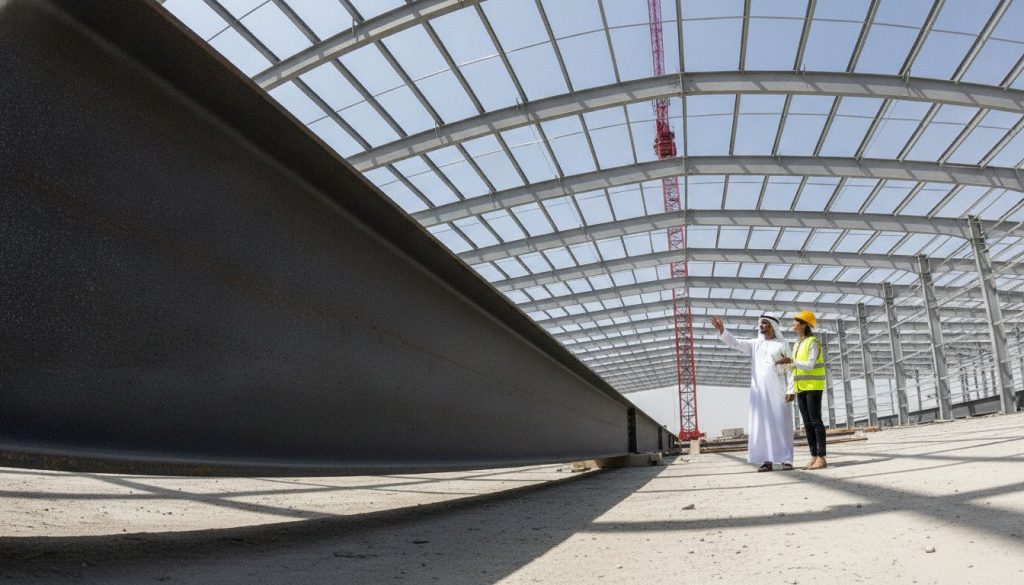
Selecting the wrong steel profile isn’t just a minor calculation error; it’s a decision that can compromise the structural integrity of a multi-million dirham project and lead to severe regulatory penalties under the 2026 Dubai Building Quality and Safety Law. While IPE and HEB beams might look similar on a preliminary blueprint, their performance under axial and bending stress is fundamentally different. You’re likely familiar with the pressure of optimizing weight-to-strength ratios while ensuring every component meets EN 10025 standards for harsh industrial environments. It’s a complex balancing act that requires more than just a cursory glance at a load table.
This guide clarifies the technical distinctions between these two critical profiles to help you maximize load-bearing efficiency and streamline your procurement process. We’ll explore the specific applications where HEB’s broader flanges outperform IPE’s lightweight efficiency, especially within the UAE’s evolving regulatory landscape. You’ll also learn which material grades are essential for local infrastructure and how to identify a dependable national partner for bulk structural steel supply.
Key Takeaways
- Distinguish between the narrow-flange geometry of IPE and the heavy-duty H-section profile of HEB to ensure precise structural alignment.
- Compare the specific weight-to-strength ratios and torsional resistance of IPE and HEB beams to optimize lateral stability in multi-story frameworks.
- Select appropriate steel grades, such as S355J2, and specialized surface treatments to combat the corrosive effects of the UAE’s saline coastal environments.
- Allocate profiles effectively by utilizing HEB for primary load-bearing columns and IPE for secondary rafters or purlins to maximize material efficiency.
- Streamline project logistics and minimize material waste through advanced cut-to-size customization and strategic bulk procurement strategies.
Understanding IPE and HEB Beam Geometry and Standards
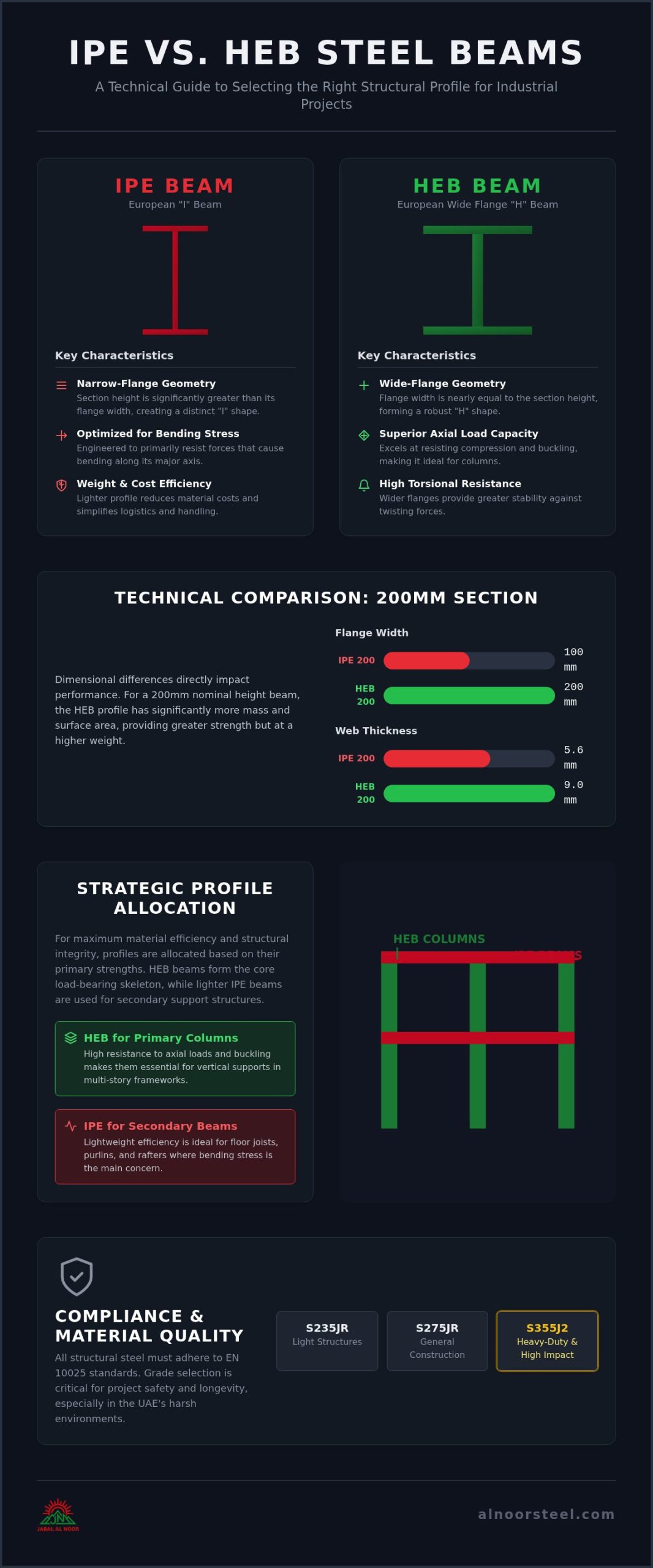
Structural integrity in heavy industry relies on the precise selection of profiles that can withstand immense stress. IPE beams, commonly known as European I-beams, feature a narrow-flange design where the height of the section significantly exceeds the width of the flanges. These are engineered primarily for applications where bending occurs about the major axis. In contrast, HEB beams, or European Wide Flange Beams, are categorized as heavy-duty H-sections. Their geometry is more equilateral; the flange width is often nearly equal to the total height, providing superior resistance to axial loads and buckling.
These profiles aren’t manufactured in a vacuum. The European I-beam standards, specifically EN 10365, govern the precise dimensions and tolerances for IPE and HEB beams. Adhering to these standards ensures that structural engineers can calculate load distributions with absolute certainty when specifying these components for complex assemblies. Within the UAE’s industrial sector, these profiles form the backbone of modern infrastructure, from oil and gas refineries to massive logistics hubs in Jebel Ali.
Anatomy of a Structural Beam: Flanges and Webs
The physical performance of a beam is dictated by its geometric distribution of material. The vertical center plate, known as the web, serves the critical function of resisting shear forces. In an IPE profile, the web is relatively thin, prioritizing weight efficiency. The horizontal components, or flanges, are responsible for resisting bending moments. While an IPE profile resembles a tall, slender “I,” an HEB profile looks like a robust “H.” This wider flange geometry in HEB sections allows for a much higher second moment of area, making them indispensable for columns that must support significant vertical weight without lateral deflection when comparing IPE and HEB beams for specific engineering applications.
Standard Specifications and EN 10025 Compliance
In the UAE, material compliance isn’t optional; it’s a safety mandate. All structural sections must meet EN 10025 standards, which define the technical delivery conditions for hot-rolled products. Engineers typically specify grades like S235JR for light structures, S275JR for general construction, and S355J2 for heavy-duty industrial applications requiring high impact toughness. Selecting the correct grade is as vital as choosing the right profile shape. For a deeper look at sourcing these materials locally, consult our structural steel supplier UAE 2026 procurement guide to ensure your project meets the latest safety regulations and operational benchmarks.
IPE vs. HEB: A Technical Comparison of Wide and Narrow Flange Profiles
Engineering precision dictates that IPE and HEB beams are not interchangeable, despite their shared classification as structural steel. IPE sections, which range from 80mm to 600mm in height, feature a narrow-flange profile that prioritizes weight efficiency. For example, an IPE 80 weighs approximately 6 kg/m, while an IPE 600 reaches 122 kg/m. In contrast, HEB sections provide much higher mass; an HEB 600 can exceed 212 kg/m. This disparity in weight-per-meter significantly impacts logistical planning, as specifying HEB beams often necessitates higher-capacity cranes and more robust transport solutions, increasing the initial procurement and handling costs.
Dimensional Differences and Weight Factors
The geometric variance between these profiles is most evident when comparing sections of the same nominal height. An IPE 200 beam has a web thickness of 5.6 mm and a flange width of 100 mm. An HEB 200, however, features a 9 mm web and a 200 mm flange width. This broader flange surface on HEB beams is critical for multi-bolt connections in heavy industrial joints, providing a more stable and wider interface for secondary framing or bracing. While IPE beams are more space-efficient for floor joists where vertical clearance is a priority, HEB sections provide the necessary web thickness to prevent buckling under extreme vertical loads.
Structural Performance Under Stress
Selecting the correct profile requires an evaluation of its Load-Bearing Capacities under specific environmental stressors. IPE beams are the optimal choice for bending stress in one plane, making them excellent candidates for roof rafters and secondary structural frameworks where the load is primarily vertical. HEB beams are the superior choice for axial compression and columns. Their H-shape geometry provides exceptional torsional resistance, allowing them to withstand twisting forces that occur during high-wind events or seismic activity. For a comprehensive look at how these shapes integrate into larger assemblies, engineers should refer to our technical guide on universal beams and columns UAE.
A strategic cost-benefit analysis often leads to a hybrid design. Using lighter IPE sections for purlins and rafters reduces the total tonnage of the project without sacrificing safety, while HEB beams provide the foundational stability required for primary columns. When your project demands high-precision materials that meet strict EN standards, you should consult a reliable supplier to ensure your inventory matches your specific design requirements.
Load-Bearing Capacities and Structural Applications in 2026 Projects
In 2026, structural engineering in the UAE focuses on systemic efficiency and material optimization. The strategic deployment of IPE and HEB beams allows for the construction of expansive industrial halls that maintain high safety margins without unnecessary weight. HEB sections serve as the primary load-bearing pillars, providing the necessary cross-sectional area to support multi-story industrial mezzanine floors. These robust H-sections are often integrated with hot rolled steel channels to create rigid frames that resist both vertical compression and lateral displacement.
The trend toward Pre-Engineered Buildings (PEB) has solidified the use of standardized European profiles across the region. By utilizing IPE beams for purlins and rafters, engineers achieve significant weight reduction in roof structures. This reduction in the dead load of the upper framework allows for larger clear spans in warehouse environments. This systemic approach ensures that every gram of steel serves a calculated purpose, aligning with the 2026 focus on sustainable and cost-effective infrastructure. It’s a method that balances technical proficiency with logistical reality.
Industrial and Warehouse Construction
Heavy machinery platforms require the exceptional stiffness provided by HEB profiles. Their broad flanges offer a superior contact area for mounting vibrating equipment, which minimizes fatigue on the structural joints. For mezzanine supports, HEB beams act as the primary girders, while IPE sections are frequently used as secondary floor joists. This combination optimizes the floor depth while maintaining the required stiffness for industrial traffic. Long-span warehouse designs rely on this hierarchy to ensure stability under the specific environmental pressures of the UAE. Using IPE and HEB beams in tandem provides a reliable framework for large-scale logistics hubs.
Infrastructure and Heavy Engineering
Infrastructure projects, particularly bridge engineering and support trestles, demand the high-performance characteristics of wide-flange HEB beams. These sections provide the foundational strength needed for temporary support structures and permanent bridge girders. To achieve maximum structural rigidity, these beams are integrated with mild steel angle bars for cross-bracing and lateral reinforcement. Government-led projects in 2026 strictly enforce compliance with these configurations to ensure long-term durability in the region’s harsh climate. This rigorous adherence to standards protects the investment and ensures the safety of public infrastructure over its entire lifecycle.
Material Grades and Surface Treatments for UAE Industrial Environments
The structural integrity of IPE and HEB beams is only as permanent as the protection applied to their surfaces. In the UAE, coastal proximity and high relative humidity accelerate oxidation, which can lead to pitting and structural failure if left unaddressed. JABAL AL NOOR Steel addresses these challenges through a methodical approach to surface preparation and coating. By providing high-grade materials combined with advanced value-added services, we ensure that structural components survive the rigorous demands of heavy industry and the aggressive saline atmosphere common in the region’s industrial zones.
Selecting the correct material grade is the first step in ensuring a project’s long-term viability. While standard construction might utilize lower grades, high-stakes infrastructure requires the enhanced mechanical properties of S355J2 steel. This grade offers superior yield strength and impact toughness, making it the preferred choice for heavy-load sections in oil and gas refineries and large-scale manufacturing plants. Ensuring your supply chain provides verified Mill Test Certificates (MTC) is essential for maintaining compliance with the 2026 Dubai Building Quality and Safety Law.
Corrosion Resistance and Longevity
Surface preparation is the foundation of effective corrosion control. Shot blasting is the industry-standard process used to remove mill scale, rust, and contaminants from the steel surface before any coating is applied. This creates a clean, profiled surface that ensures maximum adhesion for protective layers. For most structural applications, applying a red-oxide or zinc-rich primer immediately after shot blasting provides a robust barrier against moisture. In environments with extreme saline exposure, such as offshore terminals or coastal warehouses, hot-dip galvanization is often specified to extend the life cycle of IPE and HEB beams by decades.
Selecting the Right Steel Grade
Engineering specifications usually dictate the choice between S235JR, S275JR, and S355J2. S235JR is suitable for secondary structural frameworks where loads are minimal. However, for primary columns and heavy-duty mezzanine supports, S355J2 is the standard for 2026 engineering projects. This grade provides the necessary chemical composition and mechanical resistance to withstand axial compression and bending moments without excessive material thickness. Verifying the authenticity of these grades through rigorous testing and documentation is a non-negotiable aspect of modern procurement. To secure high-performance materials for your next project, you can browse our inventory of treated structural steel to ensure your site requirements are met with precision.
Strategic Sourcing: Procuring Quality IPE and HEB Beams in the UAE
Sourcing structural steel in the UAE requires a partner that understands the logistical complexities of large-scale infrastructure. While some focus solely on the per-tonne price, seasoned project managers know that the true value lies in the supplier’s inventory depth and their ability to provide pre-processed materials. Procurement of IPE and HEB beams is a strategic decision that affects the entire fabrication lifecycle. A reliable supplier ensures that every section meets EN 10025 standards while managing the bulk logistics necessary to keep a project on schedule. This level of oversight is essential for maintaining the rigorous safety benchmarks required by the 2026 Dubai Building Quality and Safety Law.
Value-Added Processing Services
On-site fabrication often leads to significant material waste and increased labor costs. By utilizing precision cut-to-size customization, contractors receive beams that are ready for immediate assembly. This pre-processing reduces the need for heavy cutting equipment at the project site and ensures that dimensional tolerances are strictly maintained according to engineering specifications. Integrating surface treatments like shot blasting and priming directly into the supply chain further streamlines operations. It’s an interconnected approach that allows for a faster transition from procurement to installation, which is critical for meeting the tight deadlines of modern industrial contracts. Reducing on-site waste isn’t just an environmental goal; it’s a logistical necessity for operational efficiency.
Inventory and National Delivery
Maintaining a comprehensive range of structural sections is essential for supporting the diverse needs of the UAE’s construction sector. From small-scale rafters to massive primary columns, having immediate access to a variety of sizes from stock prevents costly project delays. JABAL AL NOOR Steel provides a robust logistical network that ensures timely delivery across all emirates, supporting infrastructure development from Abu Dhabi to Fujairah. Our commitment to operational excellence means that every order is handled with the precision required for high-stakes energy and infrastructure projects. You can browse our full catalog and explore our diverse range of long products at the JABAL AL NOOR Steel Shop to find the exact specifications for your next build.
Choosing a veteran partner like JABAL AL NOOR Steel provides the industrial stability needed for long-term success. We don’t just supply steel; we provide a foundation of trust and technical proficiency. Our role as a steady pillar in the local landscape allows us to offer transparent and reliable bulk supply solutions that prioritize precision and long-term value for our collaborators. By combining extensive inventory with specialized customization, we help our partners navigate the complexities of modern structural engineering with unwavering confidence. This measured pace of service ensures that every project, regardless of scale, receives the professional curation it deserves.
Optimizing Structural Integrity for 2026 and Beyond
Structural excellence in the UAE’s heavy industry depends on the precise alignment of profile geometry with specific mechanical requirements. You’ve seen how the technical distinctions between IPE and HEB beams allow for a hybrid design approach that balances weight reduction with foundational stability. By integrating high-performance steel grades with advanced surface treatments, engineers can ensure long-term durability against the region’s aggressive environmental stressors. This methodical approach to material selection defines the next generation of industrial infrastructure.
JABAL AL NOOR Steel supports these high-stakes requirements with national UAE delivery for all heavy structural sections. Our operations prioritize EN compliance and red-dot quality standards to provide the industrial stability your projects demand. With specialized in-house cut-to-size and surface treatment services, we help you minimize site waste and accelerate your fabrication timelines. We’re ready to serve as the dependable partner your next structural milestone deserves. We look forward to helping you build a more resilient and efficient future for your industrial operations.
Request a Quote for IPE and HEB Beams
Frequently Asked Questions
What is the main difference between IPE and HEB beams?
The primary distinction lies in the flange-to-height ratio and material distribution. IPE profiles feature narrow flanges and are designed primarily for bending resistance about the major axis. HEB profiles have wider flanges that offer superior stability against axial compression and buckling. This makes HEB sections significantly heavier than IPE sections of the same nominal height, which influences both structural capacity and logistical planning for industrial builds.
Which beam is better for columns: IPE or HEB?
HEB beams are the preferred choice for vertical columns due to their wide-flange geometry. This design provides a larger second moment of area and enhanced torsional resistance, which are critical for preventing lateral-torsional buckling under heavy axial loads. While IPE beams are efficient for rafters and purlins where bending is the primary concern, they don’t offer the same load-bearing stability required for primary structural pillars.
Are IPE and HEB beams compatible with ASTM standards?
IPE and HEB are manufactured according to European (EN) standards, though they can often be cross-referenced with American ASTM A6 standards for specific project requirements. While dimensions differ from US wide-flange shapes, engineers frequently use equivalence tables to ensure structural compliance. It’s essential to verify that any substitution meets the specific yield strength and impact toughness requirements defined in the original design specifications.
Can IPE and HEB beams be customized to specific lengths?
Yes, both IPE and HEB beams can be customized through precision cut-to-size services to meet exact project dimensions. Utilizing pre-processed beams at the procurement stage reduces on-site labor costs and minimizes material waste. This logistical advantage is particularly valuable for large-scale infrastructure projects where precision and speed are essential for maintaining strict construction timelines across the UAE’s industrial zones.
What steel grades are most common for IPE beams in the UAE?
The most common material grades for structural sections in the UAE are S275JR and S355J2, in accordance with the EN 10025 standard. S355J2 is particularly favored for heavy industry and energy projects because it offers high yield strength and superior impact toughness. These grades ensure that structural components can withstand the mechanical stressors and environmental conditions typical of the region’s large-scale manufacturing and refinery sectors.
How does the price of HEB compare to IPE beams?
HEB beams typically command a higher price per linear meter compared to IPE beams of the same height because they possess significantly more mass. Since structural steel is often traded by weight, the heavier flanges and thicker webs of the HEB profile result in a higher total tonnage for the same length of material. Procurement managers should account for this weight difference when calculating total project costs and logistical requirements.
What surface treatments are recommended for structural steel beams?
Recommended surface treatments include shot blasting to remove mill scale, followed by the application of red-oxide or zinc-rich primers. For outdoor or coastal installations in the UAE, hot-dip galvanization is the standard for long-term corrosion resistance. These treatments protect the steel from saline air and high humidity, significantly extending the life cycle of the structural framework and reducing long-term maintenance costs for the facility.
Is EN 10025 the standard for IPE and HEB profiles?
EN 10025 is the technical delivery standard that governs the material grades and mechanical properties of IPE and HEB beams. The dimensional tolerances and profile shapes themselves are specifically defined by the EN 10365 standard. Adherence to both standards ensures that the steel sections meet the rigorous quality benchmarks required for industrial stability and safety in heavy-duty construction projects across the region.
No Comments yet!