The UAE’s industrial sector is projected to reach a valuation of USD 6.41 billion by 2034, which means the structural integrity of a single weld seam can determine the success of a multi-million Dirham infrastructure project. You likely understand that as giga-projects scale toward 2026, the margin for error in material procurement has effectively vanished. Finding reliable ERW steel pipe suppliers UAE is no longer just about sourcing a commodity; it’s about securing a technical partnership that guarantees performance under the harshest regional conditions. Uncertainty regarding weld seam integrity or the complexities of international compliance shouldn’t be allowed to stall your operations.
This guide provides the technical validation and industrial clarity you need to navigate the evolving steel market. We’ll explore the latest 2026 manufacturing benchmarks, including the mandatory ultrasonic testing updates for API 5L standards, and evaluate the importance of local customization for streamlining on-site logistics. You’ll gain a comprehensive understanding of how to identify a dependable national partner capable of managing the current 10% customs duty landscape while delivering ASTM and EN compliant materials. From specialized surface treatments to precision cut-to-size services, we’ll detail the criteria that separate foundational pillars of the industry from mere vendors.
Key Takeaways
- Evaluate the technical evolution of high-frequency Electric Resistance Welding to optimize the structural integrity and performance of modern industrial pipelines.
- Decode essential international standards, including ASTM A53 and A252, to ensure your material procurement aligns with rigorous 2026 safety and regulatory benchmarks.
- Analyze the superior cost-to-performance ratio of ERW pipes compared to seamless alternatives when partnering with established ERW steel pipe suppliers UAE for structural applications.
- Master critical sourcing criteria by prioritizing Mill Test Certificate (MTC) verification and inventory depth to maintain full material traceability and project continuity.
- Leverage national distribution networks and specialized customization services, such as cut-to-size and surface treatments, to enhance logistical efficiency in harsh regional environments.
What are ERW Steel Pipes and Why are They Essential for UAE Industry?
The industrial landscape of the United Arab Emirates relies on robust materials that can withstand high-pressure environments and extreme temperatures. Electric Resistance Welding (ERW) steel pipes represent a fundamental component of this infrastructure. These pipes are manufactured by cold-forming a flat steel ribbon into a cylindrical shape and passing a high-frequency electric current through the edges to create a longitudinal seam. This process has evolved significantly; modern engineering now favors high-frequency ERW over traditional seamless pipes for many applications due to its precise wall thickness and superior surface finish.
Leading ERW steel pipe suppliers UAE provide these materials for a wide range of critical projects. They’re essential for water transmission networks, structural frameworks in high-rise construction, and heavy-duty scaffolding systems. The preference for ERW in the UAE stems from its exceptional cost-to-performance ratio. For significant structural projects, including national infrastructure initiatives like the Etihad Rail, and various industrial zones throughout the country, ERW pipes offer the required durability without the premium costs often associated with seamless manufacturing.
The Mechanics of Electric Resistance Welding
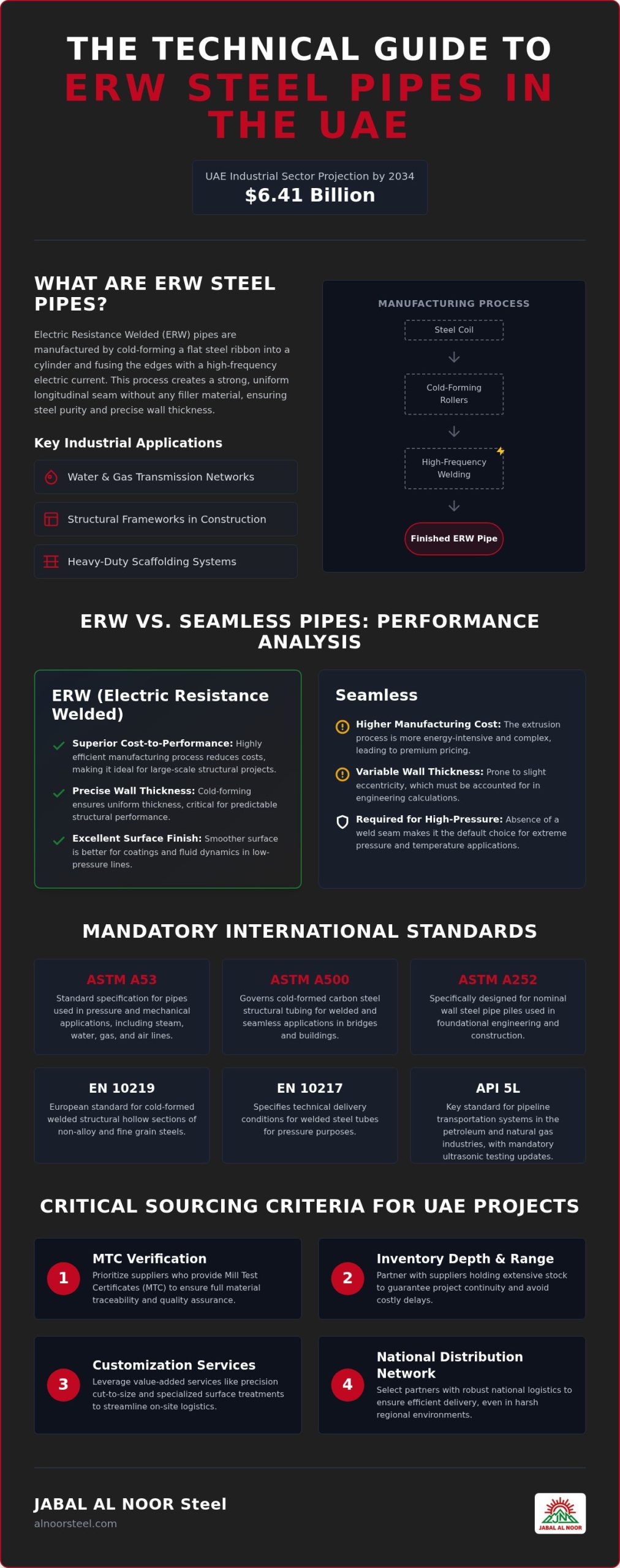
The production begins with high-quality steel coils that are continuously fed through a series of rollers. This cold-forming process ensures the steel maintains its mechanical properties while achieving a precise circular profile. Once the edges meet, a high-frequency induction current generates localized heat, fusing the metal together. No filler material is added during this stage, which preserves the purity of the steel grade. To ensure the weld zone is as strong as the base material, the pipe undergoes post-weld heat treatment. This step achieves structural homogeneity, making the seam virtually indistinguishable from the rest of the pipe body in terms of strength and endurance.
ERW vs. EFW: Understanding the Welding Methods
Choosing between different welding methods is vital for project safety and budget management. While ERW relies on pressure and electrical resistance, Electric Fusion Welding (EFW) involves heating the metal with an electric arc and often utilizes a filler material. ERW is a manufacturing process that creates a permanent longitudinal bond without the introduction of filler material, relying instead on high-frequency electrical current to fuse the edges of the steel coil. Generally, ERW is the standard for smaller and medium diameters used in structural and low-to-medium pressure applications. In contrast, EFW is reserved for larger industrial needs where thicker walls are required. Reliable ERW steel pipe suppliers UAE maintain extensive inventories of varied sizes to meet these specific engineering demands.
Technical Standards and Material Grades for ERW Pipes
Safety in the UAE’s heavy industry isn’t a suggestion; it’s a requirement enforced by rigorous technical standards. Projects spanning from desalination plants to high-rise skeletons depend on the predictability of material performance. Reliable ERW steel pipe suppliers UAE must ensure every batch complies with international benchmarks to prevent catastrophic failures in high-pressure or high-load environments. These standards provide a universal language for engineers, ensuring that a pipe sourced in Dubai meets the same mechanical criteria as one used in any other global industrial hub.
Several key standards dictate the procurement process in the region. Understanding these ensures that the material selected is fit for its specific industrial purpose:
- ASTM A53: Used for pressure and mechanical applications, typically in steam, water, gas, and air lines.
- ASTM A500: The standard for cold-formed carbon steel structural tubing used in bridges and buildings.
- ASTM A252: Specifically designed for nominal wall steel pipe piles used in foundational engineering.
- EN 10219: A European standard specifying technical delivery conditions for cold-formed welded structural hollow sections.
- EN 10217: Governs welded steel tubes for pressure purposes, essential for the energy sector.
In pressure applications, the choice between Grade A and Grade B is pivotal. Grade B features a higher yield strength, providing the necessary endurance for high-stress industrial systems, while Grade A is more suited for projects requiring significant ductility and cold bending. Most UAE contractors prioritize Grade B for its superior mechanical properties in demanding environments.
ASTM A53: The Benchmark for Pressure and Mechanical Use
The ASTM A53 specification is the industry cornerstone for ERW pipes. Type E (Electric-Resistance Welded) Grade B is the most common requirement for UAE industrial piping because it handles higher pressure loads than its Grade A counterpart. If you’re evaluating regional stockists for your next project, check our Industrial Steel Pipe Suppliers in the UAE guide for a 2026 performance comparison.
BS and EN Standards for Structural Hollow Sections
European standards like EN 10219 and the older BS 1387 govern the use of ERW tubes in structural engineering. These standards are critical for ensuring that the outside diameter and wall thickness fall within tight tolerances. Contractors often look to ERW steel pipe suppliers UAE who can provide Mill Test Certificates (MTC) proving compliance with these EN requirements. For specific engineering data on these sections and their applications in regional infrastructure, refer to the MS Hollow Sections Engineering Reference.
ERW vs. Seamless Steel Pipes: A Comparative Performance Analysis
A common misconception persists within the regional engineering sector that seamless pipes are inherently superior to welded alternatives in every scenario. While seamless pipes are essential for extreme high-pressure environments in the deep-sea oil and gas sector, modern high-frequency ERW manufacturing has bridged the performance gap for the vast majority of industrial applications. For structural frameworks and medium-pressure systems, ERW often provides a superior technical and economic value proposition. Leading ERW steel pipe suppliers UAE now provide materials that challenge the traditional dominance of seamless products in diverse sectors.
Dimensional accuracy is one of the most significant technical advantages of ERW pipes. Because they are manufactured from precision-rolled steel coils, ERW pipes maintain a highly uniform wall thickness and consistent concentricity. In contrast, the extrusion and piercing process used to create seamless pipes can lead to slight variations in wall thickness across the circumference. This uniformity in ERW pipes simplifies the welding and joining process during on-site fabrication, reducing the risk of alignment errors in complex structural assemblies.
From a procurement perspective, the cost-benefit ratio of ERW is difficult to ignore. The manufacturing process is more energy-efficient and utilizes less complex machinery than seamless production. These operational savings are passed down to the contractor, allowing for significant cost optimization on large-scale infrastructure projects without compromising structural integrity. In structural load-bearing applications, the performance of high-quality ERW is indistinguishable from seamless, provided the material meets the relevant ASTM or EN standards.
When to Specify ERW Over Seamless
ERW is the ideal specification for low-to-medium pressure water lines, structural supports, and general industrial fabrication. Its primary advantage lies in its immediate availability. While specialized seamless sizes may require long lead times from international mills, reputable ERW steel pipe suppliers UAE maintain deep inventories of standard industrial sizes. This local availability is a critical factor in maintaining project timelines for UAE infrastructure contracts, where logistical delays can lead to substantial financial penalties.
Testing and Quality Assurance for Welded Seams
Modern quality control has eliminated the “weak seam” risks associated with older welding technologies. Non-Destructive Testing (NDT), including full-body ultrasonic and hydrostatic testing, ensures that the longitudinal seam is robust and leak-proof. High-frequency induction welding creates a bond that is metallurgically identical to the parent metal. Certified ERW pipes meet the same safety factors as seamless pipes in specified industrial applications, ensuring complete reliability for regional engineers and project managers.
Critical Sourcing Criteria for Industrial ERW Pipes
Selecting the right material is only half the challenge in heavy industrial procurement. The success of a project often hinges on the capabilities of the partner providing the metal. Leading ERW steel pipe suppliers UAE must demonstrate more than just a large inventory; they must provide absolute material traceability and technical support. In a market where giga-projects are the standard, a supplier’s ability to verify the chemical and mechanical properties of their stock through Mill Test Certificates (MTC) is a non-negotiable requirement for safety and compliance.
Inventory diversity also plays a critical role in project continuity. A steady partner maintains a deep range of outside diameters and wall thicknesses, ensuring that structural engineers don’t have to compromise on design specifications due to market shortages. When you evaluate potential collaborators, look for those who understand the logistical pressures of the UAE construction sector. You can view our full inventory of tubes and pipes to understand the scale of availability required for national infrastructure projects.
Surface Treatments and Environmental Resilience
The UAE’s coastal climate presents a significant threat to steel longevity. High humidity and saline air accelerate oxidation, making raw steel vulnerable even before it’s installed. To combat this, reputable ERW steel pipe suppliers UAE offer specialized surface treatments. Hot Dip Galvanized (GI) coatings provide a robust sacrificial layer of zinc, which is essential for pipes exposed to the elements. For structural components that require painting or specialized coatings, shot blasting and priming services create a clean, textured surface that ensures long-term adhesion and prevents rust during on-site storage. These treatments are foundational to maintaining the structural integrity of the steel throughout the project’s lifecycle. For applications demanding even greater corrosion resistance in aggressive coastal or chemical environments, understanding the full range of options from stainless steel pipe suppliers UAE can help engineers select the most appropriate material for long-term performance.
Logistics and Customization Requirements
On-site efficiency is a primary driver of profitability in modern engineering. Sourcing from a national stockist with in-house customization capabilities offers a distinct advantage over importing from overseas manufacturers. Specialized cut-to-size services allow contractors to receive pipes ready for immediate installation, which significantly reduces on-site labor costs and material waste. This level of logistical precision is detailed further in our guide to Hollow Section Steel Suppliers UAE Pillar, which explores how regional experts streamline the supply chain. Choosing a supplier with a robust national distribution network ensures that bulk orders arrive exactly when needed, mitigating the risks of fluctuating freight costs and international shipping delays.
Partnering with JABAL AL NOOR Steel for National Procurement
JABAL AL NOOR Steel operates as a foundational pillar within the United Arab Emirates’ industrial landscape, providing the stability and regional expertise required for large-scale infrastructure and energy projects. As one of the most dependable ERW steel pipe suppliers UAE, we prioritize long-term partnerships, ensuring that every procurement cycle is backed by industrial stability and unwavering confidence. Our role extends beyond that of a traditional stockist; we act as a knowledgeable guide for contractors navigating the high-stakes requirements of the 2026 market.
Our commitment to international quality benchmarks is absolute. Every ERW pipe in our inventory is verified against rigorous testing protocols, including hydrostatic and ultrasonic evaluations, to ensure weld seam integrity. We provide full material traceability through Mill Test Certificates (MTC), allowing engineers to proceed with the technical validation necessary for high-pressure environments. By combining bulk supply with a sophisticated national distribution network, we streamline the supply chain for projects across Dubai, Abu Dhabi, and the Northern Emirates.
Value-Added Services for Heavy Industry
Efficiency on a construction site is often determined by the readiness of the materials. We offer specialized cut-to-size customization for ERW pipes and tubes, allowing your team to focus on assembly rather than preparation. Our expertise in surface treatments, including shot blasting and priming, provides a critical foundation for long-term structural integrity in harsh coastal climates. Additionally, our technical team is available to support project-specific steel grade selection, ensuring that your material choices align perfectly with the mechanical demands of your application.
Secure Your Industrial Steel Supply
Managing large-scale infrastructure contracts requires a steady and transparent supply of structural steel. Our extensive inventory includes everything from hollow sections and MS beams to specialized GI and stainless steel pipes. We’ve designed our procurement process to be methodical and predictable, mirroring the planned pace of the engineering sector. Whether you’re sourcing for a single project or managing an ongoing industrial requirement, our national reach ensures your supply remains secure. Explore our full range of ERW pipes and steel products at the Al Noor Steel Shop to see how our inventory supports the next generation of UAE infrastructure.
Securing Your Industrial Infrastructure for 2026 and Beyond
High-frequency ERW pipes have established themselves as a technically sound and cost-effective alternative to seamless options across the UAE’s infrastructure landscape. By prioritizing compliance with ASTM and EN standards, project managers ensure structural integrity while optimizing procurement budgets for large-scale developments. It’s clear that the success of modern engineering projects depends on material precision and logistical efficiency.
Selecting the most dependable partner among ERW steel pipe suppliers UAE is essential for navigating the current 10% customs duty landscape and meeting the rigorous 2026 API 5L updates. JABAL AL NOOR Steel has served as an established national supplier since 2010, maintaining an extensive inventory of certified steel ready for immediate dispatch. Our specialized cut-to-size and surface treatment services are designed to reduce on-site waste and ensure long-term durability in the region’s challenging climate.
Request a Quote for Bulk ERW Steel Pipe Supply
We’re ready to provide the stability and technical expertise your next project demands.
Frequently Asked Questions
What is the difference between ERW and seamless steel pipes?
ERW pipes are manufactured from steel coils and feature a longitudinal seam, while seamless pipes are extruded from a solid billet without a weld. Modern high-frequency ERW offers superior dimensional accuracy and wall thickness uniformity compared to seamless alternatives. While seamless is traditionally reserved for extreme high-pressure environments, ERW provides a more cost-effective solution for most industrial and structural applications without compromising on durability.
Are ERW pipes suitable for high-pressure applications in the UAE?
ERW pipes are highly suitable for medium-to-high pressure applications when they’re manufactured to specific standards like ASTM A53 Grade B. Leading ERW steel pipe suppliers UAE ensure these products undergo rigorous hydrostatic and ultrasonic testing to verify seam integrity. For critical infrastructure, high-frequency induction welding ensures the seam is as robust as the pipe body, meeting the safety factors required for regional industrial projects.
What are the common sizes for ERW steel pipes in industrial projects?
Standard industrial sizes typically range from 1/2 inch to 24 inches in nominal pipe size (NPS). Wall thicknesses vary according to schedules, such as Schedule 40 or Schedule 80, to meet specific pressure and structural load requirements. Reputable suppliers maintain deep inventories of these standard sizes and thicknesses to support rapid deployment in regional construction and engineering projects across the Emirates.
Does JABAL AL NOOR Steel provide Mill Test Certificates with ERW pipes?
Yes, we provide comprehensive Mill Test Certificates (MTC) with every batch of ERW pipes to ensure absolute material traceability. These certificates verify the chemical composition and mechanical properties of the steel, documenting that the material meets international standards. This documentation is essential for contractors and engineers who must confirm compliance with ASTM or EN benchmarks for project approval and safety audits.
Can ERW pipes be used for structural columns in construction?
ERW pipes are frequently utilized for structural columns and frameworks because of their excellent strength-to-weight ratio. They are manufactured to standards like ASTM A500, which specifically governs structural tubing for building and bridge construction. Their uniform wall thickness and concentricity make them highly predictable for load-bearing calculations in high-rise buildings and heavy industrial structures throughout the UAE.
What surface treatments are available for ERW pipes to prevent corrosion?
Common surface treatments include Hot Dip Galvanizing (GI) for superior moisture resistance and shot blasting followed by priming for structural painting. These treatments are vital in the UAE’s humid and saline coastal environments where oxidation occurs rapidly. Specialized coatings prevent rust during on-site storage and significantly extend the operational lifespan of the steel in harsh, high-exposure industrial settings. For environments with extreme chemical or saline exposure, consulting with stainless steel pipe suppliers UAE about corrosion-resistant alloy grades can provide an additional layer of long-term protection.
How does the cost of ERW pipes compare to seamless options?
ERW pipes generally offer a more economical solution than seamless pipes because the manufacturing process is more energy-efficient and scalable. This cost advantage allows for significant project savings, particularly in large-scale structural or low-pressure water transmission projects. Procurement teams often prioritize ERW when technical specifications don’t strictly mandate a seamless process, allowing for better budget optimization without losing performance.
Is there a difference between ERW and HFW (High-Frequency Welded) pipes?
HFW is a specific type of Electric Resistance Welding that uses a higher frequency current to create the bond. Most modern ERW steel pipe suppliers UAE provide HFW products because they offer a more refined and reliable weld seam. The high-frequency process ensures deeper heat penetration and a stronger metallurgical bond compared to older, low-frequency methods, making it the preferred choice for modern engineering.
No Comments yet!