In the high-stakes environment of heavy industry, treating steel procurement as a simple transaction is a risk that modern infrastructure projects can no longer afford. You likely recognize that inconsistent material quality and hidden logistical delays do more than just inflate budgets; they compromise the structural integrity of national landmarks and energy assets. It’s a frustration shared by many procurement officers who struggle to distinguish between transactional vendors and established steel trading companies in UAE that uphold rigorous international benchmarks. Relying on a partner that lacks a deep understanding of local industrial pressures can lead to costly non-compliance with ASTM or EN standards.
This article provides a repeatable framework to master these complexities, ensuring your supply chain remains resilient against quality fluctuations and rising operational costs. We will examine a comprehensive 2026 checklist for vetting manufacturers and trading partners, focusing on technical proficiency, adherence to global quality benchmarks, and the strategic integration of supply and processing services. By shifting your perspective from simple purchasing to integrated partnership, you can secure the long-term value and industrial stability required for the UAE’s most demanding projects. This methodical approach ensures that every beam, channel, and hollow section meets the exact specifications of your engineering requirements.
Key Takeaways
- Define a strategic sourcing framework to determine when to procure directly from manufacturers or through established steel trading companies in UAE for diverse inventory needs.
- Establish a rigorous verification process for Mill Test Certificates (MTC) to ensure total compliance with international structural standards including ASTM, EN, and JIS.
- Reduce on-site waste and lead times by prioritizing suppliers that offer integrated processing services, such as precision cut-to-size customization and specialized surface treatments.
- Implement a procurement decision matrix that evaluates potential partners based on long-term financial stability and technical proficiency rather than transactional pricing.
- Master the logistical requirements for national-scale delivery to maintain industrial stability across large-scale infrastructure and energy projects.
Understanding the Role of Steel Manufacturers in UAE Industrial Projects
The UAE’s industrial trajectory toward 2026 demands a sophisticated understanding of material supply chains. It’s no longer sufficient to view steel as a simple commodity; instead, it’s the foundational element that determines the success of large-scale infrastructure and energy assets. Reliable steel trading companies in UAE act as the critical bridge between global manufacturing standards and local project execution. These entities ensure that the massive scale of national development remains grounded in technical excellence and operational reliability. As procurement managers shift toward integrated supply partners, the focus has moved from simple price points to the long-term value provided by technical proficiency and consistent material availability.
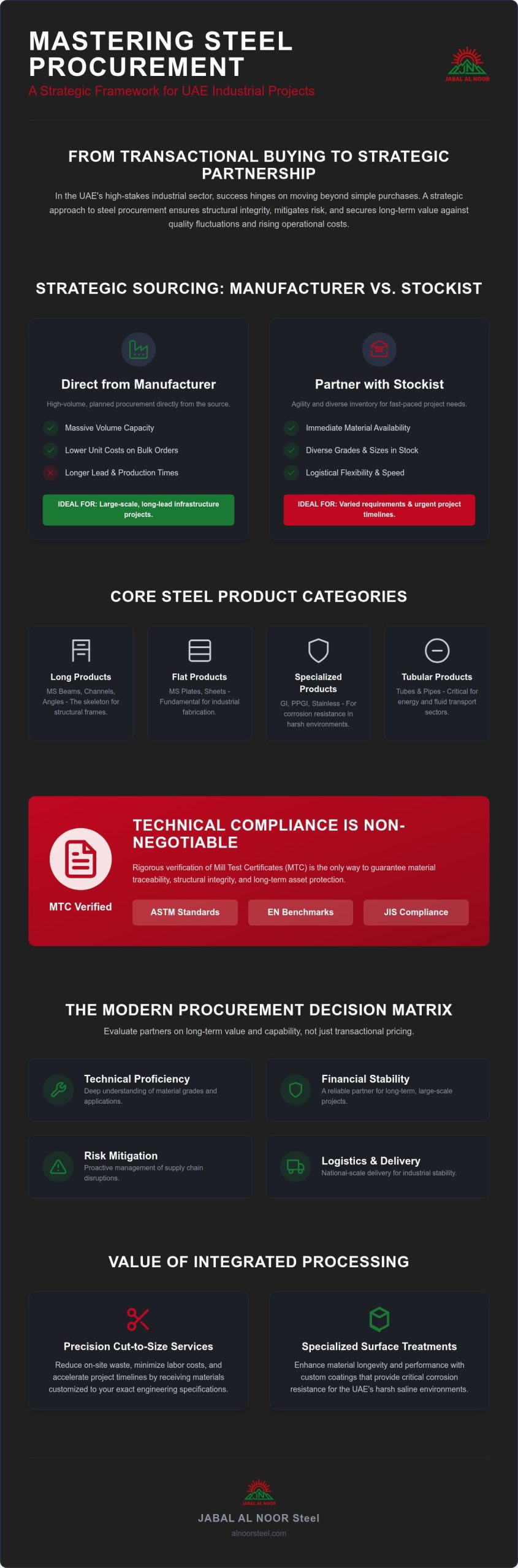
Procurement strategies typically categorize requirements into four primary pillars to maintain organizational clarity. Long products, such as MS beams, channels, and angles, provide the essential skeleton for structural frames. Flat products, including MS plates and sheets, are fundamental for heavy industrial fabrication and vessel manufacturing. Tubular products, encompassing various tubes and pipes, serve the critical energy and fluid transport sectors. Finally, specialized GI, PPGI, and stainless steel options offer the necessary corrosion resistance for projects exposed to harsh environmental conditions.
The Impact of Steel Quality on Structural Integrity
Structural longevity in the UAE is directly tied to material resilience against extreme thermal expansion and aggressive saline environments. High-grade structural steel is engineered to prevent premature fatigue, which is a critical factor for the region’s high-rise developments and energy plants. The specific chemical composition of the steel, particularly the precise balance of carbon and manganese, dictates its weldability and ultimate load-bearing capacity. Maintaining rigorous material traceability through verified Mill Test Certificates is not just a safety requirement; it’s a prerequisite for modern insurance compliance and long-term asset protection.
Economic Drivers of Steel Sourcing in the Region
Managing steel price volatility in 2026 requires a decisive shift from transactional buying to strategic inventory management. National stockists act as a vital buffer against global supply chain disruptions, providing immediate access to critical grades such as S235JR and ASTM A36. By sourcing from partner steel trading companies in UAE that possess established national logistics, contractors can effectively balance lead times with bulk procurement strategies. This integration significantly reduces the capital tied up in on-site inventory while ensuring that project milestones are met with unwavering precision. You can view the current inventory of compliant materials at the Al Noor Steel shop to better align your procurement with these shifting economic drivers.
Manufacturer vs. Stockist: A Framework for Strategic Sourcing
The decision to source from a primary mill or a national stockist depends on the scale and urgency of the project requirements. While mills offer direct production, steel trading companies in UAE provide the agility required to navigate the fast-paced construction environment. Large-scale infrastructure projects often utilize a hybrid approach, securing bulk volumes from manufacturers while relying on stockists for immediate logistical support. This dual strategy ensures that critical path activities are never stalled by production backlogs. It’s a matter of balancing volume with the precision of delivery schedules.
Procurement officers must distinguish between these two entities to optimize their supply chain. Manufacturers focus on high-volume output and standardized rolling schedules, whereas stockists focus on inventory depth and logistical flexibility. Understanding where your project sits on this spectrum is the first step toward a cost-effective procurement strategy. For pre-engineered building projects specifically, identifying a reliable steel supplier for PEB structures that can deliver certified, pre-processed components is equally critical to maintaining construction momentum.
The Manufacturer Advantage: High-Volume Production
Direct mill sourcing is typically reserved for massive, long-lead projects where bespoke rolling requirements justify high minimum order quantities (MOQs). These mill-run minimums can be prohibitive for SME contractors or for specific phases of a project that require varied but smaller quantities. Procurement managers must also account for production cycles; a mill might only roll specific profiles every few months. If your project timeline doesn’t align with these cycles, direct sourcing can introduce significant delays that ripple through the entire construction schedule. Bespoke orders are powerful but they lack the speed needed for urgent structural adjustments.
The Stockist Advantage: Inventory and Customization
National stockists bridge the gap between heavy manufacturing and on-site execution. They maintain a diversified inventory of MS Beams, Channels, and Angles, allowing for immediate dispatch regardless of current mill schedules. This “just-in-time” delivery model is essential for maintaining industrial stability and avoiding the high costs of on-site storage. Beyond simple supply, stockists offer value-added processing that mills often don’t provide. For instance, in-house cut-to-size services ensure that materials arrive ready for immediate installation, significantly reducing on-site waste and labor costs.
Reliable steel trading companies in UAE act as a technical buffer, vetting every batch for quality before it reaches your site. You can evaluate the available inventory of long and flat products to determine if a stockist has the depth required for your specific structural needs. This partnership ensures that you aren’t just buying material, but securing a reliable link in your project’s lifecycle. By leveraging a stockist’s inventory, you gain the flexibility to adapt to design changes without the months-long wait times associated with mill-direct reorders.
The Technical Compliance Checklist: Grades and Standards
Technical compliance represents the non-negotiable foundation of industrial safety in the UAE. It’s the primary metric by which professional procurement teams evaluate steel trading companies in UAE. Without a rigorous verification process, the risk of structural failure or insurance rejection becomes a tangible threat to project viability. Every batch of material must be accompanied by a Mill Test Certificate (MTC). This document serves as the steel’s birth certificate, detailing its chemical composition and mechanical properties. Verifying that the heat number on the MTC matches the physical stamp on the steel is a fundamental step in ensuring material traceability.
Identifying sub-standard or counterfeit steel requires a methodical eye. Sub-standard products often exhibit surface irregularities, inconsistent thicknesses, or documentation that lacks clear mill origin. A robust checklist for structural steel quality standards should include:
- Verification of MTC Authenticity: Cross-referencing mill stamps with digital records to confirm origin.
- Dimensional Accuracy: Measuring actual thickness and flange width against specified international tolerances.
- Surface Finish Inspection: Checking for excessive pitting, laminations, or cracks that compromise structural integrity.
- Compliance with Regional Regulations: Ensuring materials meet the specific technical requirements of UAE municipal authorities and engineering consultants.
Common Material Grades in UAE Construction
Specifying the correct grade is essential for balancing cost with structural performance. S235JR and S355JR are the dominant European standards; S355JR offers higher yield strength for load-bearing applications in high-rise or industrial builds. Conversely, ASTM A36 remains the benchmark for American-standard carbon steel, while A572 Grade 50 is preferred for its high-strength, low-alloy properties. Understanding these nuances is critical when consulting this guide on structural steel quality standards UAE to ensure your project’s engineering calculations align with the physical properties of the delivered material.
Standard Compliance for Hollow Sections and Pipes
Hollow sections and industrial piping require specific certifications to handle pressure and structural loads. EN 10219 covers cold-formed welded structural hollow sections, while EN 10210 is reserved for hot-finished sections used in more demanding structural environments. For fluid transport and energy projects, ASTM A53 and A106 define the rigorous requirements for seamless and welded carbon steel pipes. Leading steel trading companies in UAE also stock JIS standard products, which are often specified for specialized engineering builds originating from international design firms. This diversity in standards ensures that every component, from a simple support beam to a complex piping system, adheres to global safety benchmarks. To understand how industrial steel suppliers UAE are adapting their compliance frameworks to meet evolving 2026 market demands, reviewing the latest sourcing analysis provides essential context for grade selection decisions.
Operational Excellence: Evaluating Logistics and Processing
Operational efficiency in the steel sector is defined by the seamless transition from inventory to installation. While many steel trading companies in UAE claim logistical proficiency, true operational excellence is marked by the presence of in-house processing and specialized transport infrastructure. A supplier’s ability to provide national steel delivery ensures that project timelines remain synchronized across various sites. Evaluating a partner’s storage capacity and fleet reliability is as important as checking their material grades. This infrastructure acts as a buffer against the logistical bottlenecks that often plague large-scale infrastructure projects. It’s about maintaining industrial stability through every kilometer of the supply chain.
When vetting a partner’s operational capabilities, procurement teams should utilize a formal checklist:
- In-house Processing: Verification of specialized equipment for precision cut-to-size and surface treatments.
- Logistical Reach: Assessment of a dedicated national delivery fleet capable of handling long products and heavy plates.
- Storage Standards: Review of warehouse facilities to ensure materials are protected from environmental degradation and corrosion before dispatch.
- Quality Control: Evidence of rigorous inspection protocols for all value-added services.
The Value of Cut-to-Size Customization
Precision-cut beams and plates represent a major shift toward leaner construction methodologies. By sourcing materials that are already tailored to engineering drawings, contractors significantly reduce on-site labor costs and eliminate the need for secondary cutting equipment. This approach minimizes material waste, which is a key driver for optimizing project budgets in 2026. It’s about moving from delivery to immediate installation without the traditional downtime associated with site preparation. You can explore the technical advantages of this approach in our detailed reference on cut-to-size steel service UAE. This integration of supply and processing is what distinguishes an expert partner from a simple vendor.
Surface Treatment and Protection Protocols
Surface preparation is a non-negotiable requirement for structural steel exposed to the region’s high humidity and salinity. Shot blasting and priming create a stable foundation for final coatings, preventing the premature corrosion that leads to structural fatigue. While red oxide priming is a standard industrial solution, galvanized finishes offer superior longevity for high-exposure environments. It’s essential to evaluate a supplier’s in-house quality control during these processes. Inconsistent priming or poor shot blasting can compromise the bond between the steel and its protective layers, leading to long-term maintenance issues. To ensure your next project benefits from these integrated services, you can view our full range of processed steel products and technical specifications.
Selecting Your Partner: The Final Procurement Decision Matrix
The transition from technical vetting to final selection requires a structured decision matrix that weighs long-term value over initial cost. While many steel trading companies in UAE can fulfill a single order, few possess the industrial stability to act as a foundational partner for multi-year infrastructure projects. Your final scorecard should prioritize financial resilience, technical proficiency, and the breadth of available inventory. Shifting from a transactional mindset to a strategic partnership model ensures that your supply chain remains robust even during periods of global market volatility. It’s the difference between merely buying steel and securing the future of your structural assets.
A comprehensive decision matrix evaluates potential partners across four critical quadrants. Financial stability ensures the supplier can maintain the high inventory levels required for 2026 demand forecasts. Technical expertise guarantees that every MS beam and hollow section meets the specific yield strengths required by your engineers. Inventory range allows for single-source procurement, reducing the administrative burden of managing multiple vendors. Finally, logistical reliability ensures that national steel delivery remains a consistent reality rather than a periodic promise. Auditing a supplier’s facilities and reviewing their historical performance on similar-scale projects provides the empirical data needed to finalize this scorecard. For those managing pre-engineered building developments, our comprehensive guide on strategic procurement from PEB steel suppliers in 2026 offers additional frameworks for evaluating partners against rising material costs and tightening delivery windows.
The Jabal Al Noor Steel Difference
Jabal Al Noor Steel functions as the national benchmark for structural and industrial excellence. We maintain an unmatched inventory of MS Beams, Channels, Angles, and Hollow Sections, ensuring that your project never stalls due to material shortages. Our commitment to international grades is absolute; every product is backed by full material traceability and verified Mill Test Certificates. We don’t just supply materials; we provide the technical assurance that your build adheres to the highest global safety standards. This focus on precision and reliability has established us as a seasoned veteran in the UAE industrial landscape, capable of supporting the most demanding energy and infrastructure projects with unwavering confidence.
Ready to Secure Your 2026 Steel Supply?
Streamlining your procurement process starts with access to a transparent and reliable inventory. Our digital platform allows you to evaluate current stock levels for essential grades like S235JR and ASTM A36, ensuring your planning is grounded in real-time availability. For complex builds that require bespoke specifications, our technical experts are available to consult on material selection and processing requirements. This collaborative approach reduces lead times and ensures that every component is optimized for its specific structural application. You can browse our full range of structural steel products to begin finalizing your 2026 procurement strategy. Secure a partner that values precision as much as you do.
Advancing Industrial Excellence through Strategic Steel Partnerships
The path to successful project execution in 2026 lies in the rigorous evaluation of technical standards and operational capabilities. By moving beyond simple price comparisons, procurement teams can identify the steel trading companies in UAE that offer the industrial stability required for large-scale energy and infrastructure builds. You’ve seen how essential it’s to prioritize full material traceability and integrated processing services to reduce on-site waste and ensure structural integrity. This methodical approach transforms the supply chain from a logistical hurdle into a strategic asset.
Jabal Al Noor Steel remains committed to these high benchmarks, offering full compliance with ASTM, EN, and JIS standards. Our national delivery capabilities and specialized in-house cut-to-size and surface treatment services are designed to streamline your supply chain and uphold the rigorous quality your projects demand. We invite you to access our comprehensive inventory and request a quote today to secure a partner that values precision and long-term reliability. We look forward to supporting your next major development with the technical expertise and logistical efficiency that define our regional legacy.
Frequently Asked Questions
What are the most common steel manufacturers in the UAE for structural beams?
Emirates Steel Arkan is the primary national manufacturer for heavy structural sections. Other regional mills also contribute significantly to the supply chain. Most contractors secure these beams through established steel trading companies in UAE to access a broader range of profiles and immediate inventory. These trading partners consolidate products from multiple mills to ensure consistent availability for large-scale infrastructure projects across the country.
How do I verify the authenticity of a Mill Test Certificate (MTC)?
Verification begins by cross-referencing the heat number embossed on the physical steel with the number listed on the MTC. You should also check for the mill’s official stamp and a signature from the quality control department. Many modern mills now include QR codes for digital verification. If discrepancies exist, contacting the manufacturer directly or utilizing a third-party metallurgical lab for testing is the safest course of action.
Is it better to buy from a steel manufacturer or a trading company?
The choice depends on your project’s volume and timeline requirements. Manufacturers are ideal for massive, long-lead orders with bespoke rolling needs. Conversely, steel trading companies in UAE offer superior flexibility for immediate requirements and smaller quantities. They provide value-added services like cut-to-size and surface treatments that mills often don’t support. This makes traders the preferred choice for maintaining industrial stability on active construction sites.
What steel grades are mandatory for industrial construction in the UAE?
Industrial construction typically mandates the use of S235JR or S355JR under European standards (EN 10025). American standards like ASTM A36 and A572 Grade 50 are also frequently specified for specific engineering designs. The choice of grade is governed by the structural load requirements and environmental exposure of the project. It’s vital to consult your project’s technical specifications and local municipal building codes to ensure full material compliance.
Can steel companies in the UAE provide custom lengths for MS Beams?
Yes, specialized suppliers provide precision cut-to-size services for MS Beams, channels, and angles. This customization occurs at the stockist level using industrial-grade sawing equipment. Sourcing custom lengths reduces on-site labor costs and significantly minimizes material waste. It’s a critical service for contractors who need to move from delivery to immediate installation without the delays of on-site fabrication or secondary processing during high-pressure construction phases.
What is the typical lead time for national steel delivery in the UAE?
Lead times for national delivery vary based on inventory availability and processing requirements. Standard stock items are often delivered within 48 to 72 hours. However, if value-added services like shot blasting or priming are required, the timeline might extend to five or seven working days. Reliable partners maintain their own transport fleets to ensure that delivery schedules remain predictable and synchronized with your project’s critical path milestones.
Does Jabal Al Noor Steel offer GI and PPGI products for industrial use?
Jabal Al Noor Steel maintains an extensive inventory of GI, PPGI, and stainless steel products for diverse industrial applications. These materials are essential for projects requiring superior corrosion resistance in the UAE’s harsh saline environment. Whether you need flat sheets or specific profiles, these products are sourced to meet international quality benchmarks. This ensures long-term durability for roofing, cladding, and other exposed structural components in heavy industrial zones.
Are there specific standards for hollow sections used in infrastructure?
Hollow sections used in infrastructure must adhere to EN 10219 for cold-formed welded sections or EN 10210 for hot-finished structural sections. These standards define the tolerances, dimensions, and mechanical properties required for load-bearing applications. For piping systems, ASTM A53 and A106 are the primary benchmarks. Ensuring your supplier provides materials that meet these specific certifications is vital for the safety and insurance compliance of every national infrastructure project.
No Comments yet!