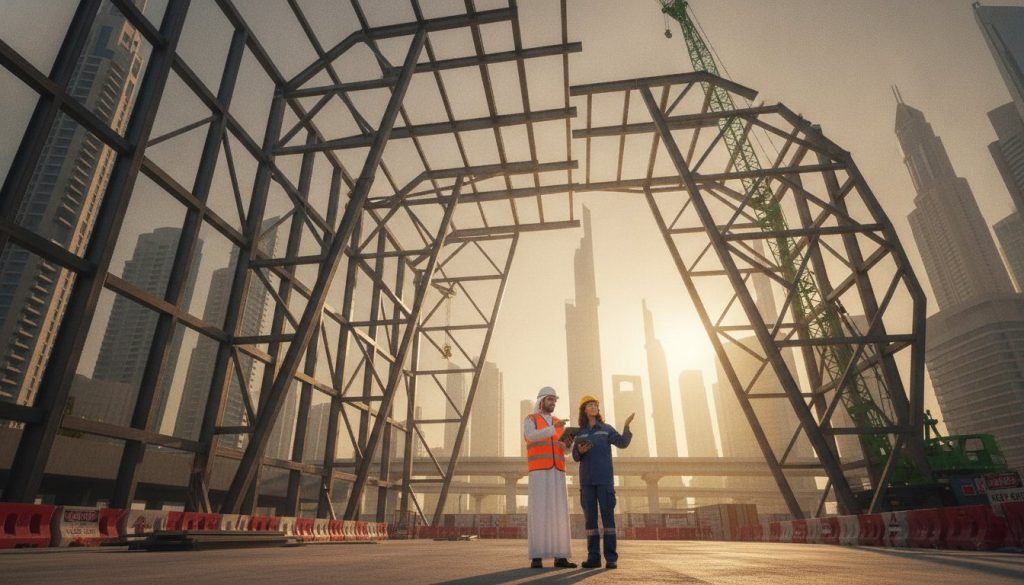
Could a single structural specification be the difference between a project’s long-term endurance and a costly regulatory failure under the updated 2026 national building codes? For engineers and procurement leads across the Emirates, the selection of MS hollow sections is no longer just about basic dimensions; it’s a high-stakes calculation of structural efficiency and legal compliance. You likely understand the frustration of reconciling conflicting EN, ASTM, and IS standards while trying to optimize weight-to-strength ratios for complex industrial frames. It’s a technical bottleneck that can stall even the most ambitious national infrastructure projects when supply consistency wavers.
This article serves as your comprehensive technical reference for 2026, designed to resolve these complexities through precise data and local expertise. We’ll provide the clarity you need to distinguish between SHS, RHS, and CHS geometries and identify why specific grades like S235JR are essential for the UAE’s unique environmental demands. By the end of this guide, you’ll possess a reliable framework for sourcing customized, compliant steel that meets the updated 2026 UAE Fire & Life Safety Code. We’ll explore material standards, geometric properties, and the strategic procurement steps necessary to maintain operational excellence in a tightening regulatory landscape.
Key Takeaways
- Master the technical distinctions between Square, Rectangular, and Circular geometries to select the most efficient profile for specific load-bearing requirements.
- Discover how the superior strength-to-weight ratio of MS hollow sections allows for significant material savings in large-scale infrastructure projects.
- Gain clarity on international steel grades, such as S235JR and S355JR, to guarantee compliance with the updated 2026 UAE Fire and Life Safety Code.
- Evaluate the functional advantages of utilizing hollow profiles within Pre-Engineered Buildings and the demanding environments of the energy sector.
- Establish a strategic procurement process that leverages local stock availability and specialized customization services to ensure on-time project delivery.
Understanding MS Hollow Sections: Definitions and Primary Geometries
MS hollow sections are structural profiles characterized by a hollow tubular cross-section, engineered to provide maximum strength with minimal material mass. In technical engineering contexts, these are formally recognized as a Hollow Structural Section (HSS), a category that encompasses various geometric shapes used in both civil and industrial construction. The mild steel utilized in their manufacture features a low carbon content, generally under 0.25%. This specific metallurgical profile is essential for UAE’s heavy industry because it ensures superior weldability and ductility. It’s these properties that allow engineers to create rigid frameworks that can withstand the dynamic loads of industrial facilities while remaining easy to modify or repair on the project site.
The production of these sections involves a rigorous cold-forming process where steel strips are rolled and welded into precise shapes. This method yields a product with consistent wall thickness and high dimensional accuracy, which is vital for maintaining structural integrity across complex assemblies. Because cold-formed steel doesn’t undergo the high-heat stress of hot-rolling, it retains a superior surface finish and tighter tolerances. This precision is a core requirement for the specialized structural components used in the region’s energy and infrastructure sectors, ensuring that every piece fits perfectly within a pre-engineered system.
Square Hollow Sections (SHS) vs. Rectangular Hollow Sections (RHS)
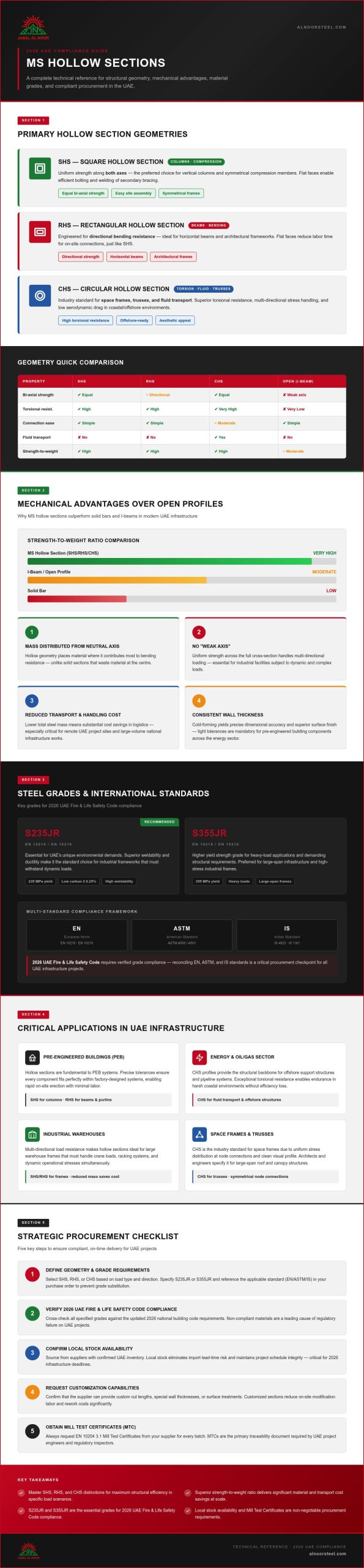
SHS and RHS represent the primary geometries for structural frames where flat surfaces are needed for efficient connection. SHS provides uniform strength along both axes, making it the preferred choice for vertical columns and symmetrical compression members. RHS is designed for applications where bending resistance is required in a specific direction, such as horizontal beams or architectural frameworks. The flat faces of both profiles simplify the bolting and welding of secondary bracing, reducing the labor time required for on-site assembly. You can source MS hollow sections through the JABAL AL NOOR Steel shop, where we maintain a diverse inventory of long products suited for national infrastructure demands.
Circular Hollow Sections (CHS): The Hydraulic and Aesthetic Choice
CHS is distinguished by its lack of flat surfaces, offering unique mechanical advantages in specific environments. Circular profiles provide exceptional performance in fluid transport and applications where aerodynamic drag must be minimized, such as in high-wind coastal zones. Beyond functional utility, architects often specify CHS for modern steelwork because of its clean visual profile and symmetry. It remains the industry standard for space frames and truss systems due to its high torsional resistance and ability to handle multi-directional stresses effectively. This geometry is particularly effective in the oil and gas sector for support structures that must endure harsh offshore conditions without sacrificing structural efficiency. For fluid conveyance applications within these same industrial environments, understanding the capabilities of ERW steel pipe suppliers UAE projects rely on can help engineers select the most compliant and performance-verified tubular products.
Mechanical Advantages: Why MS Hollow Sections Outperform Open Profiles
The engineering superiority of MS hollow sections stems from their geometric efficiency, which allows for a significantly higher strength-to-weight ratio than solid bars or traditional open profiles like I-beams. In the context of the UAE’s ambitious infrastructure goals for 2026, this efficiency is not merely a technical preference but a logistical necessity. By utilizing hollow profiles, engineers can reduce the total mass of steel required for a structure without compromising its load-bearing capacity. This reduction in material weight leads to substantial cost savings in transport and handling, especially when moving large volumes of steel to remote project sites across the Emirates.
Hollow profiles excel in handling multi-directional loading because their mass is distributed further from the neutral axis. Unlike open sections that possess a distinct “weak” axis, these components maintain uniform strength across their entire cross-section. This characteristic is essential for maintaining compliance with the stringent requirements outlined in the Hollow Section Steel Suppliers in UAE: A Comprehensive Engineering Guide. When structural integrity is non-negotiable, selecting a profile that offers predictable performance under various stress patterns is the most reliable approach for long-term stability.
Torsional Rigidity and Bending Resistance
Closed profiles provide exceptional torsional rigidity, often offering up to 200 times more resistance to twisting forces than comparable open sections. This makes them the preferred choice for structures exposed to high wind loads or seismic torque, common considerations under the updated 2026 Dubai building regulations. By adhering to ASTM specifications for HSS, engineers can accurately calculate the radius of gyration to optimize buckling resistance. This precision ensures that even slender columns remain stable under heavy axial loads, providing a secure foundation for industrial pipe racks and skyscraper frameworks.
Surface Area Efficiency and Maintenance
One of the most practical advantages of MS hollow sections is their reduced surface area, which is typically up to 40% less than that of an equivalent I-beam. This reduction directly translates to lower operational costs for essential surface treatments such as shot blasting, painting, and galvanization. Because these sections lack the “pockets” and sharp internal corners found in open profiles, the risk of localized corrosion is significantly minimized. This streamlined geometry is particularly beneficial in the UAE’s humid coastal environments where salt-laden air can quickly degrade exposed steel. If you’re planning a project that requires these durable components, you can view our current inventory of structural profiles to find the exact specifications for your needs.
Material Grades and International Standards for UAE Projects
The procurement of MS hollow sections in the United Arab Emirates is governed by a rigorous set of international benchmarks, with European (EN) and American (ASTM) standards being the most prevalent. Under the current Dubai Law No. (3) of 2026, building quality and safety are prioritized through stringent material certification. EN 10025 remains the dominant framework for structural steel in the region, providing a clear hierarchy for load-bearing performance. For engineers, understanding these standards isn’t just a matter of technical accuracy; it’s essential for ensuring that every component within a high-stakes infrastructure project meets the mandatory Quality and Safety Certificate requirements.
Material traceability remains a non-negotiable requirement for national infrastructure projects. Every batch of steel must be accompanied by a Mill Test Certificate (MTC) to verify chemical composition and mechanical properties. This documentation ensures that the steel delivered to your site in Dubai or Abu Dhabi matches the engineering specifications exactly. Without a valid MTC, contractors risk non-compliance with the 2026 Fire & Life Safety Code, which mandates detailed documentation and digital compliance monitoring for all structural elements.
Deciphering S235JR vs. S355JR Material Grades
The ‘S’ in grades like S235JR and S355JR signifies structural steel, followed by a numerical value representing the minimum yield strength in Megapascals (MPa). S235JR is widely utilized as a cost-effective standard for general construction, including Pre-Engineered Buildings (PEB) and light architectural frames. In contrast, S355JR offers significantly higher yield strength, making it the preferred choice for heavy-duty industrial frameworks and high-rise supports. The ‘JR’ suffix indicates that the material has undergone longitudinal Charpy V-notch impact testing at 27 Joules at room temperature (+20°C). Selecting the correct impact rating is vital for ensuring the longevity of a structure under the thermal stresses common in the UAE climate.
International Compliance: EN, ASTM, and JIS Standards
While EN standards are common, American influence through ASTM A36 and ASTM A500/A500M-23 is significant, particularly in projects led by international consultants. For precise engineering, referencing the Steel Tube Institute HSS Design Manuals provides a robust foundation for comparing these disparate systems. Contractors must ensure dimensional tolerances align with EN 10219 for cold-formed sections to avoid assembly issues on-site. To assist in procurement, consider the following cross-reference for major international standards:
- EN 10025: S235JR corresponds approximately to ASTM A36 and IS 2062 E250.
- EN 10025: S355JR corresponds approximately to ASTM A572 Grade 50 and JIS SM490.
- ASTM A500: Specifically covers cold-formed welded and seamless carbon steel structural tubing in rounds and shapes.
Ensuring compliance with these standards protects the long-term value of the asset. For verified material that meets these rigorous benchmarks, you can explore our full range of grades at the JABAL AL NOOR Steel shop.
Critical Applications in Modern Infrastructure and Engineering
The deployment of MS hollow sections across the UAE’s industrial landscape is a testament to their versatility and structural reliability. In 2026, as national projects scale in complexity, these sections have become indispensable for Pre-Engineered Buildings (PEB) and large-scale energy infrastructure. Their ability to provide high rigidity in a lightweight profile makes them the preferred choice for oil and gas support structures, where pipe racks must endure significant dead loads and environmental stress. These components ensure that the heavy-duty requirements of the energy sector are met with precision and long-term durability.
Beyond industrial sites, these profiles define the skeletal structures of the Emirates’ modern landmarks. Stadium roof trusses, pedestrian walkways, and bridge frameworks rely on the predictable mechanical behavior of hollow sections to achieve long spans and complex geometries. These applications require materials that can withstand both static and dynamic forces while maintaining a high safety factor. For a deeper look at sourcing these materials for major works, refer to our Structural Steel Supplier UAE: 2026 Procurement Guide.
Industrial Warehousing and Frameworks
Industrial warehousing demands efficiency in both cost and space. By utilizing RHS and SHS columns, engineers can optimize span lengths, creating vast, unobstructed floor areas essential for logistics hubs in Jebel Ali or Khalifa Port. These MS hollow sections are frequently integrated with MS channels and angles to form secondary bracing systems, ensuring the entire framework remains stable under dynamic loads. The standardized nature of these profiles facilitates modular construction, allowing for faster assembly times and reduced on-site labor costs. This methodical approach to building allows for rapid expansion of industrial capacity across the region.
Architectural and Aesthetic Structural Elements
Modern architecture in the UAE increasingly celebrates the structural skeleton of a building. Exposed structural steelwork has moved from a functional necessity to a design centerpiece. Architects favor the clean, sharp lines of square and rectangular profiles for minimalist facades and high-end commercial interiors. Conversely, the smooth, aerodynamic profile of CHS is frequently specified for curved canopies and intricate entrance designs in high-end commercial developments. This synergy between structural integrity and visual appeal allows for the creation of iconic structures that don’t sacrifice safety for style. To secure the specific profiles required for your next architectural project, browse our full inventory of hollow sections to find the perfect fit for your design requirements.
Strategic Sourcing: Procurement and Customization of MS Hollow Sections
The strategic procurement of MS hollow sections requires a shift from simple commodity purchasing to a partnership with a technically proficient supplier. In the high-stakes environment of UAE infrastructure, the availability of comprehensive stock for national projects is the primary safeguard against costly timeline overruns. Procurement leads must evaluate a supplier’s logistical reach and their ability to maintain consistent material grades across diverse project locations, from the industrial zones of Abu Dhabi to the urban developments of Dubai. A reliable partner doesn’t just deliver steel; they ensure that every component aligns with the rigorous quality benchmarks required for a 2026 Quality and Safety Certificate.
Moving beyond simple distribution, industrial processing has become a vital component of the supply chain. Value-added services such as in-house customization allow contractors to receive materials that are ready for immediate installation, bypassing the need for extensive on-site modifications. This methodical approach to sourcing ensures that the structural integrity of the project is maintained while optimizing the overall labor budget. To see how these components can be integrated into your next project, you can explore our full inventory of MS Hollow Sections and Long Products.
Cut-to-Size Services and Surface Treatments
Precision cut-to-size customization is essential for reducing on-site waste and ensuring that complex architectural frames fit together with absolute accuracy. By utilizing factory-controlled cutting, engineers can maintain tighter tolerances than what is typically achievable in the field. Furthermore, protecting MS hollow sections from the UAE’s harsh, salt-laden climate requires professional surface treatments. We provide shot blasting and priming services that offer a superior foundation for corrosion resistance compared to on-site painting. These factory-applied treatments ensure that the protective coating is uniform and adheres perfectly to the steel surface, which is critical for the long-term endurance of exposed structures in high-humidity environments.
Managing National Supply for Large-Scale Contracts
Sourcing bulk steel for multi-phase infrastructure projects demands a stockist with deep inventory reserves and a transparent supply chain. It’s vital to work with established entities that understand the nuances of UAE regulatory requirements, including the updated 2026 Fire and Life Safety Code. Consistent material grades are paramount; receiving S355JR from one batch and a different specification in the next can compromise the engineering calculations of the entire structure. By partnering with a seasoned veteran of the industry, contractors can secure the volume they need while ensuring every ton of steel is accompanied by the necessary Mill Test Certificates (MTC) for full traceability and legal compliance across all seven Emirates. For projects that also require piping systems alongside structural steel, understanding the full landscape of industrial steel pipe suppliers in the UAE is equally critical for maintaining a compliant and efficient supply chain.
Strengthening the Future of UAE Infrastructure
Engineering excellence in the Emirates’ industrial sector depends on the precise application of structural components that can withstand both environmental and regulatory pressures. We’ve explored how MS hollow sections provide the torsional rigidity and strength-to-weight ratios necessary for the next generation of warehouses, energy racks, and architectural landmarks. Prioritizing international standards like EN 10025 and ensuring full material traceability protects the long-term viability of your structural assets while meeting the strict requirements of Dubai Law No. (3) of 2026.
Securing these specialized components requires a partner with an established national logistical network and the capacity for industrial-scale processing. We maintain an extensive inventory of international grades alongside in-house shot blasting and precision cut-to-size services to meet your exact project specifications. You can secure high-quality MS hollow sections for your next project from JABAL AL NOOR Steel. Building for 2026 and beyond requires this level of precision and operational excellence. We look forward to supporting your next major development with the reliability your project deserves.
Frequently Asked Questions
What is the difference between MS hollow sections and GI pipes?
The primary difference lies in the surface treatment and intended application. MS hollow sections are structural profiles typically supplied in a black finish for load-bearing frameworks, whereas GI pipes are galvanized with a zinc coating to prevent rust in fluid transport systems. While both are tubular, hollow sections are specifically engineered for structural efficiency and weldability in construction rather than pressure containment. For a detailed comparison of MS, GI, and stainless steel piping options and their compliance with ASTM and API 5L standards, the 2026 procurement guide for industrial steel pipe suppliers in the UAE provides a rigorous technical breakdown.
Can MS hollow sections be used for underground applications?
Hollow sections can be used underground provided they receive rigorous protective treatments. Without a high-performance barrier like a bituminous coating or specialized coal-tar epoxy, the untreated steel will succumb to rapid corrosion from soil moisture and chemicals. Engineers must ensure these treatments comply with the durability standards required for subterranean infrastructure in the UAE’s often saline soil conditions.
Which steel grade is most commonly used for SHS in the UAE?
The most prevalent grades for SHS in the regional market are S235JR and S355JR, adhering to the EN 10025 standard. S235JR serves as the benchmark for general-purpose construction, while S355JR is specified for heavy-duty industrial projects requiring higher yield strength. These grades are favored for their excellent weldability and consistent mechanical properties across large-scale structural frames.
What are the standard lengths available for MS hollow sections?
Standard commercial lengths for these sections are typically 6 meters or 12 meters. These dimensions allow for efficient transport using standard flatbed trailers across the Emirates. For specialized projects, we provide precision cut-to-size services to match specific engineering drawings, which significantly reduces on-site welding and material waste during the assembly phase of a project.
How do I calculate the weight of a rectangular hollow section (RHS)?
To calculate the weight per meter of a rectangular section, use the formula: 0.0157 multiplied by the wall thickness, then multiplied by the sum of the width and height minus twice the wall thickness. For example, an RHS of 100x50mm with a 5mm thickness weighs approximately 10.99 kg/m. This calculation is essential for determining the total dead load of a framework.
Is welding MS hollow sections different from welding solid steel bars?
Welding MS hollow sections requires more precise heat management than welding solid steel bars. Because the walls of hollow profiles are relatively thin, excessive heat can lead to burn-through or structural warping. Welders must utilize specific joint preparations and techniques to ensure full penetration while maintaining the dimensional accuracy of the tubular profile, especially in high-stress industrial applications.
What surface treatments are recommended for steel used in coastal areas?
For steel structures located in coastal areas like Jumeirah or Khalifa Port, hot-dip galvanization is the most recommended treatment. This process creates a metallurgical bond that protects the steel from salt-laden air. Alternatively, a multi-layer coating system involving a zinc-rich primer followed by high-build epoxy and polyurethane topcoats provides the endurance needed to resist extreme humidity and UV exposure. For tubular steel components within these same coastal installations, evaluating the weld seam integrity standards upheld by ERW steel pipe suppliers in the UAE is an equally important step in ensuring long-term corrosion resistance across the full material specification.
Why are hollow sections preferred over I-beams for certain structures?
Hollow sections are preferred over I-beams when a project requires superior torsional rigidity or a high strength-to-weight ratio in multi-directional loading. Their closed-loop geometry provides significantly more resistance to twisting forces than open profiles. Additionally, their clean, symmetrical lines offer an aesthetic advantage for exposed structural steelwork in modern commercial buildings and public infrastructure landmarks.
No Comments yet!