Tag: S235JR

Mild Steel Angle Bars: Engineering & Procurement Guide 2026

Mild Steel Angle Bars: Engineering & Procurement Guide 2026

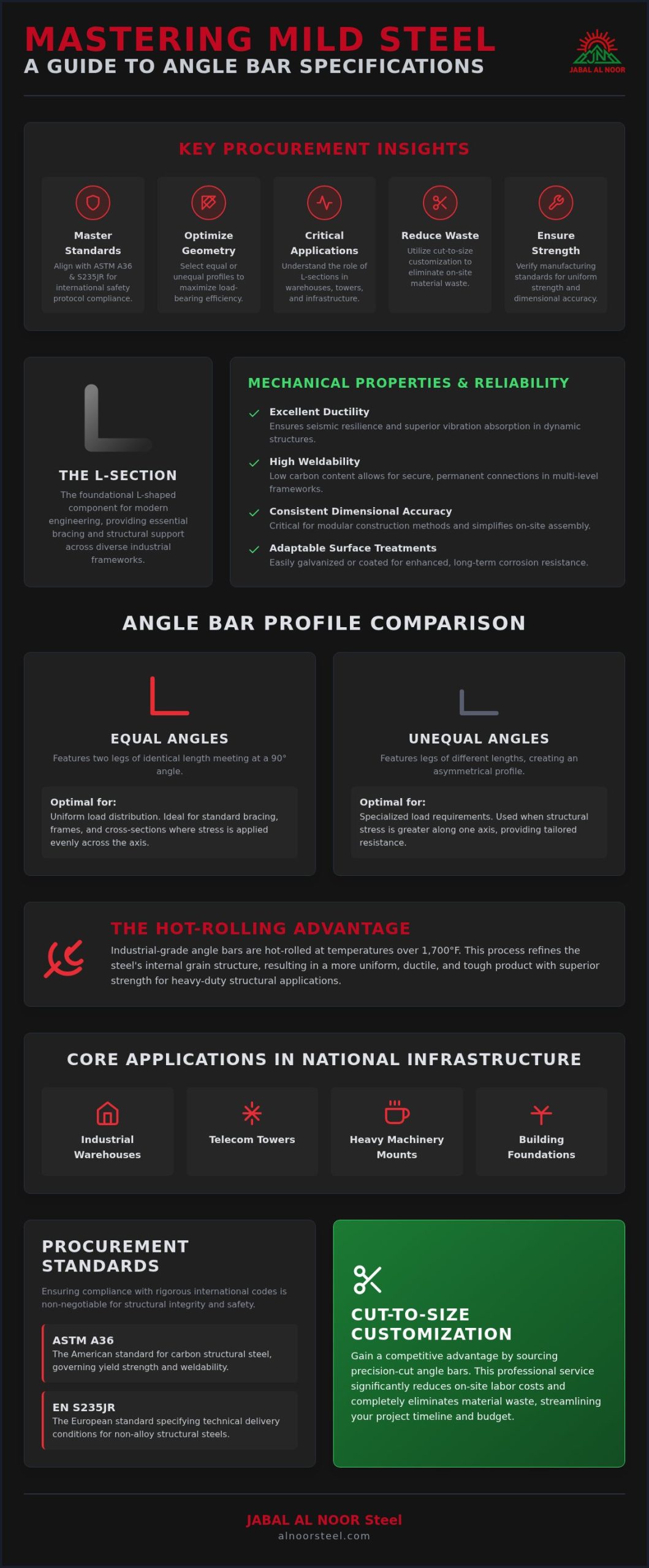
A single oversight in material grade compliance can compromise the structural integrity of an entire national infrastructure project before the first bolt is even tightened. In the high-stakes environment of heavy industry, the reliability of your supply chain is the only safeguard against catastrophic failure and costly project delays. You likely recognize that sourcing mild steel angle bars involves much more than comparing basic dimensions; it requires a rigorous alignment with ASTM or EN standards to ensure long-term durability and safety.

This comprehensive guide provides the technical clarity needed to master specifications and procurement standards for 2026. By following these benchmarks, you can secure high-quality structural steel that meets international codes while utilizing cut-to-size customization to eliminate on-site waste. We’ll examine the critical differences between equal and unequal profiles, the operational advantages of specialized surface treatments, and the logistical frameworks required to maintain precision in large-scale industrial supply. This methodical approach ensures your procurement strategy remains a foundational pillar for engineering excellence.

Key Takeaways

  • Master the technical distinctions between ASTM A36 and S235JR to ensure your structural steel aligns with rigorous international safety and engineering protocols.
  • Learn how to select the optimal geometry between equal and unequal mild steel angle bars to maximize load-bearing efficiency in specialized frameworks.
  • Identify the critical role of high-strength, hot-rolled L-sections in national infrastructure, ranging from industrial warehouses to telecommunication towers.
  • Discover how utilizing professional cut-to-size customization reduces on-site labor and eliminates material waste in large-scale procurement.
  • Gain clarity on the manufacturing standards that ensure uniform strength and dimensional accuracy for long-term structural stability in heavy-duty projects.

Understanding Mild Steel Angle Bars in Modern Engineering

Mild steel angle bars are foundational components in structural engineering, defined by their distinctive L-shaped cross-section with two perpendicular legs. These sections provide essential bracing and support across diverse industrial frameworks, serving as the skeletal structure for everything from heavy machinery mounts to building foundations. Their primary appeal lies in the balance between structural rigidity and manufacturing precision, making them indispensable for large-scale infrastructure projects that demand high endurance.

The versatility of these components stems from their low carbon content, which ensures exceptional weldability and ease of fabrication. For a deeper context on how these materials fit into broader construction standards, Understanding Structural Steel provides a comprehensive overview of the material science involved. Engineers rely on these bars not only for their load-bearing capacity but also for their predictable performance under stress. It’s this reliability that makes them the industry standard for permanent structural connections.

To visualize the manufacturing and appearance of these structural elements, watch this brief overview:

The Manufacturing Process: Hot-Rolled vs. Cold-Formed

Most industrial-grade mild steel angle bars are produced through the hot-rolling process. This involves passing the steel through rollers at temperatures exceeding 1,700°F, which is above the material’s recrystallization point. This high-temperature shaping improves the internal grain structure, resulting in a more uniform and ductile product. While cold-formed sections offer tighter tolerances for smaller applications, hot-rolled angles provide the superior strength and toughness required for heavy-duty structural frames. The cooling process typically leaves a characteristic blue-grey mill scale on the surface, which serves as a protective layer and a base for further surface treatments. You can explore a wide range of these long products at alnoorsteel.com/shop to find sections that meet your specific project requirements.

Mechanical Properties and Structural Reliability

The structural reliability of MS angles is governed by their mechanical properties, specifically tensile strength and yield point. These bars offer a high weight-to-strength ratio, allowing engineers to design rigid frameworks without adding excessive mass. Their geometric 90-degree shape provides high resistance to bending in multiple directions, which is critical for maintaining the integrity of trusses and support columns. Because they don’t easily deform under heavy loads, they contribute significantly to the overall rigidity of a framework. This structural stability is enhanced by several core characteristics:

  • Excellent ductility for seismic resilience and vibration absorption
  • High weldability for secure, permanent connections in multi-level structures
  • Consistent dimensional accuracy for modular construction and easy assembly
  • Adaptability to various surface treatments, such as galvanization, for corrosion resistance

Comparing Equal and Unequal Angle Bar Profiles

Engineering precision requires a deliberate choice between equal and unequal geometries. While both variants share the same foundational L-shaped profile, their behavior under structural stress differs significantly based on leg symmetry. Procurement teams must identify these differences early to ensure that the mild steel angle bars delivered to the site align perfectly with the specific load-bearing requirements of the project blueprints.

Equal Angles: Symmetry for Uniform Load Distribution

Equal angles feature two legs of identical length, meeting at a precise 90-degree angle. This symmetry makes them the industry standard for bracing and cross-sections where the load is distributed evenly across the axis. Engineers prefer equal sections for simple frames because the identical leg dimensions simplify calculations for moment of inertia and radius of gyration. These components are commonly utilized in light-to-medium construction for roof trusses, gate frames, and general support brackets. Because the weight is distributed symmetrically, they provide a predictable and stable performance in standard structural grids.

Unequal Angles: Solutions for Eccentric Loading

In contrast, unequal angles consist of one leg longer than the other. This asymmetrical design is specifically engineered to resist bending or twisting forces in applications where the load is not centered, often referred to as eccentric loading. By utilizing a section with varying leg dimensions, engineers can optimize material usage, placing more steel exactly where the highest stress occurs. This efficiency is particularly valuable in the construction of lintels, specialized machinery supports, and complex ship-building frames where space constraints or specific loading paths dictate the geometry.

Selecting the correct leg ratio is not merely a matter of strength; it’s a strategy for logistical efficiency. For instance, using an unequal angle for a structural lintel can provide the necessary horizontal support without the unnecessary weight of a larger equal-leg section. This precision helps in managing total project mass and reducing material costs over large-scale procurement cycles. Standard identification in engineering blueprints follows a consistent nomenclature that must be strictly adhered to during the ordering process:

  • Equal Sections: L (Leg Width) x (Leg Width) x (Thickness), such as L 100x100x10.
  • Unequal Sections: L (Long Leg) x (Short Leg) x (Thickness), such as L 125x75x8.

Understanding these designations ensures that procurement remains transparent and error-free. To find the exact dimensions required for your next infrastructure project, you can browse our comprehensive range of structural steel. Each section is sourced to meet rigorous dimensional tolerances, providing the stability and endurance your engineering designs demand.

Core Applications Across National Infrastructure Projects

While small-scale retail applications often focus on simple shelving or residential gates, the true utility of mild steel angle bars is realized within the rigorous demands of national infrastructure. These sections serve as the critical connective tissue in heavy-duty engineering, providing the necessary bracing and structural reinforcement for projects that define a nation’s industrial capacity. Their ability to resist both tension and compression makes them the primary choice for engineers designing systems that must endure decades of operational stress and environmental exposure.

Industrial Warehousing and PEB Structures

In the construction of industrial warehouses and pre-engineered buildings (PEB), angle bars provide essential lateral stability. These structures often span vast areas and require robust bracing systems to resist environmental wind loads and seismic forces. By integrating these angles with larger MS Beams, engineers create a comprehensive support network that prevents frame distortion. The angles are typically utilized as “X-bracing” or “K-bracing” along the wall and roof planes, ensuring the building remains rigid even under extreme pressure. This synergy between different long products creates a foundational pillar for modern logistics hubs and manufacturing plants.

Energy and Telecommunication Infrastructure

The energy and telecommunications sectors rely heavily on the geometric efficiency of mild steel angle bars for lattice tower construction. Whether supporting high-tension power lines or housing advanced microwave equipment, these towers must maintain perfect verticality while exposed to high-altitude wind speeds. MS angles are the preferred profile here because their open L-shape prevents the accumulation of water and debris, which simplifies long-term maintenance in remote sites. Compliance with national standards for high-tension environments ensures these structures can support heavy cabling and equipment without risking fatigue or structural collapse. Their ease of assembly allows for rapid deployment across diverse geographical terrains, supporting the steady expansion of national utility networks.

Beyond these primary structures, angle bars are indispensable for industrial safety and mechanical support systems. You’ll find them in the fabrication of:

  • Industrial Staircases and Walkways: Providing the structural frame and nosing for heavy-duty steel gratings in oil and gas refineries.
  • Mechanical Support Brackets: Securing HVAC systems, piping networks, and electrical conduits in large-scale commercial complexes.
  • Safety Guardrails: Offering high-impact resistance along elevated platforms and industrial perimeter fencing.

This wide-ranging utility underscores the importance of sourcing material that meets precise technical proficiency. When procurement teams prioritize high-grade MS angles, they aren’t just buying steel; they’re ensuring the long-term endurance of the nation’s most vital assets.
Mild Steel Angle Bars: Engineering & Procurement Guide 2026

Procurement Standards: ASTM A36 and S235JR Compliance

In the context of large-scale infrastructure, procurement precision starts with material grade compliance. Selecting the correct standard for mild steel angle bars ensures that the structural integrity of the project matches the engineer’s design intent. While several international standards exist, ASTM A36 and S235JR remain the most prevalent benchmarks for structural carbon steel. ASTM A36 is the North American standard, valued for its excellent weldability and balanced mechanical properties. Conversely, S235JR, governed by the European EN 10025 standard, is a general-purpose construction grade with a minimum yield strength of 235 MPa.

Choosing between these grades often depends on the specific project requirements and the regional engineering codes in effect. Material certification is not merely a formality; it’s a critical component of project safety and insurance underwriting. Verification of chemical composition and mechanical testing results protects the asset owner from material fatigue or catastrophic failure. Rigorous documentation ensures that every section used in the framework can withstand the calculated loads and environmental pressures.

Navigating International Steel Grades

Engineers must distinguish between ASTM, EN, and JIS standards to ensure global compatibility. For instance, while ASTM A36 is a standard for carbon steel, the S235JR grade includes a specific “JR” designation indicating longitudinal Charpy V-notch impact strength. Understanding how Structural Steel Quality Standards impact procurement allows teams to select the appropriate grade for specific load-bearing requirements. This technical proficiency reduces confusion during the sourcing phase and ensures that the materials delivered to the site perform as expected under the nation’s unique environmental conditions.

Dimensional Tolerances and Quality Certification

Beyond material grade, dimensional accuracy is paramount for seamless on-site assembly. Quality control involves checking for straightness, leg length, and thickness accuracy against specified tolerances. Every batch of mild steel angle bars must be accompanied by a Mill Test Certificate (MTC). This document serves as the official record of the steel’s origin, verifying its chemical properties and mechanical performance. A comprehensive MTC will detail the following critical parameters:

  • Chemical Composition: Precise levels of carbon, manganese, phosphorus, and sulfur.
  • Mechanical Performance: Verified tensile strength, yield strength, and elongation percentages.
  • Heat Number: Traceability back to the specific furnace batch.

Ensuring compliance with national building codes and safety regulations is impossible without this documentation. Rigorous certification processes protect the supply chain from inconsistent material quality. To secure certified structural materials that meet these exacting benchmarks, you can source your industrial steel inventory here. By prioritizing documented quality, procurement managers maintain the high standards required for national energy and infrastructure projects.

Sourcing Precision-Cut Angle Bars from JABAL AL NOOR Steel

JABAL AL NOOR Steel has served as a foundational pillar for national infrastructure since 2010. We maintain a comprehensive inventory of long products designed to meet the high-volume demands of the construction and energy sectors. Our robust supply chain ensures that premium mild steel angle bars are readily available for complex projects, providing the material consistency required for rigorous engineering benchmarks. This steady availability allows project managers to plan with confidence, knowing their structural requirements are backed by a reliable regional expert.

Value-Added Services: Cut-to-Size and Finishing

Operational efficiency in heavy industry is often achieved by reducing on-site labor and minimizing material waste. Utilizing Cut-to-Size Steel Services allows procurement managers to receive sections that are prepared for immediate structural integration. This level of customization lowers transport costs and removes the logistical burden of managing excess material at the project site. It’s a methodical approach that prioritizes precision over traditional, wasteful fabrication methods.

To combat the corrosive effects of high-humidity environments, we offer industrial surface treatments such as shot blasting and priming. Shot blasting effectively removes mill scale and surface contaminants, providing an ideal profile for protective finishes. Applying an industrial-grade primer immediately after this process ensures that the mild steel angle bars remain protected during transport and on-site storage. This proactive approach to material maintenance is essential for preserving the long-term endurance of structural frameworks in challenging climates.

Streamlining Procurement for National Contracts

Reliable partnerships are the bedrock of successful national infrastructure and energy projects. JABAL AL NOOR Steel supports these large-scale initiatives through methodical logistics and a commitment to technical proficiency. We function as a seasoned veteran of the industry, offering transparent sourcing and a steady supply of structural materials for national contracts. Our logistics network is optimized for delivery to major industrial hubs, ensuring that bulk orders arrive on schedule and in accordance with project milestones.

Engineering and procurement teams can access our online inventory to facilitate real-time sourcing of essential structural sections. This digital platform streamlines the ordering process and ensures that project timelines are maintained without the risk of material shortages. By integrating a vast physical stock with in-house industrial processing, we provide a reliable and professionally curated service for our national collaborators. This commitment to operational excellence ensures that every project we support is built on a foundation of quality and logistical efficiency.

Securing the Future of National Infrastructure

Precision in structural engineering begins with the rigorous selection of material grades and geometric profiles. By mastering the technical distinctions between ASTM and EN standards, procurement teams ensure that every framework meets the highest safety benchmarks for 2026. Integrating value-added services like cut-to-size customization and industrial surface treatments further optimizes project timelines while reducing on-site waste.

JABAL AL NOOR Steel remains a foundational pillar for the industry. Since our establishment in 2010, we’ve focused on providing a consistent supply of premium mild steel angle bars backed by full material certification. Our national supply capacity ensures that even the most complex infrastructure projects receive the technical support and logistical efficiency they require. We prioritize transparency and reliability in every partnership, ensuring your material needs are met with professional expertise.

When you prioritize verified quality and professional processing, you secure the long-term endurance of your engineering assets. We invite you to Request a Quote for Bulk Mild Steel Angle Bars to streamline your next procurement cycle. Your commitment to precision today builds the resilient infrastructure of tomorrow.

Frequently Asked Questions

What is the difference between hot-rolled and cold-rolled mild steel angle bars?

Hot-rolled sections are forged at high temperatures, which creates a more ductile and uniform internal structure suitable for heavy loads. Cold-rolled bars are shaped at room temperature to achieve precise dimensions and a polished surface finish. For industrial-scale projects, hot-rolled mild steel angle bars are the standard choice due to their superior structural toughness. These sections are specifically designed to withstand the compressive stresses found in large-scale frames and infrastructure.

Which steel grade is better for structural construction: ASTM A36 or S235JR?

The choice between ASTM A36 and S235JR depends on the specific engineering code governing your project. ASTM A36 is the North American benchmark for carbon steel, offering a minimum yield strength of 36,000 psi and excellent weldability. S235JR is the European equivalent (EN 10025), providing a minimum yield of 235 MPa. Both grades provide reliable performance, but A36 is often preferred for its slightly higher tensile properties in heavy-duty structural applications.

Can mild steel angle bars be used in marine or highly corrosive environments?

Yes, but mild steel angle bars require specialized protective coatings to endure marine or high-salinity environments. Without protection, the low carbon content of the steel remains vulnerable to rapid oxidation. We recommend using hot-dip galvanization or high-build epoxy primers to create a physical barrier against salt and moisture. These treatments ensure the structural integrity of the steel remains intact even when exposed to the harsh conditions of national coastal sites.

What are the standard lengths for MS angle bars available in the national market?

Standard stock lengths for MS angle bars in the national market are typically 6 meters or 12 meters. These lengths facilitate efficient transport and align with standard architectural modules. However, many projects require unique dimensions to minimize on-site labor and material waste. We provide precision cut-to-size services to deliver sections that match your exact specifications, ensuring that your procurement strategy supports a more streamlined and efficient construction timeline.

How do I calculate the weight of a mild steel angle bar for my project?

To calculate the weight of an angle bar, use the formula: Weight (kg) = [Leg 1 + Leg 2 – Thickness] * Thickness * Length * 0.00785. This calculation uses the standard density of carbon steel (7,850 kg/m³). For instance, an equal angle measuring 75x75x6 mm at a length of 6 meters weighs approximately 41.5 kg. Accurate weight calculations are essential for managing logistics, crane lifting capacities, and the overall load-bearing design of the framework.

What is the primary difference between equal and unequal angle profiles?

The fundamental difference is the symmetry of the legs. Equal angles feature two legs of identical length, which simplifies load-bearing calculations and provides uniform strength along both axes. Unequal angles consist of one leg longer than the other, allowing engineers to place more material exactly where it’s needed to resist bending or twisting. This geometry is particularly useful in lintels or machinery supports where the load is not centered on the section.

Does JABAL AL NOOR Steel provide material certification for all long products?

Yes, JABAL AL NOOR Steel provides comprehensive Mill Test Certificates (MTC) for all long products in our inventory. These documents verify the material’s chemical composition and mechanical properties, ensuring every section meets international standards like ASTM or EN. Our commitment to providing full material certification ensures that procurement teams can satisfy rigorous quality benchmarks and national building codes, maintaining the high safety standards required for heavy industrial projects.

What surface treatments are recommended for MS angle bars used outdoors?

For outdoor use, we recommend a combination of shot blasting and industrial priming or hot-dip galvanization. Shot blasting removes mill scale and creates an ideal surface profile for paint adhesion, which is critical for long-term protection. Galvanization provides a sacrificial zinc layer that prevents rust even if the surface is scratched. These treatments are vital for preserving the endurance of structural steel in the national climate, ensuring the framework remains secure for decades.
S235JR Steel Grade Supplier UAE: The Definitive 2026 Procurement Guide

S235JR Steel Grade Supplier UAE: The Definitive 2026 Procurement Guide

The structural integrity of a large-scale industrial project often rests on the reliability of its foundational materials, yet selecting the wrong S235JR steel grade supplier UAE can lead to costly delays and technical non-compliance. With the UAE’s local steel consumption now exceeding 350,000 metric tons per month, the demand for EN 10025:2019 compliant structural sections has reached an all-time high. You shouldn’t have to navigate the complexities of material sourcing while worrying if your inventory meets rigorous international standards.

It’s understandable that procurement teams feel the strain of fluctuating 10% import duties and the need for precision customization in a fast-moving market. This 2026 guide promises to provide the technical mastery and procurement strategies necessary to secure high-quality S235JR structural steel for the UAE industrial sector. We’ll examine how to verify technical compliance, identify a dependable national supply partner, and evaluate the cost-benefit of S235JR against higher-strength alternatives. By understanding the impact of new trade agreements and local regulatory shifts, you can ensure your projects remain both structurally sound and economically viable through every phase of construction.

Key Takeaways

  • Gain a precise understanding of S235JR nomenclature and technical specifications, including its minimum yield strength of 235 N/mm² and specific impact test properties.
  • Navigate the critical differences between S235JR and alternatives like ASTM A36 or S355JR to select the most efficient grade for your project’s load-bearing requirements.
  • Streamline your supply chain by identifying a reliable S235JR steel grade supplier UAE that provides national coverage and maintains extensive stock of beams, channels, and angles.
  • Learn how to leverage value-added services, such as cut-to-size customization and specialized surface treatments, to reduce on-site waste and accelerate installation timelines.
  • Verify technical compliance with EN 10025-2 standards by mastering the chemical composition benchmarks required for high-stakes infrastructure and industrial projects.

Understanding S235JR Steel Grade in the UAE Industrial Context

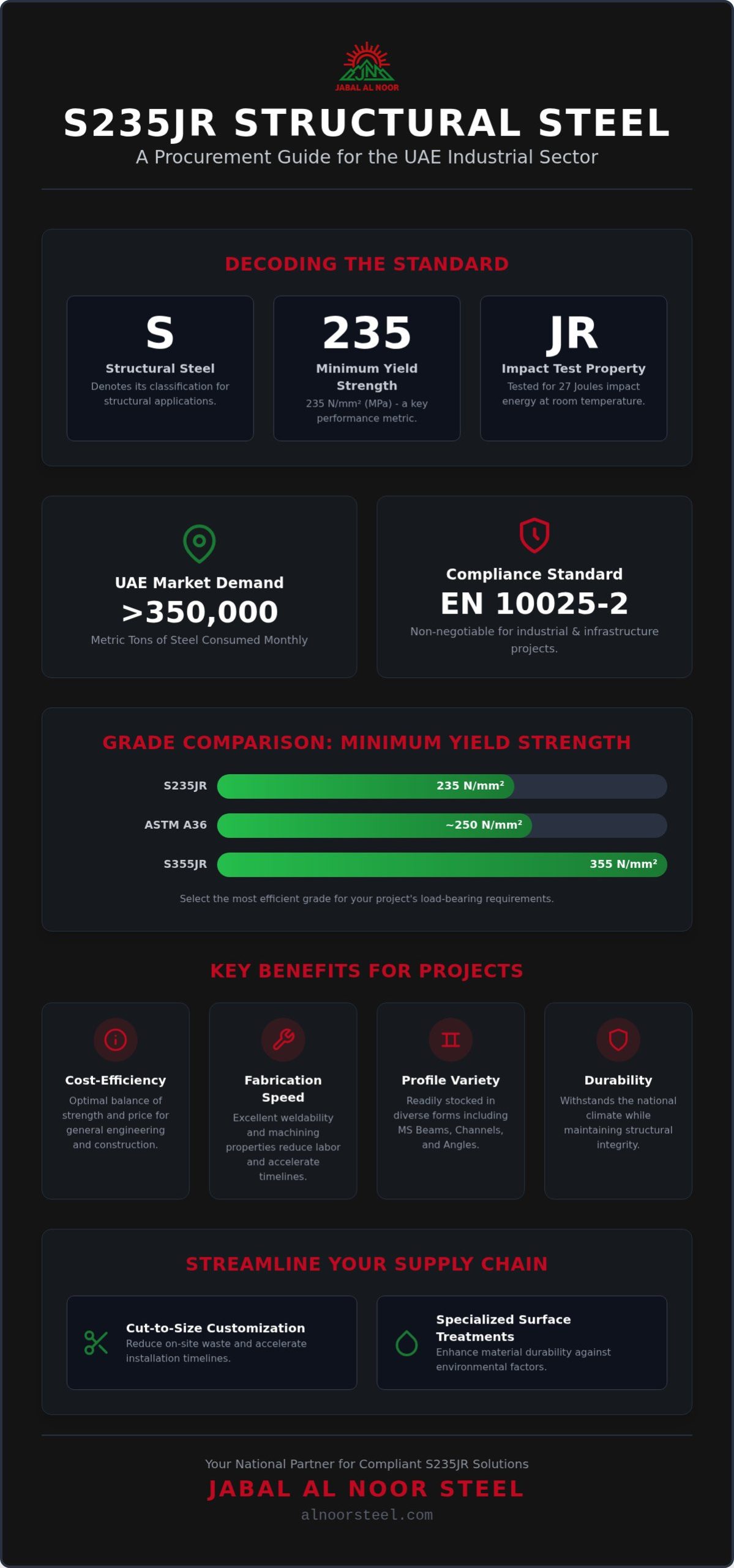
S235JR represents the foundational standard for non-alloy structural steel throughout the United Arab Emirates. It’s defined by a minimum yield strength of 235 N/mm², providing a robust yet flexible solution for general construction. The naming convention follows strict EN 10025 Standards Compliance protocols. In this system, “S” denotes its classification as structural steel, while “235” indicates the yield strength in megapascals. The “JR” suffix confirms that the material has undergone longitudinal Charpy V-notch impact testing at 27 Joules at room temperature. For project managers, identifying a consistent S235JR steel grade supplier UAE is essential to maintaining these technical benchmarks across complex procurement cycles.

While higher grades exist for specialized applications, S235JR remains the primary choice for national developments because it offers the most efficient intersection of mechanical performance and economic value. It isn’t just a material choice; it’s a strategic decision for developers who require reliability without the unnecessary expense of over-engineered specifications. This grade’s chemistry is optimized for versatility, making it the primary choice for the structural frameworks that define the national industrial sector.

The Role of S235JR in National Infrastructure

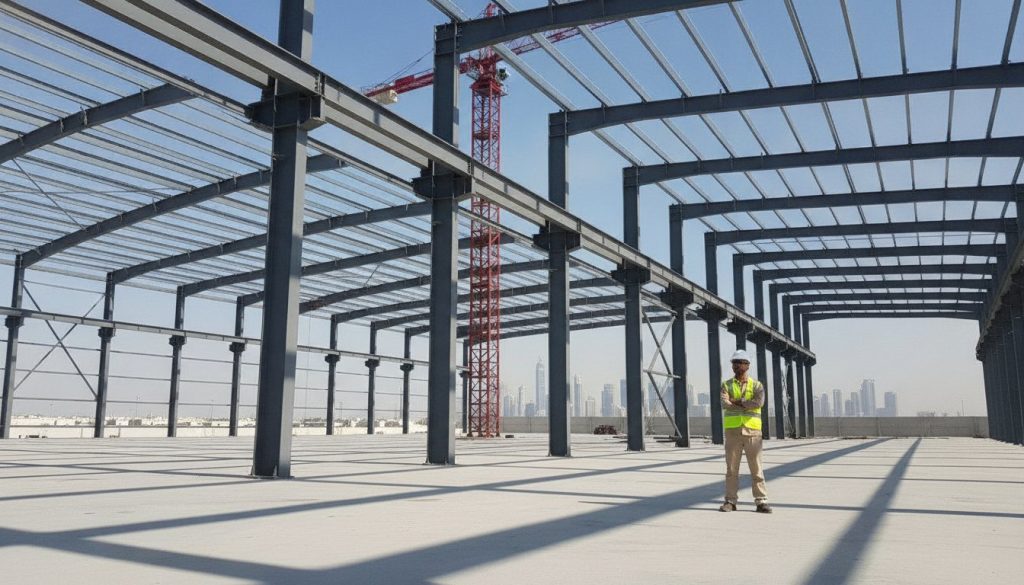
In the UAE’s industrial landscape, S235JR serves as the primary skeleton for frameworks that don’t require the extreme load-bearing capacity of high-rise skyscrapers. It’s the standard material for constructing industrial warehouses, equipment sheds, and secondary support structures. Because it’s readily available in various profiles, it ensures project continuity even when supply chains face pressure. Reliable access to structural steel inventory allows engineers to plan developments with confidence in material uniformity. Consistent sourcing from JABAL AL NOOR Steel, an authoritative S235JR steel grade supplier UAE, prevents the technical non-compliance issues that often plague projects using unverified imports.

Key Benefits for Contractors and Engineers

The widespread adoption of this grade stems from its exceptional weldability. Contractors prefer S235JR because its low carbon content means it doesn’t require specialized pre-heating or post-weld heat treatments in most standard applications. This characteristic significantly reduces fabrication costs and accelerates assembly on national construction sites. Its high ductility allows for versatile forming, enabling engineers to utilize it for custom architectural features without risking structural failure.

  • Cost-Efficiency: It provides the most economical balance between strength and price for general engineering.
  • Fabrication Speed: Excellent machining properties and ease of welding reduce labor hours and equipment wear.
  • Profile Variety: The grade is stocked in diverse forms, including MS Beams, Channels, and Angles, to suit varied design requirements.
  • Durability: When paired with appropriate surface treatments, it withstands the national climate while maintaining its structural integrity.

By choosing S235JR, engineering teams ensure they’re using a material that’s both easy to work with and fully compliant with international safety standards. It’s a dependable partner for the heavy-duty requirements of the nation’s energy and logistics sectors.

Technical Specifications and EN 10025 Standards Compliance

Compliance with international benchmarks is the non-negotiable standard for heavy industry. S235JR belongs to a family of non-alloy structural steels governed by the EN 10025-2 standards. This specific part of the regulation details the technical delivery conditions for hot-rolled products. For a project to pass municipal or industrial inspections in the UAE, the material must strictly adhere to these mechanical and chemical limits. Working with an experienced S235JR steel grade supplier UAE ensures that these technical nuances aren’t overlooked during the procurement phase.

Chemical and Mechanical Breakdown

The chemical profile of S235JR is engineered to prioritize weldability and ductility. It maintains a low carbon content, typically capped at 0.17% to 0.20% depending on product thickness, which prevents the brittleness often associated with higher-carbon alloys. Manganese levels are carefully balanced to improve surface hardness and wear resistance, while Phosphorus and Sulfur are strictly limited to 0.035% to ensure internal purity and prevent cracking during fabrication.

Mechanical properties are defined by a tensile strength that falls between 360 and 510 MPa. Elongation percentages are equally vital, ensuring the steel can deform under stress without fracture. S235JR yield strength acts as the critical threshold for structural deformation, set at a minimum of 235 MPa. Finally, the “JR” designation mandates an impact strength of 27 Joules at 20 degrees Celsius. This baseline of toughness is essential for the general engineering applications found across the country’s diverse industrial zones.

Certification and Quality Assurance

Technical specifications are only as valid as the documentation supporting them. Sourcing from a reputable S235JR steel grade supplier UAE means receiving a comprehensive Mill Test Certificate (MTC) for every batch delivered to the site. These documents provide the verifiable proof required for local project approval, detailing the exact chemical heat analysis and mechanical test results for that specific production run.

It’s vital to partner with entities that respect structural steel quality standards UAE. JABAL AL NOOR Steel maintains rigorous traceability protocols, ensuring that every beam or channel can be tracked back to its source mill. This transparency builds the trust necessary for long-term partnerships in the energy, marine, and infrastructure sectors. If you’re ready to review compliant profiles for your next project, you can explore our full range of certified structural inventory.

S235JR vs. A36 and S355: Selecting the Right Grade

Selecting the appropriate material requires a deep understanding of how different global standards interact within the regional market. In many projects, engineers must navigate the transition between European EN specifications and American ASTM standards. While S235JR is the mainstay for European-designed infrastructure, ASTM A36 is its frequent American counterpart. Choosing the wrong grade can lead to structural mismatches or procurement delays, making it vital to work with an expert S235JR steel grade supplier UAE that understands these cross-standard nuances.

Grade Comparison Framework

The primary differentiator between these grades is their yield strength. S235JR provides a minimum yield of 235 MPa, whereas ASTM A36 offers roughly 250 MPa. In contrast, S355JR is a high-yield alternative providing 355 MPa. While S355JR allows for lighter structures due to its higher strength-to-weight ratio, it comes at a premium price. For secondary structures, industrial sheds, and non-load-bearing frameworks, S235JR remains the most cost-effective solution. It doesn’t over-engineer the project, keeping budgets manageable while meeting safety codes.

Machinability and weldability also vary between these classifications. S235JR’s lower carbon content makes it easier to weld and cut than higher-yield grades, which often require more precise heat controls to avoid cracking. When selecting specific profiles, it’s essential to consider how the grade interacts with the shape. For instance, you should reference our HEB vs IPE Beams comparison to see how load-bearing capacity changes based on both the profile geometry and the steel grade used.

Environmental Resilience in the UAE

A common concern is whether S235JR can withstand the UAE’s extreme environmental conditions. High ambient temperatures lead to significant thermal expansion and contraction cycles. S235JR’s inherent ductility is a major advantage here, as it allows the steel to accommodate these thermal shifts without developing the brittle fractures that can occur in less flexible alloys. It’s a reliable choice for the region’s climate when specified correctly for the intended application.

Corrosion is the secondary challenge in coastal industrial zones. S235JR sections require robust surface treatments, such as hot-dip galvanizing or specialized industrial coatings, to ensure long-term durability. A knowledgeable S235JR steel grade supplier UAE will provide guidance on the necessary thickness and protective measures required to prevent atmospheric degradation. By focusing on these protective strategies, you can utilize the economic benefits of S235JR without compromising the lifespan of your industrial assets. You can view our available inventory of treated structural sections to find the right fit for your site conditions.

S235JR Steel Grade Supplier UAE: The Definitive 2026 Procurement Guide

Strategic Procurement: Stocking, Logistics, and Customization

Procurement efficiency in 2026 hinges on more than just material availability. It requires a partner capable of integrating national logistics with precise technical processing. Partnering with a dedicated S235JR steel grade supplier UAE allows contractors to bypass the inefficiencies of raw material handling and focus on assembly. A national stockist with a deep inventory of beams, channels, and angles ensures that project timelines aren’t vulnerable to international shipping disruptions or sudden market fluctuations. This localized availability is the bedrock of industrial stability.

Value-Added Processing Services

Moving beyond standard lengths is essential for modern engineering. S235JR profiles can be tailored to exact specifications before they ever reach the construction site. Utilizing cut to size steel services UAE significantly reduces on-site scrap and labor costs. This precision ensures that every beam fits the engineering drawings perfectly, which accelerates the installation phase and minimizes the need for on-site fabrication adjustments. It’s a method that prioritizes both speed and material economy.

Surface treatments like shot blasting and factory priming are equally critical for long-term endurance. These processes remove mill scale and apply a protective layer that prevents early-stage corrosion during transit and storage. This is particularly important for S235JR sections destined for coastal or high-humidity zones. Factory-applied primers provide a clean, ready-to-paint surface that meets the rigorous quality benchmarks of the UAE industrial sector.

Supply Chain Reliability

Reliability is the foundational pillar of large-scale infrastructure. A supplier’s ability to manage high-volume contracts determines the success of the entire build. Lead times are the most sensitive variable in the UAE’s fast-paced construction market. Delays of even a few days can cascade into weeks of lost productivity and mounting overhead costs. You don’t want your project stalled because of logistical bottlenecks.

Aligning with a veteran structural steel supplier UAE provides a necessary buffer against these risks. National logistics networks ensure that bulk deliveries are coordinated across the country, maintaining a steady flow of material from the warehouse to the foundation. This logistical proficiency is what separates a mere vendor from a long-term industrial partner. To ensure your project stays on schedule, you can view our full range of S235JR profiles and sections today.

JABAL AL NOOR Steel: Your National Partner for S235JR Solutions

JABAL AL NOOR Steel stands as a foundational pillar in the UAE industrial landscape, providing the structural backbone for the nation’s most ambitious projects. As a premier S235JR steel grade supplier UAE, we prioritize the stability and precision that heavy industry demands. We don’t just move volume; we provide the technical assurance that every beam and channel meets the rigorous EN 10025 benchmarks. Our role is to act as a steady, dependable partner for entities that value long-term value and ethical conduct over flashy innovation.

Our inventory is curated to support a broad spectrum of engineering requirements. We maintain a comprehensive stock of S235JR products, including MS Beams, Channels, Angles, Bars, and Hollow Sections. This diversity allows us to serve as a single-source partner for complex procurement needs, ensuring that material uniformity is maintained across every phase of a contract. By upholding these high standards, we reassure our clients of our capability and regional expertise in the structural sector.

Our S235JR Inventory and Capabilities

Efficiency in the 2026 market requires immediate access to materials. We’ve optimized our operations for national distribution, ensuring that our S235JR sections are available for rapid dispatch across the country. Our technical specialists provide essential support for engineers who need to evaluate the mechanical trade-offs between S235JR and S355JR for specific load-bearing applications. You can explore our full range in the Al Noor Steel Shop to see the specific dimensions and profiles currently in stock.

Building Long-Term Industrial Partnerships

Trust is earned through consistency and transparent communication. Our history is rooted in supporting large-scale infrastructure and energy projects where the stakes are high and precision is mandatory. We emphasize transparency in every transaction, from providing verified Mill Test Certificates to offering clear logistical timelines. As a seasoned S235JR steel grade supplier UAE, we understand that our reliability is the key to your operational excellence. We aren’t just a vendor; we’re a knowledgeable guide through the high-stakes requirements of heavy industry.

Initiating a procurement request is a straightforward process designed for industrial professionals. Whether you require bulk standard lengths or specialized cut-to-size customization, our technical sales team is ready to provide expert advice tailored to your engineering drawings. We invite you to contact us to discuss your 2026 project requirements and experience the precision that a dedicated national partner brings to the table. Our focus remains on providing the endurance and technical proficiency your projects deserve.

Securing Structural Excellence for Future Infrastructure

Mastering the procurement of S235JR structural steel is a strategic necessity for maintaining project timelines and technical integrity in the UAE’s evolving industrial landscape. We’ve explored the importance of adhering to EN 10025 standards and the economic advantages of selecting the right material grade for specific load-bearing requirements. By prioritizing logistical efficiency and value-added processing, you ensure that your frameworks are both cost-effective and built to endure the regional climate. Partnering with a reliable S235JR steel grade supplier UAE provides the foundation of trust needed for large-scale energy and construction success.

Jabal Al Noor Steel remains committed to supporting your vision with an EN 10025 Certified Inventory and Full UAE National Delivery. Our specialized Custom Cut-to-Size and Surface Treatments reduce on-site waste and accelerate installation, providing the precision your engineering drawings demand. Take the next step in your procurement strategy today. Request a Quote for S235JR Structural Steel and secure a steady partner for your national infrastructure requirements. We look forward to building a resilient future together.

Frequently Asked Questions

What is the equivalent of S235JR in the ASTM standard?

ASTM A36 is the recognized American equivalent to the European S235JR grade. While S235JR specifies a minimum yield strength of 235 MPa, ASTM A36 requires a slightly higher threshold of approximately 250 MPa. Both materials offer excellent weldability and formability for general construction. However, engineers must verify that the specific chemical composition and mechanical properties align with the project’s technical delivery conditions before substituting one for the other in structural drawings.

Can S235JR steel be galvanized for UAE marine environments?

Hot-dip galvanizing is highly recommended for S235JR steel utilized in UAE marine environments. This process involves coating the steel in molten zinc to create a robust barrier against the corrosive effects of salt air and high humidity. It provides essential cathodic protection, ensuring the structural integrity of beams and channels remains intact for decades. Selecting an S235JR steel grade supplier UAE that offers these specialized surface treatments is vital for coastal industrial assets.

What are the main differences between S235JR and S235J0?

The primary distinction between S235JR and S235J0 relates to their impact testing temperatures. S235JR is tested for toughness at 20 degrees Celsius, which is standard room temperature. S235J0 undergoes testing at 0 degrees Celsius to ensure durability in colder climates. Because the UAE maintains a consistently warm environment, S235JR is the most practical and widely used specification for local industrial warehouses and non-refrigerated structural frameworks, as it meets all regional safety requirements.

Is S235JR suitable for welding in heavy structural applications?

S235JR is exceptionally suitable for welding due to its low carbon equivalent value. This characteristic allows for easy fabrication without the need for pre-heating or complex post-weld heat treatments in most standard applications. It’s the reliable choice for industrial frameworks, support sections, and general engineering. While it’s ideal for many heavy structural uses, engineers often specify higher grades like S355 for sections subjected to extreme load-bearing stress or high-rise requirements where weight reduction is a priority.

What thicknesses of S235JR plates are typically stocked in the UAE?

Local inventory for S235JR plates typically covers a wide range from 3mm to 100mm in thickness. Structural projects frequently utilize 6mm, 10mm, and 12mm plates for gussets, base plates, and stiffeners. A reputable S235JR steel grade supplier UAE will maintain these dimensions in large volumes to support national infrastructure projects. It’s always advisable to verify current stock levels for specific profile dimensions if your engineering drawings require non-standard sizes or exceptionally thick sections for heavy foundations.

How does yield strength affect the design of S235JR beams?

Yield strength is the critical threshold that defines when the steel will permanently deform under load. For S235JR, this minimum value is 235 MPa. Designers use this figure to calculate the maximum safe stress a beam can withstand before failure. It ensures that the industrial framework remains stable and secure throughout its intended lifespan. Understanding this mechanical limit is essential for selecting the correct profile size to support specific equipment or roof loads without risking structural integrity.

Does S235JR comply with UAE building codes for industrial warehouses?

S235JR fully complies with UAE building codes when it is accompanied by an EN 10025 Mill Test Certificate. It serves as the primary material for the skeletons of industrial warehouses, equipment sheds, and secondary support structures across the country. Local authorities and municipal inspectors recognize this grade as a safe, reliable standard for general construction. You must ensure your supplier provides the necessary documentation to prove compliance and material traceability during the project approval phase.

What surface treatments are recommended for S235JR stored in high-humidity areas?

Shot blasting followed by an immediate application of industrial primer is the most effective treatment for S235JR stored in high-humidity zones. This process removes mill scale and creates a clean surface that bonds well with protective coatings. For sections exposed to the elements for extended periods, hot-dip galvanizing or specialized epoxy paints are necessary to prevent rust. These treatments are essential for maintaining the material’s structural integrity and aesthetic quality before it is finally installed on-site.

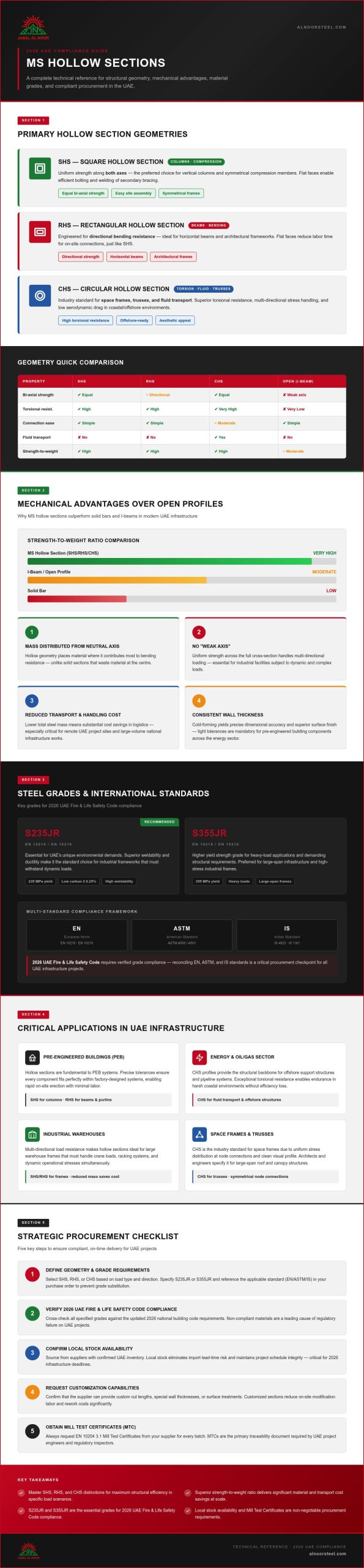
MS Hollow Sections: The Engineering Reference for UAE Infrastructure (2026)

MS Hollow Sections: The Engineering Reference for UAE Infrastructure (2026)

Could a single structural specification be the difference between a project’s long-term endurance and a costly regulatory failure under the updated 2026 national building codes? For engineers and procurement leads across the Emirates, the selection of MS hollow sections is no longer just about basic dimensions; it’s a high-stakes calculation of structural efficiency and legal compliance. You likely understand the frustration of reconciling conflicting EN, ASTM, and IS standards while trying to optimize weight-to-strength ratios for complex industrial frames. It’s a technical bottleneck that can stall even the most ambitious national infrastructure projects when supply consistency wavers.

This article serves as your comprehensive technical reference for 2026, designed to resolve these complexities through precise data and local expertise. We’ll provide the clarity you need to distinguish between SHS, RHS, and CHS geometries and identify why specific grades like S235JR are essential for the UAE’s unique environmental demands. By the end of this guide, you’ll possess a reliable framework for sourcing customized, compliant steel that meets the updated 2026 UAE Fire & Life Safety Code. We’ll explore material standards, geometric properties, and the strategic procurement steps necessary to maintain operational excellence in a tightening regulatory landscape.

Key Takeaways

  • Master the technical distinctions between Square, Rectangular, and Circular geometries to select the most efficient profile for specific load-bearing requirements.
  • Discover how the superior strength-to-weight ratio of MS hollow sections allows for significant material savings in large-scale infrastructure projects.
  • Gain clarity on international steel grades, such as S235JR and S355JR, to guarantee compliance with the updated 2026 UAE Fire and Life Safety Code.
  • Evaluate the functional advantages of utilizing hollow profiles within Pre-Engineered Buildings and the demanding environments of the energy sector.
  • Establish a strategic procurement process that leverages local stock availability and specialized customization services to ensure on-time project delivery.

Understanding MS Hollow Sections: Definitions and Primary Geometries

MS hollow sections are structural profiles characterized by a hollow tubular cross-section, engineered to provide maximum strength with minimal material mass. In technical engineering contexts, these are formally recognized as a Hollow Structural Section (HSS), a category that encompasses various geometric shapes used in both civil and industrial construction. The mild steel utilized in their manufacture features a low carbon content, generally under 0.25%. This specific metallurgical profile is essential for UAE’s heavy industry because it ensures superior weldability and ductility. It’s these properties that allow engineers to create rigid frameworks that can withstand the dynamic loads of industrial facilities while remaining easy to modify or repair on the project site.

The production of these sections involves a rigorous cold-forming process where steel strips are rolled and welded into precise shapes. This method yields a product with consistent wall thickness and high dimensional accuracy, which is vital for maintaining structural integrity across complex assemblies. Because cold-formed steel doesn’t undergo the high-heat stress of hot-rolling, it retains a superior surface finish and tighter tolerances. This precision is a core requirement for the specialized structural components used in the region’s energy and infrastructure sectors, ensuring that every piece fits perfectly within a pre-engineered system.

Square Hollow Sections (SHS) vs. Rectangular Hollow Sections (RHS)

SHS and RHS represent the primary geometries for structural frames where flat surfaces are needed for efficient connection. SHS provides uniform strength along both axes, making it the preferred choice for vertical columns and symmetrical compression members. RHS is designed for applications where bending resistance is required in a specific direction, such as horizontal beams or architectural frameworks. The flat faces of both profiles simplify the bolting and welding of secondary bracing, reducing the labor time required for on-site assembly. You can source MS hollow sections through the JABAL AL NOOR Steel shop, where we maintain a diverse inventory of long products suited for national infrastructure demands.

Circular Hollow Sections (CHS): The Hydraulic and Aesthetic Choice

CHS is distinguished by its lack of flat surfaces, offering unique mechanical advantages in specific environments. Circular profiles provide exceptional performance in fluid transport and applications where aerodynamic drag must be minimized, such as in high-wind coastal zones. Beyond functional utility, architects often specify CHS for modern steelwork because of its clean visual profile and symmetry. It remains the industry standard for space frames and truss systems due to its high torsional resistance and ability to handle multi-directional stresses effectively. This geometry is particularly effective in the oil and gas sector for support structures that must endure harsh offshore conditions without sacrificing structural efficiency. For fluid conveyance applications within these same industrial environments, understanding the capabilities of ERW steel pipe suppliers UAE projects rely on can help engineers select the most compliant and performance-verified tubular products.

Mechanical Advantages: Why MS Hollow Sections Outperform Open Profiles

The engineering superiority of MS hollow sections stems from their geometric efficiency, which allows for a significantly higher strength-to-weight ratio than solid bars or traditional open profiles like I-beams. In the context of the UAE’s ambitious infrastructure goals for 2026, this efficiency is not merely a technical preference but a logistical necessity. By utilizing hollow profiles, engineers can reduce the total mass of steel required for a structure without compromising its load-bearing capacity. This reduction in material weight leads to substantial cost savings in transport and handling, especially when moving large volumes of steel to remote project sites across the Emirates.

Hollow profiles excel in handling multi-directional loading because their mass is distributed further from the neutral axis. Unlike open sections that possess a distinct “weak” axis, these components maintain uniform strength across their entire cross-section. This characteristic is essential for maintaining compliance with the stringent requirements outlined in the Hollow Section Steel Suppliers in UAE: A Comprehensive Engineering Guide. When structural integrity is non-negotiable, selecting a profile that offers predictable performance under various stress patterns is the most reliable approach for long-term stability.

Torsional Rigidity and Bending Resistance

Closed profiles provide exceptional torsional rigidity, often offering up to 200 times more resistance to twisting forces than comparable open sections. This makes them the preferred choice for structures exposed to high wind loads or seismic torque, common considerations under the updated 2026 Dubai building regulations. By adhering to ASTM specifications for HSS, engineers can accurately calculate the radius of gyration to optimize buckling resistance. This precision ensures that even slender columns remain stable under heavy axial loads, providing a secure foundation for industrial pipe racks and skyscraper frameworks.

Surface Area Efficiency and Maintenance

One of the most practical advantages of MS hollow sections is their reduced surface area, which is typically up to 40% less than that of an equivalent I-beam. This reduction directly translates to lower operational costs for essential surface treatments such as shot blasting, painting, and galvanization. Because these sections lack the “pockets” and sharp internal corners found in open profiles, the risk of localized corrosion is significantly minimized. This streamlined geometry is particularly beneficial in the UAE’s humid coastal environments where salt-laden air can quickly degrade exposed steel. If you’re planning a project that requires these durable components, you can view our current inventory of structural profiles to find the exact specifications for your needs.

Material Grades and International Standards for UAE Projects

The procurement of MS hollow sections in the United Arab Emirates is governed by a rigorous set of international benchmarks, with European (EN) and American (ASTM) standards being the most prevalent. Under the current Dubai Law No. (3) of 2026, building quality and safety are prioritized through stringent material certification. EN 10025 remains the dominant framework for structural steel in the region, providing a clear hierarchy for load-bearing performance. For engineers, understanding these standards isn’t just a matter of technical accuracy; it’s essential for ensuring that every component within a high-stakes infrastructure project meets the mandatory Quality and Safety Certificate requirements.

Material traceability remains a non-negotiable requirement for national infrastructure projects. Every batch of steel must be accompanied by a Mill Test Certificate (MTC) to verify chemical composition and mechanical properties. This documentation ensures that the steel delivered to your site in Dubai or Abu Dhabi matches the engineering specifications exactly. Without a valid MTC, contractors risk non-compliance with the 2026 Fire & Life Safety Code, which mandates detailed documentation and digital compliance monitoring for all structural elements.

Deciphering S235JR vs. S355JR Material Grades

The ‘S’ in grades like S235JR and S355JR signifies structural steel, followed by a numerical value representing the minimum yield strength in Megapascals (MPa). S235JR is widely utilized as a cost-effective standard for general construction, including Pre-Engineered Buildings (PEB) and light architectural frames. In contrast, S355JR offers significantly higher yield strength, making it the preferred choice for heavy-duty industrial frameworks and high-rise supports. The ‘JR’ suffix indicates that the material has undergone longitudinal Charpy V-notch impact testing at 27 Joules at room temperature (+20°C). Selecting the correct impact rating is vital for ensuring the longevity of a structure under the thermal stresses common in the UAE climate.

International Compliance: EN, ASTM, and JIS Standards

While EN standards are common, American influence through ASTM A36 and ASTM A500/A500M-23 is significant, particularly in projects led by international consultants. For precise engineering, referencing the Steel Tube Institute HSS Design Manuals provides a robust foundation for comparing these disparate systems. Contractors must ensure dimensional tolerances align with EN 10219 for cold-formed sections to avoid assembly issues on-site. To assist in procurement, consider the following cross-reference for major international standards:

  • EN 10025: S235JR corresponds approximately to ASTM A36 and IS 2062 E250.
  • EN 10025: S355JR corresponds approximately to ASTM A572 Grade 50 and JIS SM490.
  • ASTM A500: Specifically covers cold-formed welded and seamless carbon steel structural tubing in rounds and shapes.

Ensuring compliance with these standards protects the long-term value of the asset. For verified material that meets these rigorous benchmarks, you can explore our full range of grades at the JABAL AL NOOR Steel shop.

MS Hollow Sections: The Engineering Reference for UAE Infrastructure (2026)

Critical Applications in Modern Infrastructure and Engineering

The deployment of MS hollow sections across the UAE’s industrial landscape is a testament to their versatility and structural reliability. In 2026, as national projects scale in complexity, these sections have become indispensable for Pre-Engineered Buildings (PEB) and large-scale energy infrastructure. Their ability to provide high rigidity in a lightweight profile makes them the preferred choice for oil and gas support structures, where pipe racks must endure significant dead loads and environmental stress. These components ensure that the heavy-duty requirements of the energy sector are met with precision and long-term durability.

Beyond industrial sites, these profiles define the skeletal structures of the Emirates’ modern landmarks. Stadium roof trusses, pedestrian walkways, and bridge frameworks rely on the predictable mechanical behavior of hollow sections to achieve long spans and complex geometries. These applications require materials that can withstand both static and dynamic forces while maintaining a high safety factor. For a deeper look at sourcing these materials for major works, refer to our Structural Steel Supplier UAE: 2026 Procurement Guide.

Industrial Warehousing and Frameworks

Industrial warehousing demands efficiency in both cost and space. By utilizing RHS and SHS columns, engineers can optimize span lengths, creating vast, unobstructed floor areas essential for logistics hubs in Jebel Ali or Khalifa Port. These MS hollow sections are frequently integrated with MS channels and angles to form secondary bracing systems, ensuring the entire framework remains stable under dynamic loads. The standardized nature of these profiles facilitates modular construction, allowing for faster assembly times and reduced on-site labor costs. This methodical approach to building allows for rapid expansion of industrial capacity across the region.

Architectural and Aesthetic Structural Elements

Modern architecture in the UAE increasingly celebrates the structural skeleton of a building. Exposed structural steelwork has moved from a functional necessity to a design centerpiece. Architects favor the clean, sharp lines of square and rectangular profiles for minimalist facades and high-end commercial interiors. Conversely, the smooth, aerodynamic profile of CHS is frequently specified for curved canopies and intricate entrance designs in high-end commercial developments. This synergy between structural integrity and visual appeal allows for the creation of iconic structures that don’t sacrifice safety for style. To secure the specific profiles required for your next architectural project, browse our full inventory of hollow sections to find the perfect fit for your design requirements.

Strategic Sourcing: Procurement and Customization of MS Hollow Sections

The strategic procurement of MS hollow sections requires a shift from simple commodity purchasing to a partnership with a technically proficient supplier. In the high-stakes environment of UAE infrastructure, the availability of comprehensive stock for national projects is the primary safeguard against costly timeline overruns. Procurement leads must evaluate a supplier’s logistical reach and their ability to maintain consistent material grades across diverse project locations, from the industrial zones of Abu Dhabi to the urban developments of Dubai. A reliable partner doesn’t just deliver steel; they ensure that every component aligns with the rigorous quality benchmarks required for a 2026 Quality and Safety Certificate.

Moving beyond simple distribution, industrial processing has become a vital component of the supply chain. Value-added services such as in-house customization allow contractors to receive materials that are ready for immediate installation, bypassing the need for extensive on-site modifications. This methodical approach to sourcing ensures that the structural integrity of the project is maintained while optimizing the overall labor budget. To see how these components can be integrated into your next project, you can explore our full inventory of MS Hollow Sections and Long Products.

Cut-to-Size Services and Surface Treatments

Precision cut-to-size customization is essential for reducing on-site waste and ensuring that complex architectural frames fit together with absolute accuracy. By utilizing factory-controlled cutting, engineers can maintain tighter tolerances than what is typically achievable in the field. Furthermore, protecting MS hollow sections from the UAE’s harsh, salt-laden climate requires professional surface treatments. We provide shot blasting and priming services that offer a superior foundation for corrosion resistance compared to on-site painting. These factory-applied treatments ensure that the protective coating is uniform and adheres perfectly to the steel surface, which is critical for the long-term endurance of exposed structures in high-humidity environments.

Managing National Supply for Large-Scale Contracts

Sourcing bulk steel for multi-phase infrastructure projects demands a stockist with deep inventory reserves and a transparent supply chain. It’s vital to work with established entities that understand the nuances of UAE regulatory requirements, including the updated 2026 Fire and Life Safety Code. Consistent material grades are paramount; receiving S355JR from one batch and a different specification in the next can compromise the engineering calculations of the entire structure. By partnering with a seasoned veteran of the industry, contractors can secure the volume they need while ensuring every ton of steel is accompanied by the necessary Mill Test Certificates (MTC) for full traceability and legal compliance across all seven Emirates. For projects that also require piping systems alongside structural steel, understanding the full landscape of industrial steel pipe suppliers in the UAE is equally critical for maintaining a compliant and efficient supply chain.

Strengthening the Future of UAE Infrastructure

Engineering excellence in the Emirates’ industrial sector depends on the precise application of structural components that can withstand both environmental and regulatory pressures. We’ve explored how MS hollow sections provide the torsional rigidity and strength-to-weight ratios necessary for the next generation of warehouses, energy racks, and architectural landmarks. Prioritizing international standards like EN 10025 and ensuring full material traceability protects the long-term viability of your structural assets while meeting the strict requirements of Dubai Law No. (3) of 2026.

Securing these specialized components requires a partner with an established national logistical network and the capacity for industrial-scale processing. We maintain an extensive inventory of international grades alongside in-house shot blasting and precision cut-to-size services to meet your exact project specifications. You can secure high-quality MS hollow sections for your next project from JABAL AL NOOR Steel. Building for 2026 and beyond requires this level of precision and operational excellence. We look forward to supporting your next major development with the reliability your project deserves.

Frequently Asked Questions

What is the difference between MS hollow sections and GI pipes?

The primary difference lies in the surface treatment and intended application. MS hollow sections are structural profiles typically supplied in a black finish for load-bearing frameworks, whereas GI pipes are galvanized with a zinc coating to prevent rust in fluid transport systems. While both are tubular, hollow sections are specifically engineered for structural efficiency and weldability in construction rather than pressure containment. For a detailed comparison of MS, GI, and stainless steel piping options and their compliance with ASTM and API 5L standards, the 2026 procurement guide for industrial steel pipe suppliers in the UAE provides a rigorous technical breakdown.

Can MS hollow sections be used for underground applications?

Hollow sections can be used underground provided they receive rigorous protective treatments. Without a high-performance barrier like a bituminous coating or specialized coal-tar epoxy, the untreated steel will succumb to rapid corrosion from soil moisture and chemicals. Engineers must ensure these treatments comply with the durability standards required for subterranean infrastructure in the UAE’s often saline soil conditions.

Which steel grade is most commonly used for SHS in the UAE?

The most prevalent grades for SHS in the regional market are S235JR and S355JR, adhering to the EN 10025 standard. S235JR serves as the benchmark for general-purpose construction, while S355JR is specified for heavy-duty industrial projects requiring higher yield strength. These grades are favored for their excellent weldability and consistent mechanical properties across large-scale structural frames.

What are the standard lengths available for MS hollow sections?

Standard commercial lengths for these sections are typically 6 meters or 12 meters. These dimensions allow for efficient transport using standard flatbed trailers across the Emirates. For specialized projects, we provide precision cut-to-size services to match specific engineering drawings, which significantly reduces on-site welding and material waste during the assembly phase of a project.

How do I calculate the weight of a rectangular hollow section (RHS)?

To calculate the weight per meter of a rectangular section, use the formula: 0.0157 multiplied by the wall thickness, then multiplied by the sum of the width and height minus twice the wall thickness. For example, an RHS of 100x50mm with a 5mm thickness weighs approximately 10.99 kg/m. This calculation is essential for determining the total dead load of a framework.

Is welding MS hollow sections different from welding solid steel bars?

Welding MS hollow sections requires more precise heat management than welding solid steel bars. Because the walls of hollow profiles are relatively thin, excessive heat can lead to burn-through or structural warping. Welders must utilize specific joint preparations and techniques to ensure full penetration while maintaining the dimensional accuracy of the tubular profile, especially in high-stress industrial applications.

What surface treatments are recommended for steel used in coastal areas?

For steel structures located in coastal areas like Jumeirah or Khalifa Port, hot-dip galvanization is the most recommended treatment. This process creates a metallurgical bond that protects the steel from salt-laden air. Alternatively, a multi-layer coating system involving a zinc-rich primer followed by high-build epoxy and polyurethane topcoats provides the endurance needed to resist extreme humidity and UV exposure. For tubular steel components within these same coastal installations, evaluating the weld seam integrity standards upheld by ERW steel pipe suppliers in the UAE is an equally important step in ensuring long-term corrosion resistance across the full material specification.

Why are hollow sections preferred over I-beams for certain structures?

Hollow sections are preferred over I-beams when a project requires superior torsional rigidity or a high strength-to-weight ratio in multi-directional loading. Their closed-loop geometry provides significantly more resistance to twisting forces than open profiles. Additionally, their clean, symmetrical lines offer an aesthetic advantage for exposed structural steelwork in modern commercial buildings and public infrastructure landmarks.

Hot Rolled Steel Channels: A Comprehensive Guide to Structural Applications

Hot Rolled Steel Channels: A Comprehensive Guide to Structural Applications, Steel Products in UAE

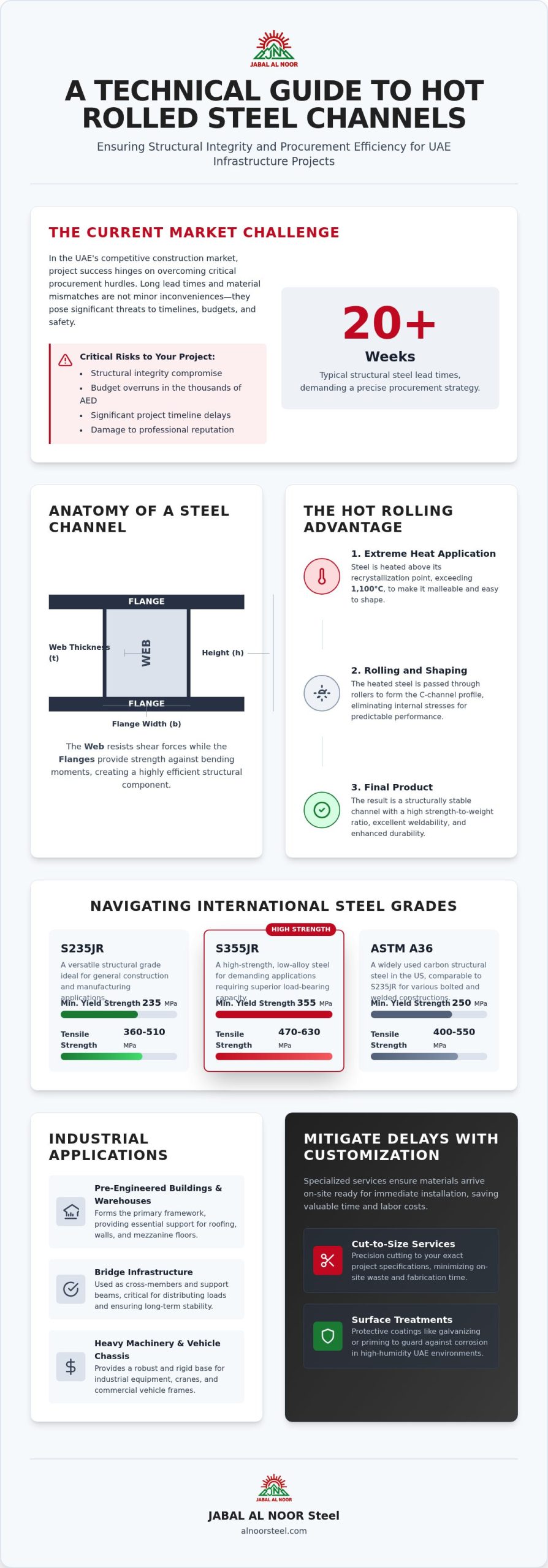
In a market where structural steel lead times can now extend beyond 20 weeks, the success of your next UAE infrastructure project depends less on the blueprint and more on the precision of your procurement strategy. You’re likely aware that selecting an incompatible material grade or facing a sudden logistical delay isn’t just a minor setback. These issues represent a genuine risk to structural integrity and project timelines that can cost thousands in AED and compromise your professional reputation.

This guide will empower you to master the technical specifications, material grades, and industrial applications of hot rolled steel channels to ensure your project meets the highest global standards. We’ll examine the critical differences between S235JR and S355JR grades, discuss dimensional tolerances under the BS EN 10025-2:2019 standard, and explore how specialized customization can mitigate common logistical bottlenecks in the local market. By the end of this article, you’ll have the technical clarity needed to secure a reliable supply chain and maintain the rigorous quality benchmarks your collaborators expect.

Key Takeaways

  • Understand the fundamental hot rolling process and how it ensures the structural stability required for large-scale industrial frameworks.
  • Learn to interpret critical dimensional notations and weight calculations for hot rolled steel channels to maintain engineering precision and logistical efficiency.
  • Identify the core differences between S235JR, S355JR, and ASTM A36 grades to ensure full compliance with UAE and international structural standards.
  • Explore the diverse applications of structural channels in pre-engineered buildings and bridge infrastructure to optimize strength-to-weight ratios.
  • Discover how specialized cut-to-size customization and surface treatments can mitigate on-site delays and protect against corrosion in high-humidity environments.

Understanding Hot Rolled Steel Channels in Structural Engineering

Hot rolled steel channels represent a foundational element in the UAE’s heavy construction sector. These sections are defined by a vertical web and two horizontal flanges that form a distinct U or C shape. Engineers often refer to them by various industry names including MS Channels, C-Channels, or Parallel Flange Channels (PFC). In specialized contexts, you might also encounter UPE sections. Each variant serves as a critical skeletal component, providing the necessary support for everything from industrial warehouses to complex bridge frameworks across the Emirates. Their structural versatility is matched by an excellent weldability that allows for rapid, secure assembly in demanding environments.

The production of these components involves passing steel through rollers at temperatures exceeding 1,100°C. This temperature is significantly above the material’s recrystallization point, which allows for large-scale shaping without the introduction of excessive internal stress. This high-heat environment ensures that hot rolled steel channels maintain a high strength-to-weight ratio while remaining easy to manipulate during on-site fabrication. The result is a product that offers industrial stability and the endurance required for long-term infrastructure projects.

The Mechanics of the Hot Rolling Process

Processing steel at such extreme temperatures fundamentally alters its internal grain structure. By heating the metal above its recrystallization threshold, manufacturers can eliminate the internal stresses that often plague cold-formed alternatives. This makes the steel more predictable under heavy loads. The cooling process naturally results in a characteristic blue-grey mill scale on the surface. While this scale is a hallmark of the hot rolling process, it also provides a base layer that can be treated or primed for enhanced durability. Because the material is processed in a malleable state, the final product is generally easier to machine and drill compared to cold-worked sections, which saves significant time during the installation phase.

Anatomy of a Steel Channel: Web vs. Flange

The structural efficiency of a structural channel lies in its specific geometry. The ‘Web’ acts as the vertical backbone, resisting shear forces, while the ‘Flanges’ extend horizontally to provide resistance against bending moments. This configuration allows for superior performance under axial loads. Engineers must choose between tapered flanges, which are thicker at the web and thin out toward the edges, and parallel flanges. Parallel flange channels (PFC) offer more uniform thickness, making them easier to bolt and join to other flat surfaces. This choice directly impacts the connection design and the overall stability of the framework, especially in large-scale national infrastructure where precision is non-negotiable. When designing complete structural systems, understanding how channels interact with complementary profiles such as IPE and HEB beams is essential for optimizing load distribution across the entire framework.

Technical Specifications: Dimensions, Profiles, and Material Properties

Precision in measurement is the cornerstone of structural safety and operational excellence. When you’re reviewing a specification sheet for hot rolled steel channels, you’ll encounter three primary notations: height (h), flange width (b), and web thickness (t). These dimensions aren’t merely geometric descriptions; they define the section’s ability to resist specific stresses. For instance, the height directly influences the moment of inertia, which determines how much the beam will deflect under a vertical load. Adhering to international tolerance standards, such as EN 10279, ensures that every piece in a bulk order aligns perfectly on-site, preventing the costly rework often caused by non-compliant materials.

Calculating the weight per metre is equally vital for the success of large-scale infrastructure. It’s not just a matter of transport logistics; it’s about the dead load calculations that dictate the stability of a bridge or warehouse. Mechanical properties, including tensile strength and yield point, define the limits of the steel’s endurance. According to technical resources from the American Institute of Steel Construction (AISC), these properties must be verified through rigorous testing to ensure the material won’t fail under peak stress. Most structural applications in the UAE also require a specific elongation percentage to accommodate the thermal expansion caused by the region’s extreme heat.

Standard vs. Parallel Flange Channels (PFC)

The choice between Parallel Flange Channels (PFC) and standard tapered sections often comes down to the complexity of the joint connections. PFCs feature flanges with a uniform thickness, which simplifies bolting and creates cleaner, more stable connections. In contrast, standard tapered channels (UPN) have flanges that thin out toward the edges. While tapered sections remain common in traditional industrial frameworks, modern UAE projects increasingly favor PFC or UPE profiles for their superior assembly efficiency. If you’re planning a project that requires high-precision assembly, reviewing our inventory of MS channels can help you identify the right profile for your specific load requirements.

Machinability and Fabrication Characteristics

Hot rolled sections are prized for their exceptional weldability. The low carbon content in standard structural grades prevents the steel from becoming brittle after cooling, which is essential for maintaining the integrity of welded joints in heavy machinery or building skeletons. During fabrication, cutting and drilling must be performed with precision to avoid introducing micro-cracks that could compromise the section. While mild steel offers the ductility needed for bending and forming, it’s vital to stay within the material’s elastic limit to ensure the final framework remains a dependable foundational pillar for the intended structure.

The selection of a specific steel grade is a decision that dictates the safety and longevity of any industrial framework. While the previous section detailed physical dimensions, the chemical composition and yield strength of hot rolled steel channels are what truly define their performance under pressure. In the United Arab Emirates, the industry primarily adheres to the BS EN 10025-2:2019 standard, where S235JR and S355JR are the dominant specifications. These grades ensure that the material possesses the predictable mechanical properties required for national infrastructure and energy projects.

Yield strength is the critical differentiator here. S235JR offers a minimum yield strength of 235 MPa, making it suitable for secondary supports and general framing. When projects involve heavy machinery or primary load-bearing structures, engineers often upgrade to S355JR. This grade provides a significantly higher yield point of 355 MPa, allowing for lighter sections to carry heavier loads without compromising safety. For a deeper understanding of how these grades fit into the broader context of construction, resources like Structural Steel 101 provide an excellent foundation for material selection and application.

Selecting the Right Grade for Your Project

Choosing between S235JR and S355JR depends entirely on the structural demand of your specific site. S235JR remains the standard for general support structures and secondary members where extreme load-bearing isn’t the primary concern. In contrast, S355JR is the preferred choice for large-span warehouses and primary frameworks that must endure significant stress. While ASTM A36 is frequently cited as the American equivalent for general-purpose structural steel, it has a different yield strength (approx. 250 MPa) and chemical composition compared to S235JR. Understanding these subtle variations ensures that your procurement aligns with the engineering requirements of the project. The same grade distinctions apply when specifying complementary structural sections such as mild steel angle bars, where ASTM A36 and EN 10025-2 equivalents carry meaningful differences in yield strength and chemical composition.

Compliance and Quality Benchmarks

Maintaining high standards of operational excellence requires a rigorous approach to material certification. Every batch of steel should be accompanied by a Mill Test Certificate (MTC), which provides a transparent record of the material’s chemical and physical properties. This traceability is vital for contractor compliance and ensures that the hot rolled steel channels delivered to the site match the exact specifications outlined in the design phase. While EN and ASTM standards are common, certain sectors in the region also utilize JIS (Japanese Industrial Standards) for specific engineering applications. This global alignment ensures that regardless of the source, the structural integrity of the project remains uncompromised.

Hot Rolled Steel Channels: A Comprehensive Guide to Structural Applications

Industrial Applications: From Infrastructure to Heavy Machinery

The versatility of hot rolled steel channels makes them indispensable across the UAE’s most demanding industrial sectors. While their technical grades were discussed in the previous section, their real-world utility is best seen in the skeletal frameworks of the region’s massive infrastructure. From expansive industrial warehouses to robust offshore platforms, these sections provide the essential rigidity required for high-stakes operations. They aren’t just components; they’re the foundational pillars that allow modern engineering to scale safely and efficiently.

In the Oil & Gas sector, channels are the standard for constructing pipe racks, equipment skids, and offshore platform supports. These structures must withstand both heavy static loads and the corrosive effects of saline environments. Similarly, in transport and logistics, manufacturers rely on these sections to build durable trailers, truck beds, and shipping containers that can endure the rigors of regional trade routes. The transport sector’s reliance on these sections stems from their ability to provide high strength without adding excessive weight to the vehicle’s chassis.

Structural Frameworks and PEB Construction

Pre-Engineered Buildings (PEB) rely heavily on channels for secondary structural members. They serve as purlins, girts, and door frames, providing the necessary support for wall and roof panels. By using hot rolled steel channels for cross-bracing and edge support, engineers can optimize material usage in large-span warehouses. This efficiency doesn’t just save on costs; it streamlines the entire assembly process. When integrated with MS beams, mild steel angle bars, and angles, these channels create a complete structural system that is both cost-effective and resilient against the UAE’s harsh environmental conditions.

Heavy Machinery and Industrial Equipment

Beyond buildings, these sections form the robust base frames for generators, compressors, and heavy industrial units. Their geometry is ideal for material handling systems, specifically as conveyor supports and racking frameworks in automated distribution centers. In the marine engineering sector, channels are frequently utilized in ship repair and barge construction, where structural stability under dynamic water pressure is paramount. If you’re managing a large-scale infrastructure project, you can view our full range of structural steel channels to find the exact specifications for your framework.

Infrastructure projects like bridges and pedestrian walkways also utilize these sections as secondary support beams. They provide the necessary lateral stability for walkways and staircases in industrial plants. Because they’re easy to weld and bolt, they’re often the first choice for on-site modifications where time and precision are equally critical. For primary load-bearing members in these same structures, engineers frequently pair channels with IPE and HEB beams to achieve the optimal balance between bending resistance and weight efficiency across the full structural system.

Procurement and Customization: Sourcing Quality Structural Channels

Securing a reliable supply of hot rolled steel channels in the United Arab Emirates requires a strategic approach that goes beyond simple price comparisons. For national contractors managing high-stakes infrastructure, the priority is the immediate availability of specific grades like S355JR and S235JR in standard 6m or 12m lengths. A partner who maintains a deep, localized inventory ensures that project timelines aren’t compromised by the global supply chain fluctuations or the 20-week lead times currently affecting the international structural steel market. This logistical stability is the bedrock of industrial confidence in the region.

The efficiency of on-site operations depends heavily on the supplier’s processing capabilities. Sourcing raw sections is only the first step. To maintain a methodical pace in construction, contractors increasingly rely on value-added services that prepare the steel for immediate installation. This reduces the need for complex fabrication setups on-site, which can be difficult to manage in the restricted spaces of urban development or remote energy sites. It’s about securing a transparent and reliable entity that prioritizes precision and long-term value for its collaborators.

Advanced Processing: Cut-to-Size and Finishing

Implementing specialized cut-to-size services is a critical factor in reducing on-site waste and improving overall logistics. By receiving hot rolled steel channels cut to exact engineering specifications, fabrication teams can eliminate the time-consuming process of manual measuring and trimming. This precision is complemented by essential surface treatments. Shot blasting is used to remove the typical blue-grey mill scale, creating a clean surface that’s ready for further treatment. In the high-humidity environments of the UAE, applying priming and protective coatings is a non-negotiable step to prevent corrosion and ensure the endurance of the structural framework.

Strategic Sourcing for National Contractors

Evaluating a supplier’s capacity for bulk structural steel requirements is vital for maintaining the momentum of large-scale industrial contracts. A national stockist must demonstrate not just a high volume of inventory, but also the logistical proficiency to deliver materials across the Emirates with unwavering consistency. This includes providing Mill Test Certificates (MTC) for every batch to ensure full traceability from the mill to the construction site. These quality benchmarks reassure clients of the brand’s capability and regional expertise. To secure the backbone of your next project, you can Explore JABAL AL NOOR Steel’s range of hot rolled channels and processing services to ensure your procurement aligns with the highest standards of operational excellence.

Securing Structural Excellence for the UAE’s Industrial Future

The complexity of modern engineering demands a material partner that understands the high-stakes requirements of national infrastructure. You’ve seen how precise grade selection and strict adherence to BS EN 10025-2:2019 standards are essential for the structural integrity of your framework. By prioritizing hot rolled steel channels that are prepared through shot blasting and priming, you ensure your project withstands the unique environmental pressures of the Emirates while maintaining a methodical pace of construction.

Success in large-scale industrial projects is built on a foundation of logistical reliability and technical proficiency. We maintain an extensive national inventory to ensure your operations remain on schedule despite global supply chain fluctuations. Our commitment to operational excellence includes full technical compliance with EN and ASTM standards, supported by advanced cut-to-size and surface treatment capabilities. This approach provides the industrial stability and unwavering confidence your collaborators expect from a seasoned veteran of the steel sector.

Request a Quote for Structural Steel Channels to secure a dependable partner for your next infrastructure milestone. We look forward to supporting your vision with precision and long-term value.

Frequently Asked Questions

What is the difference between a C-channel and a U-channel?

The primary difference lies in the flange geometry, with C-channels (Parallel Flange Channels) featuring parallel internal surfaces and U-channels (UPN) possessing tapered flanges. C-channels are often preferred for modern structural frameworks because their uniform thickness simplifies bolting and connection designs. U-channels are more traditional and are frequently found in older industrial designs or specific machine frames where the flange taper doesn’t interfere with the assembly process.

Which steel grade is better for structural use: S235JR or S355JR?

S355JR is the superior choice for primary structural applications due to its higher yield strength of 355 MPa compared to the 235 MPa offered by S235JR. While S235JR is sufficient for secondary members and light framing, S355JR allows for the construction of lighter yet stronger frameworks. This makes it the standard for large-span warehouses and heavy infrastructure projects across the UAE where load-bearing capacity is the priority.

Can hot rolled steel channels be used for outdoor applications without treatment?

Hot rolled steel channels shouldn’t be used outdoors without protective treatment because the raw mill scale offers no long-term resistance to corrosion. In the humid coastal environments of the UAE, untreated steel will rapidly develop rust, compromising its structural integrity over time. We recommend a combination of shot blasting and priming or galvanization to ensure the material maintains its endurance and safety benchmarks in exposed industrial settings.

What are the standard lengths available for hot rolled channels?

Standard lengths for hot rolled steel channels in the national market are typically 6 metres or 12 metres. These lengths allow for efficient transport and minimize the number of joints required in large-scale frameworks. For projects with specific engineering requirements, we provide cut-to-size customization to reduce on-site fabrication time and eliminate material waste, ensuring your logistics remain streamlined and cost-effective throughout the project lifecycle.

How do I calculate the weight of a hot rolled steel channel?

You can calculate the weight by multiplying the cross-sectional area of the profile by the length and the density of steel, which is approximately 7,850 kg/m³. However, most engineers prefer using standardized weight tables that provide the mass per metre (kg/m) for specific profile sizes. Precise weight calculations are essential for accurate dead load assessments and for planning the logistics of bulk transport to your construction site.

Is ASTM A36 equivalent to S235JR?

ASTM A36 and S235JR are comparable in application but aren’t strictly identical in their mechanical properties or chemical composition. ASTM A36 typically has a slightly higher yield strength of approximately 250 MPa, whereas S235JR is rated at 235 MPa. While they’re often used for similar general-purpose structural work, you must verify the specific project requirements to ensure full compliance with the engineering standards mandated for your site.

What surface treatments are recommended for steel channels in high-corrosion areas?

For high-corrosion environments like offshore platforms or coastal facilities, we recommend shot blasting followed by high-performance priming or hot-dip galvanizing. Shot blasting is critical for removing contaminants and mill scale to ensure superior coating adhesion. These treatments provide a robust barrier against the saline air and high humidity common in the region, protecting the steel from premature degradation and maintaining long-term structural stability.

Do you provide Mill Test Certificates (MTC) for structural channels?

We provide Mill Test Certificates (MTC) for all structural sections to ensure complete transparency and traceability for our clients. These documents verify that the hot rolled steel channels meet the chemical and mechanical specifications required by international standards like EN 10025. Providing this documentation is a core part of our commitment to operational excellence and helps contractors maintain full compliance with local regulatory authorities and safety benchmarks.