With the introduction of Dubai Law No. (3) of 2026, the margin for error in structural steel specification has effectively disappeared. Selecting the correct universal beams and columns UAE construction projects demand is no longer just a matter of procurement; it’s a critical decision for building safety and regulatory compliance. We understand that the pressure to balance load-bearing requirements with international standards like EN 10025 or ASTM can often lead to costly delays or material waste on site.
You’ll find that mastering the technical differences between Universal Beam (UB) and Universal Column (UC) profiles is the first step toward structural integrity. This guide details exactly how to specify the right steel grades, such as S235JR or A36, while ensuring your materials meet the high-stakes benchmarks of the local market. We’ll also examine how cut-to-size customization and surface treatments like shot blasting can streamline your project’s logistical efficiency. By the end of this article, you’ll have a clear framework for sourcing reliable structural sections that support the Emirates’ evolving industrial landscape.
Key Takeaways
- Differentiate between UB and UC profiles to align structural geometry with specific load-bearing requirements for bending or axial compression.
- Identify the critical differences between EN 10025 and ASTM grades to ensure your selection of universal beams and columns UAE meets regional compliance standards.
- Learn how specialized surface treatments such as shot blasting and priming protect structural integrity against the unique environmental challenges of the Middle East.
- Understand the logistical benefits of utilizing cut-to-size customization to minimize on-site waste and streamline the assembly of large-scale infrastructure projects.
- Gain insights into sourcing strategies that prioritize technical proficiency and inventory availability for consistent project delivery across the Emirates.
Understanding Universal Beams and Columns in the UAE Market
The structural integrity of the UAE’s rapidly expanding skyline depends on the precise application of standardized steel sections. Universal Beams (UB) and Universal Columns (UC) represent the evolution of heavy structural profiles, offering a level of predictability that is essential for modern engineering. Unlike older, less standardized sections, these profiles are manufactured to strict tolerances. This ensures that every ton of steel delivered to any construction site across the UAE performs exactly as specified in the design phase. The “Universal” designation isn’t just a name; it’s a guarantee of standardized mechanical properties that engineers rely on to calculate load-bearing capacities with absolute certainty.
In the local market, terminology often varies between contractors and suppliers. You’ll frequently hear professionals refer to “I-beams,” “H-beams,” or “wide flange sections” when discussing universal beams and columns UAE projects. While these terms are often used interchangeably in casual conversation, they refer to specific geometric configurations that dictate how a building handles stress. Universal sections are foundational to the UAE’s heavy industrial frameworks, providing the skeletal strength required for everything from oil and gas refineries to massive commercial malls.
The Anatomy of a Steel Section
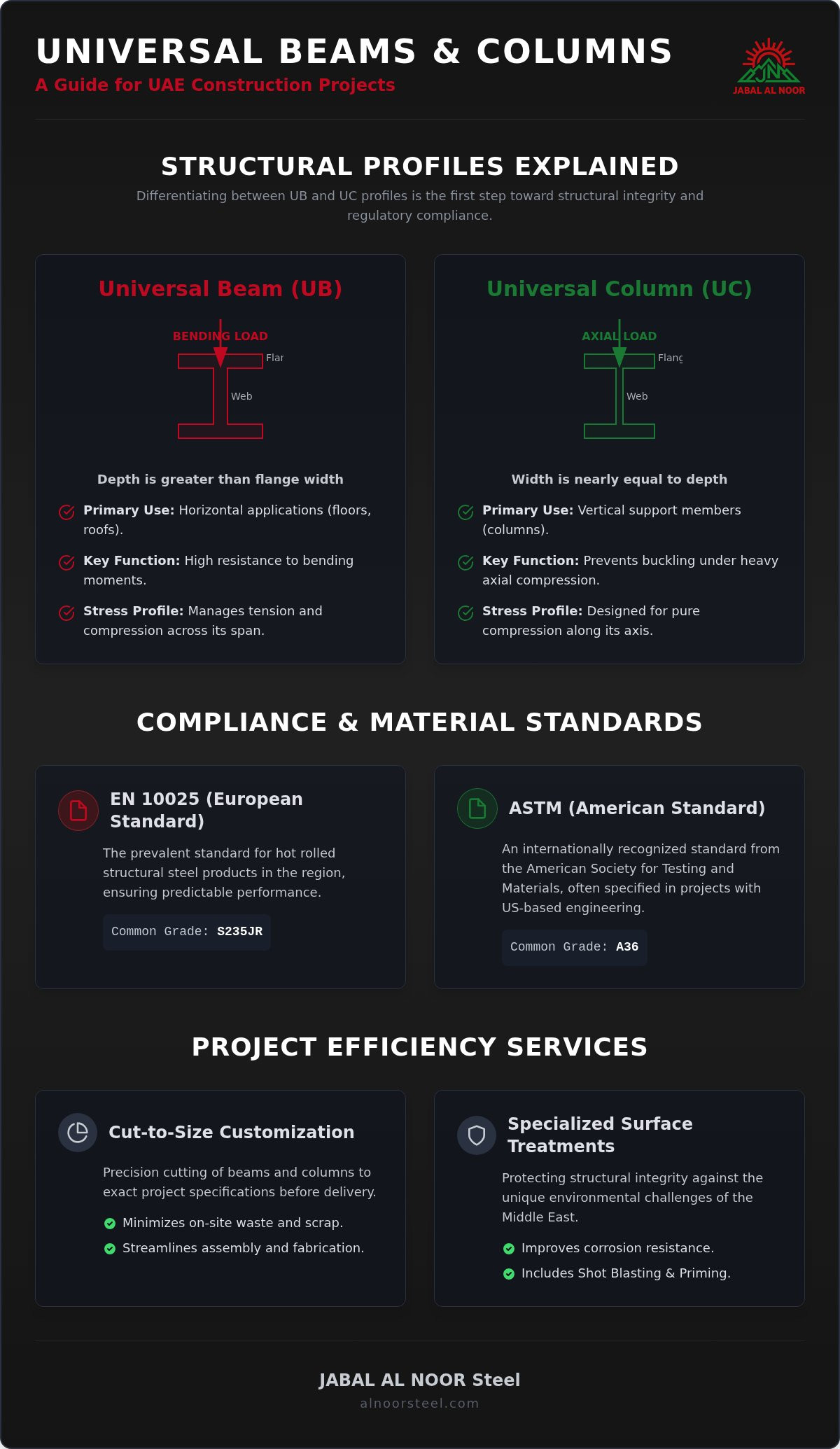
A universal section consists of two horizontal plates known as flanges, joined by a vertical component called the web. This geometric configuration is engineered to handle specific stresses. In a Universal Beam, the web is typically deeper than the flanges are wide, which provides high resistance to bending. For those Understanding Universal Beams, the relationship between the flange width and web height is the primary factor that determines the section’s mechanical capacity. Universal Columns, by contrast, feature a more square profile where the width is nearly equal to the depth. This allows them to support significant axial loads without buckling, making them ideal for vertical support members.
Why “Universal” Sections are Preferred over Standard Joists
Historically, tapered flange joists were the industry standard, but they presented significant challenges during the fabrication process. Universal sections feature parallel flanges, which simplify the connection of bolts and plates. This design choice significantly reduces the time required for on-site assembly and fabrication. These sections offer a superior strength-to-weight ratio compared to standard joists, allowing engineers to design larger spans with less total steel volume. This optimization directly impacts project overhead, making universal sections the standard choice for the UAE’s sophisticated infrastructure and industrial hubs where precision and logistical efficiency are paramount.
Structural Differences: Universal Beams vs. Universal Columns
While both profiles are essential to modern engineering, the geometric distinction between a Universal Beam (UB) and a Universal Column (UC) dictates their specific role within a structural frame. A Universal Beam is characterized by a depth that is significantly greater than its flange width. This vertical orientation concentrates the material’s mass away from the neutral axis, which provides maximum resistance to bending moments. In the context of universal beams and columns UAE suppliers provide, UBs are the standard choice for horizontal applications where the primary stress is a downward force across a span.
Universal Columns utilize a different geometric strategy. A UC profile features a width that is nearly equal to its depth, resulting in a square, “H-shaped” cross-section. This design increases the radius of gyration, which is a critical factor in preventing buckling under heavy vertical loads. Because the flanges are typically thicker than those of a comparable beam, the column can withstand intense axial compression. Engineers across the Emirates specify these sections for vertical supports in high-rise frameworks and heavy industrial substructures where stability is non-negotiable.
Load-Bearing Characteristics: Tension vs. Compression
The performance of these sections is defined by how they manage internal stresses. When a Universal Beam is loaded horizontally, the top flange undergoes compression while the bottom flange experiences tension. The deep web serves to keep these flanges apart, maximizing the section’s “moment of inertia.” Conversely, a Universal Column is designed for pure compression. Its square profile ensures that it can resist forces from multiple directions equally well. This makes UCs indispensable for the primary vertical pillars of a structure, as they don’t twist or bend easily when supporting the cumulative weight of multiple floors.
Choosing the Right Profile for Long-Span Structures
Selection depends entirely on the span and the nature of the load. For long-span structures like warehouses or aircraft hangars in Sharjah and Abu Dhabi, Universal Beams are preferred because they offer a superior weight-to-strength ratio for horizontal distances. They provide the necessary stiffness without adding excessive dead weight to the foundation. However, at the intersections where these horizontal spans meet vertical supports, the UC becomes the priority. If you are currently finalizing specifications for a large-scale project, reviewing the available MS Beams and Universal Sections in stock can help align your design with current regional availability.
In many UAE industrial projects, the efficiency of the build is often improved by using both sections in tandem. A typical portal frame might use UBs for the rafters and UCs for the stanchions. This optimized approach ensures that each piece of steel is working at its maximum theoretical capacity, reducing material costs while maintaining the rigorous safety standards required by local municipalities. Secondary structural elements such as mild steel angle bars are frequently used alongside these primary sections to provide bracing, gusset connections, and load distribution across the frame.
Material Grades and Compliance Standards in UAE Construction
Compliance in the UAE’s construction sector is governed by a dual-standard system. While many international markets strictly adhere to a single regulatory code, the Emirates’ diverse design landscape accommodates both European and American benchmarks. Selecting the correct material grade for universal beams and columns UAE projects requires a precise understanding of yield strength and chemical composition to ensure structural endurance. This choice isn’t merely technical; it’s a regulatory necessity that impacts the speed of municipality approvals and the long-term safety of the built environment.
EN 10025: The European Benchmark for Structural Steel
The EN 10025 standard is the most prevalent benchmark in the local market. Grades like S235JR provide a baseline for lighter secondary structures, while S275JR and S355JR offer significantly higher yield strengths of 275 and 355 MPa, respectively. S355JR is particularly favored for heavy industrial frameworks and high-rise developments where maximizing load-bearing capacity without increasing the section’s physical footprint is essential. The “JR” suffix indicates that the steel has undergone Charpy V-notch impact testing at room temperature, which is a critical metric for ensuring the material won’t fail under sudden stress or environmental fluctuations.
ASTM Standards: Versatility in Heavy Engineering
American standards remain a foundational pillar of Middle Eastern heavy engineering and energy sectors. ASTM A36 is a highly versatile carbon steel utilized in a broad spectrum of general construction and fabrication. For more demanding infrastructure, ASTM A572 Grade 50 is the preferred specification, offering a higher yield point of 50,000 psi. These standards are frequently mandated by international consultancy firms overseeing large-scale transport and utility projects. They ensure that the structural steel aligns with global safety protocols and specific design methodologies that have been the backbone of regional industrial growth for decades. Understanding the distinction between ASTM A36 and EN 10025-2 grade equivalents is equally critical when specifying complementary structural components; our comprehensive guide to mild steel angle bars structural uses and specifications provides a detailed breakdown of these international grade differences and their implications for high-salinity environments.
Ensuring Traceability and Quality Control
Every structural section must be accompanied by a comprehensive Mill Test Certificate (MTC). This document is the primary evidence of a material’s mechanical properties and chemical heat analysis. With the implementation of Dubai Law No. (3) of 2026, the requirements for technical and structural assessments have become more rigorous. Traceability ensures that every beam and column meets the specific quality and safety certificates mandated for modern infrastructure. Providing this level of documentation is vital for contractors who need to demonstrate compliance during the new contractor and engineering consultancy rating systems launching in early 2026.
The UAE’s harsh climate, characterized by high humidity and potential salinity in coastal areas, also influences grade selection. While the steel’s chemistry provides the strength, it’s the combination of the correct grade and professional surface treatments that ensures endurance. Higher grades often provide a greater safety margin against the environmental stresses unique to the region, making them a steady and dependable choice for high-stakes projects.
The procurement of structural steel is only the first phase of a successful project. To truly optimize a construction timeline, contractors must look beyond the raw material and consider the benefits of value-added industrial processing. High-capacity universal beams and columns UAE projects require can be significantly enhanced through precision customization and protective treatments before they even arrive at the site. This proactive approach effectively eliminates the logistical bottlenecks often associated with manual on-site fabrication. It ensures that the structural integrity established in the design phase is preserved throughout the entire lifecycle of the build.
Cut-to-Size Accuracy and Waste Reduction
Structural steel is typically supplied in standardized lengths of 12 meters. However, modern engineering designs rarely utilize these exact dimensions across every span. On-site cutting is labor-intensive and frequently generates significant scrap material that increases total project overhead. Utilizing precision cut-to-size services allows contractors to receive sections that are ready for immediate installation. This accuracy reduces the total volume of steel that must be purchased and minimizes the costs associated with waste management. By outsourcing this process to a specialized facility, project managers can maintain a cleaner, more organized site while focusing their labor resources on assembly rather than preparation.
Shot Blasting and Priming: Extending Structural Lifespan
The environmental conditions in the UAE, particularly in coastal industrial zones like Jebel Ali or Abu Dhabi, present a constant threat of corrosion. Shot blasting is a critical surface treatment that utilizes high-velocity abrasives to remove mill scale, rust, and contaminants from the steel’s surface. This process creates a specific surface profile that is essential for the effective adhesion of protective coatings. Without this preparation, any subsequent paint or primer will eventually fail, exposing the underlying metal to the elements and compromising the structure’s endurance.
Following the shot blasting process, the application of a high-quality protective primer is the standard protocol for ensuring long-term durability. Priming provides a sacrificial layer that prevents oxidation during transport, storage, and the initial construction phases. In a market where structural assessments for older buildings are now legally mandated by Law No. (3) of 2026, investing in these surface treatments early ensures that the framework remains compliant and secure for decades. You can explore our full range of Surface Treatments and Customization Services to see how we help protect your structural investment from environmental degradation.
By integrating these industrial processes directly into the supply chain, contractors gain a significant competitive advantage. The reduction in on-site labor and the extension of the material’s lifespan contribute to a more sustainable and cost-effective construction model. It’s a methodical approach that reflects the high standards and operational excellence of the UAE’s heavy industry.
Sourcing Universal Sections from JABAL AL NOOR Steel
Selecting a supply partner for heavy structural steel requires more than just reviewing a product catalog. It demands a relationship with a seasoned veteran that understands the high-stakes requirements of the UAE’s infrastructure and energy sectors. Since our establishment in 2010, JABAL AL NOOR Steel has served as a foundational pillar in the regional industrial landscape. We operate as a primary national stockist, maintaining a massive inventory of universal beams and columns UAE contractors rely on for rapid project mobilization. Our role is to provide the industrial stability and unwavering confidence necessary to keep large-scale projects on schedule and within technical specifications.
Strategic inventory management is the core of our operations. We don’t just store steel; we manage a supply chain designed for logistical efficiency. By maintaining an extensive range of MS Beams, including H, I, and Universal sections, we ensure that our partners can bypass the long lead times often associated with international sourcing. This immediate availability is critical for meeting the strict timelines of modern construction, allowing for a seamless transition from the design phase to on-site assembly.
National Supply Chain and Logistical Reliability
Our distribution reach extends across the entire United Arab Emirates, providing a consistent flow of materials to project sites from Abu Dhabi to the Northern Emirates. With local producers like Emirates Arkan Steel supplying 65% of the domestic market for heavy structural sections, we focus on bridging the gap between production and project-specific delivery. This national presence allows us to function as a steady, dependable partner for contractors managing multiple sites simultaneously. We’ve refined our logistical processes to handle the complexities of bulk structural steel transport, ensuring that every section arrives in optimal condition. This reliability is backed by our internal operational excellence, which prioritizes transparency and long-term value over short-term gains.
Technical Support for Procurement Professionals
Procurement in the structural steel sector involves navigating complex grade compliance and regulatory benchmarks. Our team provides the technical proficiency required to ensure that every beam and column meets the necessary international standards, whether you’re specifying EN 10025 grades like S355JR or American ASTM benchmarks. We provide comprehensive Mill Test Certificates (MTC) with every order, ensuring full traceability and compliance with the latest building safety laws, including Dubai Law No. (3) of 2026. This documentation is vital for demonstrating quality during the new contractor rating system assessments launching in early 2026.
Initiating a procurement request is a methodical process designed for precision. Whether you require standard lengths or specialized cut-to-size customization and surface treatments, our team is ready to facilitate your requirements. We encourage procurement professionals to reach out with detailed specifications to begin a technical consultation. By aligning your structural needs with our established inventory and processing capabilities, you ensure the endurance and integrity of your framework for decades to come.
Securing Your Structural Framework for Future Growth
The successful delivery of large-scale infrastructure projects in the Emirates depends on the precision of your material specifications. By distinguishing between the bending resistance of Universal Beams and the axial strength of Universal Columns, you align your structural design with the highest engineering benchmarks. Adhering to recognized EN 10025 and ASTM standards is no longer just a recommendation; it’s a critical requirement for regulatory compliance and long-term building safety. Utilizing professional surface treatments and cut-to-size customization further ensures that your materials are prepared to withstand the unique environmental pressures of the Middle East while reducing unnecessary waste on site.
When you’re ready to source universal beams and columns UAE projects require, partnering with a dependable national stockist ensures your procurement remains steady and transparent. Our commitment to maintaining a compliant inventory and providing full in-house processing services allows you to focus on the complexities of construction with unwavering confidence. We invite you to Request a Technical Quote for Universal Beams and Columns and leverage our national distribution reach for your next development. We look forward to establishing a reliable partnership that supports the enduring success of your structural frameworks.
Frequently Asked Questions
What is the difference between a Universal Beam and a Universal Column?
Universal Beams are primarily designed for horizontal spans where bending resistance is the priority, while Universal Columns feature a square profile to support vertical axial loads. The depth of a UB is significantly greater than its flange width to maximize stiffness across a span. Universal Columns have nearly equal depth and width, which prevents buckling under heavy compression in vertical pillars.
Which steel grade is most commonly used for beams in the UAE?
The most frequently specified grades for universal beams and columns UAE projects are EN 10025 S275JR and S355JR. While S275JR is suitable for general structural work, S355JR is preferred for heavy-duty applications due to its higher yield strength. ASTM A36 also remains a common choice for projects following American design codes. Selecting the correct grade ensures the structure can withstand both static loads and regional environmental stressors.
Can Universal Beams be used for residential construction in the UAE?
Universal Beams are an excellent choice for residential projects that require wide, open-plan spaces without the need for intrusive support walls. They allow for larger window openings and expansive spans that reinforced concrete cannot easily achieve. While many villas rely on traditional masonry, incorporating structural steel beams provides greater architectural flexibility. All such installations must follow the specific building codes enforced by the local Emirate’s municipality.
What are the standard lengths available for Universal Columns?
The industry standard length for structural steel sections is 12 meters. While these are the stock lengths available at most national distributors, specialized cut-to-size services are available to meet specific architectural requirements. This customization reduces on-site labor and eliminates the logistical burden of managing excess material waste during the assembly phase of a project. Accurate sizing is essential for maintaining the planned construction schedule.
How does shot blasting improve the performance of structural steel?
Shot blasting removes mill scale and surface oxidation to create a specific anchor profile for protective coatings. In the high-humidity environment of the UAE, this process is essential for ensuring that primers and paints adhere correctly to the metal. Without this treatment, corrosion can develop beneath the surface, eventually compromising the structural integrity of the entire framework. It’s a foundational step for ensuring the endurance of the steel.
Does JABAL AL NOOR Steel provide Mill Test Certificates for all products?
Yes, JABAL AL NOOR Steel provides Mill Test Certificates (MTC) for all structural sections in our inventory. These documents are essential for meeting the rigorous quality benchmarks established by UAE municipalities and the Building Safety Law issued in 2026. An MTC provides a verified record of the steel’s chemical composition and mechanical properties, ensuring that every beam and column is traceable and compliant with project specifications.
What is the advantage of using S355JR over S235JR for columns?
S355JR offers a significantly higher yield strength of 355 MPa compared to the 235 MPa provided by S235JR. This increased capacity allows engineers to specify lighter, more compact sections that can still support the same axial loads. Using a higher grade often results in a more efficient design, reducing the total tonnage of steel required for large-scale infrastructure projects. This optimization directly impacts the overall efficiency of the structural framework.
How do I calculate the weight of a Universal Beam per meter?
You can find the weight per meter in standardized property tables, which list the mass for every profile size. For example, a 203 x 133 x 30 UB weighs exactly 30 kilograms per linear meter. If tables aren’t available, the weight is calculated by multiplying the cross-sectional area by the standard density of steel, which is 7,850 kilograms per cubic meter. Accurate weight calculations are vital for foundation design and transport logistics.
Pingback:Comprehensive Guide to Mild Steel Angle Bars: Structural Uses and Specifications 2026