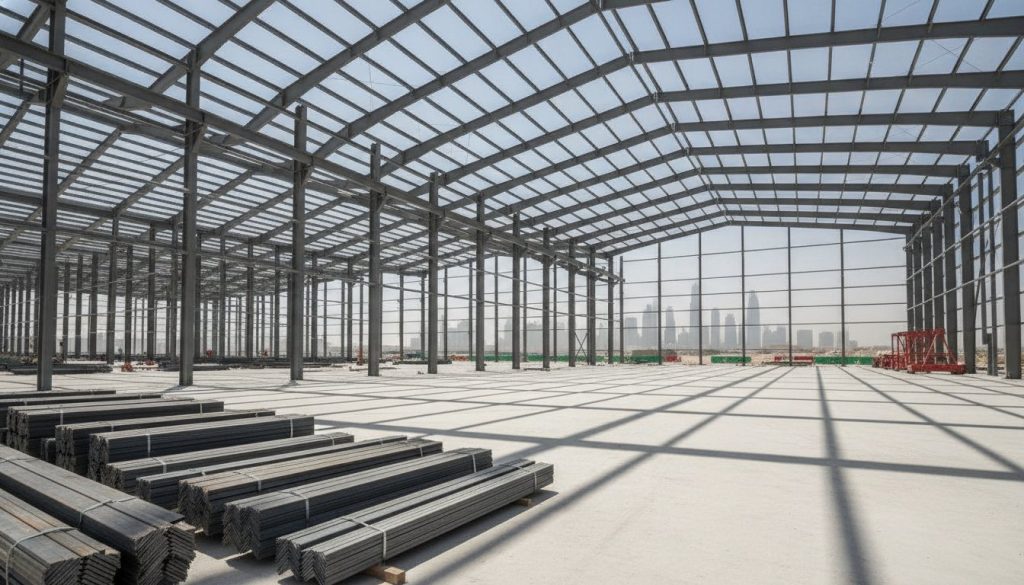
Could the subtle technical distinction between an ASTM A36 and an EN 10025-2 specification be the silent catalyst for structural fatigue in your next infrastructure project? In the rigorous industrial landscape of the United Arab Emirates, the selection of mild steel angle bars requires a deep understanding of international grade equivalents to ensure material longevity against the region’s unique high-salinity conditions. You likely recognize that the integrity of a framework rests on the precision of its smallest connectors, yet logistical delays and grade confusion can compromise even the most disciplined project timelines.
This comprehensive guide provides the definitive technical framework for structural engineering, offering the clarity needed to optimize load distribution across both equal and unequal profiles. We’ll demystify current 2026 grading standards, including the critical yield strength benchmarks of 250 MPa for carbon structural steel, while addressing the specific environmental durability requirements of the Middle East. You’ll gain a thorough overview of geometric specifications, international standards comparison, and the strategic advantages of partnering with a dependable national supplier for your structural requirements.
Key Takeaways
- Master the technical distinctions between equal and unequal profiles to optimize load distribution and structural integrity in complex frameworks.
- Understand how the precise carbon composition of mild steel angle bars ensures superior weldability and ductility for long-term industrial endurance.
- Navigate international grading standards, including ASTM A36 and EN 10025-2, to guarantee compliance with regional engineering regulations in the UAE.
- Identify the most effective application frameworks for MS angles within pre-engineered buildings and high-capacity warehouse racking systems.
- Discover how utilizing cut-to-size customization and national supply chains can minimize on-site waste and significantly accelerate project timelines.
Understanding Mild Steel Angle Bars and Their Structural Significance
Mild steel angle bars represent the foundational architecture of the modern industrial world. These L-shaped structural sections are produced through a meticulous hot-rolling process, where semi-finished steel billets are heated above their recrystallization temperature and passed through industrial rollers. This method results in high-strength profiles that exhibit a uniform grain structure, providing the predictable mechanical performance required for large-scale engineering. Within the fabrication sector, these components are frequently referred to as the universal connector because they offer a reliable method for joining disparate structural members while maintaining rigid alignment.
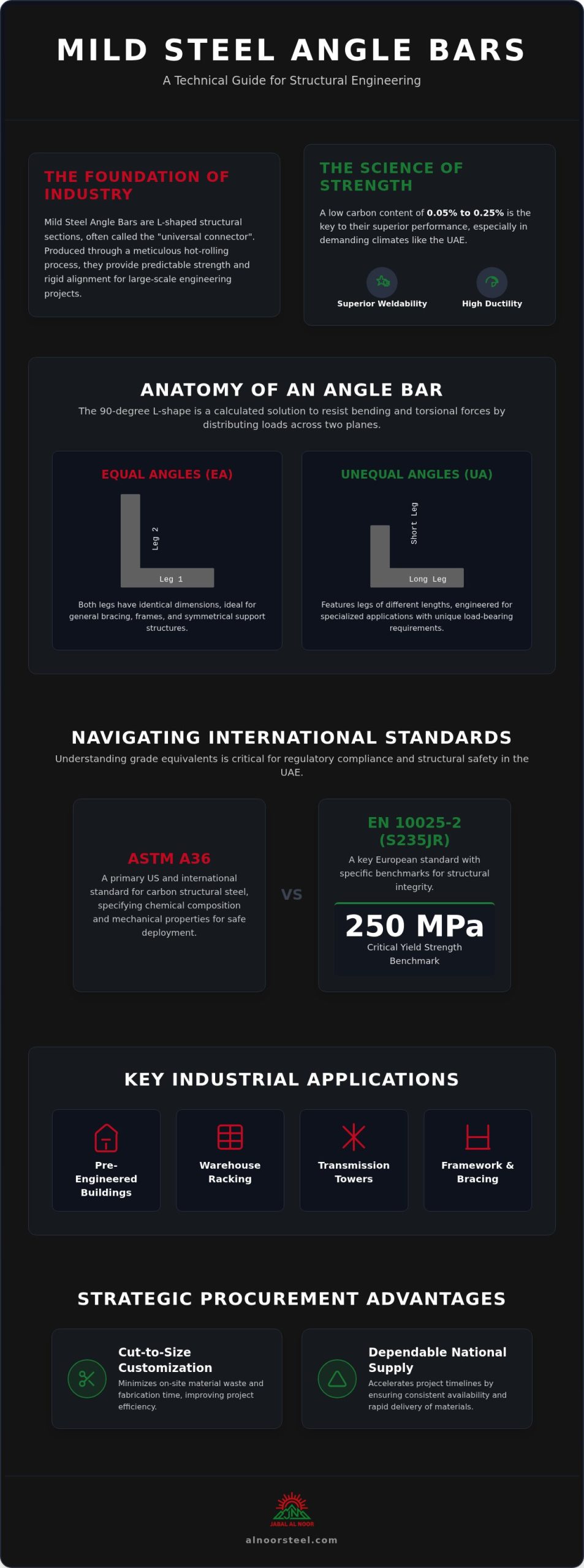
The technical utility of these sections stems from their specific chemical composition. Unlike high-carbon variants, mild steel contains a lower carbon percentage, typically between 0.05% and 0.25%. This precise balance is critical for the heavy industry projects common across the United Arab Emirates, as it ensures superior weldability and ductility. These properties allow engineers to fuse components securely without the risk of brittle fractures, even when the structure is subjected to the intense thermal expansion and contraction cycles typical of the regional climate.
To better understand the practical applications of these components, watch this helpful video:
Adherence to recognized benchmarks is essential for national structural compliance. The ASTM A36 steel standard remains a primary reference point for these products, specifying the minimum yield strength and chemical requirements necessary for safe deployment. By following these rigorous grading standards, project managers can ensure that the mild steel angle bars integrated into their frameworks will perform consistently under the calculated design loads, reducing the risk of long-term structural fatigue.
The Geometry of the L-Shape
The 90-degree profile of an angle bar is not merely a matter of convenience; it is a calculated geometric solution for resistance against bending and torsion. By positioning two “legs” perpendicular to one another, the section effectively distributes load across both horizontal and vertical planes. This geometry makes it an ideal choice for bracing and reinforcement. When selecting these components, engineers focus on three primary dimensions: the width of the legs, the thickness of the material, and the overall length. These specifications dictate the moment of inertia and the cross-sectional area, which are the defining factors in determining how much weight a specific profile can support before deformation occurs.
Why Mild Steel is the Industry Standard
While high-carbon steel offers greater hardness, it often lacks the structural flexibility required for large-scale national infrastructure projects in the UAE. Mild steel provides a more forgiving profile that can absorb energy and withstand vibrations without snapping. It is also significantly more cost-effective when procured in bulk for warehouse racking, transmission towers, or pre-engineered buildings. This balance of affordability and technical proficiency ensures that mild steel angle bars remain the preferred choice for developers who prioritize both safety margins and logistical efficiency. You can explore a wide range of these structural components through our inventory of long products, which are maintained to meet rigorous international quality benchmarks.
Equal vs. Unequal Angles: Engineering Differences and Performance
Selecting the appropriate profile for a structural framework requires a precise understanding of mass distribution and axial resistance. The primary technical distinction lies in the leg length ratio. Equal angles (EA) possess identical leg dimensions, whereas unequal angles (UA) feature one leg longer than the other. This geometric variation isn’t merely aesthetic; it fundamentally alters the section’s center of gravity and its moment of inertia. In mild steel angle bars, moving the mass further from the neutral axis in one direction allows the component to resist bending more effectively along a specific plane. This makes UA profiles indispensable for designs where load requirements are not uniform across all axes.
National inventory standards in the UAE typically accommodate a wide variety of these sections to meet diverse engineering demands. Standard equal angle dimensions often start at 20mm and extend up to 200mm, with material thicknesses ranging from 3mm to 25mm. Unequal angles are frequently stocked in configurations such as 75 x 50mm or 150 x 90mm. The thickness of the material serves as the critical determinant for the weight-to-strength ratio. While a thicker section increases the load-bearing capacity, it also adds significant dead weight to the structure. Professional engineers must calculate this balance carefully to ensure the framework remains efficient without compromising safety margins.
Equal Angles (EA) in Symmetrical Loading
Symmetrical mild steel angle bars are the industry standard for applications where forces are distributed evenly. They’re the most common choice for cross-bracing in transmission towers and framing for industrial warehouse shelving. Because both legs provide identical resistance, the structural response remains predictable regardless of the orientation during installation. This simplicity reduces the likelihood of fabrication errors in residential trusses and light industrial frames, making them a reliable staple for contractors across the Emirates.
Unequal Angles (UA) for Specialized Engineering
Unequal angles are specified when a project faces unbalanced forces or space constraints that prevent the use of symmetrical sections. In mechanical engineering and heavy machinery brackets, the vertical load often outweighs the lateral pressure. By utilizing a longer vertical leg, an engineer can maximize the section’s stiffness and resistance to deflection without the weight penalty of a larger equal angle. This strategic use of material helps optimize the total cost of steel in large-scale infrastructure. When your design calls for these specialized load-bearing characteristics, you can consult our inventory of long products to select the precise profile and grade required for your specific application.
The performance of these sections is also influenced by their placement within a truss or frame. UA profiles are often used in situations where the steel must fit into a tight corner while still providing substantial support along one primary axis. This versatility ensures that even the most complex architectural requirements can be met with standard industrial components, provided the selection is backed by rigorous technical analysis.
Material Grades and Standards: ASTM A36 to S235JR
Standardized grading is not merely a bureaucratic requirement; it is a structural necessity for the safety of large-scale infrastructure in the United Arab Emirates. When procuring mild steel angle bars, contractors must distinguish between various international benchmarks to ensure the material matches the specific engineering calculations of the project. Adherence to these standards guarantees that every component in a framework reacts predictably under stress, thermal expansion, and environmental pressure. Without this uniformity, the risk of structural failure increases, particularly in the high-stakes sectors of energy and heavy industry.
ASTM A36 remains the most prevalent standard for carbon structural steel in many regional projects. It specifies a minimum yield strength of 250 MPa and a tensile strength range of 400 to 550 MPa. This grade is valued for its versatility, allowing it to be used effectively in bolted, riveted, or welded constructions. Its chemical composition is carefully controlled, limiting carbon content to approximately 0.26% to maintain the ductility required for shaping and fabrication without compromising the overall toughness of the industrial profile.
The European benchmark, EN 10025 S235JR, offers a comparable alternative often specified in international engineering contracts. The performance of these grades is dictated by the precise inclusion of Manganese and Silicon. Manganese enhances the steel’s hardness and tensile strength, while Silicon acts as a deoxidizing agent during the manufacturing process to ensure a clean, high-quality finish. These elements work in tandem to produce mild steel angle bars that can endure the rigorous demands of the UAE’s industrial landscape.
ASTM A36 vs. S235JR: A Comparative Analysis
While both grades are frequently used in structural applications, their mechanical thresholds differ slightly. A36 provides a higher minimum yield point than its European counterpart, which can influence the total volume of steel required for load-bearing frames. S235JR is a structural grade with a minimum yield strength of 235 MPa. Both materials exhibit excellent weldability and machinability, allowing for efficient on-site fabrication. Choosing between them often depends on the specific design codes of the project and the availability of certified stock within the national supply chain. For projects requiring primary load-bearing members, understanding how these grades perform across different profiles is essential — engineers specifying angle bars alongside IPE and HEB beams must carefully evaluate how each section’s yield strength interacts within a composite structural system.
Compliance and Certification for Contractors
Reliable procurement hinges on the provision of Mill Test Certificates (MTC). These documents serve as a verified record of the steel’s chemical and physical properties, ensuring that the material delivered to your site meets the exact specifications of the design. Maintaining strict traceability from the manufacturer to the final installation is a fundamental pillar of structural safety. For deeper compliance insights, you may explore our guide on Structural Steel Quality Standards. This level of documentation protects contractors from liability and ensures that every structural member contributes to the long-term endurance of the project.
Key Applications and Selection Criteria for Industrial Projects
Selecting mild steel angle bars for industrial projects requires more than a cursory glance at dimensions. It involves a systematic evaluation of load-bearing requirements and environmental exposure. In Pre-Engineered Buildings (PEB), these sections serve as critical girts and purlin braces, providing the necessary lateral stability for large-span structures. Similarly, heavy-duty warehouse racking systems rely on the consistent geometry of these angles to maintain vertical alignment under significant pallet loads. In these contexts, the material acts as a primary stabilizer, ensuring that the broader assembly remains rigid under dynamic stress.
The energy sector utilizes these components extensively in the construction of high-voltage transmission towers and substation frameworks. Here, the precision of the angle is paramount for maintaining the structural integrity of the lattice. For marine and offshore environments, the vulnerability of bare mild steel to accelerated corrosion makes specialized surface treatments non-negotiable. Shot blasting and priming are essential precursors to final coating, ensuring the material can withstand the aggressive coastal conditions of the Arabian Gulf. Beyond heavy infrastructure, these bars are the standard for general fabrication, serving as reliable brackets, lintels, and even decorative industrial trim where a clean, 90-degree finish is required.
Environmental Factors in the UAE Climate
High humidity levels and atmospheric salinity present significant challenges for steel longevity in the Emirates. Protective coatings, such as galvanization or industrial-grade primers, are vital for extending the operational lifecycle of mild steel angle bars. These components are rarely used in isolation; they’re often integrated with Hot Rolled Steel Channels to create robust composite frameworks capable of resisting both axial and lateral stressors. This synergy between different structural sections is what allows for the creation of durable industrial enclosures that meet local safety regulations and withstand the regional climate.
Selection Checklist for Procurement Officers
Procurement decisions must be grounded in technical data rather than unit cost alone. Officers should verify that the section modulus of the selected angle meets the calculated bending moments of the design. While mild steel angle bars are versatile, it’s necessary to assess whether Universal Beams and Columns are required as the primary load-bearing members, using angles as secondary supports. Finally, consider the logistical impact of standard lengths versus customized sections. Sourcing pre-cut components reduces on-site scrap and labor costs, directly improving the project’s bottom line. To ensure your project remains on schedule with high-specification materials, you can order structural steel components directly from our inventory.
Strategic Procurement: Customization and Supply Solutions
Strategic procurement in the heavy industry sector isn’t merely about the acquisition of raw materials; it’s about optimizing the entire supply chain to enhance project efficiency. Sourcing mild steel angle bars from a national stockist with an extensive inventory provides a safeguard against the logistical delays that frequently plague large-scale infrastructure projects. This approach ensures that contractors have immediate access to the specific profiles required, whether they’re standard equal sections or specialized unequal dimensions. By maintaining a robust local supply, developers can mitigate the risks associated with international market fluctuations and ensure a steady flow of components to the site.
Cut-to-size customization represents a significant advancement in on-site logistics management. Instead of receiving standard lengths that require extensive manual labor and produce considerable scrap, engineers can order sections precisely tailored to their design specifications. This precision reduces on-site waste, which is a critical factor in maintaining the profitability of high-stakes industrial contracts in the UAE. It also simplifies the assembly process, as components arrive ready for immediate integration into the framework, reducing the need for heavy cutting equipment at the project location. In complex structural designs where angle bars are paired with primary framing members such as IPE and HEB beams, pre-cut customization ensures dimensional accuracy across the entire assembly, minimizing costly on-site adjustments.
Value-Added Services: Beyond the Bar
Surface preparation is a fundamental step in ensuring the long-term durability of structural steel, especially within the high-salinity environments of the Emirates. Shot blasting provides a superior method for removing mill scale and contaminants, creating a textured surface that significantly improves the adhesion of protective coatings. Following this with professional priming ensures that mild steel angle bars are protected from oxidation during transit and storage. Receiving ready-to-install sections that have already undergone these treatments allows contractors to bypass on-site preparation, accelerating the construction phase while upholding the highest quality benchmarks for corrosion resistance.
Partnering for National Infrastructure
Reliability in bulk supply is the cornerstone of successful partnerships in the oil, gas, and construction sectors. A seasoned supplier acts as a knowledgeable guide, offering technical support to ensure the correct profiles are selected for complex engineering challenges. This collaborative approach prioritizes precision and long-term value over short-term savings, creating a voice of stability in the regional industrial landscape. To maintain the momentum of your industrial projects with a dependable supply of high-grade materials, you can explore our full range of structural components at JABAL AL NOOR Steel. Our commitment to operational excellence and adherence to international standards ensures that your infrastructure is built on a foundation of stability and trust.
Securing the Future of UAE Infrastructure
The structural integrity of any industrial project depends on the precise selection and procurement of mild steel angle bars. Throughout this guide, we’ve analyzed how geometric profiles and international grading standards like ASTM A36 and EN 10025 dictate performance in high-stakes environments. You now understand that optimizing load distribution requires more than just material; it demands a strategic approach to customization and surface protection. By integrating shot-blasted and primed sections into your framework, you effectively eliminate on-site bottlenecks and address the regional challenges of high salinity. It’s about ensuring every connector meets a rigorous benchmark.
Reliable infrastructure isn’t built on guesswork. It’s established through consistent adherence to global quality standards and a dependable national supply chain. We provide comprehensive logistics coverage for all long products, ensuring your structural components arrive exactly when they’re needed. If you’re ready to enhance your project’s efficiency and durability, browse our inventory of MS Angle Bars and structural steel at JABAL AL NOOR Steel. We’re here to support your vision with precision and industrial stability.
Frequently Asked Questions
What is the difference between equal and unequal mild steel angle bars?
Equal angles possess identical leg lengths, providing symmetrical resistance for applications like cross-bracing and light framing. Unequal angles feature one leg longer than the other, which shifts the center of gravity and optimizes the moment of inertia for specialized engineering. This makes unequal mild steel angle bars ideal for brackets and machinery supports where vertical loads significantly outweigh lateral forces.
Which steel grade is best for structural angle bars: ASTM A36 or S235JR?
The choice between these grades depends entirely on your project’s engineering specifications and design codes. ASTM A36 is a common US standard with a minimum yield strength of 250 MPa, while S235JR is the European benchmark specifying 235 MPa. Both grades offer the superior weldability and ductility required for heavy industrial frameworks across the United Arab Emirates.
Can mild steel angle bars be used in outdoor environments without treatment?
Utilizing bare mild steel in outdoor environments is not recommended in the UAE due to high atmospheric salinity and humidity. Without protective surface treatments like shot blasting, priming, or galvanization, the material will oxidize rapidly and compromise structural integrity. Professional suppliers provide these value-added services to ensure your structural components withstand the region’s aggressive coastal climate.
What are the standard lengths available for MS angle bars in the UAE?
Standard industrial lengths for these sections are typically 6 meters or 12 meters to accommodate large-scale logistics. However, sourcing from a national stockist allows you to utilize cut-to-size customization services. This precision reduces on-site scrap and streamlines the installation process for complex infrastructure projects, ensuring that you only receive the exact dimensions required for your framework.
How do I calculate the weight of a mild steel angle bar?
You can determine the theoretical mass by using a standard engineering formula based on the density of steel. The calculation is: Weight (kg/m) = [Leg 1 + Leg 2 – Thickness] * Thickness * 0.00785. Applying this formula helps procurement officers estimate the total tonnage for mild steel angle bars, which is essential for calculating dead loads and coordinating site logistics.
Are MS angle bars suitable for welding in heavy industrial applications?
Yes, these components are specifically designed for high-performance welding in industrial sectors. Their low carbon content, generally between 0.05% and 0.25%, ensures excellent weldability without the risk of brittle fractures. This allows for secure fusion in substation frames, transmission towers, and warehouse racking systems where structural endurance is a non-negotiable requirement for safety and compliance.
What value-added services should I look for in a steel supplier?
A reliable partner should offer more than just material supply; they should provide comprehensive customization and protection solutions. Look for specialized services such as shot blasting to prepare the surface for coating adhesion and industrial priming for corrosion resistance. National suppliers who offer these “ready-to-install” sections significantly reduce on-site labor costs and accelerate your project’s construction timeline.
How does the thickness of the angle bar affect its load-bearing capacity?
The thickness of the legs directly influences the section’s moment of inertia and its overall resistance to bending. A thicker profile increases the cross-sectional area, allowing the bar to support heavier loads and resist torsion more effectively before deformation occurs. Engineers must balance this increased capacity against the added dead weight to ensure the structural framework remains both safe and efficient.