Tag: structural engineering

IPE and HEB Beams: A Comprehensive Comparison for Structural Engineering

IPE and HEB Beams: A Comprehensive Comparison for Structural Engineering

Selecting the heaviest steel profile available might seem like a shortcut to structural safety, but it often leads to unnecessary material costs and logistical complications. Most engineers and procurement specialists understand the pressure of balancing rigid safety standards with strict project budgets. It’s common to feel overwhelmed by the subtle geometric differences between European sections or the nuances of the latest EN 10365:2026 updates. Mastering the critical differences between IPE and HEB beams is essential to ensure you select the profile that guarantees both structural integrity and maximum cost-efficiency for your specific application.

In this comprehensive comparison, we provide a clear framework for choosing between these two profiles based on bending versus compression needs. You’ll gain a reliable understanding of how geometry influences performance and how to align technical delivery conditions, such as the updated EN 10025-2:2024 standards, with your procurement strategy. We will also address common confusion regarding regional terminology and the upcoming EN 10034:2026 tolerance requirements. This methodical overview serves as an authoritative guide for large-scale infrastructure and energy projects that demand precision, durability, and long-term value.

Key Takeaways

  • Differentiate between IPE and HEB profiles by understanding how their specific web and flange dimensions dictate performance under bending and axial stress.
  • Evaluate technical properties like Section Modulus and Moment of Inertia to prevent over-specification and reduce overall material expenditure.
  • Identify the most efficient applications for each profile, from specifying IPE for horizontal rafters to utilizing HEB for heavy-duty foundations and bridge girders.
  • Ensure compliance with international standards by mastering the selection of S235JR and S355JR grades and the verification of Mill Test Certificates.
  • Streamline your procurement of IPE and HEB beams by partnering with established national suppliers capable of providing cut-to-size customization and specialized surface treatments.

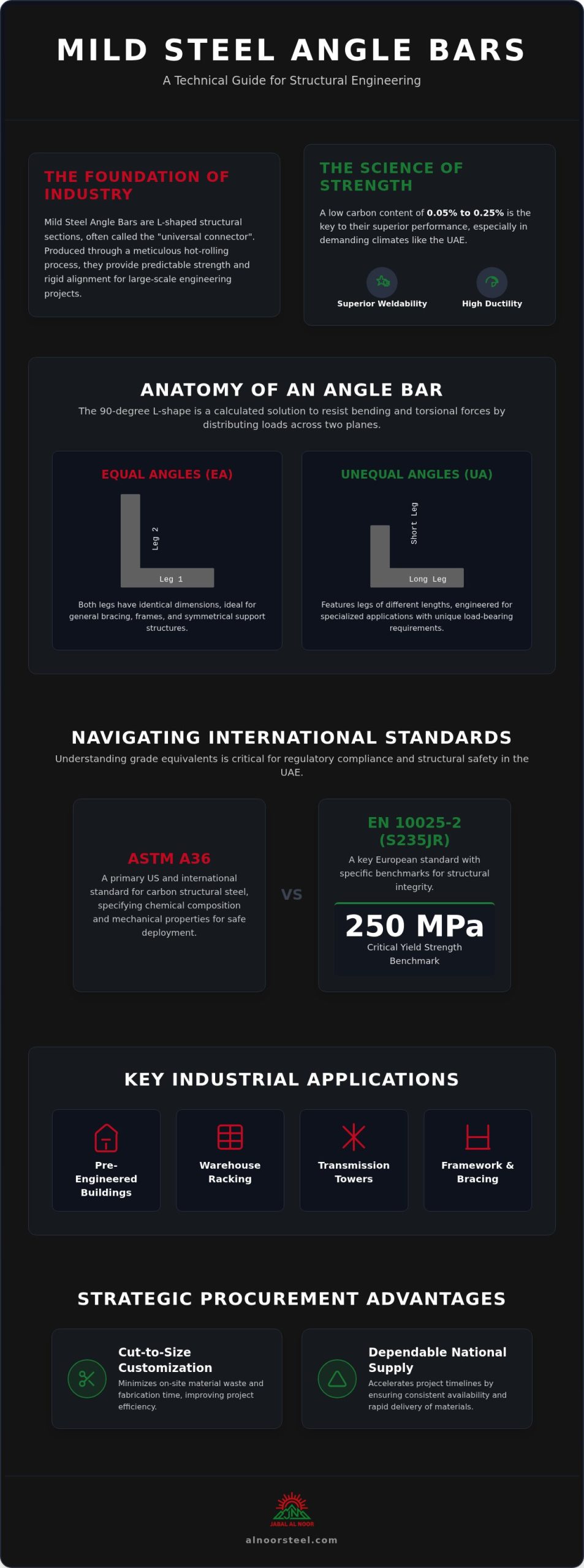
Understanding IPE and HEB Beams in Structural Frameworks

Structural steel serves as the foundational skeleton for large-scale infrastructure and energy projects. Selecting the specific profile for a project isn’t merely a technicality; it’s a strategic decision that impacts the long-term stability and financial viability of the build. Engineering professionals frequently evaluate IPE and HEB beams to determine which section provides the necessary load-bearing capacity without inflating material costs. These profiles are strictly governed by the EN 10025 standard, which ensures that mechanical properties and chemical compositions meet rigorous industrial benchmarks. Choosing the correct profile is critical. It prevents the common pitfall of over-specification, which increases project expenses and logistical complexity.

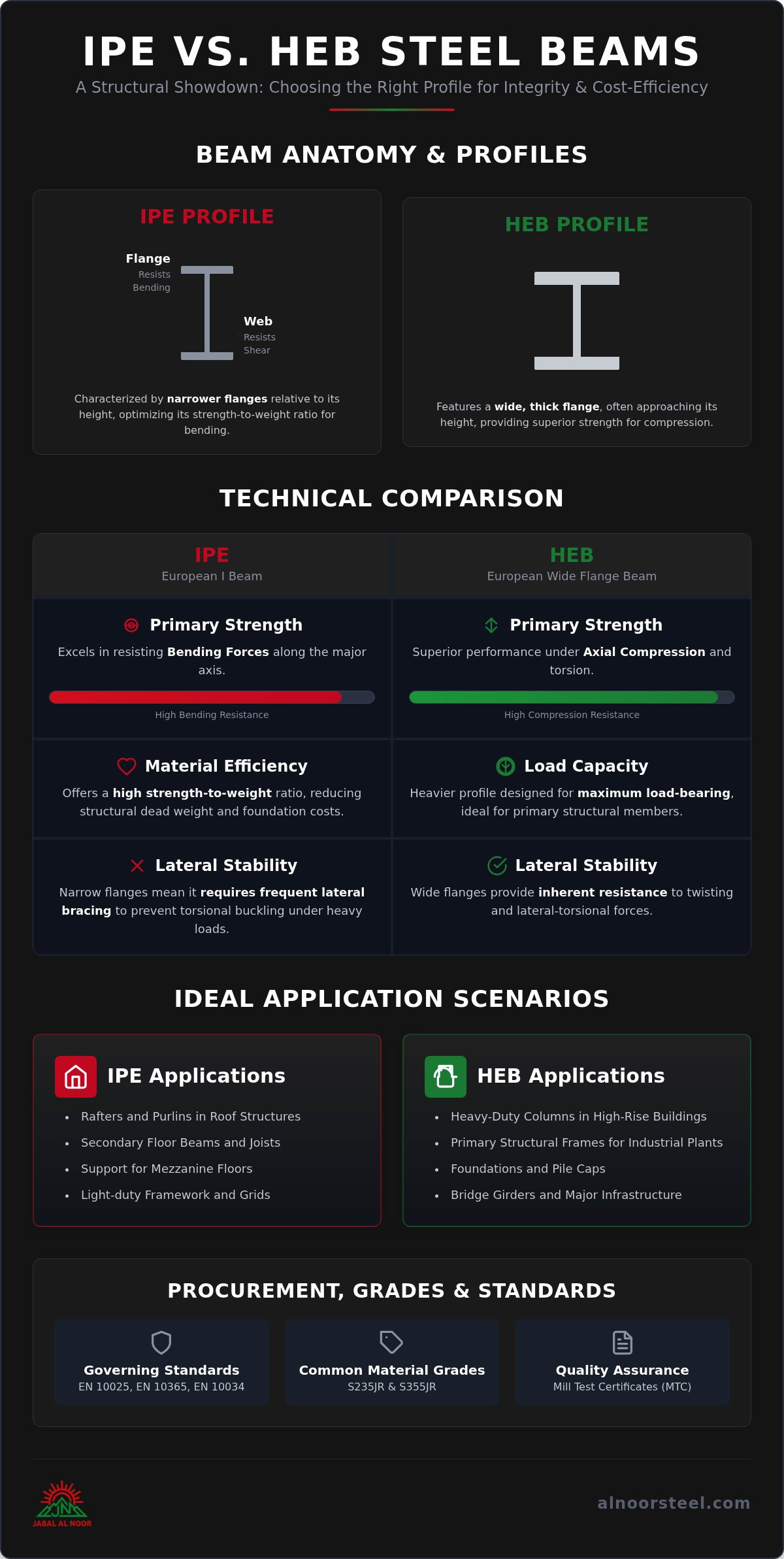
The mechanical performance of an I-beam depends on its geometric distribution of steel. The section consists of two horizontal plates, known as flanges, connected by a vertical component called the web. In structural mechanics, the web primarily resists shear forces, while the flanges counteract the majority of the bending moment. By understanding these roles, you can optimize your design for specific stress types. You can find the full range of these structural components at the Al Noor Steel shop, where international grade compliance is a standard requirement for every section.

The Anatomy of an IPE Beam

The IPE profile, or European I Beam, is characterized by its narrow flanges relative to the height of its web. Modern IPE sections utilize parallel flange designs that simplify connections compared to older tapered versions. These beams are exceptionally material-efficient when resisting bending forces in horizontal applications. Because the mass is concentrated away from the neutral axis, IPE sections offer a high strength-to-weight ratio. They’re ideal for rafters and secondary floor supports where vertical loads are the primary concern. Using IPE sections helps reduce the dead weight of the structure, which can lead to significant savings in the foundation and support columns.

The Anatomy of an HEB Beam

In contrast, the HEB beam is a European Wide Flange Beam where the flange width often approaches the total height of the section. These profiles feature a significantly thicker web and flanges than their IPE or HEA counterparts. This robust geometry makes the HEB profile the superior choice for handling axial compression and torsion. They’re foundational elements in heavy-duty columns and bridge girders where multi-directional stress is a constant factor. While they’re heavier and more expensive than IPE beams, their ability to withstand massive vertical loads makes them indispensable for the primary structural members of high-rise buildings and industrial plants.

Technical Comparison: IPE vs HEB Design Properties

Technical specifications dictate the structural efficiency of any industrial build. When comparing IPE and HEB beams, the most significant variance lies in their Section Modulus (W) and Moment of Inertia (I). IPE profiles are engineered to maximize bending resistance along the major axis while using the least amount of steel possible. This makes IPE the lighter champion for horizontal applications where weight reduction is a priority. Conversely, HEB profiles possess a much higher Moment of Inertia on the minor axis. This geometric property provides the lateral stability required for heavy load-bearing members. Detailed technical data on these ArcelorMittal I sections confirms that while IPE is efficient for simple bending, HEB is necessary when lateral forces are present.

Flange width directly impacts a beam’s resistance to lateral-torsional buckling. IPE beams have relatively narrow flanges, meaning they require frequent lateral bracing to prevent twisting under heavy loads. HEB profiles feature wide flanges that provide inherent resistance to these torsional forces. This geometric stability is why engineers prefer HEB sections for multi-story columns and primary structural frames. The upcoming EN 10034:2026 standard will introduce even tighter tolerances for flange parallelism, further enhancing the reliability of these wide-flange sections in precision engineering.

Load-Bearing Capacity and Stress Distribution

HEB beams distribute heavy vertical loads across a significantly wider surface area than IPE sections. This distribution reduces the localized stress on connecting plates and foundations. While IPE beams perform exceptionally well under uniform distributed loads (UDL) in flooring systems, they lack the cross-sectional area to handle concentrated axial compression effectively. The wide flange design provides a substantial footprint that minimizes the risk of local buckling under extreme compression. This makes HEB the standard for foundational columns in high-stakes infrastructure projects.

Weight and Logistics Considerations

The weight difference between these profiles has a massive impact on project logistics. For instance, an IPE 300 weighs approximately 42.2 kg per meter, whereas an HEB 300 weighs roughly 117 kg per meter. This means an HEB section is nearly 2.7 times heavier than an IPE section of the same height. Such a drastic increase in mass affects everything from transportation costs to the capacity of the cranes required on-site. When planning your logistics, it’s also worth researching Hollow Section Steel Suppliers in UAE to see how different profiles can complement your beam selection. For a reliable supply of these components, you can browse the full inventory selection to match your specific engineering requirements.

Application Scenarios: When to Specify IPE vs HEB

Mapping IPE and HEB beams to specific structural roles requires a deep understanding of load paths and architectural constraints. While both profiles are essential in modern construction, they serve fundamentally different purposes within a building skeleton. IPE beams excel as horizontal members. Their high depth-to-width ratio makes them the industry standard for roof purlins and rafters where the primary stress is bending. In residential construction, they provide a sleek, narrow profile that architects often prefer for exposed steel features or secondary floor supports where vertical clearance is a priority.

HEB sections function as the workhorse of vertical load paths. Their massive cross-sectional area and thick flanges make them indispensable for primary columns and heavy-duty foundations. In bridge engineering, HEB girders handle the complex torsional and axial stresses that would cause lighter sections to fail. These beams are designed to remain stable under the immense pressure of multiple stories, providing the foundational strength required for high-rise infrastructure and industrial warehouses.

Pre-Engineered Buildings (PEB) frequently utilize a hybrid approach to optimize both safety and cost. Engineers might specify HEB for the main frame columns to ensure axial stability while using IPE for the roof rafters to minimize the total tonnage of the project. This strategic mix ensures structural integrity while maintaining budget efficiency. By selecting the right profile for each specific load case, you avoid the unnecessary expense of over-designing secondary members.

Horizontal vs. Vertical Structural Roles

IPE is the preferred choice for spanning long distances with minimal weight. It’s often used in floor systems where the goal is to resist gravity loads across a wide bay without adding excessive dead weight. HEB is indispensable for high-rise vertical supports because its wider flanges resist buckling over long vertical spans. For project managers, selecting a reliable Structural Steel Supplier UAE ensures that both profiles are available in the required grades to meet these distinct structural roles.

Environmental and Industrial Factors

Industrial machinery platforms often face high-frequency vibrations that can lead to fatigue in thinner sections. In these environments, the mass and damping capacity of HEB beams provide superior performance and operational safety. Conversely, IPE is the better choice for architectural features where a slimmer, more refined profile is desired. In the oil and gas sector, where infrastructure must withstand extreme conditions and heavy equipment loads, HEB sections provide the necessary durability and resistance to harsh industrial environments.
IPE and HEB Beams: A Comprehensive Comparison for Structural Engineering

Procurement Factors: Material Grades and Customization

Procurement of IPE and HEB beams involves more than selecting a profile height. You must specify the correct steel grade to match the structural calculations of your project. S235JR is a standard non-alloy structural steel with a yield strength of 235 MPa; it’s suitable for many secondary IPE applications. In contrast, S355JR provides a higher yield strength of 355 MPa, which is often mandatory for the heavy-duty HEB columns used in infrastructure. Using S355JR can sometimes allow for a lighter profile while maintaining the same load capacity, which helps reduce the total weight of the structure. This grade is particularly effective for large-scale energy projects where endurance and high standards are the primary metrics.

Every beam must be accompanied by a Mill Test Certificate (MTC). This document verifies the chemical composition and mechanical properties of the steel, ensuring it meets the rigorous EN 10025 standards. Without this verification, you risk introducing non-compliant materials into high-stakes projects. It’s a foundational step in maintaining operational excellence and ensuring long-term structural safety. Reliable procurement requires a transparent view of these certificates to guarantee that the materials match the engineer’s specifications exactly.

Sourcing International Standard Steel

Compliance with Structural Steel Quality Standards UAE is a non-negotiable requirement for government and energy sector contracts. Large-scale projects require a partner with stockist capabilities rather than just a middleman supplier. A true stockist maintains an extensive inventory of various grades and sizes, which ensures that project timelines aren’t delayed by manufacturing lead times. This regional expertise allows for a steady flow of materials that meet both EN 10025 and ASTM standards, providing the logistical efficiency necessary for complex construction schedules.

Value-Added Services for Contractors

On-site efficiency is significantly improved through a Cut-to-Size Steel Service in the UAE. This logistical service reduces on-site welding and material waste, allowing for immediate assembly upon delivery. Additionally, surface treatments like shot blasting and priming are essential for beams exposed to harsh industrial environments. These processes remove mill scale and apply a protective layer that prevents corrosion during transport and installation. For contractors, these services provide industrial stability by ensuring every component arrives ready for immediate use. To ensure your next project utilizes only high-standard materials, you can view our full range of structural steel sections.

Strategic Sourcing from JABAL AL NOOR Steel

Securing a reliable supply of IPE and HEB beams is a critical factor in maintaining the momentum of large-scale infrastructure and energy projects. JABAL AL NOOR Steel maintains a comprehensive inventory of MS beams, including IPE, HEB, and HEA sections, ensuring that structural requirements are met with precision and speed. Our commitment to international quality benchmarks means every section complies with the latest EN 10025 standards. This dedication to operational excellence provides contractors and engineers with the industrial stability needed to execute complex builds. We prioritize long-term partnership over transactional sales, offering expert consultation to help you align beam profiles with specific load-bearing requirements.

National delivery capabilities ensure that heavy structural components reach project sites across the UAE without delay. Managing the logistics of high-tonnage steel requires a sophisticated supply chain and a deep understanding of regional industrial pressures. We provide the transparency and reliability expected from a seasoned industry veteran. Our inventory isn’t limited to standard sizes; we offer the specialized support needed for high-stakes projects that demand rigorous quality benchmarks and verified material origins.

A Trusted Partner for Long Products

With decades of experience in the regional steel distribution sector, we’ve established ourselves as a foundational pillar for the construction industry. We understand that time-sensitive infrastructure projects don’t have room for supply chain interruptions. Our role as a leading entity among Steel Suppliers in UAE allows us to offer consistent availability even for rare or high-demand profiles. This seasoned expertise ensures that every client receives materials that are not only compliant with international standards but also optimized for logistical efficiency.

Ready to Support Your Next Project

Every construction project has unique requirements, and we’re prepared to provide the specific solutions your engineering team demands. Whether you need to request a quote for bulk IPE and HEB beams or require access to our full range of hollow sections and flat products, our procurement process is designed for clarity and speed. We address the common industry gap in value-added services by providing specialized cut-to-size customization and surface treatments like shot blasting and priming. These services reduce on-site waste and ensure your steel arrives ready for immediate structural integration. To secure the materials for your next build, explore our structural steel inventory and partner with a supplier that values precision and long-term value.

Optimizing Structural Integrity with Precise Beam Selection

Mastering the technical nuances of IPE and HEB beams is the first step toward achieving industrial stability in your next project. We’ve established that while IPE sections offer unmatched efficiency for horizontal bending, the wide-flange HEB profile remains the standard for vertical load-bearing members. Selecting the correct steel grade, such as S355JR, ensures your structure meets the rigorous safety benchmarks required for large-scale infrastructure. These decisions directly impact both the safety of the build and the project’s overall cost-efficiency.

Partnering with a dependable supplier transforms these technical choices into operational reality. JABAL AL NOOR Steel provides the regional expertise and logistical efficiency needed to keep complex projects on schedule. With an EN 10025 Compliant Inventory and In-house Cut-to-Size Services, we help you minimize on-site waste and streamline the assembly process. Our National UAE Distribution Network ensures that high-standard materials are delivered directly to your site with unwavering reliability and professionalism.

Request a Quote for Structural Beams to secure the precision and long-term value your project deserves. We’re ready to provide the foundational strength for your engineering success.

Frequently Asked Questions

What is the main difference between IPE and HEB beams?

The primary distinction lies in their cross-sectional geometry and intended structural role. IPE sections feature narrower flanges and are optimized for resisting bending moments in horizontal applications like floor joists. HEB profiles possess wider flanges and thicker webs, providing the axial stability required for vertical columns. This design difference makes HEB sections significantly heavier and more capable of handling multi-directional stress in large-scale infrastructure projects.

Can I use an IPE beam for a column in a multi-story building?

While technically possible for light loads, IPE beams aren’t the standard choice for primary columns in multi-story structures. Their narrow flanges make them susceptible to lateral buckling under heavy axial compression. HEB profiles are specifically engineered for vertical support because their wide-flange design provides the necessary stability to prevent twisting. For secondary supports or light-duty frames, IPE might suffice, but primary structural integrity usually demands the robust cross-section of an HEB beam.

Which is more cost-effective: IPE or HEB?

IPE beams are generally more cost-effective for horizontal spans because they provide high strength with minimal steel weight. This reduces material costs and transportation expenses for roof rafters and secondary floor beams. However, for heavy vertical loads, using an HEB beam is more economical than attempting to reinforce multiple lighter IPE sections. True cost-efficiency is achieved by matching the beam profile to the specific stress requirements of the engineering design.

What do the numbers after the beam type (e.g., IPE 200) signify?

The numerical value following the profile designation indicates the nominal height of the beam in millimeters. For instance, an IPE 200 has a total height of approximately 200mm. These dimensions are standardized under EN 10365:2026 to ensure consistency across the industrial supply chain. Engineers use these numbers to quickly identify the section properties required for their calculations, allowing for precise procurement and structural alignment during the design phase.

Are HEB beams the same as Wide Flange Beams (W-Beams)?

HEB beams are the European version of Wide Flange beams, but they’re not identical to American W-beams. While both share the “H” shape and wide-flange characteristics, HEB profiles follow European EN standards, whereas W-beams adhere to American ASTM standards. There are subtle differences in dimensions and weight per meter. For projects in the UAE, specifying IPE and HEB beams ensures compliance with the European standards most commonly utilized in regional infrastructure.

Which steel grade is most common for IPE and HEB beams in the UAE?

Structural steel in the UAE most commonly utilizes S235JR and S355JR grades in accordance with the EN 10025 standard. S235JR is a standard grade suitable for many general construction applications. S355JR is frequently specified for HEB beams in high-stress environments because it offers a higher yield strength of 355 MPa. Choosing the correct grade is essential for ensuring that the structural framework can withstand the operational pressures of heavy industry.

Do you offer surface treatments for beams used in outdoor environments?

JABAL AL NOOR Steel provides specialized surface treatments to protect structural components from harsh outdoor conditions. We offer shot blasting to remove mill scale and priming to create a corrosion-resistant barrier. These treatments are vital for maintaining the durability of steel in the humid and saline environments often found across the UAE. Proper surface protection extends the lifecycle of your structural framework and reduces long-term maintenance requirements for industrial infrastructure.

What are the standard lengths for IPE and HEB beams in stock?

Standard stock lengths for these profiles are typically 6 meters or 12 meters to facilitate efficient transport and handling. However, project requirements often demand precise dimensions to minimize on-site waste and welding. We provide in-house cut-to-size customization for our entire inventory of long products. This service allows contractors to receive beams that are ready for immediate installation, significantly improving the logistical efficiency and safety of high-stakes construction projects.
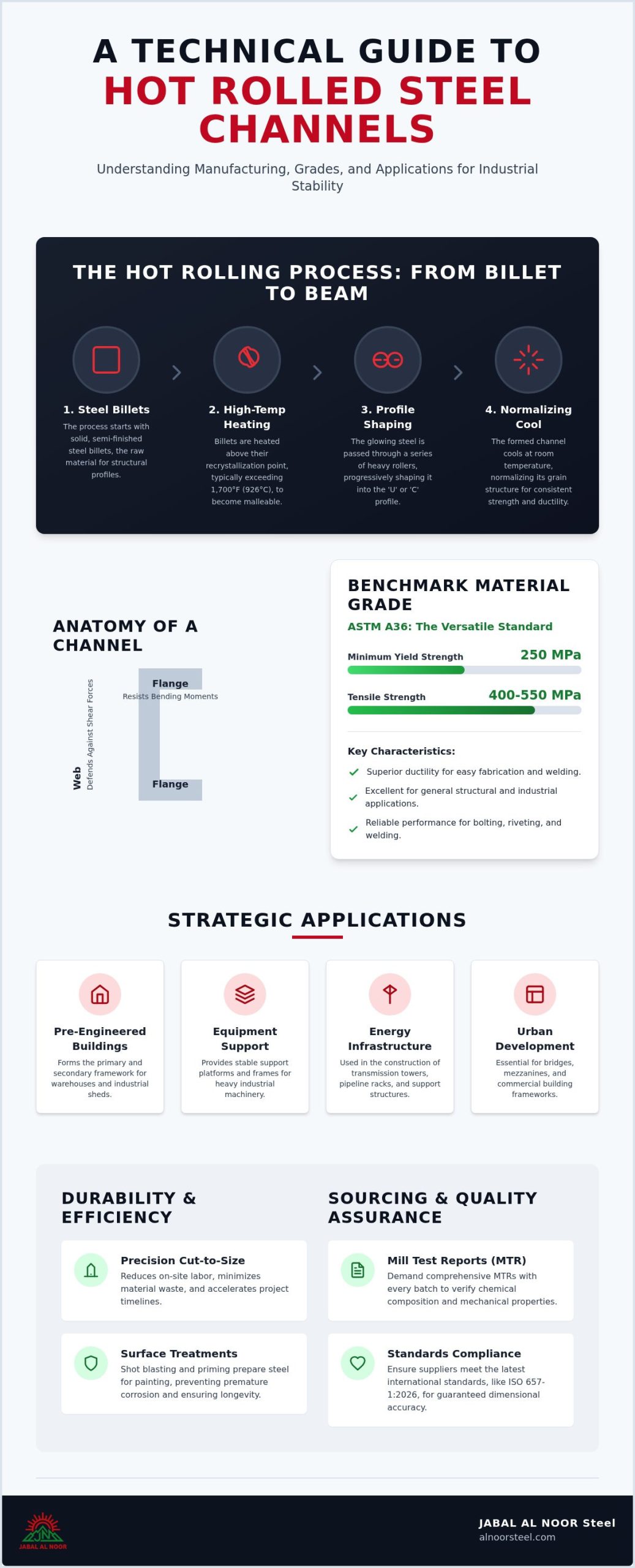
Hot Rolled Steel Channels: Technical Guide 2026

Hot Rolled Steel Channels: Technical Guide 2026

With the release of ISO 657-1:2026 in April, the global standards for structural steel dimensions have undergone their most significant refinement in years. You likely recognize that even a minor deviation from these updated international benchmarks can compromise the safety and longevity of a high-stakes infrastructure project. Sourcing hot rolled steel channels that meet exact cut-to-size specifications while resisting corrosion in aggressive industrial environments remains a persistent challenge for procurement teams and structural engineers. It’s a high-stakes environment where material non-compliance isn’t just a logistical error; it’s a fundamental structural risk.

This technical guide provides the authoritative expertise you need to master material grades like ASTM A36 and A572, ensuring your projects are built with unwavering industrial stability. We’ll examine the latest 2026 specification updates, the critical role of specialized surface treatments, and the logistical frameworks required to secure a dependable long-term supply partner. By the end of this analysis, you’ll have the technical proficiency to identify the precise channel dimensions and grades necessary to maintain operational excellence across any large-scale application. Whether you’re managing energy infrastructure or urban development, understanding these specifications is the key to enduring structural integrity.

Key Takeaways

  • Understand the fundamental manufacturing mechanics of hot rolled sections and how the recrystallization process improves material ductility for complex industrial fabrication.
  • Learn to identify the correct material grades, such as ASTM A36, to ensure your hot rolled steel channels provide the necessary load-bearing reliability for structural frameworks.
  • Examine the strategic application of MS channels in Pre-Engineered Buildings (PEB) and heavy equipment support systems to optimize structural stability and operational safety.
  • Discover how utilizing precision cut-to-size services and specialized surface treatments like shot blasting can significantly reduce on-site labor and prevent premature corrosion.
  • Master the procurement process by evaluating national suppliers based on transparent certification standards and the provision of comprehensive Mill Test Reports.

Understanding Hot Rolled Steel Channels: Geometry and Manufacturing Excellence

Hot rolled steel channels are fundamental components in the construction of large-scale infrastructure and industrial frameworks. These sections, often referred to as MS channels, are structural profiles with a distinctive “U” or “C” shape. They are manufactured by passing steel through heavy rollers at extreme temperatures, a process that ensures high load-bearing capacity and structural predictability. Jabal Al Noor Steel maintains a rigorous focus on these geometric standards to ensure every profile provides the stability required for heavy-duty engineering.

The defining characteristic of hot rolled steel channels is the temperature at which they are formed. When steel is heated above its recrystallization threshold, typically exceeding 1,700°F, it enters a malleable state. This allows for the creation of large, complex shapes without the internal stresses associated with cold-forming. Consequently, Structural steel produced this way exhibits superior ductility. This makes the material easier to weld, cut, and fabricate on-site, which is essential for projects with demanding timelines.

Unlike the smooth, oily surface of cold-finished steel, these channels possess a characteristic blue-grey, scaled finish. This mill scale is a natural byproduct of the high-temperature cooling process. While it provides a degree of initial protection, it often requires surface treatments like shot blasting before painting or galvanizing. Understanding this finish is vital for engineers who must account for surface preparation costs in their project budgets.

The Hot Rolling Process: From Billets to Structural Profiles

The journey starts with solid steel billets. These are heated until they glow, ensuring they can be shaped by successive rolling stands. Each pass through the rollers refines the dimensions until the precise “U” or “C” profile is achieved. Once the desired geometry is reached, the steel is allowed to cool at room temperature. This controlled cooling phase is essential; it normalizes the grain structure, providing the consistent mechanical properties that Jabal Al Noor Steel guarantees for every batch. This methodical approach results in a finished product that resists cracking under heavy stress.

Anatomy of a Channel: Web and Flange Dynamics

Every channel consists of a vertical web and two horizontal flanges. The web is the primary defender against shear forces, maintaining the section’s height under load. In contrast, the flanges provide the necessary resistance against bending moments. Standard channels often feature a slight taper on the inner flange surfaces, which is a hallmark of traditional hot rolling. However, modern engineering also utilizes parallel flange channels for easier bolting and connection. You can explore these variations within the Jabal Al Noor Steel inventory to find the exact fit for your structural requirements.

Material Grades and International Standards for Structural Integrity

Selecting the appropriate material grade is a critical decision that dictates the load-bearing reliability and long-term safety of any industrial structure. It’s not merely about dimensions; it’s about the chemical and mechanical properties that allow hot rolled steel channels to withstand specific environmental and physical stresses. Jabal Al Noor Steel prioritizes material compliance to ensure that every section integrated into a project meets the rigorous demands of modern engineering.

ASTM A36: The Versatile Standard

ASTM A36 remains the industry benchmark for general-purpose structural steel. This grade provides a minimum yield strength of 250 MPa and a tensile strength ranging from 400 to 550 MPa. Because of its relatively low carbon content, A36 steel channels are exceptionally well-suited for welding, bolting, and riveting. These characteristics make them a staple in the manufacturing of agricultural equipment, heavy-duty trailers, and architectural framing where ease of fabrication is as vital as structural support.

EN 10025 Grades: S235JR vs. S355JR

European standards offer a different categorization based on specific yield points. While S235JR is frequently used for lighter structural work, S355JR provides a significantly higher yield strength, making it the superior choice for heavy-duty infrastructure and large-scale energy projects. The “JR” suffix is a technical designation indicating that the material has undergone impact testing at room temperature (20°C) to verify its toughness. S355JR is the preferred grade for high-stress structural members that must maintain integrity under immense weight and pressure.

International Grade Equivalency Framework

Navigating the transition between ASTM, EN, and JIS standards requires a precise cross-reference framework. While ASTM A36 is often compared to EN S235JR or JIS SS400, they are not always identical in their chemical composition or permissible tolerances. Engineering teams must ensure that the selected material aligns perfectly with national building codes and project-specific safety factors. For a deeper understanding of regional requirements, you can consult our Structural Steel Quality Standards UAE: A 2026 Reference Guide.

The balance between strength and weldability is maintained through strict control of carbon and manganese levels within the steel. This precision prevents the material from becoming brittle during the cooling process or subsequent fabrication. To ensure your project utilizes only the highest quality certified sections, we invite you to explore the Jabal Al Noor Steel inventory for comprehensive material options.

Strategic Applications of MS Channels in Modern Engineering

The utility of hot rolled steel channels extends far beyond basic framing. In heavy industry, these sections provide a specialized geometry that balances weight efficiency with high torsional rigidity. This makes them indispensable for large-scale projects where structural integrity is a non-negotiable requirement. Jabal Al Noor Steel supplies these profiles to sectors ranging from energy production to logistics, ensuring that every application benefits from the material’s inherent durability and compliance with international standards.

Structural Frameworks and PEB Construction

In Pre-Engineered Buildings (PEB) and industrial warehouses, MS channels serve as the primary secondary structural members. They are typically utilized as purlins and girts, providing the necessary support for wall and roof panels. Their “C” or “U” shape allows for efficient nesting and bolting, which accelerates the construction timeline without sacrificing strength. These sections are often integrated with other Long Products: The Foundation of Modern Infrastructure to create a cohesive, high-performance skeleton for large-span structures. The exceptional weight-to-strength ratio of these channels reduces the overall dead load of the building, allowing for more expansive interior spaces and optimized foundation designs.

Industrial Support Systems and Framework

Beyond building envelopes, hot rolled steel channels are foundational to industrial infrastructure. In the oil and gas sector, they form the backbone of complex pipe racks and equipment skids, where they must withstand both mechanical stress and environmental exposure. Their structural predictable nature is equally valued in several other specialized applications:

  • Machinery Support: Creating robust frames for heavy industrial equipment to minimize vibration and ensure alignment.
  • Access and Safety: Fabricating stair stringers, handrails, and mezzanine floor supports in manufacturing facilities.
  • Renewable Energy: Serving as the primary mounting structures for solar panel arrays, where long-term endurance is critical.

The transportation and infrastructure sectors also rely heavily on these profiles. In truck chassis and rail car manufacturing, channels provide the necessary stiffness to handle dynamic loads during transit. Similarly, in bridge construction and infrastructure repairs, they are often used as bracing members or for reinforcing existing concrete structures. By selecting the correct grade and dimensions, engineers ensure that these components contribute to a lifetime of service in even the most demanding environments.

Hot Rolled Steel Channels: Technical Guide 2026

Enhancing Durability: Cut-to-Size and Surface Treatment Protocols

Raw structural steel is rarely ready for immediate installation upon leaving the rolling mill. To achieve the rigorous quality benchmarks required for national infrastructure and energy projects, hot rolled steel channels must undergo precise secondary processing. Jabal Al Noor Steel provides integrated value-added services to ensure that every section delivered is optimized for durability and logistical efficiency. These protocols don’t just prepare the steel for use; they are essential for ensuring the long-term stability of the entire structural assembly.

The Advantages of Cut-to-Size Customization

Standard mill lengths of 6 or 12 meters often result in substantial on-site waste and require intensive manual labor for field modifications. Jabal Al Noor Steel utilizes advanced industrial sawing and shearing technology to provide precision cut-to-size services that adhere to tight dimensional tolerances. This capability is detailed extensively in our Cut-to-Size Steel Service in the UAE: A Comprehensive Procurement Reference. By sourcing pre-cut sections, contractors can significantly reduce their logistical burden. Precision cutting also ensures that joints and connections fit perfectly during the first assembly, which is critical for maintaining the structural integrity of large-span frameworks. This methodical approach to material preparation reflects our commitment to operational excellence and long-term value for our partners.

Surface Treatments: Shot Blasting and Priming

The blue-grey mill scale described in our discussion of manufacturing geometry is a brittle layer that can flake off, taking any paint or coating with it. Shot blasting is the definitive mechanical process used to propel abrasive media against the steel at high velocity. This removes all contaminants and creates a specific surface roughness, known as a “profile,” which is necessary for high-performance industrial coatings. Following this, the application of a primer is non-negotiable for structural longevity. We offer several treatment options to meet specific environmental demands:

  • Red Oxide Primers: A dependable and cost-effective base for general industrial and architectural applications.
  • Zinc-Rich Primers: Provides cathodic protection, making it the superior choice for high-salinity coastal zones or humid environments.
  • Compatibility: Treated channels remain fully compatible with subsequent hot-dip galvanization or specialized epoxy coatings.

These surface treatments ensure that your hot rolled steel channels maintain their structural capacity for decades, even in the harshest industrial climates. If your project requires high-precision sections ready for immediate deployment, explore our customized steel channel options today.

Strategic Procurement: Sourcing Quality Structural Steel for Large-Scale Projects

Procuring structural steel for large-scale infrastructure is a strategic undertaking that demands meticulous attention to material provenance and logistical reliability. Sourcing hot rolled steel channels for high-volume industrial applications involves more than comparing unit costs; it requires verifying that every section possesses the transparent certification necessary to meet stringent building codes. Jabal Al Noor Steel understands that in the heavy industry sector, a supplier’s capability is measured by their ability to provide consistent, high-grade material without compromising project timelines. This focus on reliability is what transforms a vendor into a foundational partner for national development.

Evaluating Supplier Inventory and Compliance

A dependable steel stockist must maintain an extensive and diverse inventory of MS channels, beams, and angles to accommodate the fluctuating needs of complex projects. This depth of stock ensures that contractors don’t face delays due to material shortages or limited size availability. Beyond mere volume, the value of a partner lies in their technical expertise and adherence to international standards. Prioritizing partners with a deep understanding of the Steel Suppliers in UAE: A 2026 Strategic Procurement Guide ensures that your procurement strategy is aligned with the latest market requirements and quality benchmarks. Jabal Al Noor Steel provides comprehensive Mill Test Reports (MTRs) for all products, offering the transparency required for engineering audits and quality assurance protocols. This commitment to compliance guarantees that every component integrated into your structure is a verified asset that supports long-term structural integrity.

Logistics and Support for Industrial Contracts

The success of a project often hinges on the logistical efficiency of the supply chain. Timely delivery is essential for maintaining the methodical pace of construction and engineering sectors. A supplier must demonstrate a robust national delivery network capable of reaching diverse project sites with precision and predictability. At Jabal Al Noor Steel, we prioritize logistical excellence to ensure your structural components arrive exactly when they are needed. You can view our current availability and specifications through the Jabal Al Noor Steel Shop, which serves as a vital resource for planning your material requirements. We also encourage direct consultation for projects requiring specialized surface treatments or precision customization. This collaborative approach allows us to tailor our support to the specific pressures and high-stakes requirements of your most ambitious energy and infrastructure projects. Choosing a partner who values consistency and ethical conduct ensures long-term value and operational excellence for all collaborators.

Securing Structural Excellence for Future Infrastructure

The 2026 technical landscape demands a level of precision that leaves no room for material non-compliance. Mastering the nuances of geometry, grade selection, and surface preparation is the only way to ensure structural integrity in high-stakes projects. By prioritizing certified standards and utilizing precision processing, you protect your infrastructure against premature failure and environmental degradation. Jabal Al Noor Steel remains committed to supporting these standards through our extensive national inventory of long products and specialized in-house capabilities. Our specialized shot blasting and priming services ensure that your hot rolled steel channels are delivered ready for immediate, long-term deployment. We invite you to partner with a veteran of the industry who values precision and ethical conduct as much as you do. Explore our full range of MS channels and structural steel at Jabal Al Noor Steel to secure a dependable foundation for your next industrial project. We look forward to supporting your vision with unwavering quality and logistical efficiency.

Frequently Asked Questions

What is the difference between a hot rolled channel and a cold rolled channel?

Hot rolled channels are formed at temperatures exceeding 1,700°F, which makes the steel more malleable and cost-effective for large structural sections. In contrast, cold rolled channels are processed at room temperature to achieve superior dimensional precision and a smoother surface finish. While cold rolling increases strength through strain hardening, hot rolled steel channels remain the industry standard for heavy-duty infrastructure due to their excellent ductility and ease of welding in demanding environments.

Which steel grade is best for heavy industrial MS channels?

For heavy industrial applications, high-strength low-alloy grades like ASTM A572 Grade 50 or EN 10025 S355JR are generally considered the best options. These grades offer a higher yield strength compared to standard carbon steel, allowing for reduced material weight without sacrificing structural integrity. Choosing a high-strength grade is essential for high-stress members in oil and gas pipe racks or large-span warehouse frames where load-bearing reliability is the primary concern for engineering teams.

Do hot rolled steel channels require surface treatment before installation?

While not strictly mandatory for every indoor application, surface treatment is highly recommended for any structural steel exposed to the elements. The mill scale on hot rolled steel channels is brittle and can trap moisture, leading to rapid corrosion over time. Shot blasting to a specific profile followed by the application of a zinc-rich or red oxide primer ensures long-term durability. This is especially vital in the humid or saline climates typical of national infrastructure projects.

Can hot rolled steel channels be easily welded?

Yes, hot rolled channels are exceptionally easy to weld using standard industrial techniques such as MIG, TIG, or arc welding. The high-temperature manufacturing process normalizes the grain structure and reduces internal stresses, which minimizes the risk of cracking or warping during the welding process. This weldability is one of the primary reasons why ASTM A36 and S235JR grades are favored for fabricating complex machinery frames and secondary structural supports in the construction sector.

What are the standard lengths available for MS channels in the UAE?

Standard mill lengths for MS channels in the national market are typically 6 meters and 12 meters. However, relying solely on standard lengths often leads to excessive material waste and increased on-site labor costs. JABAL AL NOOR Steel provides specialized cut-to-size customization to meet exact project specifications. This service allows contractors to receive precision-engineered components that are ready for immediate installation, effectively streamlining the construction timeline for large-scale industrial contracts and energy infrastructure.

How does the “U” shape of a channel contribute to its load-bearing capacity?

The “U” or “C” geometry of a channel is specifically engineered to optimize the distribution of stress across the section. The vertical web provides the necessary resistance against shear forces, while the horizontal flanges offer stability against bending moments. This configuration makes channels ideal for use as purlins or girts in Pre-Engineered Buildings. When properly oriented, the shape provides a high strength-to-weight ratio, allowing for lighter structures that don’t compromise on overall safety or endurance.

Is ASTM A36 equivalent to S235JR for structural applications?

ASTM A36 and EN S235JR are often treated as functional equivalents in general structural applications, though they belong to different regulatory frameworks. ASTM A36 is the American benchmark for carbon structural steel, while S235JR is the European standard defined under EN 10025. While their yield strengths are comparable, engineers must verify specific chemical requirements and impact testing results for each project. JABAL AL NOOR Steel ensures all supplied material meets the precise international grade compliance requested for your contract.

What industries typically use hot rolled steel channels?

Hot rolled steel channels are utilized across a diverse range of heavy industries, including construction, energy, and logistics. They are foundational components in Pre-Engineered Buildings, oil and gas pipe racks, and solar mounting structures. Additionally, the transportation sector relies on these sections for manufacturing truck chassis and rail cars. Their versatility and structural predictability make them indispensable for any application requiring robust, long-term support in high-stakes engineering environments across the country.

Optimizing Steel Profiles for Engineering Projects: A Technical Case Study

Optimizing Steel Profiles for Engineering Projects: A Technical Case Study

What if the difference between a project’s structural failure and its long-term endurance isn’t found in the architectural blueprints, but in the specific chemical composition and geometric precision of its steel? For professionals managing heavy industry infrastructure, the choice of steel profiles for engineering projects represents a critical intersection of material science and logistical reality. You recognize that standard lengths often lead to excessive material wastage, while inconsistent supply of international grades like ASTM or EN can stall even the most robust timelines. These operational hurdles, combined with the persistent threat of corrosion in harsh industrial environments, demand a more methodical approach to procurement.

We understand that maintaining rigorous engineering safety standards requires a partner who values precision as much as you do. This technical case study reveals how strategic selection and customization of steel profiles ensure structural integrity while optimizing logistical efficiency. We’ll explore how utilizing specific grades such as ASTM A572 Grade 50, coupled with advanced surface treatments and cut-to-size customization, significantly reduces on-site fabrication time and secures long-term value for bulk orders. By the end of this analysis, you’ll see how a streamlined supply chain and adherence to the latest AISC standards directly impact the durability and efficiency of large-scale engineering works.

Key Takeaways

  • Learn to evaluate cross-sectional properties, such as the moment of inertia and section modulus, to ensure material selection aligns with specific load and stress requirements.
  • Discover how strategic customization and advanced surface treatments for steel profiles for engineering projects mitigate material wastage and prevent corrosion in harsh industrial environments.
  • Understand the structural advantages of a hybrid approach, combining Universal Beams and Hollow Sections, to optimize the load-bearing capacity of complex industrial frameworks.
  • Gain insights into streamlining project timelines by integrating cut-to-size services and logistical planning into the early stages of procurement.
  • Identify the key technical benchmarks and international standards, such as ASTM and EN grades, required to maintain compliance in large-scale infrastructure developments.

The Role of Structural Steel Profiles in Modern Engineering Projects

Structural steel profiles serve as the essential load-bearing skeleton for the vast majority of industrial infrastructure. These components provide the necessary rigidity and strength to withstand immense gravitational and lateral forces. The evolution of engineering requirements has transitioned from basic support structures to highly complex, high-tensile frameworks that prioritize weight optimization without compromising safety. Selecting the correct Structural steel configuration is no longer just a procurement task; it’s a fundamental engineering decision that dictates the project’s long-term endurance.

In the context of modern industrial applications, the use of specialized steel profiles for engineering projects has become standard practice. This shift is driven by the need for material traceability and rigorous grade certification. In high-stakes sectors like oil and gas or large-scale energy infrastructure, using non-certified materials introduces unacceptable risks. Every beam or channel must be traceable to its mill of origin. This ensures that the chemical composition and mechanical properties align perfectly with the structural design requirements specified by the engineers.

Foundational Profiles: Beams, Channels, and Angles

The primary inventory used across the UAE industrial landscape consists of several critical shapes, each serving a distinct mechanical purpose. MS Beams, including H-beams, I-beams, and Universal Beams, remain the primary choice for horizontal load distribution. Their geometry is specifically designed to resist bending under heavy vertical loads. Structural channels complement these by providing lateral stability and essential support in secondary frameworks or as functional cladding supports. Angle bars offer immense versatility. They’re the preferred choice for bracing, complex trusses, and critical connection points where two surfaces meet at a right angle.

Meeting International Engineering Standards

Compliance with global benchmarks is a non-negotiable requirement for ensuring structural safety and project longevity. Standards like EN 10025 and ASTM A36 define the essential quality parameters for yield strength and weldability. For instance, ASTM A36 is widely utilized for its excellent structural properties in bolted or welded constructions. Additionally, JIS standard profiles are frequently integrated into regional designs that follow Japanese engineering methodologies. Maintaining these benchmarks ensures that every component performs predictably under stress. For a deeper look at these requirements, consult our Structural Steel Quality Standards UAE guide to understand how these certifications impact your procurement strategy.

Technical Selection: Matching Steel Profiles to Load and Stress Requirements

Selecting the appropriate geometry for structural members requires a rigorous analysis of cross-sectional properties. Engineers primarily focus on the moment of inertia and the section modulus to determine how a profile will react under specific stress conditions. The moment of inertia quantifies a shape’s resistance to bending and deflection, while the section modulus indicates the strength of the cross-section relative to its depth. The American Institute of Steel Construction (AISC) provides the technical framework for these calculations, ensuring that the chosen steel profiles for engineering projects meet the necessary safety margins for their intended spans. Precision in these calculations prevents structural over-design, which can lead to unnecessary costs and excessive weight.

Optimizing the weight-to-strength ratio is vital for reducing foundation loads in large-scale infrastructure. The choice of steel profiles for engineering projects involves more than just selecting a shape; it’s about matching material chemistry to mechanical demand. Several factors influence this selection process:

  • Design Spans: The distance between supports dictates the required depth and weight of the profile to prevent sagging.
  • Dead Loads: The cumulative weight of the permanent structural elements must be supported without compromising the factor of safety.
  • Dynamic Stressors: Environmental forces such as wind, seismic activity, and vibration from heavy machinery require profiles with high fatigue resistance.

Optimizing with Hollow Sections

Square, rectangular, and circular hollow sections are increasingly preferred for architectural engineering and space frames due to their structural efficiency. Their primary engineering advantage lies in superior torsional resistance. Unlike open sections, hollow profiles provide uniform strength across multiple axes, making them ideal for columns and members subjected to multi-directional loading. These sections also offer a smaller surface area, which reduces the volume of protective coatings required. For more information on sourcing these specific components, refer to our guide on Hollow Section Steel Suppliers in UAE.

Selecting High-Grade Materials for Stress-Heavy Zones

In environments where structural demands exceed the capacity of standard mild steel, specifying high-strength alloys becomes necessary. ASTM A572 Grade 50 is frequently used in stress-heavy zones because it offers a higher yield strength without a proportional increase in weight. This grade is essential for projects requiring long spans or heavy equipment support where reducing the overall tonnage is a priority. While general-purpose frameworks often utilize standard MS, specialized industrial environments may require stainless steel to combat extreme corrosion. You can browse our full inventory of certified structural materials to find the exact grade required for your technical specifications.

Engineering Optimization Through Custom Processing and Surface Treatments

The transition from technical selection to physical implementation represents a critical phase in the lifecycle of any infrastructure project. While choosing the correct grade is vital, the logistical efficiency of steel profiles for engineering projects is often determined in the processing warehouse. Receiving project-ready components significantly reduces on-site fabrication errors and accelerates assembly timelines. By shifting the complex work of cutting and coating from the construction site to a controlled industrial environment, engineers can maintain higher quality benchmarks while simultaneously lowering operational costs.

Receiving steel that is already prepared for immediate installation offers a distinct economic advantage. It eliminates the need for specialized cutting machinery and large-scale coating setups at the project location. This reduction in on-site labor and equipment requirements translates directly into a safer work environment and a more predictable project schedule. The synergy between material procurement and value-added processing ensures that the structural integrity established during the design phase is preserved through to the final assembly.

Precision Cut-to-Size Services

Integrating exact-length beams and columns into the procurement process is a strategic move that directly impacts the project’s bottom line. When profiles are delivered according to precise cut lists derived from engineering CAD designs, the scrap rate drops significantly. This precision eliminates the need for on-site disposal of offcuts and reduces the associated costs of material wastage. Factory-controlled tolerances ensure that every connection point aligns perfectly, minimizing the need for corrective on-site welding or secondary cutting. This level of accuracy is essential for maintaining the structural integrity of high-tensile frameworks where even minor deviations can lead to stress concentrations. Procuring custom length steel beams UAE suppliers provide allows engineering teams to integrate factory-precision cutting directly into the supply chain, achieving zero-waste efficiency from the outset. For a comprehensive overview of how this process transforms supply chain efficiency, see our guide on cut to size steel service UAE procurement practices.

Surface Preparation: Shot Blasting and Priming

The longevity of a structure in harsh industrial environments depends heavily on the quality of its initial surface preparation. Shot blasting is the most effective method for removing mill scale and rust, which are the primary catalysts for sub-film corrosion. This process provides a clean, textured surface that is scientifically optimized for coating adhesion. For a detailed technical overview, see our guide on Steel Plate Shot Blasting in the UAE.

Following the cleaning process, applying a high-quality primer is essential to protect the freshly exposed steel from oxidation. Priming serves as a critical foundation for high-performance industrial coatings, ensuring they remain bonded under extreme thermal and mechanical stress. Our Steel Surface Priming in UAE technical guide explains how this synergy between material grade and surface treatment extends the service life of structural components. By receiving steel that is already shot-blasted and primed, engineering teams can focus on assembly rather than environmental protection, resulting in a more streamlined and reliable construction process.

Case Analysis: Solving Structural Challenges in Industrial and Infrastructure Projects

Heavy industrial warehouse construction frequently encounters structural bottlenecks where conventional design choices lead to excessive material use or restrictive interior clearances. In recent technical evaluations of large-scale facilities, engineers identified that over-reliance on a single profile type often results in inefficient load paths. To address this, many projects are now adopting a hybrid profile approach. By integrating Universal Beams for primary spans with Hollow Sections for columns and secondary supports, designers can maximize interior volume while minimizing the total tonnage of steel profiles for engineering projects.

This strategic integration doesn’t just improve aesthetics; it delivers measurable results. Implementing this hybrid methodology has allowed some projects to achieve a 15% reduction in total steel weight without compromising the safety margins required by the 2024 International Building Code (IBC). Jabal Al Noor Steel serves as a foundational pillar in these scenarios, providing the technical expertise and inventory depth necessary to facilitate such complex procurement requirements. You can source high-performance steel profiles from our extensive inventory to begin optimizing your own structural frameworks.

Infrastructure Resilience in Harsh Climates

Coastal engineering projects across the UAE present a unique challenge: mitigating the relentless impact of high salinity and humidity. Structural integrity can be quickly compromised if standard carbon steel is left unprotected in these environments. The implementation of GI (Galvanized Iron) and Stainless Steel profiles for exposed elements has proven to be the most effective solution for long-term resilience. These materials provide an inherent barrier against oxidation, significantly extending the service life of national infrastructure. By selecting corrosion-resistant grades from the outset, engineering teams reduce the frequency of maintenance cycles and ensure the enduring stability of public works.

Streamlining Logistics for National Contracts

Coordinating the supply of steel profiles for engineering projects across multiple sites requires a sophisticated logistical framework. Bulk delivery for national contracts often fails when stockists lack the necessary regional reach or inventory volume. A successful strategy relies on leveraging a centralized inventory and a robust national distribution network to maintain project momentum. This approach facilitates just-in-time delivery, ensuring that heavy structural components arrive exactly when the site team is ready for installation. By eliminating on-site storage bottlenecks and maintaining a consistent supply of certified grades, contractors can avoid the costly delays that often plague large-scale infrastructure developments.

Strategic Procurement: Sourcing and Logistics for Large-Scale Engineering

The success of large-scale infrastructure depends as much on supply chain stability as it does on structural design. Sourcing steel profiles for engineering projects at this magnitude requires a stockist with a comprehensive regional inventory and the logistical capacity to support multi-phase developments. A procurement failure during the sourcing stage can trigger a cascade of delays, impacting everything from on-site labor schedules to the financial viability of the contract. Lead engineers and procurement officers must prioritize partners who demonstrate technical proficiency through rigorous certification and transparent documentation management.

Managing large-scale contracts involves more than simple transactions. It requires a partner who understands the nuances of bulk supply, providing the necessary credit facilities and detailed documentation that heavy industry demands. Jabal Al Noor ensures operational excellence by acting as a steady, dependable link in the industrial chain, prioritizing long-term partnership and precision over aggressive marketing. This grounded approach provides the industrial stability required for projects that form the backbone of national infrastructure.

Managing Bulk Steel Supply Chains

Ensuring material availability for phase-based engineering projects is a logistical challenge that requires meticulous planning and deep stock reserves. When a project moves from foundation work to structural framing, the specific grades and profiles must be ready for immediate dispatch to prevent momentum loss. A reliable supply chain is built on several foundational pillars:

  • Transparent Documentation: Every delivery must be accompanied by Mill Test Certificates (MTC) to verify that the chemical composition and mechanical properties align with design specs.
  • Phase-Specific Inventory: Maintaining a vast stock of ASTM A36, S235JR, and Grade 50 ensures the right material is available for the right phase of construction.
  • Logistical Coordination: Coordinating heavy-load transport across the UAE requires a deep understanding of regional transport regulations and specific site access constraints.

Selecting a Dependable Industrial Partner

Regional expertise is a vital asset when navigating the specific industrial requirements of the UAE. A dependable partner doesn’t just deliver materials; they provide the technical assurance that every component meets the rigorous quality benchmarks the region upholds. Building a long-term partnership with an established entity ensures consistency in material quality and ethical conduct, which are the cornerstones of successful infrastructure projects. It’s about finding a veteran guide that understands the high-stakes requirements of the energy and construction sectors.

As the industry moves toward more complex and high-tensile frameworks, the need for a transparent and reliable supply partner becomes even more pronounced. By choosing a veteran of the industrial landscape, you secure a foundation of precision and logistical efficiency. You can optimize your engineering project with Jabal Al Noor Steel by accessing our comprehensive inventory and value-added processing services.

Securing the Future of Industrial Infrastructure

Achieving structural excellence in heavy industry requires a precise alignment of material science, custom fabrication, and logistical foresight. We’ve explored how matching cross-sectional properties to specific load demands prevents over-design while ensuring absolute safety. Integrating factory-controlled surface treatments and cut-to-size services further optimizes on-site timelines by delivering project-ready components. These efficiencies are fundamental to maintaining the rigorous standards required for large-scale infrastructure and energy developments.

The strategic procurement of steel profiles for engineering projects serves as the final, critical step in ensuring long-term structural endurance. As an ISO-compliant structural steel stockist with a national distribution network across the UAE, Jabal Al Noor provides the industrial stability your projects demand. Our comprehensive value-added processing services ensure that every beam, channel, and hollow section arrives ready for immediate installation. We invite you to explore our full inventory of engineering steel profiles to secure a dependable partner for your next development. We look forward to supporting your vision with precision and operational excellence.

Frequently Asked Questions

What are the most common steel profiles used in UAE engineering projects?

The most common steel profiles for engineering projects in the UAE include MS Beams, structural channels, angle bars, and hollow sections. Engineers frequently specify Universal Beams and Columns for primary load distribution due to their superior bending resistance. Additionally, square and rectangular hollow sections are widely utilized for architectural supports and space frames. These profiles are typically sourced in international grades such as ASTM A36 or S235JR to ensure compliance with regional safety standards.

How does cut-to-size customization benefit heavy engineering contractors?

Receiving custom lengths through cut to size steel service UAE providers directly reduces material wastage and on-site fabrication time. By utilizing beams and columns at precise lengths derived from CAD designs, contractors eliminate the need for secondary cutting and disposal of offcuts. This precision minimizes assembly errors and allows for a more predictable construction schedule. It’s an essential strategy for optimizing project budgets and ensuring that structural components fit perfectly within complex industrial frameworks without requiring extensive modifications.

Why is shot blasting necessary for structural steel profiles?

Maintaining structural integrity in harsh environments requires shot blasting to remove mill scale, rust, and contaminants from the steel surface. This process creates a clean, textured profile that is essential for the superior adhesion of industrial coatings and primers. Without proper preparation, protective layers can fail prematurely, leading to sub-film corrosion and weakened frameworks. It ensures that the steel can withstand environmental stressors while maintaining its load-bearing capacity over an extended service life.

Which steel grade is best for high-load industrial frameworks?

For frameworks subjected to extreme stress, ASTM A572 Grade 50 is the preferred choice due to its high yield strength and excellent weight-to-strength ratio. This grade allows engineers to support immense loads with less total steel tonnage, which can reduce foundation requirements and overall material costs. While standard mild steel is sufficient for general-purpose supports, Grade 50 provides the necessary mechanical properties for long-span structures and heavy equipment platforms facing significant dynamic stress.

How do hollow sections compare to open beams in structural engineering?

While open beams are highly efficient for vertical load distribution across horizontal spans, hollow sections offer superior torsional resistance and multi-axial strength. These profiles provide uniform strength that makes them ideal for columns and bracing in space frames. Their closed geometry also results in a smaller surface area, which can reduce the cost and volume of protective coatings required for environmental protection in industrial settings, offering a distinct advantage over standard beams.

Can Jabal Al Noor provide international standard certifications for all profiles?

Yes, we provide comprehensive Mill Test Certificates (MTC) and international standard certifications for our entire inventory. As an ISO-compliant stockist, we ensure that every batch of steel meets the rigorous chemical and mechanical benchmarks defined by JIS, EN, and ASTM standards. This transparency is vital for maintaining material traceability and ensuring that all steel profiles for engineering projects align perfectly with the technical specifications required by structural consultants and local authorities.

What surface treatments are recommended for steel profiles in coastal areas?

In coastal environments, we recommend a combination of shot blasting, high-performance priming, and the use of GI or stainless steel profiles. Galvanized steel provides an inherent sacrificial layer that protects against the high salinity and humidity characteristic of coastal regions. For carbon steel components, applying a robust epoxy or polyurethane coating over a shot-blasted and primed surface is essential to prevent rapid oxidation and extend the maintenance cycles of the infrastructure.

How does Jabal Al Noor manage bulk delivery for national engineering projects?

We manage bulk delivery through a sophisticated national distribution network and a centralized inventory system that ensures material availability for phase-based projects. Our logistical framework is designed to coordinate heavy-load transport across the UAE, facilitating just-in-time delivery to multiple sites simultaneously. This approach prevents on-site storage bottlenecks and maintains project momentum by ensuring that certified structural components arrive exactly when the installation teams are ready to proceed with assembly.

Hollow Section Steel Suppliers in UAE: A Comprehensive Engineering Guide

Hollow Section Steel Suppliers in UAE: A Comprehensive Engineering Guide

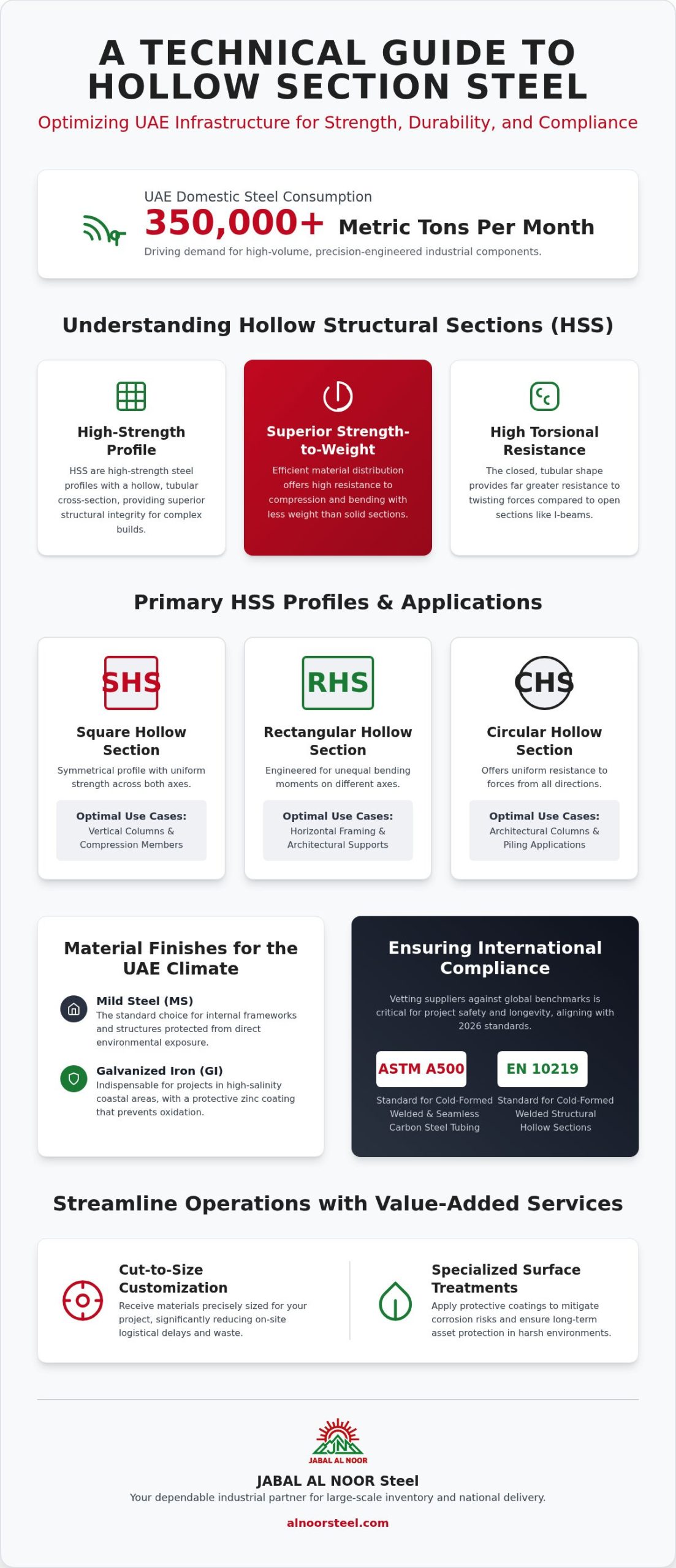
With domestic steel consumption in the UAE now exceeding 350,000 metric tons per month, the pressure on industrial supply chains to maintain both volume and technical precision has never been higher. For engineers and procurement specialists, the challenge isn’t just finding material; it’s securing components that meet rigorous safety codes without facing the common bottlenecks of logistical delays or rigid, non-customized inventory. You recognize that the structural integrity of a major infrastructure project depends on the meticulous selection of materials that adhere to strict international benchmarks.

Identifying dependable hollow section steel suppliers UAE is a critical step in ensuring your project aligns with the latest 2026 standards for durability and performance. This guide provides the technical clarity you need to navigate the sourcing process with confidence. You’ll gain a thorough understanding of the structural differences between SHS, RHS, and CHS profiles, alongside a breakdown of essential compliance standards like ASTM A500 and EN 10219. We also examine how value-added services, such as cut-to-size customization and specialized surface treatments, can streamline your operations and provide long-term protection for your assets.

Key Takeaways

  • Learn why Hollow Structural Sections (HSS) provide superior strength-to-weight ratios for high-stakes infrastructure projects throughout the Emirates.
  • Identify the critical load-bearing differences between Square Hollow Sections (SHS) and Rectangular Hollow Sections (RHS) to ensure optimal structural performance.
  • Evaluate material compliance by understanding international benchmarks like ASTM A500 and EN 10219 when vetting hollow section steel suppliers UAE.
  • Discover how specialized surface treatments and cut-to-size customization mitigate corrosion risks and reduce on-site logistical delays.
  • Gain insights into selecting a dependable industrial partner capable of maintaining large-scale inventory and ensuring national delivery across the region.

What is Hollow Section Steel and Its Role in UAE Infrastructure?

A Hollow Structural Section (HSS) represents a high-strength steel profile characterized by its hollow, tubular cross-section. These sections are manufactured through either cold-forming or hot-rolling processes, resulting in a product that provides superior structural integrity for complex builds. For engineers engaging with hollow section steel suppliers UAE, understanding this fundamental geometry is the first step in optimizing material selection for local industrial requirements. These profiles are not merely components; they are the essential framework for the region’s most ambitious architectural and energy projects.

One of the primary advantages of HSS is its exceptional strength-to-weight ratio. Unlike solid steel sections, hollow profiles distribute material efficiently around the axis, providing high resistance to compression and bending. This efficiency is particularly valuable in the UAE’s high-rise sector, where torsional resistance is paramount. The closed shape of the hollow section offers far greater resistance to twisting forces than open sections like I-beams or channels. Beyond structural performance, the clean lines and uniform profiles of HSS provide high architectural versatility. This aesthetic appeal is essential for modern UAE facades, where structural members are frequently left exposed as part of the design language.

The Evolution of Steel Construction in the UAE

The UAE’s construction landscape has undergone a significant transformation, moving away from traditional masonry toward steel-intensive modular construction. This shift is driven by the need for rapid infrastructure development and the increasing complexity of modern architectural designs. HSS plays a vital role here by facilitating faster project completion times through prefabricated components. As the market expands, the ability of hollow section steel suppliers UAE to provide consistent, high-grade material becomes a cornerstone of regional growth. The transition to steel allows for greater spans and more creative structural solutions that were previously unattainable with conventional materials.

Key Benefits for Large-Scale Engineering

Large-scale engineering projects benefit from reduced foundation loads because the lighter structural weight of hollow sections permits more efficient load distribution. This reduction in mass allows for more economical foundation designs without compromising safety or longevity. Additionally, the flat surfaces of square and rectangular sections simplify the process of welding and joining in complex industrial fabrications. When sourcing these materials, professionals often turn to established entities like Jabal Al Noor Steel to ensure inventory availability and technical compliance. As of 2026, HSS is commonly defined as a structural profile produced from carbon steel grades such as S235JR, which balances weldability with reliable yield strength for versatile applications.

Primary Types of Hollow Structural Sections (HSS) and Their Applications

Selecting the correct profile geometry is a fundamental decision that dictates the structural efficiency and longevity of any industrial build. Professional hollow section steel suppliers UAE provide three primary shapes: Square Hollow Sections (SHS), Rectangular Hollow Sections (RHS), and Circular Hollow Sections (CHS). Each profile offers distinct mechanical advantages. SHS is prized for its inherent symmetry, which ensures uniform load-bearing capacity across multiple axes, making it the preferred choice for vertical columns and compression members. In contrast, RHS is engineered for applications where bending moments are unequal, providing a high strength-to-weight ratio for horizontal framing and architectural supports.

The choice between material finishes, specifically Mild Steel (MS) and Galvanized Iron (GI), further defines the section’s suitability for the UAE environment. While MS hollow sections are the standard for internal frameworks and protected structures, GI sections are indispensable for projects situated in high-salinity coastal areas. These galvanized sections undergo a protective zinc coating process that prevents oxidation in humid conditions. When engineers specify materials according to an ASTM Specification A500 or A1085, they ensure the steel possesses the necessary yield strength and wall thickness tolerances required for heavy-duty applications. This technical precision is what separates a standard supplier from a true industrial partner.

Square and Rectangular Sections for Frameworks

Square and rectangular profiles are the backbone of the UAE’s industrial warehousing and mezzanine sectors. Their flat surfaces allow for seamless integration with other structural components, such as MS Beams and Channels, creating rigid and space-saving designs. These sections are frequently utilized in industrial sheds and roofing frameworks where high resistance to lateral loads is required. Because they are easy to weld and bolt, they significantly reduce the complexity of on-site assembly. For those managing large-scale procurement, you can view our comprehensive inventory of these essential structural shapes.

Circular Sections in Industrial Piping and Scaffolding

Circular Hollow Sections offer a unique combination of aesthetic appeal and functional performance. Unlike square sections, CHS provides superior torsional resistance, making it ideal for conveyor systems, heavy-duty machinery supports, and even large-scale scaffolding systems. It’s important to distinguish between standard fluid-transport pipes and structural CHS. While standard pipes are rated for internal pressure, structural CHS is manufactured to withstand external loads and environmental stresses. For projects requiring fluid-transport solutions alongside structural steel, understanding the full range of options from industrial steel pipe suppliers UAE ensures you select the correct specification for each application. These sections are also widely used in non-structural capacities, such as safety handrails and decorative fencing, where their smooth profile reduces wind resistance and enhances safety in public spaces. Reliable hollow section steel suppliers UAE ensure these products meet the specific wall thickness requirements necessary for both industrial and architectural roles.

Material Grades and International Standards for UAE Projects

Technical precision is the foundation of industrial safety and structural longevity in the Middle East. When procuring structural tubing, engineers must look beyond basic dimensions to the specific material grades that define a section’s mechanical performance. The two most prominent benchmarks encountered in the region are ASTM A500 and EN 10219. ASTM A500 is the standard for cold-formed carbon steel structural tubing, commonly specified in projects influenced by North American engineering codes. Conversely, EN 10219 represents the European standard for cold-formed welded structural hollow sections, which remains the primary reference for the majority of commercial and industrial construction across the Emirates.

Understanding the distinction between grades like S235JR and S355J2 is essential for heavy industry applications. S235JR is a versatile grade with a minimum yield strength of 235 MPa, making it suitable for general frameworks and secondary structures. For high-load environments, such as industrial platforms or heavy machinery supports, S355J2 is preferred due to its higher yield strength of 355 MPa and superior impact resistance at lower temperatures. Every transaction involving these materials must be supported by a Mill Test Certificate (MTC). This document provides a transparent record of the steel’s chemical and mechanical properties, ensuring the batch meets the project’s design requirements.

Navigating ASTM vs EN Standards

Project specifications often dictate whether ASTM or EN standards are required, with ASTM usually appearing in oil, gas, and energy sector designs. EN standards are the backbone of regional commercial construction. Ensuring material consistency across international supply chains requires a deep understanding of equivalent grades. For instance, ASTM A500 Grade B is frequently viewed as a functional equivalent to EN 10219 S275, though slight variations in ductility and weldability exist. Selecting the right standard ensures that the welding procedures and structural calculations remain valid throughout the project lifecycle. For a comprehensive breakdown of how these international benchmarks align with local regulatory requirements, the structural steel quality standards UAE 2026 reference guide provides detailed technical equivalents and compliance protocols essential for project managers. Projects in the oil and gas sector that require both structural sections and piping systems should also consult a detailed comparison of MS, GI, and stainless steel options from industrial steel pipe suppliers UAE to maintain full compliance across all material categories.

Quality Assurance in Steel Sourcing

Rigorous quality assurance involves verifying the chemical composition of the steel, specifically the levels of carbon, manganese, and phosphorus. High carbon levels can impede weldability, while controlled manganese levels are necessary to maintain tensile strength and elongation benchmarks. Mechanical testing is equally vital to confirm that the steel can withstand the stresses of high-salinity coastal environments and extreme thermal expansion. Sourcing from established hollow section steel suppliers UAE ensures grade compliance and provides the peace of mind that every structural member has undergone standardized testing. This commitment to quality prevents costly structural failures and ensures that your infrastructure meets the highest global benchmarks for endurance.

Hollow Section Steel Suppliers in UAE: A Comprehensive Engineering Guide

Key Procurement Factors: Customization and Surface Treatments

Sourcing from hollow section steel suppliers UAE requires a strategic focus on how materials are prepared for the region’s environmental stressors. While identifying the correct grade is essential, the practical longevity of a structure depends on surface integrity and logistical precision. The UAE’s high-salinity coastal environments and extreme thermal fluctuations demand more than just raw steel. Leading industrial partners provide a suite of value-added services, including advanced surface preparation and precision cutting, to ensure that every structural member arrives on-site ready for immediate and long-term performance.

Shot blasting and priming represent the first line of defense in maintaining structural durability. This process involves cleaning the steel surface of mill scale and rust to create a profile that ensures superior coating adhesion. Without this meticulous preparation, protective layers are prone to delamination, leaving the hollow sections vulnerable to the region’s relentless humidity. National delivery capabilities further complement these technical services, ensuring that bulk supplies reach large-scale industrial sites across the Emirates without the delays typically associated with third-party logistics. Trusting a supplier with integrated processing and transport streamlines the entire procurement cycle.

Surface Treatments for Harsh Climates

Protective coatings are mandatory for any project exposed to the elements in the Middle East. Red oxide priming is a standard, cost-effective solution for internal frameworks, providing a reliable base for further painting. For more aggressive environments, galvanized finishes offer a metallurgical bond with a zinc coating that provides sacrificial protection against oxidation. This layer is critical for protecting the steel against the combined effects of thermal expansion and salt-laden air. Choosing the right finish depends on the project’s proximity to the coast and the expected service life of the infrastructure. For roofing and cladding applications in these same coastal environments, understanding the full range of corrosion-resistant sheet options from a qualified PPGI sheet supplier UAE projects rely on can further strengthen your overall material specification strategy.

Optimizing On-Site Logistics

Modern modular construction thrives on the efficiency of pre-processed components. By utilizing professional cut-to-size services, contractors can virtually eliminate on-site waste and significantly accelerate the assembly phase of a project. This industrial processing reduces the need for specialized cutting labor at the job site, which lowers overall project costs and improves safety standards. Precision cut-to-size customization minimizes project overhead by ensuring that every section arrives according to exact engineering specifications. To secure materials that meet these rigorous standards, you can order hollow sections and surface treatment services directly from our established inventory.

Strategic Sourcing: Partnering with Jabal Al Noor Steel

Jabal Al Noor Steel stands as a foundational pillar in the regional market, distinguishing itself among hollow section steel suppliers UAE through over a decade of operational excellence. We recognize that the heavy industry sector requires more than just a material vendor; it demands a dependable partner that can navigate the complexities of large-scale infrastructure and energy projects. Our role is to serve as a knowledgeable guide, ensuring that every structural component delivered meets the rigorous demands of modern engineering. This authoritative expertise is rooted in our deep connection to the local industrial landscape, where we’ve supported the growth of the nation’s backbone through consistent supply and technical proficiency.

Our comprehensive inventory reflects the scale and diversity of the UAE’s industrial requirements. From MS Beams, H-Beams, and I-Beams to a vast range of high-grade hollow sections, we maintain a stock that’s ready for immediate deployment across the seven emirates. Every product we supply is sourced with an unwavering commitment to international benchmarks, including ASTM, EN, and JIS requirements. This adherence to global quality ensures that our clients receive materials capable of withstanding the unique environmental and structural pressures of the Middle East. By combining this vast supply with advanced processing capabilities and a robust national logistics network, we offer an end-to-end service that minimizes delays and maximizes project efficiency.

Why Industrial Partners Choose Jabal Al Noor

Professional transparency is the cornerstone of our operations. We provide full material certification and grade verification for every batch, acknowledging that Mill Test Certificates are non-negotiable for project compliance and safety audits. Our infrastructure is specifically designed to handle bulk industrial contracts, providing the stability and volume necessary for national-scale infrastructure projects. This grounded approach to partnership has established us as a seasoned veteran in the landscape, prioritizing long-term value and ethical conduct over temporary market trends. Clients trust us because we provide the industrial stability and unwavering confidence required for high-stakes builds; we don’t just supply material, we provide structural certainty.

Next Steps for Procurement Managers

Selecting the correct material grade and dimensions is a technical decision that impacts the safety, longevity, and budget of your entire project. We encourage procurement managers to consult with our technical experts to ensure that the chosen hollow sections align perfectly with your structural calculations and environmental needs. Whether you require specific surface treatments like shot blasting and priming or precision cut-to-size processing to reduce on-site labor, our team is equipped to provide tailored solutions. You can view our full structural steel inventory and shop online to begin the procurement process with a partner that values precision and reliability as much as you do.

Optimizing Your Structural Steel Procurement for Regional Success

Navigating the complex requirements of modern infrastructure demands a deep understanding of material specifications and environmental challenges. By prioritizing the correct geometry, whether it’s the torsional strength of circular sections or the uniform load-bearing of square profiles, you ensure the long-term stability of your build. Adherence to international benchmarks like ASTM A500 and EN 10219 isn’t just a regulatory necessity; it’s the foundation of safety in a high-stakes industrial landscape. When vetting hollow section steel suppliers UAE, look for partners who integrate technical compliance with advanced processing capabilities.

Jabal Al Noor Steel provides the industrial stability your projects require through a comprehensive inventory and a robust national delivery network. As a dedicated stockist of international grades, we offer specialized in-house shot blasting and priming services to protect your assets against the region’s unique climate stressors. We’re committed to maintaining the highest standards of operational excellence for every collaborator we serve. Secure high-grade structural steel for your next project with Jabal Al Noor Steel and build with the confidence that only a seasoned industry veteran can provide. We look forward to supporting your next engineering milestone.

Frequently Asked Questions

What is the difference between SHS and RHS in structural steel?

Square Hollow Sections (SHS) feature equal side lengths that provide uniform load resistance across all axes, making them the preferred choice for vertical columns and compression members. Rectangular Hollow Sections (RHS) have unequal sides designed to resist bending forces in a specific direction. RHS is more efficient for horizontal framing and architectural supports where the load is primarily applied to the major axis.

Which steel grade is most commonly used for hollow sections in the UAE?

The most frequently specified grades in the UAE are S235JR and S355J2, which comply with the EN 10219 standard for cold-formed structural sections. For projects following North American codes, ASTM A500 Grade B is the primary benchmark. These grades offer a balance of weldability and yield strength that’s essential for industrial stability in the region’s diverse infrastructure projects.

Can hollow sections be used for load-bearing columns in high-rise buildings?

Hollow Structural Sections (HSS) are frequently utilized as load-bearing columns because they offer exceptional torsional resistance and a high strength-to-weight ratio. Their closed geometry makes them more resistant to twisting forces than open sections like I-beams. This performance is vital for high-rise frameworks where structural efficiency and reduced foundation loads are critical procurement factors.

Are hollow sections more expensive than traditional I-beams?

While the initial cost per ton of hollow sections can be higher than traditional I-beams, they often result in lower total project costs. Their high strength-to-weight ratio allows for a reduction in the total mass of steel required for the structure. Additionally, their smaller surface area compared to open sections reduces the volume of fireproofing and protective coatings needed for the build.

What surface treatments are recommended for steel used near UAE coastal areas?

For coastal projects, a combination of shot blasting, red oxide priming, and hot-dip galvanization is highly recommended to combat high salinity and humidity. Galvanized Iron (GI) sections provide a sacrificial zinc layer that prevents oxidation in harsh maritime conditions. Professional hollow section steel suppliers UAE provide these in-house surface treatments to ensure long-term structural endurance against the elements. For complementary cladding and roofing materials in these same environments, procurement teams should also evaluate options from a trusted GI and PPGI sheet supplier UAE contractors depend on for verified coating thickness and corrosion resistance.

Do you provide cut-to-size services for all hollow section orders?

We provide comprehensive cut-to-size customization for all hollow section orders to minimize on-site waste and accelerate the assembly process. Our industrial processing facilities ensure every piece is cut to exact engineering tolerances. This service reduces the need for secondary processing at the project site, which lowers labor costs and improves overall project safety for our industrial partners.

How do I verify the quality of hollow section steel from a supplier?

Quality verification is achieved by requesting a Mill Test Certificate (MTC) that details the steel’s chemical composition and mechanical properties. You should ensure the material complies with international standards like ASTM A500 or EN 10219. Working with established hollow section steel suppliers UAE guarantees that your inventory has undergone rigorous testing for tensile strength and yield benchmarks prior to delivery.

What are the standard lengths available for MS hollow sections in the UAE?

MS hollow sections are typically stocked in standard lengths of 6 meters and 12 meters across the UAE market. These standard dimensions facilitate efficient transport and handling for large-scale industrial sites. We also offer specialized customization to provide non-standard lengths that meet the specific requirements of your modular construction or industrial framing project through our national delivery network. For a detailed technical breakdown of grade specifications and compliance requirements, our engineering reference guide for MS hollow sections in UAE infrastructure provides comprehensive 2026 data to support your procurement decisions.

Comprehensive Guide to Mild Steel Angle Bars: Structural Uses and Specifications 2026

Comprehensive Guide to Mild Steel Angle Bars: Structural Uses and Specifications 2026

Could the subtle technical distinction between an ASTM A36 and an EN 10025-2 specification be the silent catalyst for structural fatigue in your next infrastructure project? In the rigorous industrial landscape of the United Arab Emirates, the selection of mild steel angle bars requires a deep understanding of international grade equivalents to ensure material longevity against the region’s unique high-salinity conditions. You likely recognize that the integrity of a framework rests on the precision of its smallest connectors, yet logistical delays and grade confusion can compromise even the most disciplined project timelines.

This comprehensive guide provides the definitive technical framework for structural engineering, offering the clarity needed to optimize load distribution across both equal and unequal profiles. We’ll demystify current 2026 grading standards, including the critical yield strength benchmarks of 250 MPa for carbon structural steel, while addressing the specific environmental durability requirements of the Middle East. You’ll gain a thorough overview of geometric specifications, international standards comparison, and the strategic advantages of partnering with a dependable national supplier for your structural requirements.

Key Takeaways

  • Master the technical distinctions between equal and unequal profiles to optimize load distribution and structural integrity in complex frameworks.
  • Understand how the precise carbon composition of mild steel angle bars ensures superior weldability and ductility for long-term industrial endurance.
  • Navigate international grading standards, including ASTM A36 and EN 10025-2, to guarantee compliance with regional engineering regulations in the UAE.
  • Identify the most effective application frameworks for MS angles within pre-engineered buildings and high-capacity warehouse racking systems.
  • Discover how utilizing cut-to-size customization and national supply chains can minimize on-site waste and significantly accelerate project timelines.

Understanding Mild Steel Angle Bars and Their Structural Significance

Mild steel angle bars represent the foundational architecture of the modern industrial world. These L-shaped structural sections are produced through a meticulous hot-rolling process, where semi-finished steel billets are heated above their recrystallization temperature and passed through industrial rollers. This method results in high-strength profiles that exhibit a uniform grain structure, providing the predictable mechanical performance required for large-scale engineering. Within the fabrication sector, these components are frequently referred to as the universal connector because they offer a reliable method for joining disparate structural members while maintaining rigid alignment.

The technical utility of these sections stems from their specific chemical composition. Unlike high-carbon variants, mild steel contains a lower carbon percentage, typically between 0.05% and 0.25%. This precise balance is critical for the heavy industry projects common across the United Arab Emirates, as it ensures superior weldability and ductility. These properties allow engineers to fuse components securely without the risk of brittle fractures, even when the structure is subjected to the intense thermal expansion and contraction cycles typical of the regional climate.

To better understand the practical applications of these components, watch this helpful video:

Adherence to recognized benchmarks is essential for national structural compliance. The ASTM A36 steel standard remains a primary reference point for these products, specifying the minimum yield strength and chemical requirements necessary for safe deployment. By following these rigorous grading standards, project managers can ensure that the mild steel angle bars integrated into their frameworks will perform consistently under the calculated design loads, reducing the risk of long-term structural fatigue.

The Geometry of the L-Shape

The 90-degree profile of an angle bar is not merely a matter of convenience; it is a calculated geometric solution for resistance against bending and torsion. By positioning two “legs” perpendicular to one another, the section effectively distributes load across both horizontal and vertical planes. This geometry makes it an ideal choice for bracing and reinforcement. When selecting these components, engineers focus on three primary dimensions: the width of the legs, the thickness of the material, and the overall length. These specifications dictate the moment of inertia and the cross-sectional area, which are the defining factors in determining how much weight a specific profile can support before deformation occurs.

Why Mild Steel is the Industry Standard

While high-carbon steel offers greater hardness, it often lacks the structural flexibility required for large-scale national infrastructure projects in the UAE. Mild steel provides a more forgiving profile that can absorb energy and withstand vibrations without snapping. It is also significantly more cost-effective when procured in bulk for warehouse racking, transmission towers, or pre-engineered buildings. This balance of affordability and technical proficiency ensures that mild steel angle bars remain the preferred choice for developers who prioritize both safety margins and logistical efficiency. You can explore a wide range of these structural components through our inventory of long products, which are maintained to meet rigorous international quality benchmarks.

Equal vs. Unequal Angles: Engineering Differences and Performance

Selecting the appropriate profile for a structural framework requires a precise understanding of mass distribution and axial resistance. The primary technical distinction lies in the leg length ratio. Equal angles (EA) possess identical leg dimensions, whereas unequal angles (UA) feature one leg longer than the other. This geometric variation isn’t merely aesthetic; it fundamentally alters the section’s center of gravity and its moment of inertia. In mild steel angle bars, moving the mass further from the neutral axis in one direction allows the component to resist bending more effectively along a specific plane. This makes UA profiles indispensable for designs where load requirements are not uniform across all axes.

National inventory standards in the UAE typically accommodate a wide variety of these sections to meet diverse engineering demands. Standard equal angle dimensions often start at 20mm and extend up to 200mm, with material thicknesses ranging from 3mm to 25mm. Unequal angles are frequently stocked in configurations such as 75 x 50mm or 150 x 90mm. The thickness of the material serves as the critical determinant for the weight-to-strength ratio. While a thicker section increases the load-bearing capacity, it also adds significant dead weight to the structure. Professional engineers must calculate this balance carefully to ensure the framework remains efficient without compromising safety margins.

Equal Angles (EA) in Symmetrical Loading

Symmetrical mild steel angle bars are the industry standard for applications where forces are distributed evenly. They’re the most common choice for cross-bracing in transmission towers and framing for industrial warehouse shelving. Because both legs provide identical resistance, the structural response remains predictable regardless of the orientation during installation. This simplicity reduces the likelihood of fabrication errors in residential trusses and light industrial frames, making them a reliable staple for contractors across the Emirates.

Unequal Angles (UA) for Specialized Engineering

Unequal angles are specified when a project faces unbalanced forces or space constraints that prevent the use of symmetrical sections. In mechanical engineering and heavy machinery brackets, the vertical load often outweighs the lateral pressure. By utilizing a longer vertical leg, an engineer can maximize the section’s stiffness and resistance to deflection without the weight penalty of a larger equal angle. This strategic use of material helps optimize the total cost of steel in large-scale infrastructure. When your design calls for these specialized load-bearing characteristics, you can consult our inventory of long products to select the precise profile and grade required for your specific application.

The performance of these sections is also influenced by their placement within a truss or frame. UA profiles are often used in situations where the steel must fit into a tight corner while still providing substantial support along one primary axis. This versatility ensures that even the most complex architectural requirements can be met with standard industrial components, provided the selection is backed by rigorous technical analysis.

Material Grades and Standards: ASTM A36 to S235JR

Standardized grading is not merely a bureaucratic requirement; it is a structural necessity for the safety of large-scale infrastructure in the United Arab Emirates. When procuring mild steel angle bars, contractors must distinguish between various international benchmarks to ensure the material matches the specific engineering calculations of the project. Adherence to these standards guarantees that every component in a framework reacts predictably under stress, thermal expansion, and environmental pressure. Without this uniformity, the risk of structural failure increases, particularly in the high-stakes sectors of energy and heavy industry.

ASTM A36 remains the most prevalent standard for carbon structural steel in many regional projects. It specifies a minimum yield strength of 250 MPa and a tensile strength range of 400 to 550 MPa. This grade is valued for its versatility, allowing it to be used effectively in bolted, riveted, or welded constructions. Its chemical composition is carefully controlled, limiting carbon content to approximately 0.26% to maintain the ductility required for shaping and fabrication without compromising the overall toughness of the industrial profile.

The European benchmark, EN 10025 S235JR, offers a comparable alternative often specified in international engineering contracts. The performance of these grades is dictated by the precise inclusion of Manganese and Silicon. Manganese enhances the steel’s hardness and tensile strength, while Silicon acts as a deoxidizing agent during the manufacturing process to ensure a clean, high-quality finish. These elements work in tandem to produce mild steel angle bars that can endure the rigorous demands of the UAE’s industrial landscape.

ASTM A36 vs. S235JR: A Comparative Analysis

While both grades are frequently used in structural applications, their mechanical thresholds differ slightly. A36 provides a higher minimum yield point than its European counterpart, which can influence the total volume of steel required for load-bearing frames. S235JR is a structural grade with a minimum yield strength of 235 MPa. Both materials exhibit excellent weldability and machinability, allowing for efficient on-site fabrication. Choosing between them often depends on the specific design codes of the project and the availability of certified stock within the national supply chain. For projects requiring primary load-bearing members, understanding how these grades perform across different profiles is essential — engineers specifying angle bars alongside IPE and HEB beams must carefully evaluate how each section’s yield strength interacts within a composite structural system.

Compliance and Certification for Contractors

Reliable procurement hinges on the provision of Mill Test Certificates (MTC). These documents serve as a verified record of the steel’s chemical and physical properties, ensuring that the material delivered to your site meets the exact specifications of the design. Maintaining strict traceability from the manufacturer to the final installation is a fundamental pillar of structural safety. For deeper compliance insights, you may explore our guide on Structural Steel Quality Standards. This level of documentation protects contractors from liability and ensures that every structural member contributes to the long-term endurance of the project.

Comprehensive Guide to Mild Steel Angle Bars: Structural Uses and Specifications 2026

Key Applications and Selection Criteria for Industrial Projects

Selecting mild steel angle bars for industrial projects requires more than a cursory glance at dimensions. It involves a systematic evaluation of load-bearing requirements and environmental exposure. In Pre-Engineered Buildings (PEB), these sections serve as critical girts and purlin braces, providing the necessary lateral stability for large-span structures. Similarly, heavy-duty warehouse racking systems rely on the consistent geometry of these angles to maintain vertical alignment under significant pallet loads. In these contexts, the material acts as a primary stabilizer, ensuring that the broader assembly remains rigid under dynamic stress.

The energy sector utilizes these components extensively in the construction of high-voltage transmission towers and substation frameworks. Here, the precision of the angle is paramount for maintaining the structural integrity of the lattice. For marine and offshore environments, the vulnerability of bare mild steel to accelerated corrosion makes specialized surface treatments non-negotiable. Shot blasting and priming are essential precursors to final coating, ensuring the material can withstand the aggressive coastal conditions of the Arabian Gulf. Beyond heavy infrastructure, these bars are the standard for general fabrication, serving as reliable brackets, lintels, and even decorative industrial trim where a clean, 90-degree finish is required.

Environmental Factors in the UAE Climate

High humidity levels and atmospheric salinity present significant challenges for steel longevity in the Emirates. Protective coatings, such as galvanization or industrial-grade primers, are vital for extending the operational lifecycle of mild steel angle bars. These components are rarely used in isolation; they’re often integrated with Hot Rolled Steel Channels to create robust composite frameworks capable of resisting both axial and lateral stressors. This synergy between different structural sections is what allows for the creation of durable industrial enclosures that meet local safety regulations and withstand the regional climate.

Selection Checklist for Procurement Officers

Procurement decisions must be grounded in technical data rather than unit cost alone. Officers should verify that the section modulus of the selected angle meets the calculated bending moments of the design. While mild steel angle bars are versatile, it’s necessary to assess whether Universal Beams and Columns are required as the primary load-bearing members, using angles as secondary supports. Finally, consider the logistical impact of standard lengths versus customized sections. Sourcing pre-cut components reduces on-site scrap and labor costs, directly improving the project’s bottom line. To ensure your project remains on schedule with high-specification materials, you can order structural steel components directly from our inventory.

Strategic Procurement: Customization and Supply Solutions

Strategic procurement in the heavy industry sector isn’t merely about the acquisition of raw materials; it’s about optimizing the entire supply chain to enhance project efficiency. Sourcing mild steel angle bars from a national stockist with an extensive inventory provides a safeguard against the logistical delays that frequently plague large-scale infrastructure projects. This approach ensures that contractors have immediate access to the specific profiles required, whether they’re standard equal sections or specialized unequal dimensions. By maintaining a robust local supply, developers can mitigate the risks associated with international market fluctuations and ensure a steady flow of components to the site.

Cut-to-size customization represents a significant advancement in on-site logistics management. Instead of receiving standard lengths that require extensive manual labor and produce considerable scrap, engineers can order sections precisely tailored to their design specifications. This precision reduces on-site waste, which is a critical factor in maintaining the profitability of high-stakes industrial contracts in the UAE. It also simplifies the assembly process, as components arrive ready for immediate integration into the framework, reducing the need for heavy cutting equipment at the project location. In complex structural designs where angle bars are paired with primary framing members such as IPE and HEB beams, pre-cut customization ensures dimensional accuracy across the entire assembly, minimizing costly on-site adjustments.

Value-Added Services: Beyond the Bar

Surface preparation is a fundamental step in ensuring the long-term durability of structural steel, especially within the high-salinity environments of the Emirates. Shot blasting provides a superior method for removing mill scale and contaminants, creating a textured surface that significantly improves the adhesion of protective coatings. Following this with professional priming ensures that mild steel angle bars are protected from oxidation during transit and storage. Receiving ready-to-install sections that have already undergone these treatments allows contractors to bypass on-site preparation, accelerating the construction phase while upholding the highest quality benchmarks for corrosion resistance.

Partnering for National Infrastructure

Reliability in bulk supply is the cornerstone of successful partnerships in the oil, gas, and construction sectors. A seasoned supplier acts as a knowledgeable guide, offering technical support to ensure the correct profiles are selected for complex engineering challenges. This collaborative approach prioritizes precision and long-term value over short-term savings, creating a voice of stability in the regional industrial landscape. To maintain the momentum of your industrial projects with a dependable supply of high-grade materials, you can explore our full range of structural components at JABAL AL NOOR Steel. Our commitment to operational excellence and adherence to international standards ensures that your infrastructure is built on a foundation of stability and trust.

Securing the Future of UAE Infrastructure

The structural integrity of any industrial project depends on the precise selection and procurement of mild steel angle bars. Throughout this guide, we’ve analyzed how geometric profiles and international grading standards like ASTM A36 and EN 10025 dictate performance in high-stakes environments. You now understand that optimizing load distribution requires more than just material; it demands a strategic approach to customization and surface protection. By integrating shot-blasted and primed sections into your framework, you effectively eliminate on-site bottlenecks and address the regional challenges of high salinity. It’s about ensuring every connector meets a rigorous benchmark.

Reliable infrastructure isn’t built on guesswork. It’s established through consistent adherence to global quality standards and a dependable national supply chain. We provide comprehensive logistics coverage for all long products, ensuring your structural components arrive exactly when they’re needed. If you’re ready to enhance your project’s efficiency and durability, browse our inventory of MS Angle Bars and structural steel at JABAL AL NOOR Steel. We’re here to support your vision with precision and industrial stability.

Frequently Asked Questions

What is the difference between equal and unequal mild steel angle bars?

Equal angles possess identical leg lengths, providing symmetrical resistance for applications like cross-bracing and light framing. Unequal angles feature one leg longer than the other, which shifts the center of gravity and optimizes the moment of inertia for specialized engineering. This makes unequal mild steel angle bars ideal for brackets and machinery supports where vertical loads significantly outweigh lateral forces.

Which steel grade is best for structural angle bars: ASTM A36 or S235JR?

The choice between these grades depends entirely on your project’s engineering specifications and design codes. ASTM A36 is a common US standard with a minimum yield strength of 250 MPa, while S235JR is the European benchmark specifying 235 MPa. Both grades offer the superior weldability and ductility required for heavy industrial frameworks across the United Arab Emirates.

Can mild steel angle bars be used in outdoor environments without treatment?

Utilizing bare mild steel in outdoor environments is not recommended in the UAE due to high atmospheric salinity and humidity. Without protective surface treatments like shot blasting, priming, or galvanization, the material will oxidize rapidly and compromise structural integrity. Professional suppliers provide these value-added services to ensure your structural components withstand the region’s aggressive coastal climate.

What are the standard lengths available for MS angle bars in the UAE?

Standard industrial lengths for these sections are typically 6 meters or 12 meters to accommodate large-scale logistics. However, sourcing from a national stockist allows you to utilize cut-to-size customization services. This precision reduces on-site scrap and streamlines the installation process for complex infrastructure projects, ensuring that you only receive the exact dimensions required for your framework.

How do I calculate the weight of a mild steel angle bar?

You can determine the theoretical mass by using a standard engineering formula based on the density of steel. The calculation is: Weight (kg/m) = [Leg 1 + Leg 2 – Thickness] * Thickness * 0.00785. Applying this formula helps procurement officers estimate the total tonnage for mild steel angle bars, which is essential for calculating dead loads and coordinating site logistics.

Are MS angle bars suitable for welding in heavy industrial applications?

Yes, these components are specifically designed for high-performance welding in industrial sectors. Their low carbon content, generally between 0.05% and 0.25%, ensures excellent weldability without the risk of brittle fractures. This allows for secure fusion in substation frames, transmission towers, and warehouse racking systems where structural endurance is a non-negotiable requirement for safety and compliance.

What value-added services should I look for in a steel supplier?

A reliable partner should offer more than just material supply; they should provide comprehensive customization and protection solutions. Look for specialized services such as shot blasting to prepare the surface for coating adhesion and industrial priming for corrosion resistance. National suppliers who offer these “ready-to-install” sections significantly reduce on-site labor costs and accelerate your project’s construction timeline.

How does the thickness of the angle bar affect its load-bearing capacity?

The thickness of the legs directly influences the section’s moment of inertia and its overall resistance to bending. A thicker profile increases the cross-sectional area, allowing the bar to support heavier loads and resist torsion more effectively before deformation occurs. Engineers must balance this increased capacity against the added dead weight to ensure the structural framework remains both safe and efficient.