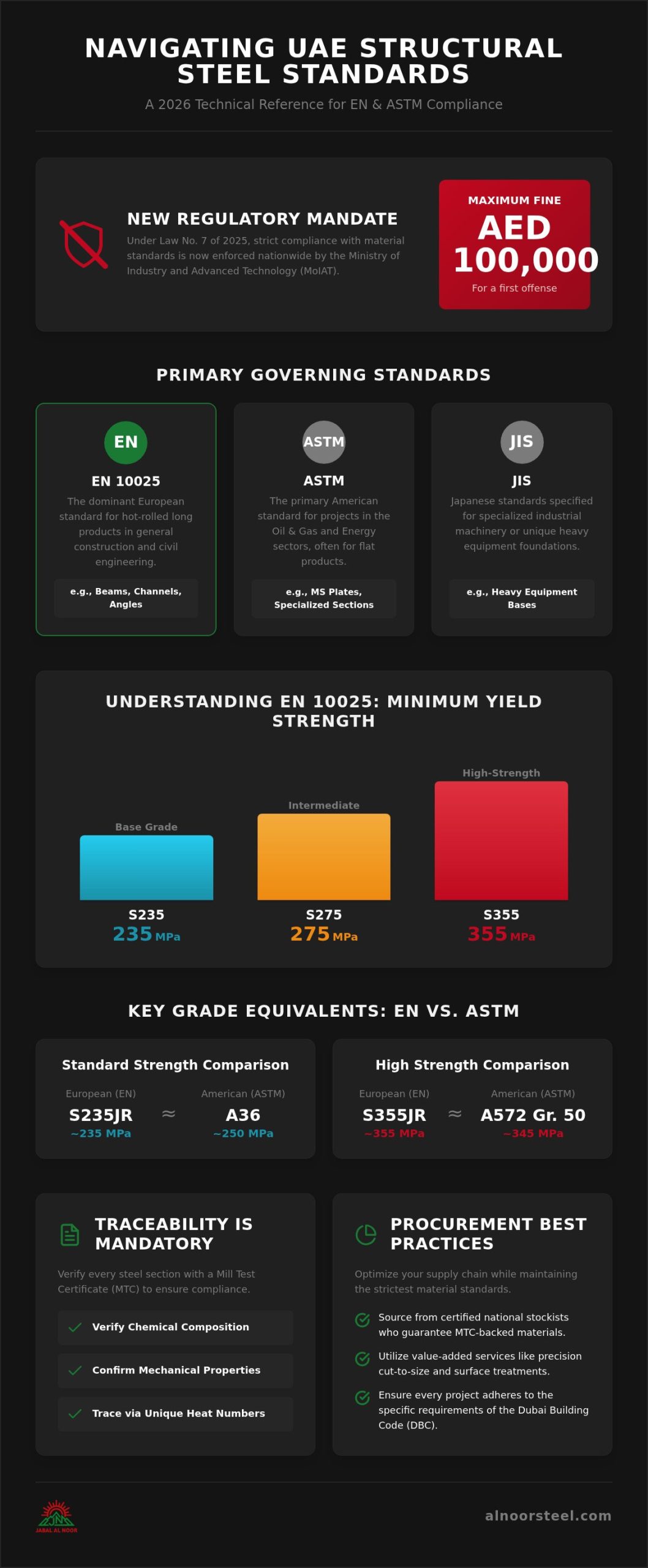
Operating with non-compliant materials or failing to meet registration deadlines across the UAE now carries a maximum fine of AED 100,000 for a first offense. As Law No. 7 of 2025 reshapes the construction landscape, engineers and contractors face increasing pressure to master the specific structural steel quality standards UAE authorities demand. You likely feel the strain of distinguishing between EN 10025:2019 and ASTM A36/A36M:2021 while ensuring every Mill Test Certificate aligns with the new performance-based Contractor Rating System. It’s a high-stakes environment where technical precision is the only safeguard against project delays and regulatory scrutiny.
This guide serves as your definitive 2026 technical reference for navigating these complex international steel grades and local compliance protocols. We’ll clarify the technical equivalents between European and American standards, provide a framework for verifying material traceability through heat numbers, and outline how to source compliant long and flat products nationwide. By the end of this article, you’ll have the knowledge required to maintain operational excellence and ensure your procurement strategy meets the rigorous benchmarks set by the Ministry of Industry and Advanced Technology.
Key Takeaways
- Understand the evolving regulatory landscape and the mandatory structural steel quality standards UAE authorities require for large-scale infrastructure projects in 2026.
- Distinguish between S235, S275, and S355 designations under the EN 10025 framework to ensure precise grade selection for hot-rolled long products.
- Compare ASTM A36 and high-strength ASTM A572 Grade 50 against European equivalents to ensure compliance when procurement involves MS plates and flat products.
- Implement a robust traceability protocol by utilizing Mill Test Certificates (MTCs) and heat numbers to verify the chemical and mechanical properties of every steel section.
- Optimize procurement by sourcing from national stockists who offer specialized cut-to-size and surface treatment services while maintaining strict material standards.
The Framework of Structural Steel Standards in the UAE
Structural steel standards serve as the fundamental technical benchmarks that dictate the chemical composition and mechanical properties of every beam, plate, and section used in modern infrastructure. These protocols ensure that material performance is predictable under stress, providing engineers with the data needed to calculate load-bearing capacities and safety margins. In the local market, adhering to structural steel quality standards UAE authorities mandate is no longer a matter of choice; it’s a prerequisite for project viability and legal operation. These standards define the limits for carbon content, yield strength, and ductility, ensuring that the steel can withstand the specific rigors of the Gulf’s built environment.
The UAE construction sector is currently undergoing a significant shift toward unified national compliance. While individual emirates previously maintained distinct oversight, the Ministry of Industry and Advanced Technology (MoIAT) now oversees the Emirates Conformity Assessment Scheme (ECAS) to standardize quality across the country. For contractors, failing to align with these benchmarks poses severe risks. Under Dubai Municipality’s Law No. 7 of 2025, operating without proper registration in the unified Contractor Register can lead to fines of up to AED 100,000 for a first offense. This regulatory tightening ensures that only materials with verified provenance reach the job site.
To better understand the rigorous testing involved in maintaining these benchmarks, watch this helpful video:
Primary Governing Bodies: EN, ASTM, and JIS
Project requirements in the UAE typically draw from three major international frameworks. The EN 10025 Standard is the most prevalent for hot-rolled products used in general construction and civil engineering. Meanwhile, ASTM standards remain the primary reference for the oil, gas, and energy sectors, where specific alloy requirements are common. Occasionally, JIS (Japanese) standards are specified for specialized industrial machinery or unique heavy equipment foundations. A reliable stockist ensures that all inventory, from MS beams to hollow sections, is fully traceable to these codes via Mill Test Certificates (MTCs). You can explore compliant materials in our online shop to find sections that meet these rigorous criteria.
Why UAE Projects Require High-Grade Compliance
The environmental conditions in the Middle East present unique challenges to material integrity. Extreme heat and high-salinity coastal environments accelerate corrosion and can compromise the structural longevity of low-grade steel. By strictly following structural steel quality standards UAE regulations, contractors mitigate the risk of premature material fatigue. High-grade compliance reduces project risk for national contractors, ensuring that structures remain durable for decades. Selecting the correct grade, such as S355 or ASTM A572 Grade 50, is essential for maintaining the stability of large-scale infrastructure projects while satisfying the strict requirements of insurance and safety audits.
EN 10025: The Dominant Standard for UAE Long Products
EN 10025 stands as the primary technical framework for hot-rolled structural steel across the Middle East. It’s the benchmark for long products, including MS beams, channels, and angles used in everything from commercial malls to industrial sheds. Within this standard, the “S” designation refers to structural steel, followed by a numerical value representing the minimum yield strength in megapascals (MPa) for a specific thickness. For instance, S275 indicates a yield strength of 275 MPa. Adhering to these structural steel quality standards UAE mandates ensures that fabrication projects meet the safety thresholds outlined in the Dubai Building Code (DBC).
Understanding the alphanumeric suffix is equally critical for heavy industrial applications. While competitors often overlook sub-grade nuances, the distinction between JR, J0, and J2 defines the material’s impact energy absorption and toughness. “JR” indicates impact testing at room temperature (+20°C), whereas “J0” signifies testing at 0°C. The “J2” designation signifies toughness at -20°C. In the high-stakes environment of UAE energy projects or heavy infrastructure where welding stresses are high, selecting a J2 sub-grade provides an additional layer of safety against brittle fracture. For a comprehensive breakdown of how these sub-grade distinctions affect structural performance and regulatory approval, consult our EN 10025 steel grades UAE structural reference guide for the full technical framework.
Steel Grade S235JR vs. S355JR
Choosing between S235JR and S355JR depends entirely on the design load and scale of the structure. S235JR is often sufficient for secondary steelwork, purlins, or smaller warehouses, but it lacks the load-bearing capacity required for the UAE’s record-breaking high-rises. S355JR offers significantly higher yield strength, allowing engineers to specify lighter sections without sacrificing structural integrity. S355JR is the standard for high-tensile structural applications. This efficiency reduces the overall weight of the steel frame, which can lower logistics and foundation costs for national contractors working on heavy industrial plants.
Compliance for Beams and Sections
Dimensional accuracy is just as important as chemical composition when sourcing long products. Universal beams (UB) and universal columns (UC) must conform to EN 10365, which standardizes the geometry of H-beams and I-beams to ensure uniformity across suppliers. For MS channels and angles, meeting strict dimensional tolerance standards prevents misalignments and costly delays during onsite assembly. If you’re managing a project in 2026, consult the Structural Steel Supplier UAE: 2026 Procurement Guide to ensure your material sourcing aligns with current national regulations. You can also view our full range of certified long products to find sections that meet these rigorous European specifications.
ASTM A36 vs. EN Grades: A Material Comparison
ASTM A36 remains the dominant specification for MS plates and flat products throughout the Emirates. While the EN 10025 framework covers the majority of long sections, project consultants often specify American standards for specialized energy and oil and gas infrastructure. For heavy structural components requiring superior load-bearing capacity, ASTM A572 Grade 50 steel in the UAE provides a high-strength alternative. It offers a minimum yield strength of 345 MPa, making it a staple for bridge girders and industrial equipment supports. Engineers don’t just look at strength; they must also account for the chemical variations that define these structural steel quality standards UAE projects require.
Technical nuances in carbon content significantly impact weldability and on-site processing. American grades often allow for a slightly higher carbon range compared to their European counterparts, which can alter the material’s ductility and required pre-heating temperatures. It’s a common mistake to assume these sections are geometrically interchangeable. Substituting an EN beam for an ASTM section requires a complete re-verification of connection designs because flange widths and web thicknesses vary between the two systems. Failing to account for these discrepancies can lead to misalignments during erection or failure to meet the strict safety audits mandated by national building codes.
Selecting Between ASTM and EN for UAE Tenders
The choice between ASTM and EN standards is typically dictated by the project’s origin and the specific design codes, such as AISC or Eurocode, adopted by the consultant. A frequent pitfall in procurement involves ordering by “equivalent” without verifying the specific mechanical properties on the Mill Test Certificate. At JABAL AL NOOR Steel, we mitigate this risk by maintaining an inventory that often includes dual-certified materials. This ensures that national contractors can fulfill requirements for both American and European specifications from a single, reliable source, maintaining industrial stability throughout the supply chain.
Steel Grade Comparison Table
The following table provides a quick reference for the mechanical properties of the most common grades found in the UAE market. For precise procurement, you can browse compliant steel grades in our shop to see our current inventory of certified sections.
| Steel Grade | Yield Strength (min) | Tensile Strength | Elongation (min) |
|---|---|---|---|
| ASTM A36 | 250 MPa | 400-550 MPa | 20% |
| EN S235JR | 235 MPa | 360-510 MPa | 26% |
| ASTM A572 Gr. 50 | 345 MPa | 450 MPa (min) | 18% |
| EN S355JR | 355 MPa | 470-630 MPa | 22% |
Traceability and Certification: The Role of the MTC
The Mill Test Certificate (MTC) functions as the definitive birth certificate for every structural steel section delivered to a UAE construction site. It’s the only document that provides a transparent record of a material’s chemical and mechanical history, ensuring that the stock aligns with structural steel quality standards UAE regulators enforce. Without a valid MTC, a beam is merely an unidentified piece of metal, regardless of its appearance. The document links physical inventory to laboratory results through a unique heat number, which is a specific identification code assigned to a batch of steel during the melting process at the mill.
High-stakes infrastructure projects in the UAE often demand different levels of certification depending on the risk profile of the structure. A Type 3.1 certificate is issued by the manufacturer’s own authorized inspection representative, confirming that the products comply with the order requirements. For critical energy or offshore applications, a Type 3.2 certificate is required, which involves an independent third-party inspection from bodies like TUV or Bureau Veritas. This additional layer of scrutiny ensures that the material’s provenance is beyond reproach, satisfying the rigorous safety audits common in Abu Dhabi and Dubai’s industrial zones.
What to Look for in a Mill Test Certificate
A comprehensive MTC breaks down the chemical composition analysis, specifically looking at Carbon, Manganese, and Silicon levels to determine weldability and strength. Mechanical testing results are equally vital, featuring Charpy V-notch impact tests that measure the steel’s toughness and tensile tests that confirm its yield strength. You must verify these figures against the project specifications to avoid structural fatigue. An MTC must match the heat number stamped on the steel profile. If the stamped number and the certificate don’t align, the material’s integrity cannot be legally verified, which can lead to immediate project suspension during a municipality inspection.
Traceability Protocols for National Contractors
Maintaining a rigorous paper trail from the mill to the job site is a foundational requirement for modern contractors. This logistical chain ensures that every MS beam or plate can be traced back to its original melt, providing a safety net in the rare event of a material failure. JABAL AL NOOR Steel prioritizes this industrial stability by ensuring full traceability for all long and flat products in our inventory. We recommend using the UAE Steel Stockist Checklist: 2026 Procurement Guide to establish a verification workflow for your procurement team. You can also view our certified inventory to see how we maintain these high standards across our entire product range.
Sourcing Compliant Steel and Value-Added Processing
Procurement for heavy industry in the Emirates requires more than just identifying the lowest price per tonne. To maintain the integrity of a project, engineers must prioritize national stockists who operate with established quality protocols and rigorous material verification. These stockists act as the final gatekeeper, ensuring that every MS beam or hollow section delivered to the site remains compliant with the structural steel quality standards UAE regulators mandate. When you source from a local partner with deep regional roots, you’re investing in industrial stability and a supply chain that understands the specific pressures of the Middle Eastern construction environment.
Integrating value-added services like cut-to-size customization is a logistical necessity for modern contractors. However, this processing must be handled with precision to avoid compromising the material’s structural properties. Professional stockists ensure that cutting techniques don’t create excessive heat-affected zones that could alter the yield strength or ductility of the steel. By maintaining the grade standards during the customization phase, suppliers help contractors reduce on-site labor and waste while keeping the project strictly within the engineering codes defined in the design phase.
Surface Treatments and Corrosion Standards
The UAE’s coastal geography presents a persistent threat to steel longevity due to high humidity and airborne salinity. Surface treatments like shot blasting and priming are essential steps for ensuring EN-compliant steel survives these harsh conditions. Shot blasting to SA 2.5 standards removes mill scale and rust, providing a clean profile for protective coatings to bond effectively. This finishing process isn’t merely cosmetic; it’s a technical requirement for meeting the durability benchmarks expected in Abu Dhabi and Dubai. Professional finishing extends the service life of MS channels and angles, preventing the premature oxidation that can lead to structural fatigue in high-salinity environments. For projects where sheet steel components also require corrosion protection, understanding the full range of coated steel options is equally important — our GI and PPGI sheet supplier UAE procurement guide covers the technical standards and coating specifications required for compliant flat sheet procurement in 2026.
Partnering for Large-Scale UAE Infrastructure
Success in large-scale infrastructure projects depends on logistical efficiency and the reliability of the supply partner. JABAL AL NOOR Steel balances bulk supply capabilities with the specialized requirements of individual projects, offering national delivery to Dubai, Sharjah, Abu Dhabi, and across the Northern Emirates. Partnering with a grounded, authoritative supplier provides the transparency needed for long-term collaborations. This seasoned expertise ensures that every delivery is accompanied by the necessary certification and that all processing meets international benchmarks. You can explore our full inventory of standard-compliant steel products to find the materials required for your next infrastructure or energy project.
Future-Proofing Infrastructure Through Material Excellence
Mastering the complex landscape of structural steel quality standards UAE authorities mandate is the foundation of every successful construction and energy project in the region. By prioritizing the technical distinctions between EN and ASTM grades and enforcing strict traceability through Mill Test Certificates, you protect your operations from the legal and structural risks of non-compliance. These benchmarks aren’t just regulatory hurdles; they’re the industrial pillars that ensure the endurance of the Emirates’ built environment.
Since 2010, JABAL AL NOOR Steel has acted as a foundational pillar for the nation’s industrial and construction sectors. Our operations prioritize transparency, offering full MTC traceability for every section in our inventory to ensure your procurement meets the highest global benchmarks. With a national reach that spans the entire UAE, we stand ready to deliver the high-quality materials your infrastructure requires. Secure your project’s integrity with certified steel from JABAL AL NOOR Steel. We’re committed to your long-term success and the continued stability of the region’s industrial landscape.
Frequently Asked Questions
What are the most common structural steel grades used in the UAE?
The most prevalent grades in the local market include S275JR and S355JR under the EN 10025 framework, alongside ASTM A36 for flat products. These materials satisfy the majority of commercial and industrial requirements. For high-strength applications, engineers often specify ASTM A572 Grade 50. Selecting these grades ensures your project aligns with the structural steel quality standards UAE consultants typically mandate for durability and load-bearing capacity.
How do EN 10025 standards differ from ASTM A36?
EN 10025 is a European standard where the grade number indicates minimum yield strength in megapascals (MPa). In contrast, ASTM A36 is an American carbon structural steel specification with a minimum yield point of 250 MPa. While they serve similar purposes, their chemical compositions and dimensional tolerances vary. You shouldn’t treat them as identical without an engineering review, as their performance under specific stress conditions differs significantly.
Is it possible to substitute S355JR for ASTM A572 Grade 50?
Substitution is often technically feasible since S355JR offers a slightly higher yield strength of 355 MPa compared to the 345 MPa of ASTM A572 Grade 50. However, you must obtain consultant approval before making any changes. Designers must verify that the geometric profile of the EN beam matches the original ASTM design, as differences in flange width or web thickness can affect connection details and overall structural geometry. For a detailed engineering comparison of these two grades, our ASTM A572 Grade 50 steel UAE comprehensive engineering guide provides the technical validation needed to finalize your material selection.
What is a Mill Test Certificate (MTC) and why is it required?
An MTC is a quality assurance document issued by the steel mill that confirms the material’s chemical and mechanical properties. It’s required to prove that the steel meets the specific project standards and safety regulations. Without this certificate, you can’t verify the material’s origin or its ability to withstand design loads. It serves as essential documentation for municipal inspections and insurance audits during the construction phase.
Do UAE building codes require specific steel certifications for contractors?
Yes, current regulations like Dubai Municipality’s Law No. 7 of 2025 mandate that contractors use materials that comply with unified national registries. Additionally, the Emirates Conformity Assessment Scheme (ECAS) requires specific certifications for structural steel to ensure public safety. Following these structural steel quality standards UAE protocols is mandatory to avoid heavy fines, which can reach AED 100,000 for unregistered or non-compliant operations.
How does shot blasting affect the quality standard of structural steel?
Shot blasting doesn’t change the steel’s internal grade, but it’s vital for meeting surface quality standards like SA 2.5. This process removes mill scale and contaminants, creating an ideal profile for protective coatings. In the UAE’s high-salinity environment, this preparation is a technical requirement to prevent subsurface corrosion. It ensures that the structural integrity of the steel isn’t compromised by environmental degradation over the building’s lifespan.
Can I source JIS standard steel products nationally in the UAE?
You can source JIS (Japanese Industrial Standards) steel products through established national stockists like Jabal Al Noor Steel. While EN and ASTM are more common, JIS grades are often required for specialized industrial machinery or heavy equipment foundations. Sourcing these materials locally reduces lead times and ensures the products come with the necessary Mill Test Certificates to satisfy local regulatory and engineering oversight.
What is the importance of the ‘heat number’ on a steel beam?
The heat number is a unique identification code that links a specific steel section back to its original production batch at the mill. It’s the key to full material traceability. By matching the heat number stamped on the beam to the one listed on the MTC, you can verify the exact chemical makeup and laboratory test results for that specific piece. This link is critical for maintaining quality control on-site.