With the release of ISO 657-1:2026 in April, the global standards for structural steel dimensions have undergone their most significant refinement in years. You likely recognize that even a minor deviation from these updated international benchmarks can compromise the safety and longevity of a high-stakes infrastructure project. Sourcing hot rolled steel channels that meet exact cut-to-size specifications while resisting corrosion in aggressive industrial environments remains a persistent challenge for procurement teams and structural engineers. It’s a high-stakes environment where material non-compliance isn’t just a logistical error; it’s a fundamental structural risk.
This technical guide provides the authoritative expertise you need to master material grades like ASTM A36 and A572, ensuring your projects are built with unwavering industrial stability. We’ll examine the latest 2026 specification updates, the critical role of specialized surface treatments, and the logistical frameworks required to secure a dependable long-term supply partner. By the end of this analysis, you’ll have the technical proficiency to identify the precise channel dimensions and grades necessary to maintain operational excellence across any large-scale application. Whether you’re managing energy infrastructure or urban development, understanding these specifications is the key to enduring structural integrity.
Key Takeaways
- Understand the fundamental manufacturing mechanics of hot rolled sections and how the recrystallization process improves material ductility for complex industrial fabrication.
- Learn to identify the correct material grades, such as ASTM A36, to ensure your hot rolled steel channels provide the necessary load-bearing reliability for structural frameworks.
- Examine the strategic application of MS channels in Pre-Engineered Buildings (PEB) and heavy equipment support systems to optimize structural stability and operational safety.
- Discover how utilizing precision cut-to-size services and specialized surface treatments like shot blasting can significantly reduce on-site labor and prevent premature corrosion.
- Master the procurement process by evaluating national suppliers based on transparent certification standards and the provision of comprehensive Mill Test Reports.
Understanding Hot Rolled Steel Channels: Geometry and Manufacturing Excellence
Hot rolled steel channels are fundamental components in the construction of large-scale infrastructure and industrial frameworks. These sections, often referred to as MS channels, are structural profiles with a distinctive “U” or “C” shape. They are manufactured by passing steel through heavy rollers at extreme temperatures, a process that ensures high load-bearing capacity and structural predictability. Jabal Al Noor Steel maintains a rigorous focus on these geometric standards to ensure every profile provides the stability required for heavy-duty engineering.
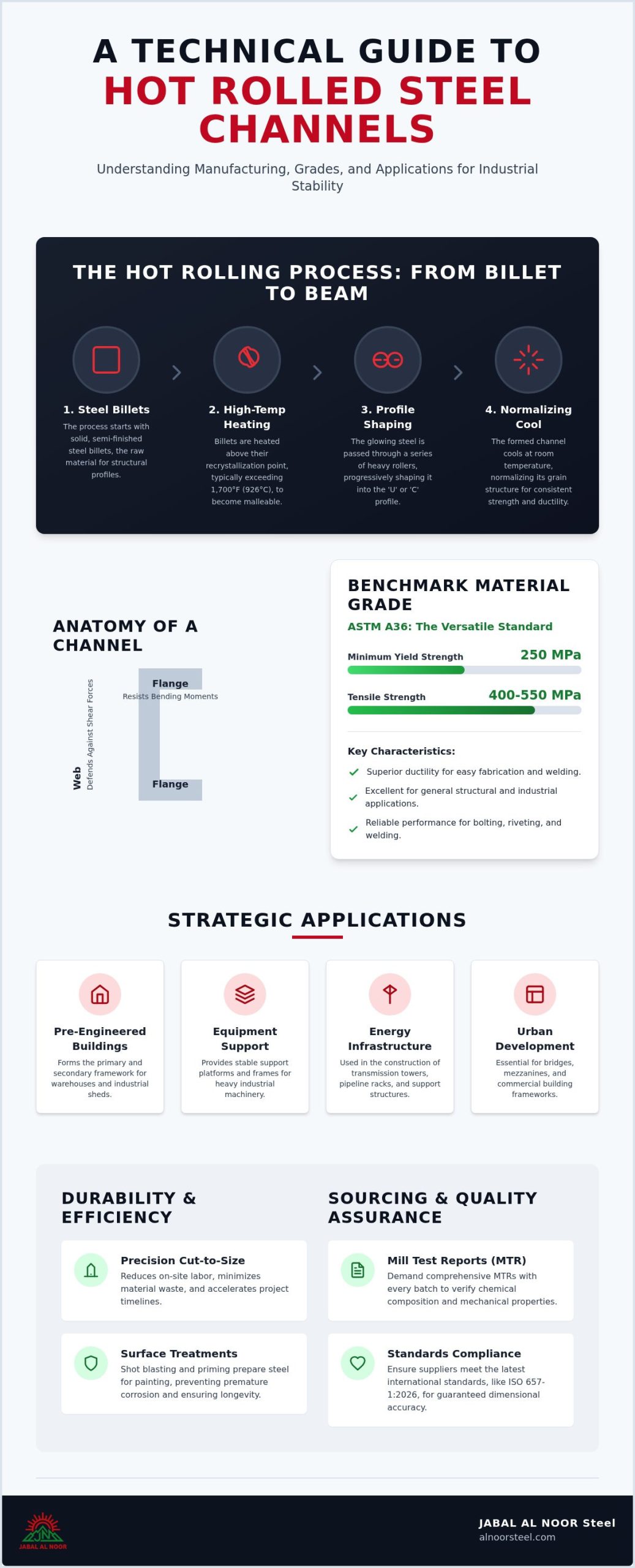
The defining characteristic of hot rolled steel channels is the temperature at which they are formed. When steel is heated above its recrystallization threshold, typically exceeding 1,700°F, it enters a malleable state. This allows for the creation of large, complex shapes without the internal stresses associated with cold-forming. Consequently, Structural steel produced this way exhibits superior ductility. This makes the material easier to weld, cut, and fabricate on-site, which is essential for projects with demanding timelines.
Unlike the smooth, oily surface of cold-finished steel, these channels possess a characteristic blue-grey, scaled finish. This mill scale is a natural byproduct of the high-temperature cooling process. While it provides a degree of initial protection, it often requires surface treatments like shot blasting before painting or galvanizing. Understanding this finish is vital for engineers who must account for surface preparation costs in their project budgets.
The Hot Rolling Process: From Billets to Structural Profiles
The journey starts with solid steel billets. These are heated until they glow, ensuring they can be shaped by successive rolling stands. Each pass through the rollers refines the dimensions until the precise “U” or “C” profile is achieved. Once the desired geometry is reached, the steel is allowed to cool at room temperature. This controlled cooling phase is essential; it normalizes the grain structure, providing the consistent mechanical properties that Jabal Al Noor Steel guarantees for every batch. This methodical approach results in a finished product that resists cracking under heavy stress.
Anatomy of a Channel: Web and Flange Dynamics
Every channel consists of a vertical web and two horizontal flanges. The web is the primary defender against shear forces, maintaining the section’s height under load. In contrast, the flanges provide the necessary resistance against bending moments. Standard channels often feature a slight taper on the inner flange surfaces, which is a hallmark of traditional hot rolling. However, modern engineering also utilizes parallel flange channels for easier bolting and connection. You can explore these variations within the Jabal Al Noor Steel inventory to find the exact fit for your structural requirements.
Material Grades and International Standards for Structural Integrity
Selecting the appropriate material grade is a critical decision that dictates the load-bearing reliability and long-term safety of any industrial structure. It’s not merely about dimensions; it’s about the chemical and mechanical properties that allow hot rolled steel channels to withstand specific environmental and physical stresses. Jabal Al Noor Steel prioritizes material compliance to ensure that every section integrated into a project meets the rigorous demands of modern engineering.
ASTM A36: The Versatile Standard
ASTM A36 remains the industry benchmark for general-purpose structural steel. This grade provides a minimum yield strength of 250 MPa and a tensile strength ranging from 400 to 550 MPa. Because of its relatively low carbon content, A36 steel channels are exceptionally well-suited for welding, bolting, and riveting. These characteristics make them a staple in the manufacturing of agricultural equipment, heavy-duty trailers, and architectural framing where ease of fabrication is as vital as structural support.
EN 10025 Grades: S235JR vs. S355JR
European standards offer a different categorization based on specific yield points. While S235JR is frequently used for lighter structural work, S355JR provides a significantly higher yield strength, making it the superior choice for heavy-duty infrastructure and large-scale energy projects. The “JR” suffix is a technical designation indicating that the material has undergone impact testing at room temperature (20°C) to verify its toughness. S355JR is the preferred grade for high-stress structural members that must maintain integrity under immense weight and pressure.
International Grade Equivalency Framework
Navigating the transition between ASTM, EN, and JIS standards requires a precise cross-reference framework. While ASTM A36 is often compared to EN S235JR or JIS SS400, they are not always identical in their chemical composition or permissible tolerances. Engineering teams must ensure that the selected material aligns perfectly with national building codes and project-specific safety factors. For a deeper understanding of regional requirements, you can consult our Structural Steel Quality Standards UAE: A 2026 Reference Guide.
The balance between strength and weldability is maintained through strict control of carbon and manganese levels within the steel. This precision prevents the material from becoming brittle during the cooling process or subsequent fabrication. To ensure your project utilizes only the highest quality certified sections, we invite you to explore the Jabal Al Noor Steel inventory for comprehensive material options.
Strategic Applications of MS Channels in Modern Engineering
The utility of hot rolled steel channels extends far beyond basic framing. In heavy industry, these sections provide a specialized geometry that balances weight efficiency with high torsional rigidity. This makes them indispensable for large-scale projects where structural integrity is a non-negotiable requirement. Jabal Al Noor Steel supplies these profiles to sectors ranging from energy production to logistics, ensuring that every application benefits from the material’s inherent durability and compliance with international standards.
Structural Frameworks and PEB Construction
In Pre-Engineered Buildings (PEB) and industrial warehouses, MS channels serve as the primary secondary structural members. They are typically utilized as purlins and girts, providing the necessary support for wall and roof panels. Their “C” or “U” shape allows for efficient nesting and bolting, which accelerates the construction timeline without sacrificing strength. These sections are often integrated with other Long Products: The Foundation of Modern Infrastructure to create a cohesive, high-performance skeleton for large-span structures. The exceptional weight-to-strength ratio of these channels reduces the overall dead load of the building, allowing for more expansive interior spaces and optimized foundation designs.
Industrial Support Systems and Framework
Beyond building envelopes, hot rolled steel channels are foundational to industrial infrastructure. In the oil and gas sector, they form the backbone of complex pipe racks and equipment skids, where they must withstand both mechanical stress and environmental exposure. Their structural predictable nature is equally valued in several other specialized applications:
- Machinery Support: Creating robust frames for heavy industrial equipment to minimize vibration and ensure alignment.
- Access and Safety: Fabricating stair stringers, handrails, and mezzanine floor supports in manufacturing facilities.
- Renewable Energy: Serving as the primary mounting structures for solar panel arrays, where long-term endurance is critical.
The transportation and infrastructure sectors also rely heavily on these profiles. In truck chassis and rail car manufacturing, channels provide the necessary stiffness to handle dynamic loads during transit. Similarly, in bridge construction and infrastructure repairs, they are often used as bracing members or for reinforcing existing concrete structures. By selecting the correct grade and dimensions, engineers ensure that these components contribute to a lifetime of service in even the most demanding environments.
Enhancing Durability: Cut-to-Size and Surface Treatment Protocols
Raw structural steel is rarely ready for immediate installation upon leaving the rolling mill. To achieve the rigorous quality benchmarks required for national infrastructure and energy projects, hot rolled steel channels must undergo precise secondary processing. Jabal Al Noor Steel provides integrated value-added services to ensure that every section delivered is optimized for durability and logistical efficiency. These protocols don’t just prepare the steel for use; they are essential for ensuring the long-term stability of the entire structural assembly.
The Advantages of Cut-to-Size Customization
Standard mill lengths of 6 or 12 meters often result in substantial on-site waste and require intensive manual labor for field modifications. Jabal Al Noor Steel utilizes advanced industrial sawing and shearing technology to provide precision cut-to-size services that adhere to tight dimensional tolerances. This capability is detailed extensively in our Cut-to-Size Steel Service in the UAE: A Comprehensive Procurement Reference. By sourcing pre-cut sections, contractors can significantly reduce their logistical burden. Precision cutting also ensures that joints and connections fit perfectly during the first assembly, which is critical for maintaining the structural integrity of large-span frameworks. This methodical approach to material preparation reflects our commitment to operational excellence and long-term value for our partners.
Surface Treatments: Shot Blasting and Priming
The blue-grey mill scale described in our discussion of manufacturing geometry is a brittle layer that can flake off, taking any paint or coating with it. Shot blasting is the definitive mechanical process used to propel abrasive media against the steel at high velocity. This removes all contaminants and creates a specific surface roughness, known as a “profile,” which is necessary for high-performance industrial coatings. Following this, the application of a primer is non-negotiable for structural longevity. We offer several treatment options to meet specific environmental demands:
- Red Oxide Primers: A dependable and cost-effective base for general industrial and architectural applications.
- Zinc-Rich Primers: Provides cathodic protection, making it the superior choice for high-salinity coastal zones or humid environments.
- Compatibility: Treated channels remain fully compatible with subsequent hot-dip galvanization or specialized epoxy coatings.
These surface treatments ensure that your hot rolled steel channels maintain their structural capacity for decades, even in the harshest industrial climates. If your project requires high-precision sections ready for immediate deployment, explore our customized steel channel options today.
Strategic Procurement: Sourcing Quality Structural Steel for Large-Scale Projects
Procuring structural steel for large-scale infrastructure is a strategic undertaking that demands meticulous attention to material provenance and logistical reliability. Sourcing hot rolled steel channels for high-volume industrial applications involves more than comparing unit costs; it requires verifying that every section possesses the transparent certification necessary to meet stringent building codes. Jabal Al Noor Steel understands that in the heavy industry sector, a supplier’s capability is measured by their ability to provide consistent, high-grade material without compromising project timelines. This focus on reliability is what transforms a vendor into a foundational partner for national development.
Evaluating Supplier Inventory and Compliance
A dependable steel stockist must maintain an extensive and diverse inventory of MS channels, beams, and angles to accommodate the fluctuating needs of complex projects. This depth of stock ensures that contractors don’t face delays due to material shortages or limited size availability. Beyond mere volume, the value of a partner lies in their technical expertise and adherence to international standards. Prioritizing partners with a deep understanding of the Steel Suppliers in UAE: A 2026 Strategic Procurement Guide ensures that your procurement strategy is aligned with the latest market requirements and quality benchmarks. Jabal Al Noor Steel provides comprehensive Mill Test Reports (MTRs) for all products, offering the transparency required for engineering audits and quality assurance protocols. This commitment to compliance guarantees that every component integrated into your structure is a verified asset that supports long-term structural integrity.
Logistics and Support for Industrial Contracts
The success of a project often hinges on the logistical efficiency of the supply chain. Timely delivery is essential for maintaining the methodical pace of construction and engineering sectors. A supplier must demonstrate a robust national delivery network capable of reaching diverse project sites with precision and predictability. At Jabal Al Noor Steel, we prioritize logistical excellence to ensure your structural components arrive exactly when they are needed. You can view our current availability and specifications through the Jabal Al Noor Steel Shop, which serves as a vital resource for planning your material requirements. We also encourage direct consultation for projects requiring specialized surface treatments or precision customization. This collaborative approach allows us to tailor our support to the specific pressures and high-stakes requirements of your most ambitious energy and infrastructure projects. Choosing a partner who values consistency and ethical conduct ensures long-term value and operational excellence for all collaborators.
Securing Structural Excellence for Future Infrastructure
The 2026 technical landscape demands a level of precision that leaves no room for material non-compliance. Mastering the nuances of geometry, grade selection, and surface preparation is the only way to ensure structural integrity in high-stakes projects. By prioritizing certified standards and utilizing precision processing, you protect your infrastructure against premature failure and environmental degradation. Jabal Al Noor Steel remains committed to supporting these standards through our extensive national inventory of long products and specialized in-house capabilities. Our specialized shot blasting and priming services ensure that your hot rolled steel channels are delivered ready for immediate, long-term deployment. We invite you to partner with a veteran of the industry who values precision and ethical conduct as much as you do. Explore our full range of MS channels and structural steel at Jabal Al Noor Steel to secure a dependable foundation for your next industrial project. We look forward to supporting your vision with unwavering quality and logistical efficiency.
Frequently Asked Questions
What is the difference between a hot rolled channel and a cold rolled channel?
Hot rolled channels are formed at temperatures exceeding 1,700°F, which makes the steel more malleable and cost-effective for large structural sections. In contrast, cold rolled channels are processed at room temperature to achieve superior dimensional precision and a smoother surface finish. While cold rolling increases strength through strain hardening, hot rolled steel channels remain the industry standard for heavy-duty infrastructure due to their excellent ductility and ease of welding in demanding environments.
Which steel grade is best for heavy industrial MS channels?
For heavy industrial applications, high-strength low-alloy grades like ASTM A572 Grade 50 or EN 10025 S355JR are generally considered the best options. These grades offer a higher yield strength compared to standard carbon steel, allowing for reduced material weight without sacrificing structural integrity. Choosing a high-strength grade is essential for high-stress members in oil and gas pipe racks or large-span warehouse frames where load-bearing reliability is the primary concern for engineering teams.
Do hot rolled steel channels require surface treatment before installation?
While not strictly mandatory for every indoor application, surface treatment is highly recommended for any structural steel exposed to the elements. The mill scale on hot rolled steel channels is brittle and can trap moisture, leading to rapid corrosion over time. Shot blasting to a specific profile followed by the application of a zinc-rich or red oxide primer ensures long-term durability. This is especially vital in the humid or saline climates typical of national infrastructure projects.
Can hot rolled steel channels be easily welded?
Yes, hot rolled channels are exceptionally easy to weld using standard industrial techniques such as MIG, TIG, or arc welding. The high-temperature manufacturing process normalizes the grain structure and reduces internal stresses, which minimizes the risk of cracking or warping during the welding process. This weldability is one of the primary reasons why ASTM A36 and S235JR grades are favored for fabricating complex machinery frames and secondary structural supports in the construction sector.
What are the standard lengths available for MS channels in the UAE?
Standard mill lengths for MS channels in the national market are typically 6 meters and 12 meters. However, relying solely on standard lengths often leads to excessive material waste and increased on-site labor costs. JABAL AL NOOR Steel provides specialized cut-to-size customization to meet exact project specifications. This service allows contractors to receive precision-engineered components that are ready for immediate installation, effectively streamlining the construction timeline for large-scale industrial contracts and energy infrastructure.
How does the “U” shape of a channel contribute to its load-bearing capacity?
The “U” or “C” geometry of a channel is specifically engineered to optimize the distribution of stress across the section. The vertical web provides the necessary resistance against shear forces, while the horizontal flanges offer stability against bending moments. This configuration makes channels ideal for use as purlins or girts in Pre-Engineered Buildings. When properly oriented, the shape provides a high strength-to-weight ratio, allowing for lighter structures that don’t compromise on overall safety or endurance.
Is ASTM A36 equivalent to S235JR for structural applications?
ASTM A36 and EN S235JR are often treated as functional equivalents in general structural applications, though they belong to different regulatory frameworks. ASTM A36 is the American benchmark for carbon structural steel, while S235JR is the European standard defined under EN 10025. While their yield strengths are comparable, engineers must verify specific chemical requirements and impact testing results for each project. JABAL AL NOOR Steel ensures all supplied material meets the precise international grade compliance requested for your contract.
What industries typically use hot rolled steel channels?
Hot rolled steel channels are utilized across a diverse range of heavy industries, including construction, energy, and logistics. They are foundational components in Pre-Engineered Buildings, oil and gas pipe racks, and solar mounting structures. Additionally, the transportation sector relies on these sections for manufacturing truck chassis and rail cars. Their versatility and structural predictability make them indispensable for any application requiring robust, long-term support in high-stakes engineering environments across the country.