Tag: industrial materials

Bulk Steel Supply: 2026 Industrial Procurement Guide

Bulk Steel Supply: 2026 Industrial Procurement Guide

In the 2026 industrial landscape, a single deviation in material grade or a minor logistical bottleneck can jeopardize the entire fiscal viability of a multi-million dollar infrastructure project. You likely understand that securing a reliable bulk steel supply is no longer just about finding the lowest price per ton. It’s about mitigating the risks of material non-compliance and site delays that quickly erode your margins. It’s a high-stakes environment where the quality of your structural sections and the precision of your delivery schedule define your project’s success.

This guide provides the strategic framework you need to master the complexities of high-volume steel procurement. We’ll show you how to guarantee compliance with ASTM and EN standards while leveraging pre-processing services to reduce onsite labor costs. You’ll gain a clear understanding of the current regulatory environment, including the impact of new import frameworks and the shift toward digitalized fabrication. By the end of this article, you’ll have a blueprint for a streamlined supply chain that prioritizes durability, technical proficiency, and operational excellence.

Key Takeaways

  • Transitioning from transactional purchasing to a strategic bulk steel supply model ensures project continuity and long-term cost-efficiency for large-scale infrastructure.
  • Understanding the technical nuances of international grades for MS beams, channels, and angles is critical for maintaining structural integrity and meeting rigorous project specifications.
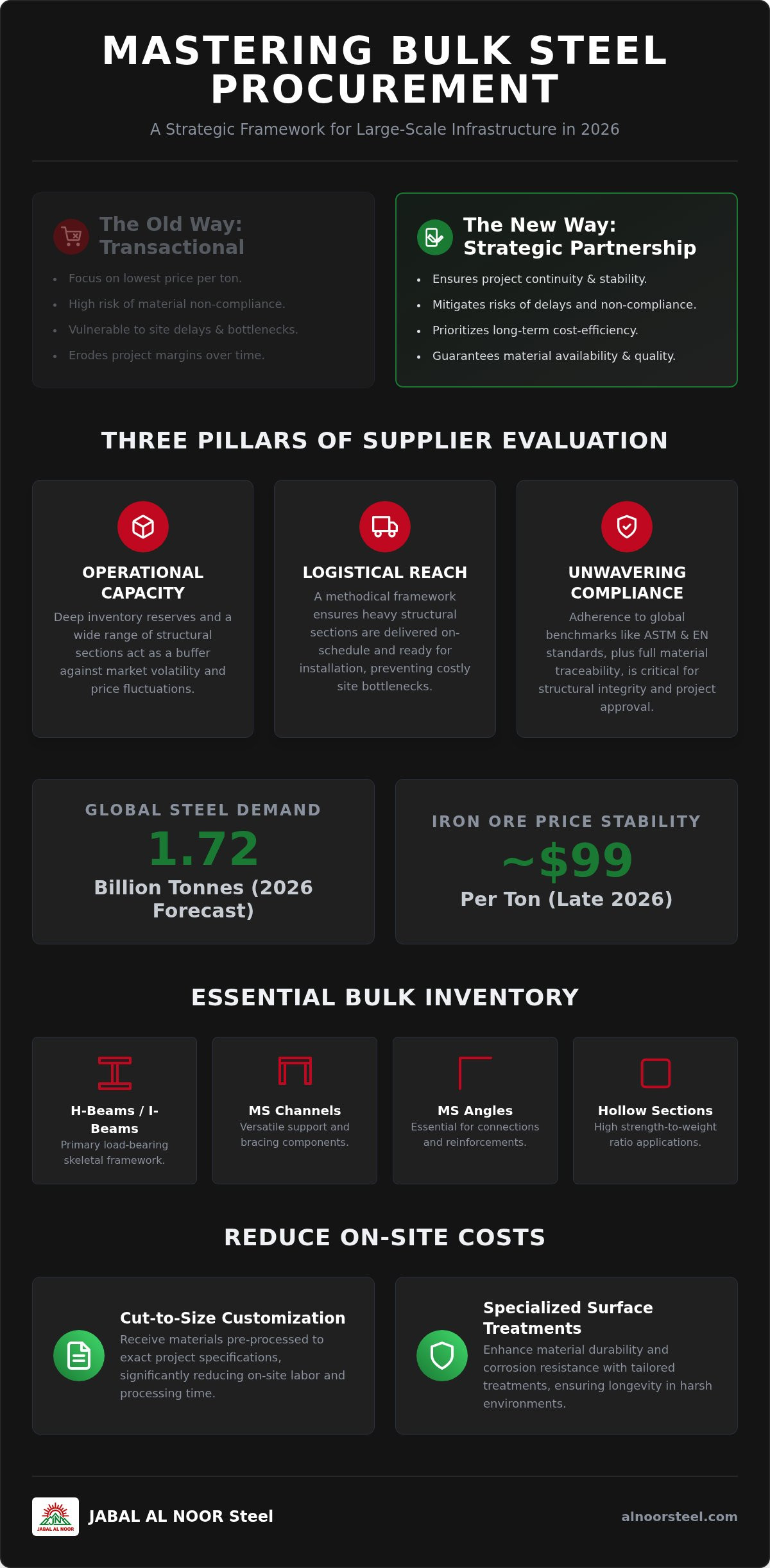
  • Successful procurement requires evaluating suppliers on three fundamental pillars: their operational capacity, logistical reach, and unwavering compliance with global quality benchmarks.
  • Implementing a methodical logistics framework for heavy structural sections prevents site bottlenecks and ensures materials are delivered on schedule and ready for installation.
  • Leveraging value-added services such as cut-to-size customization and specialized surface treatments can significantly reduce onsite processing time and labor costs.

Understanding the Dynamics of Bulk Steel Supply for Large-Scale Projects

Large-scale infrastructure projects require a fundamental shift in how materials are acquired. Moving away from transactional, retail-based purchasing toward a strategic bulk steel supply model is essential for maintaining the fiscal and structural integrity of major works. This transition involves more than simply increasing order volumes; it necessitates a comprehensive understanding of supply chain variables that impact long-term project viability. Strategic procurement allows contractors to lock in material availability at a time when global steel demand is forecast to reach 1.72 billion tonnes in 2026. By establishing a foundational partnership with a national supplier, industrial buyers can ensure a consistent flow of MS beams, channels, and hollow sections. This stability is the cornerstone of operational excellence in the construction and energy sectors.

Volume vs. Value: Defining Bulk Procurement in 2026

Tonnage alone is a poor metric for success in high-volume industrial contracts. A robust bulk steel supply requires inventory depth that can absorb market volatility and sudden shifts in project requirements. For instance, with iron ore prices hovering around $99 per ton in late 2026, suppliers with deep stock reserves provide a critical buffer against price fluctuations. Industrial buyers must prioritize inventory that includes a wide range of structural sections. This includes everything from universal columns to specialized hollow sections. You can view our current range of available materials at our inventory portal. True value in bulk procurement is found in the intersection of material availability and scheduled delivery. It’s about having the right grade of steel on-site exactly when the assembly phase begins, rather than letting raw tonnage sit idle.

The Impact of Global Standards on National Supply Chains

National supply chains are increasingly sensitive to international trade frameworks. The implementation of Regulation (EU) 2026/1384 and the “Melt and Pour” traceability requirements have made technical transparency a non-negotiable standard. Industrial procurement teams must work with suppliers who can document the exact origin of their materials. This level of precision is vital for understanding steel properties and production history, which directly affects the performance of structural frameworks in harsh environments. Maintaining material consistency across massive projects requires a supplier who understands regional engineering demands. Whether it is managing the 50% duty on excess imports in certain jurisdictions or ensuring compliance with ASTM standards, the technical proficiency of your supply partner is paramount. A steady, dependable partner acts as a guide through these regulatory complexities, ensuring that your structural components remain compliant and your project timelines remain intact.

Essential Material Grades and Structural Sections in Bulk Inventory

Efficient bulk steel supply is predicated on a comprehensive inventory that aligns with exact engineering specifications. In the industrial sector, material selection is a rigorous process where the specific mechanical properties of the steel must match the intended load-bearing requirements of the project. Whether the environment demands the corrosion resistance of GI and stainless steel or the foundational strength of mild steel, having immediate access to a diverse range of sections is vital for project continuity. A steady supplier ensures that these materials aren’t just available in volume, but are compliant with the technical benchmarks that define modern infrastructure.

Long Products: The Foundation of Structural Frameworks

Structural integrity begins with the selection of primary load-bearing components. We maintain an extensive stock of MS Beams, H-Beams, and I-Beams, which serve as the skeletal framework for large-scale industrial facilities. These sections are complemented by the versatility of MS Channels and Angles, which provide essential support and bracing in diverse structural applications. For modern infrastructure projects requiring high strength-to-weight ratios, sourcing high-quality MS bars and hollow sections (RHS, SHS, and CHS) is necessary to ensure the endurance of the framework under stress. You can review the technical specifications of our long products to ensure they meet your project’s rigorous demands.

Navigating International Grades: ASTM vs. EN Standards

Compliance with global benchmarks is a prerequisite for any national infrastructure project. Procurement teams often find themselves comparing ASTM A36 and EN S235JR for general construction, as both offer reliable weldability and strength. However, for high-strength applications where weight reduction is a priority, ASTM A572 Grade 50 is frequently specified due to its higher yield point. Adhering to these international standards, including JIS and other regional benchmarks, is a critical factor in maintaining U.S. steel manufacturing competitiveness and ensuring global quality across supply chains. A knowledgeable supplier acts as a technical consultant, helping you navigate these standards to ensure every component in your bulk order meets the required safety and performance metrics.

Evaluating Bulk Steel Suppliers: Capability, Capacity, and Compliance

Selecting a partner for industrial procurement is a decision that dictates the operational efficiency of your entire project. While price is always a factor, high-stakes infrastructure demands a deeper evaluation focused on capability and technical compliance. A reliable bulk steel supply isn’t merely a commodity exchange; it’s a commitment to maintaining project momentum through rigorous quality assurance and logistical precision. You need a partner that understands the specific pressures of large-scale structural contracts and possesses the physical infrastructure to support them.

Inventory Depth vs. Just-in-Time Delivery

Many procurement teams fall into the trap of relying on trading partners who maintain minimal physical stock. This “thin-inventory” model creates significant risks when market demand spikes or global shipping lanes face disruption. According to the latest steel production data, fluctuations in output can lead to immediate shortages for those without a robust stocking strategy. A true stockist maintains a massive, ready-to-ship inventory of structural components. When evaluating a steel stockist in UAE, look for a partner with national reach and the financial capacity to hold high volumes of MS beams, channels, and hollow sections. This depth ensures project continuity even during periods of extreme market volatility.

Industrial Processing: Cut-to-Size and Surface Treatments

Technical expertise extends beyond simple distribution into specialized value-added services. For modern contractors, the logistical advantages of cut-to-size steel services are transformative. Pre-processed steel arrives on-site ready for immediate assembly, which significantly reduces labor costs and minimizes waste. Surface treatments, such as shot blasting and priming, are equally critical for ensuring long-term corrosion resistance in harsh industrial environments. These pre-processing capabilities streamline the supply chain, allowing your team to focus on construction rather than material preparation. It’s a methodical approach that prioritizes precision and long-term value over short-term savings.

Ultimately, the right partner acts as an authoritative guide through the complexities of high-volume structural contracts. They provide the technical documentation, material traceability, and logistical reliability that general brokers simply can’t match. By prioritizing capacity and compliance over the lowest initial bid, you secure a foundational pillar that supports the long-term value of your infrastructure. This steady and dependable approach is what separates successful industrial projects from those plagued by delays and material failures.
Bulk Steel Supply: 2026 Industrial Procurement Guide

Strategic Procurement: Managing Logistics and Quality Assurance

Managing a large-scale project requires a methodical approach to procurement that prioritizes long-term value over short-term savings. It’s a step-by-step framework that begins with precise material forecasting and concludes with rigorous on-site verification. A reliable bulk steel supply chain integrates quality control at every stage, from initial warehouse selection to the final offloading of heavy structural sections. This systematic oversight prevents the costly logistical bottlenecks that often occur when delivery schedules aren’t aligned with construction milestones. It’s about maintaining project momentum through unwavering operational excellence.

Logistical efficiency for heavy sections, such as universal beams and large hollow sections, demands specialized handling and planning. It is not enough to simply order the required tonnage. You must coordinate the transport of oversized loads to ensure they arrive when the site is prepared to receive them. This synchronization minimizes double-handling and reduces the risk of material damage during transit. By treating logistics as a core component of the procurement strategy, industrial buyers can protect their margins and ensure the structural integrity of the final framework.

Streamlining On-Site Logistics with Custom Steel Profiles

Precision customization is a primary driver of assembly speed in modern engineering. By utilizing steel profiles for engineering projects, contractors can significantly reduce material waste and on-site labor costs. Pre-processed sections arrive cut to exact lengths, allowing for immediate installation upon delivery. This optimization of the supply chain ensures that the delivery of complex structural components matches the planned pace of the construction sector. It allows for a predictable flow of materials that keeps the project on schedule and within budget.

Certification and Compliance in Industrial Steel Supply

Total traceability is the bedrock of industrial safety and ethical conduct. Every component in a bulk order must be accompanied by a Mill Test Certificate (MTC) that documents its chemical composition and mechanical properties. Adhering to structural steel quality standards is a non-negotiable requirement for high-stakes infrastructure. You must verify material grades and manufacturing origins to ensure compliance with project-specific engineering demands. Third-party inspections provide an additional layer of security, confirming that the bulk steel supply meets the rigorous benchmarks expected of a foundational pillar in the industry. This transparency builds the trust necessary for long-term partnerships.

You can browse our full inventory of certified structural components to secure the materials required for your next national infrastructure project.

Partnering with JABAL AL NOOR Steel for National Infrastructure Excellence

JABAL AL NOOR Steel has operated as a foundational pillar of the national industrial landscape since 2010. We prioritize the rigorous quality benchmarks required for high-stakes energy and infrastructure projects. Our commitment to operational excellence ensures that every structural component we deliver meets the highest standards of endurance. We understand that your project’s success relies on a transparent and reliable entity that values precision above all else. This professional approach has allowed us to build long-term partnerships rooted in trust and technical proficiency.

Our role in the industry is defined by a sense of stability and unwavering confidence. We don’t just act as a middleman; we function as a seasoned veteran that understands the specific pressures of large-scale construction. By maintaining a grounded and reliable presence, we reassure our clients of our capability to handle the most complex industrial requirements. This established voice is deeply rooted in the local industrial landscape, providing a sense of security for every collaborator we serve.

Comprehensive Inventory of Structural Long Products

We maintain a massive national inventory that serves as a strategic reserve for the construction sector. Our stock includes a comprehensive range of Universal Beams, Columns, and Channels, all compliant with international engineering standards. For projects in harsh environments, we source specialized GI, PPGI, and stainless steel products to prevent corrosion and ensure structural longevity. This logistical capability allows us to support massive frameworks without the delays associated with smaller, less-equipped trading partners. We focus on providing the specific material grades required for the most demanding engineering projects.

Industrial Processing and Surface Treatment Solutions

A successful procurement strategy requires the seamless integration of material supply and industrial processing. We provide advanced cut-to-size customization to meet the precision requirements of complex engineering designs. Our facility also offers specialized surface treatments, including shot blasting and priming, which enhance the durability of structural sections before they reach the site. These value-added services are essential for streamlining assembly and reducing on-site labor. If you are preparing for a high-volume project, our team is available for bulk steel supply consultations to help you navigate the technical and logistical requirements of your contract.

Our legacy is built on reliability and a deep understanding of the regional industrial landscape. We provide the technical proficiency and dependable support necessary for national infrastructure excellence. By choosing a partner that prioritizes stability and global quality, you ensure your project remains a benchmark of industrial achievement. Our methodical and steady approach mirrors the planned pace of the engineering sectors we serve, ensuring a secure and professionally curated experience.

Advancing Industrial Excellence Through Strategic Partnership

Mastering the complexities of 2026 procurement requires a transition from transactional buying to a strategic partnership model. You’ve seen that a reliable bulk steel supply depends on more than just volume; it’s a commitment to technical precision and logistical synchronization. By prioritizing material grades that meet ASTM and EN standards and leveraging pre-processing services like cut-to-size customization, you can eliminate site delays and ensure the structural integrity of your framework. These methodical steps protect your project’s fiscal health and long-term durability.

JABAL AL NOOR Steel has served as a foundational pillar for industrial success since 2010. We maintain a massive inventory and provide national supply coverage to support high-stakes infrastructure across the country. Our team ensures full compliance with international standards, providing the technical documentation and reliability your project demands. We invite you to explore our industrial steel inventory and request a quote today. Let’s build a legacy of operational excellence together.

Frequently Asked Questions

What are the primary benefits of bulk steel supply for construction projects?

Securing a bulk steel supply provides significant cost-efficiency through economies of scale and protects projects from market price volatility. It ensures project continuity by maintaining a consistent inventory of essential structural components on-site, ready for immediate assembly. This procurement model allows contractors to lock in specific material grades, preventing delays caused by sudden global shortages. By centralizing supply, you streamline the administrative process and maintain a high standard of operational excellence.

Which international steel grades are most common in the UAE market?

The national industrial market primarily utilizes ASTM and EN standards to ensure structural integrity across various environments. Common grades include ASTM A36 for general construction and EN S235JR or S355JR for projects requiring specific European technical benchmarks. For high-strength applications where weight reduction is a priority, ASTM A572 Grade 50 is frequently specified. These grades are essential for maintaining the high standards required for large-scale infrastructure and energy projects throughout the country.

How do I ensure the quality and traceability of bulk steel orders?

Total traceability is achieved through the mandatory provision of Mill Test Certificates (MTC) for every component in your order. These documents verify the chemical composition and mechanical properties of the steel, ensuring they match your engineering specs. You should also verify manufacturing origins and consider third-party inspections for high-stakes contracts. This level of oversight confirms that the materials meet rigorous international safety requirements before they are integrated into the final structural framework.

What value-added processing services are available for bulk structural steel?

We provide specialized industrial processing designed to reduce on-site labor and improve assembly speed. Available services include advanced cut-to-size customization for all long and flat products, ensuring sections arrive ready for immediate installation. We also offer surface treatments like shot blasting and priming to enhance corrosion resistance and material longevity. These value-added services streamline the procurement process, allowing your team to focus on construction rather than material preparation at the project site.

How does JABAL AL NOOR Steel manage logistical delivery for large-scale contracts?

JABAL AL NOOR Steel manages logistical delivery through a dedicated infrastructure that prioritizes national reach and project synchronization. We coordinate the transport of heavy structural sections and oversized loads to ensure they arrive according to your specific construction milestones. This methodical approach minimizes double-handling and protects your project’s fiscal margins by preventing site bottlenecks. Our steady and dependable logistics network mirrors the planned pace of the engineering sector, providing a professionally curated delivery experience.

Can I customize the lengths of structural beams and channels in a bulk order?

Precision customization is a core service that allows you to specify exact lengths for all structural beams, channels, and hollow sections. Our cut-to-size services utilize industrial-grade equipment to ensure every section meets your engineering profiles with absolute accuracy. This customization significantly reduces material waste and eliminates the need for extensive on-site modifications. It’s a critical component of a modern procurement strategy that prioritizes efficiency and reduces the total labor costs associated with large-scale frameworks.

What is the difference between ASTM and EN standards in structural steel?

The primary difference lies in the regional origin and specific technical benchmarks defined by the American Society for Testing and Materials (ASTM) versus European Standards (EN). While both ensure high quality, they have slight variations in chemical composition and yield strength requirements. For example, ASTM A36 is a common standard for mild steel, while EN S235JR is its European equivalent often used in similar applications. Understanding these nuances is vital for selecting the correct material grade for your project.

How do surface treatments like shot blasting benefit structural steel?

Surface treatments are essential for protecting structural steel from aggressive environmental factors in industrial settings. Shot blasting removes mill scale and rust, creating a clean surface that ensures superior adhesion for protective coatings. Priming then provides an initial layer of defense against oxidation and corrosion. These processes significantly extend the service life of structural components, reducing long-term maintenance requirements and ensuring the endurance of the foundational framework in harsh or corrosive environments.
Chequered Steel Plates: A 2026 Industrial Reference for National Infrastructure

Chequered Steel Plates: A 2026 Industrial Reference for National Infrastructure

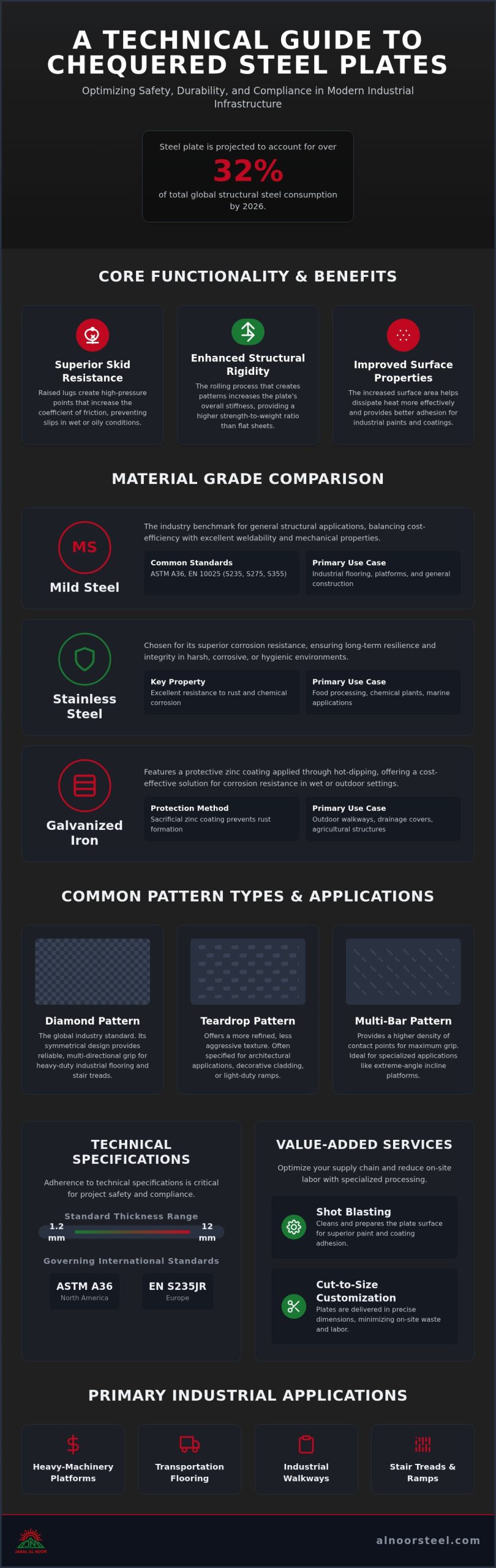
Did you know that steel plate accounts for over 32% of total global structural steel consumption in 2026? For infrastructure leaders and project engineers, selecting the right chequered steel plates is no longer just a matter of routine procurement. It is a critical decision that impacts long-term structural safety, skid resistance, and maintenance cycles. You likely understand the immense pressure of balancing immediate load-bearing requirements with the persistent threat of corrosive industrial environments. It is often difficult to navigate the technical nuances between ASTM A36 and EN S235JR while ensuring every millimetre of thickness meets rigorous national standards and 2026 regulatory benchmarks.

This reference guide provides the technical clarity you need to eliminate sourcing risks and select the optimal material for your specific industrial application. We will examine the mechanical properties of Mild Steel, Stainless Steel, and Galvanized Iron, detail the evolving international standards, and provide a clear framework for calculating load-bearing capacities. By the end of this technical overview, you will have the expertise to source compliant materials from reliable national suppliers capable of precise customization for large-scale infrastructure projects.

Key Takeaways

  • Distinguish between Mild Steel, Stainless Steel, and Galvanized Iron grades to ensure long-term material resilience in diverse industrial environments.
  • Master the technical specifications of chequered steel plates, including thickness ranges from 1.2mm to 12mm and their specific load-bearing capacities.
  • Ensure project compliance by understanding the international standards, such as ASTM A36 and EN S235JR, that govern structural steel quality.
  • Identify how value-added services like shot blasting and cut-to-size customization can optimize your supply chain and reduce on-site labor requirements.
  • Evaluate the performance of industrial tread plates across various infrastructure sectors, including heavy-machinery platforms and high-traffic transportation flooring.

Understanding Chequered Steel Plates: Patterns and Functionality

Chequered steel plates, commonly referred to as Tread plate or checker plates, are industrial-grade flat products characterized by a regular pattern of raised lugs on one side. These plates provide an essential safety layer in environments where moisture, oil, or debris create hazardous footing conditions. Beyond their primary safety function, they offer significant mechanical advantages. The rolling process used to create the patterns increases the plate’s overall rigidity, providing a higher strength-to-weight ratio compared to standard flat sheets. This added structural integrity makes them a preferred choice for load-bearing surfaces in heavy industry.

The increased surface area created by these raised patterns also helps dissipate heat and provides better adhesion for industrial coatings. For engineers managing national infrastructure projects, selecting the correct pattern isn’t merely an aesthetic choice; it’s a technical requirement for ensuring operational longevity and worker safety. Chequered steel plates serve as the foundational floor for the modern industrial landscape, combining durability with practical risk mitigation.

To better understand the manufacturing and visual profile of these materials, watch this helpful overview:

The Mechanics of Slip Resistance

The functionality of chequered steel plates relies on the interaction between the raised lugs and the contact surface of industrial footwear or machinery tires. These protrusions create localized high-pressure points that bite into rubber soles, significantly increasing the coefficient of friction. Proper pattern spacing is vital. It allows for the efficient drainage of fluids like water or lubricants, preventing the “hydroplaning” effect that often leads to industrial slips. When evaluating skid resistance for high-traffic pedestrian walkways, engineers must consider the lug height. A taller lug provides more aggressive grip but may pose a trip hazard if not specified correctly for the intended traffic type.

Pattern Types and Aesthetic Considerations

While several variations exist, the diamond pattern remains the global industry standard for heavy-duty industrial flooring and stair treads. Its symmetrical design provides multi-directional grip, making it ideal for large platforms where traffic moves in various paths. In contrast, teardrop patterns offer a more refined appearance. Architects often specify these for decorative cladding or lighter ramps where aesthetic appeal is as important as functionality. For specialized applications like extreme-angle incline platforms, multi-bar patterns provide a higher density of contact points, ensuring stability for both personnel and heavy equipment under challenging gradients.

Material Grades and Standards for Industrial Tread Plates

Selecting the correct material grade is a fundamental step in ensuring the endurance of national infrastructure projects. While chequered steel plates are ubiquitous across industrial landscapes, their performance varies significantly based on their specific chemical composition and the manufacturing standards they uphold. A project’s success often rests on the ability to match material resilience with the environmental stresses of the site.

Mild Steel (MS) and Carbon Steel Grades

ASTM A36 remains the industry benchmark for general structural applications due to its excellent weldability and balanced mechanical properties. It’s the primary choice for industrial flooring where high-strength requirements must be met with cost-efficiency. In European contexts, EN 10025 standards govern grades like S235, S275, and S355. The numerical value in these grades indicates the minimum yield strength in MPa, providing engineers with a predictable performance metric for load calculations. These hot-rolled plates are highly workable, allowing for seamless integration into complex structural frameworks. For engineers designing load-carrying applications, referencing the North American Specification for the Design of Cold-Formed Steel Structural Members provides a rigorous framework for ensuring safety and compliance across various jurisdictions. For energy and infrastructure projects that also require tubular carbon steel components, our guide on carbon steel pipe suppliers UAE offers a detailed comparison of grades and procurement strategies for 2026.

Stainless Steel for Harsh Environments

When projects face persistent corrosive threats, Grade 304 stainless steel offers a dependable standard for indoor industrial flooring and food processing facilities. It provides the necessary hygiene and oxidation resistance required in regulated environments. However, for offshore or coastal infrastructure, Grade 316 provides essential marine-grade protection. This specific grade includes molybdenum, which significantly enhances resistance to chloride-induced pitting and crevice corrosion. You can find more details on these material properties and their industrial applications in our Stainless Steel 316 Pipe Supplier Reference. Depending on the architectural requirements, these plates are available in mill finishes or polished variants to meet specific aesthetic and sanitation standards.

Galvanized Iron (GI) plates provide a practical, cost-effective alternative for outdoor environments where humidity is a constant factor. The hot-dip galvanizing process creates a metallurgical bond that shields the base metal from corrosive elements, extending the service life of the installation. In specialized scenarios where weight is the primary engineering constraint, aluminum variants are preferred. These offer a high strength-to-weight ratio, which is vital for mobile platforms, transport applications, and portable ramps. To ensure your project utilizes the correct grade for its specific demands, you can review our comprehensive inventory of graded flat and long products. Choosing the right material for chequered steel plates isn’t just about immediate utility; it’s about securing the long-term value and safety of the infrastructure.

Primary Industrial Applications of Checker Plates in Modern Infrastructure

The versatility of chequered steel plates makes them a staple in heavy industry, where operational safety and structural resilience are non-negotiable. These plates function as more than just a surface; they’re an integrated safety solution for environments that demand high friction and mechanical endurance. From power plants to coastal refineries, the application of these plates ensures that personnel and equipment can move securely across complex industrial landscapes. Their ability to withstand high-impact loads while providing consistent slip resistance makes them essential for maintaining operational continuity.

Infrastructure and Utility Applications

National infrastructure projects frequently utilize these plates for critical access points and pedestrian safety. Trench covers are a primary example, providing a secure passage for vehicles and personnel over sensitive utility lines while allowing for easy maintenance access. On bridge walkways, the raised patterns provide a reliable surface that remains effective even during periods of high humidity or rainfall. Ensuring these materials meet the BS EN 10025-2 steel standards is vital for verifying their mechanical properties in such high-stakes environments. These plates are often integrated with other structural components, a topic we explore further in our Hollow Section Steel Suppliers in UAE Guide.

Logistics and Commercial Transport

In the logistics sector, the durability of chequered steel plates is leveraged to reinforce transport assets. Truck bed liners and trailer flooring utilize these plates to protect the vehicle chassis from the heavy impact of shifting cargo and industrial equipment. This reinforcement extends the service life of the fleet and reduces maintenance costs. Within warehouse facilities, mezzanine flooring constructed from checker plates allows for the vertical expansion of storage capacity. These elevated platforms must support significant weight while ensuring that forklift operators and warehouse staff have a stable, anti-slip surface for loading and unloading operations. Loading dock ramps also rely on these plates to provide the necessary traction for pallet jacks navigating steep inclines.

Beyond these heavy-duty uses, checker plates are fundamental to structural safety systems. They’re the industry standard for stair treads on emergency exits and fire escapes, where consistent grip is critical during rapid evacuations. Architecturally, these plates are often applied as protective wall cladding in high-traffic industrial corridors. This application shields the underlying structure from mechanical wear and tear while providing a clean, professional aesthetic that reflects the high standards of a modern industrial facility. Whether used for utility access or architectural protection, the choice of plate must always align with the specific technical demands of the environment.

Chequered Steel Plates: A 2026 Industrial Reference for National Infrastructure

Technical Specifications: Sizing, Thickness, and Load-Bearing Factors

Precise engineering requires an exact understanding of material dimensions. Chequered steel plates are available in a broad spectrum of thicknesses, ranging from 1.2mm for architectural cladding to 12mm or more for heavy industrial flooring. Standard configurations typically include 1000 x 2000mm, 1220 x 2440mm, and 1500 x 6000mm dimensions. Choosing the correct size minimizes material waste and reduces the number of weld joints required on-site, which directly impacts the structural integrity of the final installation.

Calculating the weight per square meter is a vital step for structural load budgeting. Engineers must factor in the base plate thickness alongside the additional mass of the raised pattern. This calculation ensures that supporting beams and columns aren’t overstressed by the flooring weight. Adhering to international thickness and flatness tolerances also prevents alignment issues during large-scale fabrication. This precision is what separates a reliable industrial installation from one prone to premature wear or safety hazards.

Selecting the Right Thickness

Material thickness must be matched to the expected traffic and impact levels of the environment. Light-duty plates, ranging from 1.2mm to 3mm, are ideal for decorative interior elements, cabinet lining, or light pedestrian paths where weight saving is prioritized. For standard warehouse flooring, mezzanine platforms, and truck bed liners, medium-duty plates between 4mm and 6mm provide the necessary durability. Heavy-duty applications, involving plates of 8mm to 12mm and above, are reserved for heavy machinery platforms and high-impact industrial zones that experience constant mechanical stress and heavy equipment movement.

Procurement Logistics and Inventory Management

National-scale infrastructure demands a robust logistical framework. Sourcing bulk quantities requires a partner capable of maintaining consistent inventory levels across diverse grades and sizes. Every structural plate must be accompanied by a Mill Test Certificate (MTC) to verify compliance with chemical and mechanical specifications. This documentation is essential for project audits and long-term liability management. For detailed insights on managing these requirements, refer to our Structural Steel Supplier UAE 2026 Procurement Guide. To secure high-quality materials for your next project, you can browse our full inventory of chequered steel plates and other flat products.

Processing and Surface Treatments for Enhanced Durability

Raw steel is rarely ready for immediate installation in high-stakes infrastructure projects. To ensure chequered steel plates perform over decades, they must undergo rigorous processing and surface treatments. These value-added services reduce the logistical burden on construction sites and provide the necessary chemical defense against atmospheric corrosion. It’s a fundamental step that transforms a basic flat product into a specialized industrial component ready for the most demanding environments.

Precision Customization Services

Factory-level customization is a strategic choice for large-scale projects. By utilizing precision cutting, engineers receive plates that fit structural frameworks exactly, which eliminates the need for hazardous on-site modifications. This process significantly reduces material waste and labor costs. Beyond simple sizing, professional edge finishing is a critical safety requirement. Deburring and smoothing the edges of heavy plates ensures safe handling for installation teams and prevents mechanical interference with adjacent structural members. You can explore the technical advantages of these processes in our Cut-to-Size Steel Service Reference. Receiving customized plates allows for a methodical and steady construction pace, mirroring the planned nature of the engineering sector.

Surface Treatments for Longevity

Surface preparation is the most influential factor in a coating’s lifespan. Shot blasting to SA 2.5 standards is the industry benchmark for removing mill scale, rust, and contaminants. This process creates a specific surface profile that ensures optimal adhesion for industrial-grade primers and paints. For plates destined for humid or chemically aggressive environments, applying a high-performance primer immediately after blasting is essential to prevent flash rusting. This proactive approach ensures the material’s endurance and maintains the rigorous quality benchmarks required for national infrastructure.

When long-term outdoor resilience is the primary goal, hot-dip galvanization provides the most robust protection. This metallurgical process creates zinc-iron alloy layers that shield the base metal from moisture and oxidation. Choosing the right finish depends on the project’s environmental exposure:

  • Black (Uncoated): Suitable for indoor, dry environments or where the client will apply specialized coatings on-site.
  • Primed: Ideal for temporary protection during transit and as a base for final industrial topcoats.
  • Galvanized: The standard for coastal infrastructure, bridge walkways, and any application exposed to the elements.

Implementing these treatments ensures that the chequered steel plates maintain their structural integrity and slip-resistant properties throughout their intended service life. By integrating these services at the procurement stage, project managers secure a more efficient, safer, and durable outcome for critical assets. It’s about providing long-term value and unwavering stability for every collaborator involved in the project.

Securing Long-Term Structural Integrity for National Infrastructure

Choosing the right chequered steel plates is a foundational decision that impacts the safety and longevity of every large-scale project. We’ve explored how balancing mechanical skid resistance with rigorous material standards like ASTM and EN ensures that industrial surfaces withstand the pressures of modern infrastructure. By prioritizing technical precision in thickness selection and utilizing professional surface treatments like shot blasting, you can significantly reduce maintenance cycles and on-site labor. It’s about ensuring every component meets the highest benchmarks for durability and performance.

Reliability in the supply chain is equally critical. Accessing a national distribution network with in-house cut-to-size capabilities allows for a more methodical and secure procurement process. Whether your project requires the corrosion resistance of Stainless Steel 316 or the structural stability of hot-rolled carbon steel, maintaining high standards is the key to operational excellence. Our commitment to global quality benchmarks and logistical efficiency makes us a steady partner for your construction needs.

View Our Full Inventory of Chequered Steel Plates to find the exact specifications for your next project. We look forward to supporting your industrial goals with dependable, high-quality steel solutions.

Frequently Asked Questions

What is the difference between chequered plate and tread plate?

Chequered plate and tread plate are synonymous terms used to describe the same industrial product. While “chequered” is more common in European and Commonwealth markets, “tread plate” is frequently used in North America. Both refer to a flat steel product featuring a raised pattern on one side for skid resistance. Other industry terms include checker plate and floor plate. Regardless of the nomenclature, the technical specifications and safety functions remains identical across global standards.

Which material is best for outdoor chequered plates in the UAE climate?

For outdoor environments characterized by high humidity and salinity, Galvanized Iron (GI) or Stainless Steel Grade 316 are the most resilient choices. The hot-dip galvanizing process provides a sacrificial zinc layer that protects the base steel from oxidation. In coastal areas where chemical aggression is higher, SS 316 is the superior option due to its molybdenum content. These materials ensure that chequered steel plates maintain their structural integrity despite the harsh atmospheric conditions.

How is the thickness of a chequered steel plate measured?

The thickness of a chequered plate is always measured based on the “on-the-flat” dimension, which is the thickness of the base metal excluding the raised pattern. When engineers specify a 6mm plate, they’re referring to the flat sheet’s gauge. The raised lugs or diamonds add extra height, but this additional dimension isn’t included in the nominal thickness used for load-bearing calculations. This distinction is vital for ensuring precise structural fitment and compliance with international standards.

Can chequered steel plates be welded easily?

Yes, chequered steel plates can be welded using standard industrial methods, though the process varies by material. Mild steel plates (ASTM A36) offer excellent weldability for structural frameworks. When working with galvanized plates, the zinc coating must be removed from the weld area to prevent brittle joints and hazardous fumes. Stainless steel variants require compatible filler rods and specialized techniques to preserve the material’s corrosion resistance at the heat-affected zone during fabrication.

What are the standard sizes available for mild steel checker plates?

Standard dimensions for mild steel checker plates typically include 1000 x 2000 mm, 1220 x 2440 mm, and 1500 x 3000 mm. Larger configurations like 1500 x 6000 mm are also available for extensive industrial platforms to minimize the number of required joints. These standardized sizes allow for efficient logistical planning and inventory management. Most national suppliers also provide customization services to cut these plates to specific project dimensions, reducing on-site labor and material waste.

How do I calculate the load-bearing capacity of a chequered plate?

Calculating load-bearing capacity requires evaluating the base plate thickness, the span between structural supports, and the material’s yield strength. Engineers utilize standard deflection formulas to determine how much weight the plate can support without permanent deformation. It’s important to factor in both static loads, like machinery, and dynamic loads, such as forklift traffic. Referencing standards like EN 10025-2 provides the necessary mechanical data to perform these calculations accurately for safety-critical infrastructure.

Is stainless steel chequered plate worth the extra cost?

Stainless steel is a worthwhile investment when the long-term cost of maintenance and replacement outweighs the initial procurement price. While mild steel is cost-effective for dry indoor areas, it requires frequent painting or coating in corrosive settings. Stainless steel (SS 304 or 316) provides inherent resistance to rust and chemical exposure, making it essential for food processing, marine, or chemical plants. The reduced downtime and extended service life often provide superior value for high-stakes projects.

What surface treatments are recommended for industrial flooring?

For industrial flooring, the most effective surface treatments involve shot blasting followed by high-performance coatings. Shot blasting to SA 2.5 standards removes mill scale and creates a surface profile that ensures maximum adhesion for primers. Depending on the environment, you might choose an epoxy coating for chemical resistance or hot-dip galvanization for outdoor durability. These treatments protect the steel from atmospheric corrosion while maintaining the essential slip-resistant properties of the raised pattern over its service life.