In the UAE’s industrial sector, a single millimeter of oxidation isn’t just a maintenance issue; it’s a structural liability that can compromise multi-million dirham assets within months. Choosing the right priming steel surface treatments UAE professionals trust is the only way to combat the relentless combination of high humidity and saline air that defines our region. You likely recognize that untreated steel begins to degrade the moment it’s exposed to the elements, leading to rapid rust formation and escalating maintenance costs that drain project budgets. This vulnerability often stems from a lack of specialized protection during the initial fabrication phase, which leaves structural components exposed to corrosive forces.
We understand the frustration of seeing high-quality coatings fail prematurely due to poor surface preparation or non-compliance with ISO 12944 standards. This technical guide provides a comprehensive roadmap for selecting priming systems that endure the UAE’s extreme environment while maximizing the lifecycle of your industrial assets. You’ll discover how specialized treatments protect structural integrity, the logistical benefits of receiving pre-primed steel at your site, and the latest 2026 regulatory updates affecting construction standards. By prioritizing technical proficiency in surface preparation, you ensure the long-term stability and safety of every project you undertake.
Key Takeaways
- Understand how specialized priming shields structural steel from the UAE’s aggressive humidity and saline conditions to prevent rapid oxidation.
- Learn to specify high-performance priming steel surface treatments UAE projects require to meet international ISO 12944 corrosion standards.
- Discover the quality advantages of shop-applied priming in controlled environments compared to the technical risks of on-site coating.
- Explore how integrated procurement, including cut-to-size and pre-primed steel delivery, reduces on-site labor and accelerates project timelines.
- Identify the critical factors for matching primer chemistries with specific topcoats to ensure long-term structural integrity and reduced maintenance costs.
The Critical Role of Priming Steel Surface Treatments in the UAE
Priming serves as the primary interface between raw structural steel and its surrounding environment. It’s the foundational layer of a multi-coat protective system, designed to establish a chemical and mechanical bond with the metal substrate. In an industrial context, priming steel surface treatments UAE professionals utilize are not merely aesthetic; they’re essential barriers that prevent the immediate onset of oxidation. Without this initial coating, even the highest grade of structural steel remains vulnerable to the rapid degradation caused by the region’s aggressive atmospheric conditions. Beyond simple protection, the primer acts as a critical bonding agent, providing the necessary “tooth” for intermediate and topcoat layers to adhere correctly, ensuring the entire coating system functions as a singular, durable unit.
The economic implications of neglecting this stage are severe. In large-scale infrastructure projects, premature corrosion leads to astronomical maintenance costs and potential structural failure. When steel is left untreated after fabrication, the salt-laden air characteristic of the UAE initiates a corrosive cycle that’s difficult to arrest once it takes hold. By integrating priming into the initial procurement and fabrication phase, asset owners can significantly extend the service life of their investments. This proactive approach transforms steel from a perishable commodity into a long-term industrial asset.
Understanding the UAE Environmental Corrosivity
The international standard ISO 12944 classifies environmental corrosivity into categories ranging from C1 (very low) to CX (extreme). Due to the high humidity and pervasive salinity found throughout the country, many coastal and industrial zones in the UAE fall strictly under C5 or CX classifications. These environments demand rigorous protective measures because the rate of metal loss is significantly higher than in temperate climates. Additionally, the intense UV radiation prevalent in the region can degrade unprotected surfaces and certain coating binders, making the selection of a UV-stable priming system even more vital for maintaining structural integrity during the construction phase.
Priming as a Preventive Maintenance Strategy
Investing in professional surface treatments at the start of a project drastically reduces the total lifecycle cost of structural steel. While unprimed steel may seem cost-effective initially, the subsequent expenses for on-site rust removal and recoating far exceed the price of factory-applied protection. Proper priming prevents “under-film” corrosion, a phenomenon where rust spreads beneath a coating layer, causing widespread delamination and structural weakening. The induction period of corrosion for untreated steel in saline air refers to the initial phase during which moisture and chlorides accumulate on the surface before visible oxidation begins to compromise the metal substrate. By applying a primer before this period ends, you lock in the steel’s original strength. For organizations seeking reliable materials, sourcing structural steel products that are ready for immediate treatment is a foundational step in any robust maintenance strategy.
Technical Classification of Industrial Steel Primers
Selecting the appropriate priming steel surface treatments UAE projects require involves understanding the specific chemical interactions between the coating and the metal. We categorize these treatments based on their protective mechanism, either sacrificial or barrier based, to ensure they meet the rigorous demands of the regional climate. This technical classification ensures that whether you’re dealing with flat products or complex tubes and pipes, the foundation of your coating system is technically sound and compatible with the intended environment.
Zinc-Rich Primers: Sacrificial Protection
Zinc-rich primers are the gold standard for heavy structural steel and offshore components. These systems utilize a high concentration of zinc dust to provide cathodic protection, which is vital in high-salinity zones. The chemical reaction involves the zinc dust acting as an anode that corrodes preferentially to the steel substrate, effectively creating a galvanic cell that protects the underlying metal. Inorganic Zinc (IOZ) primers offer superior heat resistance and are often specified for the most severe C5 and CX environments, while organic zinc primers provide better flexibility for components subject to mechanical movement.
Epoxy and Alkyd Primers: Barrier Protection
Epoxy primers provide a dense, impermeable barrier that’s highly resistant to chemicals, moisture, and abrasion. They’re the preferred choice for industrial environments where the steel might face mechanical stress or chemical exposure. In contrast, alkyd primers are more cost-effective but are generally limited to mild atmospheric conditions. When we compare durability in UAE soil conditions, epoxy systems outperform alkyds significantly; the high salinity and varying moisture levels in local ground conditions can cause alkyd films to fail through saponification or rapid moisture ingress. For projects requiring long-term endurance, sourcing high-quality MS beams and hollow sections that are compatible with these high-performance epoxy systems is a critical procurement step.
Structural components like MS beams and plates often require weldable primers, also known as shop primers. These thin-film coatings allow engineers to perform on-site assembly and welding without the need for extensive grinding, which saves significant labor time. However, the high-temperature climate of the UAE necessitates careful management of drying times. While heat accelerates the initial set, it’s vital to monitor overcoating intervals strictly. If the surface becomes too hard or contaminated by dust between coats, inter-coat adhesion will suffer, leading to potential delamination of the final system. Maintaining a controlled application environment is the only way to ensure these technical primers perform to their rated specifications.
Shop Priming vs. On-Site Coating: Logistics and Quality
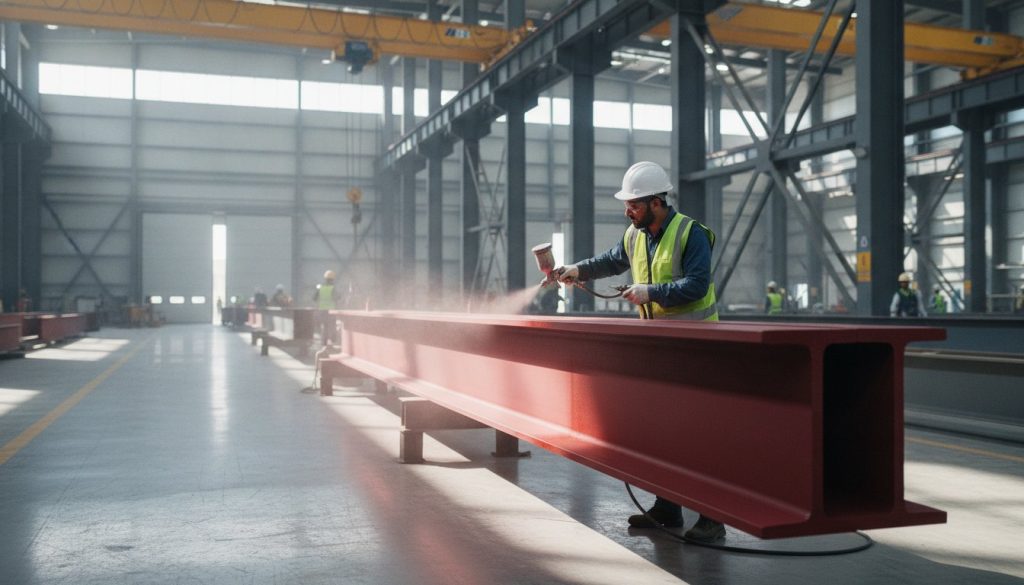
Shop-applied priming steel surface treatments UAE contractors prefer offer a level of precision that’s impossible to replicate on an active construction site. On-site painting is often at the mercy of the environment, where high humidity and sudden sandstorms can contaminate wet films, leading to poor adhesion and premature failure. By shifting the application to a centralized facility, projects eliminate these weather-related risks entirely. Receiving pre-primed steel components directly at the project site significantly reduces the required on-site labor and accelerates the assembly schedule. This methodical approach ensures that the protective system is applied under optimal conditions every time, regardless of the season.
Centralized facilities also provide superior environmental and safety controls. Overspray and volatile organic compound (VOC) emissions are managed more effectively in a shop than in open-air site conditions, ensuring compliance with evolving regional health and safety regulations. This industrial stability allows for a predictable production pace, which is essential for large-scale infrastructure projects that operate on tight delivery windows. It’s about moving from a reactive site-based process to a proactive, quality-controlled manufacturing environment.
The Synergy of Shot Blasting and Priming
The success of any priming system depends entirely on the cleanliness and profile of the metal. Priming must occur immediately after the shot blasting process to prevent the formation of flash rust, which occurs when bare steel is exposed to humid air. Achieving a “Very Thorough” blast cleaning grade, specifically Sa 2.5 as per ISO 8501-1, provides the mechanical anchor required for high-performance primers. For a deeper look at this process, see our guide on Steel Plate Shot Blasting in the UAE: A Guide to Surface Preparation. This sequence ensures the primer bonds deeply into the steel’s surface profile, creating a foundation that’s resistant to delamination.
Quality Assurance in Controlled Shop Conditions
Shop conditions allow for the rigorous monitoring of Dry Film Thickness (DFT) using calibrated magnetic or ultrasonic gauges. This precision is difficult to maintain on-site, where wind and uneven lighting can affect application consistency. Uniform coverage is especially critical on complex geometric shapes, such as Universal Beams and Columns, where corners and flanges are prone to thin spots. Professional shops adhere strictly to NACE and SSPC standards, performing wet film tests and checking ambient conditions like dew point and relative humidity before application begins. This level of oversight guarantees that the structural steel arrives on-site with a protective layer that meets the exact engineering specifications for the project.
Selecting the Right Treatment for UAE Project Specifications
Identifying the correct priming steel surface treatments UAE engineers specify requires a multi-faceted evaluation of the project’s operational environment. Selection isn’t a singular choice but a strategic decision based on the intended service life and the compatibility of the primer with subsequent intermediate coats. Infrastructure projects, such as bridges or industrial warehouses, often prioritize long-term barrier protection to withstand atmospheric salinity. Conversely, the Oil & Gas sector demands high-performance sacrificial systems capable of resisting both chemical exposure and extreme thermal cycling. These decisions are governed by international benchmarks, including ASTM D5144 for industrial coatings and various EN standards for structural steelwork, ensuring that the protective system meets global quality expectations.
Material thickness also influences the selection process. Thinner steel profiles require coatings with high flexibility to prevent cracking during handling or thermal expansion, while heavy-gauge MS beams can support thicker, more robust primer films. Engineers must also consider the “induction period” mentioned earlier, ensuring the chosen primer can be applied within the specific window required for the steel’s grade and surface profile. This technical alignment prevents the premature failure of the entire coating system, protecting the foundational investment of the project. For a detailed examination of how geometric precision and grade selection interact with these protective requirements, our analysis of steel profiles for engineering projects provides essential context for procurement decisions.
Priming Requirements for Long and Flat Products
Hollow sections and pipes present unique challenges, particularly regarding internal corrosion and the difficulty of reaching recessed areas. Specialized low-viscosity primers are often used to ensure even coverage inside these profiles. For those managing diverse inventories, the treatment protocols for GI and PPGI steel sheets require primers that can adhere to zinc-coated or pre-painted surfaces without compromising the existing protective layers. Heavy-duty MS plates used in storage tanks or marine vessels require even more rigorous priming systems, often involving multiple layers of epoxy-based primers to provide a dense, impermeable shield against moisture ingress.
Adhering to Structural Steel Quality Standards
A robust priming strategy is essential for maintaining compliance with Structural Steel Quality Standards. Documentation and certification are non-negotiable components of the procurement process. Professional steel suppliers provide comprehensive batch certificates for both the steel and the primer, along with detailed application logs that record ambient conditions and Dry Film Thickness (DFT) readings. Verifying these certificates ensures that the materials delivered to the project site meet the precise engineering specifications required for safety and longevity. This transparency is a hallmark of a reliable partnership in the heavy industry sector.
To ensure your project utilizes materials that meet these rigorous technical benchmarks, you can explore our full range of structural steel products and value-added treatment services.
Jabal Al Noor Steel: Integrated Priming and Surface Solutions
Jabal Al Noor Steel stands as a foundational pillar in the regional industrial landscape, offering a seamless integration of material procurement and advanced finishing. We provide a comprehensive inventory of structural steel that’s ready for immediate, customized treatment. By centralizing these processes, we eliminate the logistical complexities and quality risks often associated with managing multiple vendors for the same project. Our in-house capabilities for shot blasting, cut to size steel service UAE projects depend on, and professional priming ensure that every component meets the precise technical requirements of the UAE’s heavy industry sectors. This integrated approach allows us to maintain strict oversight over the entire preparation cycle, guaranteeing that the protective foundation of your steel is technically sound.
A One-Stop Solution for Steel Procurement
Streamlining your supply chain is essential for maintaining project momentum and reducing overhead. We offer direct access to a wide range of Long and Flat products, including MS beams, channels, and hollow sections that meet international standards. This integrated model allows engineers to source their materials and specify their finishing requirements, such as shot blasting or priming, in a single transaction. Our customization options ensure that steel is prepared according to specific engineering blueprints, arriving at the project site ready for immediate installation. This efficiency is particularly valuable for large-scale infrastructure and energy projects where timelines are non-negotiable and precision is paramount.
Reliability and Regional Expertise Since 2010
With a proven track record supporting UAE industrial projects since 2010, we’ve established ourselves as a dependable partner for the nation’s most demanding sectors. Our approach is rooted in transparency and technical proficiency, ensuring that our clients receive not just materials, but long-term structural value. We understand the specific pressures of the local environment and provide direct consultation for complex priming steel surface treatments UAE specifications. This expertise allows us to guide our collaborators through the selection of optimal coating systems that comply with global quality benchmarks and regional requirements.
Our national logistics network ensures the efficient delivery of pre-treated steel products across the UAE. By receiving components that have already undergone shot blasting and priming in a controlled shop environment, contractors can focus on assembly rather than on-site surface preparation. This logistical efficiency, combined with our commitment to ethical conduct and operational excellence, makes us a steady partner in the ongoing development of the region’s infrastructure. We take pride in maintaining the high standards that our clients require for their most critical industrial assets.
Securing Structural Longevity in the UAE
Choosing the right priming steel surface treatments UAE engineers specify is a fundamental step in protecting multi-million dirham industrial assets. Throughout this guide, we’ve highlighted how specialized priming acts as a critical insurance policy against the region’s extreme humidity and salinity. By prioritizing shop-applied treatments and adhering to international ISO standards, you eliminate the risks of premature coating failure and significantly reduce long-term maintenance costs. This methodical approach ensures that your structural steel remains a stable, dependable pillar of your project’s infrastructure.
Since 2010, Jabal Al Noor Steel has provided the technical proficiency and regional expertise required for the UAE’s most demanding sectors. With our ISO and ASTM compliant inventory and reliable national delivery, we’re ready to support your procurement needs with unwavering confidence. View our full range of structural steel and surface treatment options to secure the endurance of your next project. We’re committed to being the steady partner you need for a resilient and successful build.
Frequently Asked Questions
What is the most durable primer for steel in coastal UAE environments?
Zinc-rich epoxy and inorganic zinc primers are the most durable options for coastal regions. These systems provide superior cathodic protection by acting as a sacrificial anode, which is essential in environments classified as C5 or CX under ISO 12944. While barrier primers only block moisture, these specialized priming steel surface treatments UAE professionals utilize ensure that even if the coating is scratched, the underlying steel remains protected from the aggressive saline atmosphere.
Can primed steel be welded on-site without removing the coating?
You can weld steel treated with specific “weldable shop primers” without removing the coating first. These thin-film treatments are formulated to minimize interference with weld integrity and prevent the release of excessive toxic fumes during the process. However, for heavy-duty primers like high-build epoxies, you must grind the coating back from the weld zone to ensure a sound connection. Always verify the primer’s weldable certification before proceeding with on-site assembly.
How long does a shop-applied primer last before a topcoat is required?
The exposure window for shop-applied primers typically ranges from three to six months before a topcoat becomes necessary. This duration depends on the primer type and the severity of the storage environment. Standard shop primers are designed for temporary protection during transit and assembly. If you exceed the recommended overcoating interval, the surface may require additional cleaning or a “mist coat” to ensure the intermediate and topcoat layers adhere correctly to the aged primer.
What is the difference between red oxide primer and zinc-rich primer?
Red oxide primers function primarily as a barrier against moisture and are best suited for mild, non-corrosive environments. In contrast, zinc-rich primers provide active galvanic protection by sacrificing zinc particles to prevent the steel from oxidizing. For the high-salinity conditions found across the UAE, zinc-rich systems are the industry standard for structural steel. They offer significantly higher durability and resistance to under-film corrosion compared to the simpler barrier protection provided by red oxide.
Is shot blasting mandatory before applying a steel primer?
Shot blasting to a minimum grade of Sa 2.5 is considered mandatory for all high-performance industrial priming. This process removes mill scale and rust while creating the specific surface profile required for the primer to achieve a mechanical bond. Without this step, the priming steel surface treatments UAE projects require will likely suffer from poor adhesion and premature delamination. Relying on manual wire brushing is generally insufficient for meeting international corrosion standards in heavy industry.
How does temperature affect the application of steel surface treatments in the UAE?
High ambient temperatures in the region significantly impact the curing process and application technique. While heat can accelerate drying times, it also increases the risk of “dry spray,” where the primer particles dry before hitting the metal surface. This results in a porous, non-protective film. Technicians must also monitor the steel’s surface temperature to ensure it remains at least three degrees Celsius above the dew point to prevent moisture from being trapped beneath the coating.
Does Jabal Al Noor Steel provide certification for primed steel products?
Jabal Al Noor Steel provides comprehensive documentation for all treated products to ensure full traceability and compliance. This includes mill test certificates for the raw steel and detailed application reports for the surface treatments. These reports typically document the blast cleaning grade achieved, the batch numbers of the primers used, and the final dry film thickness (DFT) readings. This level of transparency is vital for meeting the rigorous quality standards required in large-scale infrastructure projects.
What standards govern steel surface preparation and priming in the Middle East?
Surface preparation and priming in the region are primarily governed by ISO 12944 and ISO 8501-1 standards. Additionally, many projects specify compliance with SSPC (Society for Protective Coatings) and NACE (National Association of Corrosion Engineers) benchmarks. These international standards provide the framework for classifying environmental corrosivity and defining the necessary cleanliness levels for metal substrates. Adhering to these established protocols ensures that the protective systems applied are globally recognized for their quality and reliability.