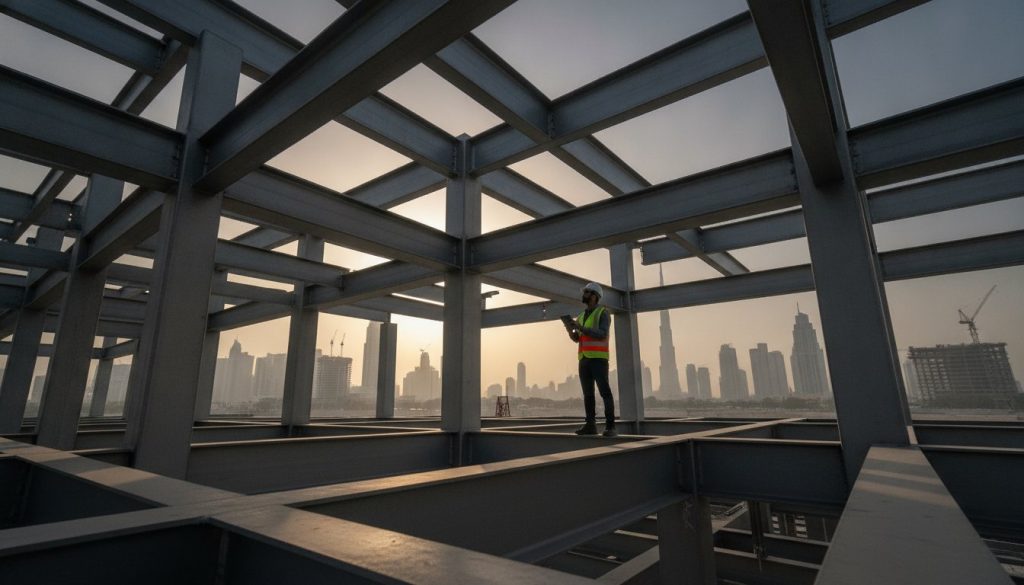
With domestic steel consumption in the UAE now exceeding 350,000 metric tons per month, the pressure on industrial supply chains to maintain both volume and technical precision has never been higher. For engineers and procurement specialists, the challenge isn’t just finding material; it’s securing components that meet rigorous safety codes without facing the common bottlenecks of logistical delays or rigid, non-customized inventory. You recognize that the structural integrity of a major infrastructure project depends on the meticulous selection of materials that adhere to strict international benchmarks.
Identifying dependable hollow section steel suppliers UAE is a critical step in ensuring your project aligns with the latest 2026 standards for durability and performance. This guide provides the technical clarity you need to navigate the sourcing process with confidence. You’ll gain a thorough understanding of the structural differences between SHS, RHS, and CHS profiles, alongside a breakdown of essential compliance standards like ASTM A500 and EN 10219. We also examine how value-added services, such as cut-to-size customization and specialized surface treatments, can streamline your operations and provide long-term protection for your assets.
Key Takeaways
- Learn why Hollow Structural Sections (HSS) provide superior strength-to-weight ratios for high-stakes infrastructure projects throughout the Emirates.
- Identify the critical load-bearing differences between Square Hollow Sections (SHS) and Rectangular Hollow Sections (RHS) to ensure optimal structural performance.
- Evaluate material compliance by understanding international benchmarks like ASTM A500 and EN 10219 when vetting hollow section steel suppliers UAE.
- Discover how specialized surface treatments and cut-to-size customization mitigate corrosion risks and reduce on-site logistical delays.
- Gain insights into selecting a dependable industrial partner capable of maintaining large-scale inventory and ensuring national delivery across the region.
What is Hollow Section Steel and Its Role in UAE Infrastructure?
A Hollow Structural Section (HSS) represents a high-strength steel profile characterized by its hollow, tubular cross-section. These sections are manufactured through either cold-forming or hot-rolling processes, resulting in a product that provides superior structural integrity for complex builds. For engineers engaging with hollow section steel suppliers UAE, understanding this fundamental geometry is the first step in optimizing material selection for local industrial requirements. These profiles are not merely components; they are the essential framework for the region’s most ambitious architectural and energy projects.
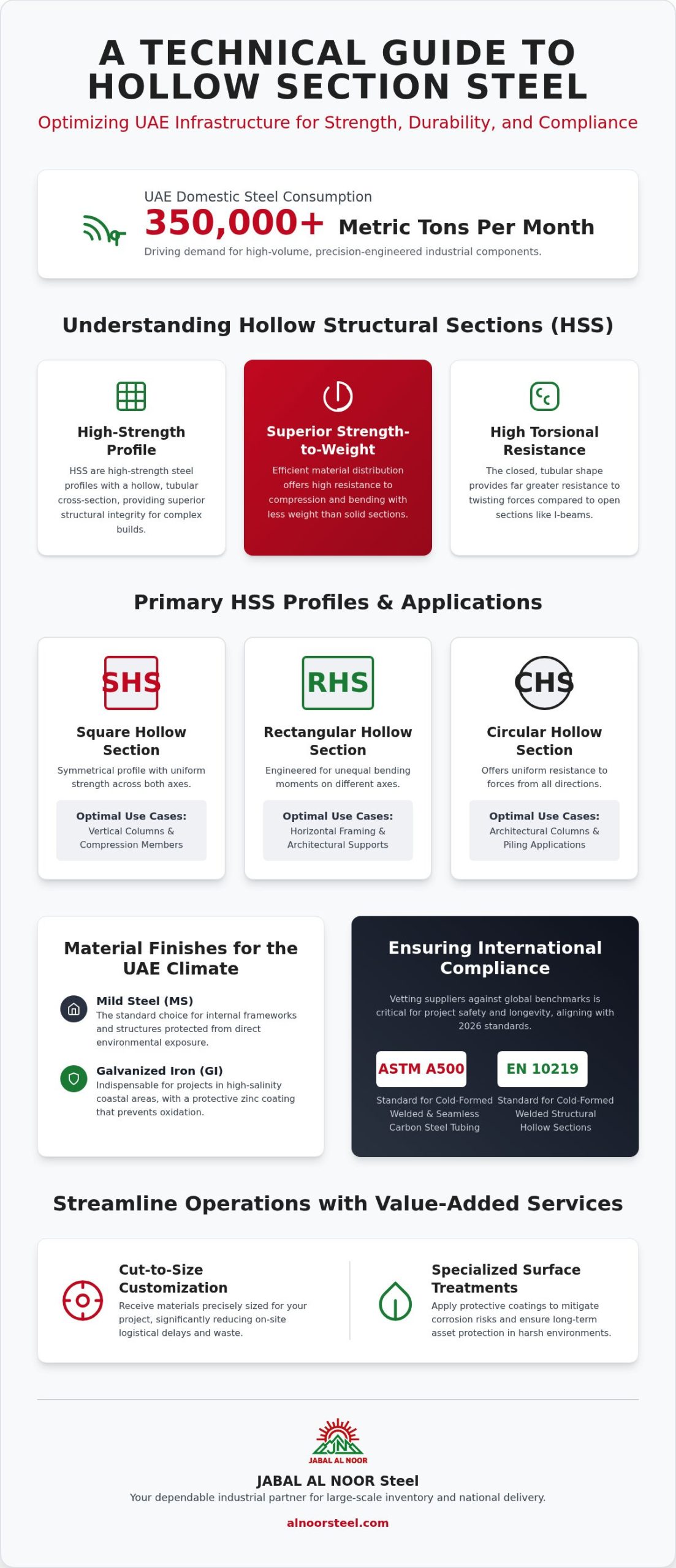
One of the primary advantages of HSS is its exceptional strength-to-weight ratio. Unlike solid steel sections, hollow profiles distribute material efficiently around the axis, providing high resistance to compression and bending. This efficiency is particularly valuable in the UAE’s high-rise sector, where torsional resistance is paramount. The closed shape of the hollow section offers far greater resistance to twisting forces than open sections like I-beams or channels. Beyond structural performance, the clean lines and uniform profiles of HSS provide high architectural versatility. This aesthetic appeal is essential for modern UAE facades, where structural members are frequently left exposed as part of the design language.
The Evolution of Steel Construction in the UAE
The UAE’s construction landscape has undergone a significant transformation, moving away from traditional masonry toward steel-intensive modular construction. This shift is driven by the need for rapid infrastructure development and the increasing complexity of modern architectural designs. HSS plays a vital role here by facilitating faster project completion times through prefabricated components. As the market expands, the ability of hollow section steel suppliers UAE to provide consistent, high-grade material becomes a cornerstone of regional growth. The transition to steel allows for greater spans and more creative structural solutions that were previously unattainable with conventional materials.
Key Benefits for Large-Scale Engineering
Large-scale engineering projects benefit from reduced foundation loads because the lighter structural weight of hollow sections permits more efficient load distribution. This reduction in mass allows for more economical foundation designs without compromising safety or longevity. Additionally, the flat surfaces of square and rectangular sections simplify the process of welding and joining in complex industrial fabrications. When sourcing these materials, professionals often turn to established entities like Jabal Al Noor Steel to ensure inventory availability and technical compliance. As of 2026, HSS is commonly defined as a structural profile produced from carbon steel grades such as S235JR, which balances weldability with reliable yield strength for versatile applications.
Primary Types of Hollow Structural Sections (HSS) and Their Applications
Selecting the correct profile geometry is a fundamental decision that dictates the structural efficiency and longevity of any industrial build. Professional hollow section steel suppliers UAE provide three primary shapes: Square Hollow Sections (SHS), Rectangular Hollow Sections (RHS), and Circular Hollow Sections (CHS). Each profile offers distinct mechanical advantages. SHS is prized for its inherent symmetry, which ensures uniform load-bearing capacity across multiple axes, making it the preferred choice for vertical columns and compression members. In contrast, RHS is engineered for applications where bending moments are unequal, providing a high strength-to-weight ratio for horizontal framing and architectural supports.
The choice between material finishes, specifically Mild Steel (MS) and Galvanized Iron (GI), further defines the section’s suitability for the UAE environment. While MS hollow sections are the standard for internal frameworks and protected structures, GI sections are indispensable for projects situated in high-salinity coastal areas. These galvanized sections undergo a protective zinc coating process that prevents oxidation in humid conditions. When engineers specify materials according to an ASTM Specification A500 or A1085, they ensure the steel possesses the necessary yield strength and wall thickness tolerances required for heavy-duty applications. This technical precision is what separates a standard supplier from a true industrial partner.
Square and Rectangular Sections for Frameworks
Square and rectangular profiles are the backbone of the UAE’s industrial warehousing and mezzanine sectors. Their flat surfaces allow for seamless integration with other structural components, such as MS Beams and Channels, creating rigid and space-saving designs. These sections are frequently utilized in industrial sheds and roofing frameworks where high resistance to lateral loads is required. Because they are easy to weld and bolt, they significantly reduce the complexity of on-site assembly. For those managing large-scale procurement, you can view our comprehensive inventory of these essential structural shapes.
Circular Sections in Industrial Piping and Scaffolding
Circular Hollow Sections offer a unique combination of aesthetic appeal and functional performance. Unlike square sections, CHS provides superior torsional resistance, making it ideal for conveyor systems, heavy-duty machinery supports, and even large-scale scaffolding systems. It’s important to distinguish between standard fluid-transport pipes and structural CHS. While standard pipes are rated for internal pressure, structural CHS is manufactured to withstand external loads and environmental stresses. For projects requiring fluid-transport solutions alongside structural steel, understanding the full range of options from industrial steel pipe suppliers UAE ensures you select the correct specification for each application. These sections are also widely used in non-structural capacities, such as safety handrails and decorative fencing, where their smooth profile reduces wind resistance and enhances safety in public spaces. Reliable hollow section steel suppliers UAE ensure these products meet the specific wall thickness requirements necessary for both industrial and architectural roles.
Material Grades and International Standards for UAE Projects
Technical precision is the foundation of industrial safety and structural longevity in the Middle East. When procuring structural tubing, engineers must look beyond basic dimensions to the specific material grades that define a section’s mechanical performance. The two most prominent benchmarks encountered in the region are ASTM A500 and EN 10219. ASTM A500 is the standard for cold-formed carbon steel structural tubing, commonly specified in projects influenced by North American engineering codes. Conversely, EN 10219 represents the European standard for cold-formed welded structural hollow sections, which remains the primary reference for the majority of commercial and industrial construction across the Emirates.
Understanding the distinction between grades like S235JR and S355J2 is essential for heavy industry applications. S235JR is a versatile grade with a minimum yield strength of 235 MPa, making it suitable for general frameworks and secondary structures. For high-load environments, such as industrial platforms or heavy machinery supports, S355J2 is preferred due to its higher yield strength of 355 MPa and superior impact resistance at lower temperatures. Every transaction involving these materials must be supported by a Mill Test Certificate (MTC). This document provides a transparent record of the steel’s chemical and mechanical properties, ensuring the batch meets the project’s design requirements.
Navigating ASTM vs EN Standards
Project specifications often dictate whether ASTM or EN standards are required, with ASTM usually appearing in oil, gas, and energy sector designs. EN standards are the backbone of regional commercial construction. Ensuring material consistency across international supply chains requires a deep understanding of equivalent grades. For instance, ASTM A500 Grade B is frequently viewed as a functional equivalent to EN 10219 S275, though slight variations in ductility and weldability exist. Selecting the right standard ensures that the welding procedures and structural calculations remain valid throughout the project lifecycle. For a comprehensive breakdown of how these international benchmarks align with local regulatory requirements, the structural steel quality standards UAE 2026 reference guide provides detailed technical equivalents and compliance protocols essential for project managers. Projects in the oil and gas sector that require both structural sections and piping systems should also consult a detailed comparison of MS, GI, and stainless steel options from industrial steel pipe suppliers UAE to maintain full compliance across all material categories.
Quality Assurance in Steel Sourcing
Rigorous quality assurance involves verifying the chemical composition of the steel, specifically the levels of carbon, manganese, and phosphorus. High carbon levels can impede weldability, while controlled manganese levels are necessary to maintain tensile strength and elongation benchmarks. Mechanical testing is equally vital to confirm that the steel can withstand the stresses of high-salinity coastal environments and extreme thermal expansion. Sourcing from established hollow section steel suppliers UAE ensures grade compliance and provides the peace of mind that every structural member has undergone standardized testing. This commitment to quality prevents costly structural failures and ensures that your infrastructure meets the highest global benchmarks for endurance.
Key Procurement Factors: Customization and Surface Treatments
Sourcing from hollow section steel suppliers UAE requires a strategic focus on how materials are prepared for the region’s environmental stressors. While identifying the correct grade is essential, the practical longevity of a structure depends on surface integrity and logistical precision. The UAE’s high-salinity coastal environments and extreme thermal fluctuations demand more than just raw steel. Leading industrial partners provide a suite of value-added services, including advanced surface preparation and precision cutting, to ensure that every structural member arrives on-site ready for immediate and long-term performance.
Shot blasting and priming represent the first line of defense in maintaining structural durability. This process involves cleaning the steel surface of mill scale and rust to create a profile that ensures superior coating adhesion. Without this meticulous preparation, protective layers are prone to delamination, leaving the hollow sections vulnerable to the region’s relentless humidity. National delivery capabilities further complement these technical services, ensuring that bulk supplies reach large-scale industrial sites across the Emirates without the delays typically associated with third-party logistics. Trusting a supplier with integrated processing and transport streamlines the entire procurement cycle.
Surface Treatments for Harsh Climates
Protective coatings are mandatory for any project exposed to the elements in the Middle East. Red oxide priming is a standard, cost-effective solution for internal frameworks, providing a reliable base for further painting. For more aggressive environments, galvanized finishes offer a metallurgical bond with a zinc coating that provides sacrificial protection against oxidation. This layer is critical for protecting the steel against the combined effects of thermal expansion and salt-laden air. Choosing the right finish depends on the project’s proximity to the coast and the expected service life of the infrastructure. For roofing and cladding applications in these same coastal environments, understanding the full range of corrosion-resistant sheet options from a qualified PPGI sheet supplier UAE projects rely on can further strengthen your overall material specification strategy.
Optimizing On-Site Logistics
Modern modular construction thrives on the efficiency of pre-processed components. By utilizing professional cut-to-size services, contractors can virtually eliminate on-site waste and significantly accelerate the assembly phase of a project. This industrial processing reduces the need for specialized cutting labor at the job site, which lowers overall project costs and improves safety standards. Precision cut-to-size customization minimizes project overhead by ensuring that every section arrives according to exact engineering specifications. To secure materials that meet these rigorous standards, you can order hollow sections and surface treatment services directly from our established inventory.
Strategic Sourcing: Partnering with Jabal Al Noor Steel
Jabal Al Noor Steel stands as a foundational pillar in the regional market, distinguishing itself among hollow section steel suppliers UAE through over a decade of operational excellence. We recognize that the heavy industry sector requires more than just a material vendor; it demands a dependable partner that can navigate the complexities of large-scale infrastructure and energy projects. Our role is to serve as a knowledgeable guide, ensuring that every structural component delivered meets the rigorous demands of modern engineering. This authoritative expertise is rooted in our deep connection to the local industrial landscape, where we’ve supported the growth of the nation’s backbone through consistent supply and technical proficiency.
Our comprehensive inventory reflects the scale and diversity of the UAE’s industrial requirements. From MS Beams, H-Beams, and I-Beams to a vast range of high-grade hollow sections, we maintain a stock that’s ready for immediate deployment across the seven emirates. Every product we supply is sourced with an unwavering commitment to international benchmarks, including ASTM, EN, and JIS requirements. This adherence to global quality ensures that our clients receive materials capable of withstanding the unique environmental and structural pressures of the Middle East. By combining this vast supply with advanced processing capabilities and a robust national logistics network, we offer an end-to-end service that minimizes delays and maximizes project efficiency.
Why Industrial Partners Choose Jabal Al Noor
Professional transparency is the cornerstone of our operations. We provide full material certification and grade verification for every batch, acknowledging that Mill Test Certificates are non-negotiable for project compliance and safety audits. Our infrastructure is specifically designed to handle bulk industrial contracts, providing the stability and volume necessary for national-scale infrastructure projects. This grounded approach to partnership has established us as a seasoned veteran in the landscape, prioritizing long-term value and ethical conduct over temporary market trends. Clients trust us because we provide the industrial stability and unwavering confidence required for high-stakes builds; we don’t just supply material, we provide structural certainty.
Next Steps for Procurement Managers
Selecting the correct material grade and dimensions is a technical decision that impacts the safety, longevity, and budget of your entire project. We encourage procurement managers to consult with our technical experts to ensure that the chosen hollow sections align perfectly with your structural calculations and environmental needs. Whether you require specific surface treatments like shot blasting and priming or precision cut-to-size processing to reduce on-site labor, our team is equipped to provide tailored solutions. You can view our full structural steel inventory and shop online to begin the procurement process with a partner that values precision and reliability as much as you do.
Optimizing Your Structural Steel Procurement for Regional Success
Navigating the complex requirements of modern infrastructure demands a deep understanding of material specifications and environmental challenges. By prioritizing the correct geometry, whether it’s the torsional strength of circular sections or the uniform load-bearing of square profiles, you ensure the long-term stability of your build. Adherence to international benchmarks like ASTM A500 and EN 10219 isn’t just a regulatory necessity; it’s the foundation of safety in a high-stakes industrial landscape. When vetting hollow section steel suppliers UAE, look for partners who integrate technical compliance with advanced processing capabilities.
Jabal Al Noor Steel provides the industrial stability your projects require through a comprehensive inventory and a robust national delivery network. As a dedicated stockist of international grades, we offer specialized in-house shot blasting and priming services to protect your assets against the region’s unique climate stressors. We’re committed to maintaining the highest standards of operational excellence for every collaborator we serve. Secure high-grade structural steel for your next project with Jabal Al Noor Steel and build with the confidence that only a seasoned industry veteran can provide. We look forward to supporting your next engineering milestone.
Frequently Asked Questions
What is the difference between SHS and RHS in structural steel?
Square Hollow Sections (SHS) feature equal side lengths that provide uniform load resistance across all axes, making them the preferred choice for vertical columns and compression members. Rectangular Hollow Sections (RHS) have unequal sides designed to resist bending forces in a specific direction. RHS is more efficient for horizontal framing and architectural supports where the load is primarily applied to the major axis.
Which steel grade is most commonly used for hollow sections in the UAE?
The most frequently specified grades in the UAE are S235JR and S355J2, which comply with the EN 10219 standard for cold-formed structural sections. For projects following North American codes, ASTM A500 Grade B is the primary benchmark. These grades offer a balance of weldability and yield strength that’s essential for industrial stability in the region’s diverse infrastructure projects.
Can hollow sections be used for load-bearing columns in high-rise buildings?
Hollow Structural Sections (HSS) are frequently utilized as load-bearing columns because they offer exceptional torsional resistance and a high strength-to-weight ratio. Their closed geometry makes them more resistant to twisting forces than open sections like I-beams. This performance is vital for high-rise frameworks where structural efficiency and reduced foundation loads are critical procurement factors.
Are hollow sections more expensive than traditional I-beams?
While the initial cost per ton of hollow sections can be higher than traditional I-beams, they often result in lower total project costs. Their high strength-to-weight ratio allows for a reduction in the total mass of steel required for the structure. Additionally, their smaller surface area compared to open sections reduces the volume of fireproofing and protective coatings needed for the build.
What surface treatments are recommended for steel used near UAE coastal areas?
For coastal projects, a combination of shot blasting, red oxide priming, and hot-dip galvanization is highly recommended to combat high salinity and humidity. Galvanized Iron (GI) sections provide a sacrificial zinc layer that prevents oxidation in harsh maritime conditions. Professional hollow section steel suppliers UAE provide these in-house surface treatments to ensure long-term structural endurance against the elements. For complementary cladding and roofing materials in these same environments, procurement teams should also evaluate options from a trusted GI and PPGI sheet supplier UAE contractors depend on for verified coating thickness and corrosion resistance.
Do you provide cut-to-size services for all hollow section orders?
We provide comprehensive cut-to-size customization for all hollow section orders to minimize on-site waste and accelerate the assembly process. Our industrial processing facilities ensure every piece is cut to exact engineering tolerances. This service reduces the need for secondary processing at the project site, which lowers labor costs and improves overall project safety for our industrial partners.
How do I verify the quality of hollow section steel from a supplier?
Quality verification is achieved by requesting a Mill Test Certificate (MTC) that details the steel’s chemical composition and mechanical properties. You should ensure the material complies with international standards like ASTM A500 or EN 10219. Working with established hollow section steel suppliers UAE guarantees that your inventory has undergone rigorous testing for tensile strength and yield benchmarks prior to delivery.
What are the standard lengths available for MS hollow sections in the UAE?
MS hollow sections are typically stocked in standard lengths of 6 meters and 12 meters across the UAE market. These standard dimensions facilitate efficient transport and handling for large-scale industrial sites. We also offer specialized customization to provide non-standard lengths that meet the specific requirements of your modular construction or industrial framing project through our national delivery network. For a detailed technical breakdown of grade specifications and compliance requirements, our engineering reference guide for MS hollow sections in UAE infrastructure provides comprehensive 2026 data to support your procurement decisions.