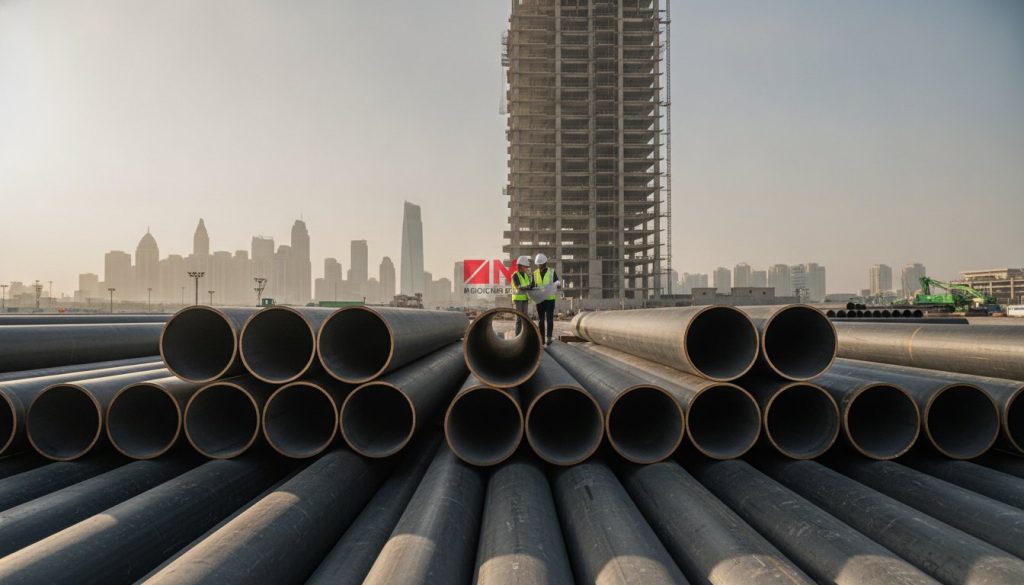
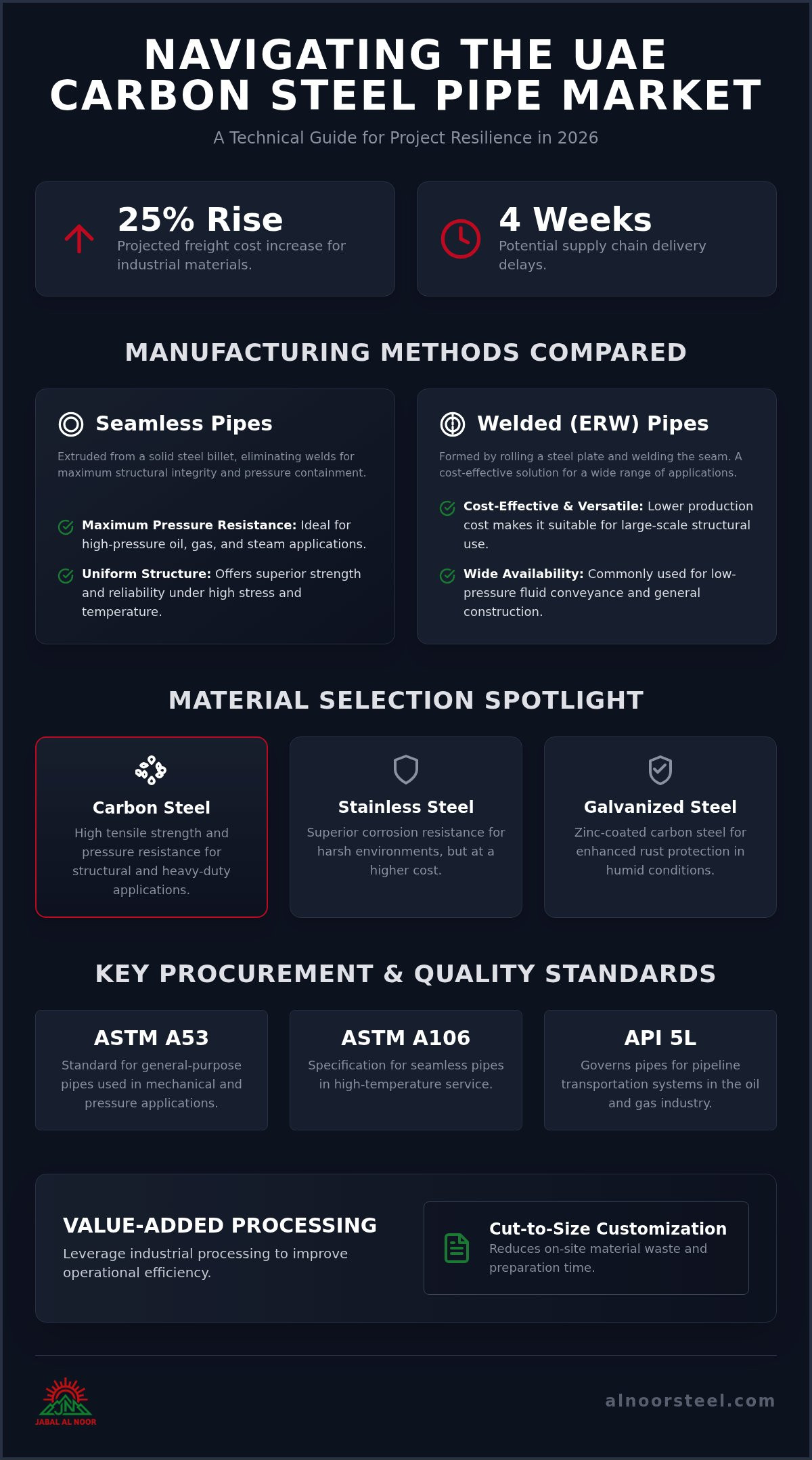
With freight costs for industrial materials projected to rise by as much as 25% across the Gulf in 2026, the margin for procurement error has never been thinner. For project managers overseeing large-scale energy or infrastructure developments, the search for reliable carbon steel pipe suppliers UAE is no longer just about price. It’s about securing a supply chain that can withstand regional logistical disruptions and delivery delays of up to four weeks. You likely recognize that the intersection of extreme environmental humidity and rigorous ASTM or API standards makes material selection a high-stakes decision where technical precision is non-negotiable.
We understand that matching precise technical specifications to your project’s lifecycle requirements is a complex and demanding process. This guide provides a comprehensive technical comparison of carbon steel pipe grades and manufacturing standards to ensure your procurement strategy remains resilient against market volatility. We’ll examine the critical differences between seamless and welded options, evaluate the necessity of specialized surface treatments for the unique UAE climate, and outline strategies for identifying suppliers with the national reach required to maintain operational excellence throughout 2026.
Key Takeaways
- Understand the performance differences between seamless and welded manufacturing methods to align material selection with specific pressure and structural requirements.
- Navigate complex procurement standards, including ASTM A53, A106, and API 5L, to maintain strict quality compliance across heavy infrastructure projects.
- Establish a resilient supply chain by partnering with carbon steel pipe suppliers UAE that offer national delivery and extensive inventory to bypass 2026 logistical disruptions.
- Assess the advantages of carbon steel’s high-strength properties compared to stainless and galvanized alternatives for large-scale industrial applications.
- Leverage value-added industrial processing, such as cut-to-size customization, to improve operational efficiency and reduce material waste on the project site.
The Role of Carbon Steel Pipes in UAE Industrial Infrastructure
Carbon steel pipes represent the backbone of modern industrial engineering, defined by their high-strength alloy composition where carbon content dictates the final mechanical performance. Unlike more complex alloys, these pipes provide the structural integrity required for heavy-duty applications without the prohibitive costs of exotic metals. For project managers engaging with carbon steel pipe suppliers UAE, understanding the specific balance of carbon and iron is essential for ensuring that every component meets the rigorous demands of the regional environment.
In 2026, carbon steel remains the primary material for the UAE’s most ambitious energy, desalination, and construction projects. The material’s inherent pressure resistance and tensile strength make it indispensable for the expansion of national infrastructure, including the Etihad Rail network and major water distribution upgrades. These projects require materials that can endure high temperatures and mechanical stress while remaining easy to weld and modify on-site. Sourcing from a national supplier with a comprehensive inventory of long products ensures that these large-scale operations proceed without the delays associated with international procurement.
To better understand the scale and application of these industrial components, watch this overview of regional steel supply:
Mechanical properties such as weldability and ductility are critical factors in material selection. Carbon steel’s versatility allows it to be used in everything from low-pressure water lines to high-pressure oil conduits. When you evaluate tubes and pipes for your project, the consistency of these properties determines the long-term endurance of the installation. A dependable partner provides transparency regarding these technical benchmarks, ensuring compliance with global quality standards and maintaining project timelines in a volatile 2026 market.
Key Applications Across UAE National Sectors
The utility of carbon steel extends across diverse industrial landscapes. In the construction sector, these pipes form the structural frameworks for industrial warehouses and pre-engineered building (PEB) structures, providing the necessary support for massive spans. In the energy sector, they facilitate efficient fluid transportation across oil, gas, and water distribution networks. Additionally, heavy civil engineering projects rely on large-diameter carbon steel pipes for piling and foundation support, ensuring the stability of infrastructure built on varied terrain.
Understanding Carbon Content and Pipe Performance
The performance of a pipe is directly linked to its carbon concentration. Low carbon steel, often referred to as mild steel, is widely utilized for general structural purposes because of its excellent weldability and formability. This makes it the preferred choice for hollow sections used in PEB structures. Medium and high carbon variants are reserved for high-pressure or high-wear environments where hardness is prioritized over ductility. Understanding how these levels influence the material’s response to stress helps engineers select the right industrial tubes for specific operational pressures, balancing the need for toughness with the requirements for on-site fabrication.
Manufacturing Comparison: Seamless vs. Welded Carbon Steel Pipes
Choosing between seamless and welded pipes is a technical decision that affects both the budget and the structural longevity of a project. Seamless pipes are manufactured through a process of extrusion, where a solid steel billet is pierced to create a hollow tube. This method eliminates the need for longitudinal or circumferential welds, providing maximum pressure handling capabilities. Leading carbon steel pipe suppliers UAE prioritize seamless options for high-stakes applications where the risk of seam failure must be entirely mitigated.
Welded pipes, including Electric Resistance Welded (ERW) and Submerged Arc Welded (SAW) varieties, offer a different set of advantages. ERW pipes are produced by cold-forming steel coils into a cylindrical shape and using high-frequency electric currents to fuse the edges. For massive national infrastructure projects, LSAW (Longitudinal Submerged Arc Welded) and SSAW (Spiral Submerged Arc Welded) provide large-diameter solutions that are essential for heavy-duty foundations and transmission lines. These manufacturing methods must adhere to strict UAE procurement and quality standards to ensure the surface finishes and dimensional tolerances meet the specific requirements of the Ministry of Industry and Advanced Technology (MoIAT).
When to Specify Seamless Carbon Steel
Seamless tubes are the industry standard for critical applications in high-temperature and high-pressure environments, particularly within the oil and gas sector. Their primary advantage lies in their structural uniformity. Because they lack a weld seam, they offer superior strength under internal pressure and greater resistance to mechanical stress. When procurement teams evaluate carbon steel pipe suppliers UAE for refinery or chemical processing plants, seamless pipes are often mandated by safety protocols to prevent leaks in volatile environments. Securing these materials requires a partner with deep regional expertise who understands the logistical nuances of 2026 supply chains.
The Versatility of ERW Pipes in Construction
ERW pipes serve as a cost-effective alternative for structural applications where extreme pressure isn’t a primary factor. They’re frequently utilized in building frameworks, hollow sections for warehouses, and low-to-medium pressure water networks. Electric Resistance Welded (ERW) pipes for 2026 infrastructure projects typically range from 1/8 inch to 24 inches in outside diameter, balancing structural rigidity with material efficiency. If your project involves large-scale PEB structures or standard industrial piping, you can browse our comprehensive inventory of industrial pipes to find the exact specifications required for your site.
Material Selection: Carbon Steel vs. Stainless and Galvanized Pipes
In the UAE’s heavy industrial sector, selecting the correct material involves a rigorous assessment of structural requirements and environmental exposure. Carbon steel serves as the high-strength, cost-effective foundation for projects that demand massive load-bearing capacity. While specialized alloys exist, most industrial frameworks rely on the predictable mechanical performance of carbon steel. Engaging with experienced carbon steel pipe suppliers UAE allows procurement teams to secure materials that balance immediate capital expenditure with long-term operational endurance.
Stainless steel offers superior corrosion resistance, particularly in coastal zones where humidity and salt levels are extreme. However, the significantly higher cost per ton often makes it a niche choice for specific high-risk components rather than a general structural solution. For projects requiring extreme chemical or salt resistance, you should consult our Stainless Steel 316 Pipe Supplier guide to understand where these specialized materials justify their investment. Galvanized Iron (GI) provides a middle ground, utilizing a zinc coating to offer atmospheric protection against rust, though it lacks the sheer structural strength of untreated carbon steel for heavy-duty columns.
Cost vs. Performance in Harsh Climates
The decision between these materials often centers on the total cost of ownership. Carbon steel is remarkably affordable at the point of purchase, but it requires diligent surface management to survive the UAE’s high-salinity and high-temperature conditions. Professional suppliers mitigate this by offering in-house industrial processing, such as shot blasting and priming. These surface treatments significantly extend the life of the material by creating a robust barrier against oxidation. When comparing the initial cost of carbon steel against the long-term maintenance of stainless steel, many engineers find that treated carbon steel remains the most viable option for the majority of infrastructure projects in 2026.
Structural Load Bearing and Ductility
Carbon steel remains the superior choice for large-scale structural beams, columns, and heavy industrial frameworks. Its high ductility allows it to absorb energy and deform without catastrophic failure, which is a critical safety feature in large-scale engineering. This material also boasts exceptional weldability, allowing for complex on-site fabrication that’s often difficult or impossible with specialized alloys. For those focusing on architectural or structural designs, it’s beneficial to explore Hollow Section Steel Suppliers in UAE to see how these shapes integrate into modern construction. The ease of modification and the sheer load-bearing capacity of carbon steel ensure its continued dominance in the national industrial landscape.
Procurement Standards and Quality Compliance in the UAE
In the UAE’s industrial sector, adherence to international quality benchmarks is the only way to ensure operational safety and structural longevity. Reliable carbon steel pipe suppliers UAE must provide comprehensive documentation for every batch, starting with Mill Test Certificates (MTC). These certificates verify the chemical composition and mechanical properties of the steel, ensuring the material matches the engineer’s exact specifications. For a deep dive into local compliance, you can consult our Structural Steel Quality Standards UAE reference guide.
Navigating ASTM and API Specifications
ASTM A53 and ASTM A106 are the most common specifications you’ll encounter. While ASTM A53 covers both seamless and welded pipes for general use, ASTM A106 is strictly for seamless pipe intended for high-temperature service. Grade B is typically preferred over Grade A in both standards because of its higher tensile and yield strength. The ASTM A106 standard serves as the industry benchmark for high-temperature seamless pipe applications. Understanding dimensional standards like Nominal Pipe Size (NPS) and Schedules, such as Sch 40, Sch 80, or Sch 160, is equally vital for ensuring that wall thickness can withstand intended internal pressures. For oil and gas transportation, API 5L standards dictate the requirements for line pipe, focusing on toughness and weldability for cross-country pipelines. These standards ensure that the steel can survive the high-stress environments of the 2026 energy landscape.
Ensuring Traceability and Certification
Traceability is a non-negotiable requirement for government-backed infrastructure and energy projects. Steel stockists play a critical role here by maintaining clear records of material origins and processing history. This includes facilitating third-party inspections to verify that the pipes meet the intended quality benchmarks before they reach the site. While ASTM is dominant, many structural projects also reference EN 10025 for hot-rolled structural steel sections, including hollow sections used in building frames. This European standard provides a framework for the mechanical properties of structural steel, ensuring consistency across diverse engineering applications. Maintaining this level of technical transparency builds the trust necessary for long-term industrial partnerships. If you’re ready to secure high-grade materials for your next project, you can browse our certified inventory of tubes and pipes to ensure full compliance with UAE standards.
Sourcing with JABAL AL NOOR Steel: National Supply and Customization
JABAL AL NOOR Steel has established itself as a foundational pillar within the UAE’s heavy industry since 2010, prioritizing reliability and technical precision. As one of the leading carbon steel pipe suppliers UAE, we maintain an extensive inventory of structural components to ensure your projects remain on schedule despite the logistical disruptions projected for 2026. Our facilities house a comprehensive range of Tubes and Pipes, hollow sections, and long products that strictly adhere to international quality benchmarks. This depth of inventory allows procurement teams to bypass the uncertainty of global shipping delays by sourcing from a dependable national partner.
National Logistics and Bulk Supply
Securing a resilient supply chain is critical for the success of massive national infrastructure projects. We’ve developed a methodical stocking model that allows us to manage large-scale industrial contracts with unwavering professional reliability. Our national delivery coverage ensures that high-grade materials reach your project site consistently, regardless of the regional landscape’s complexity. By maintaining significant reserves of essential ASTM and API grades, we provide a necessary buffer against the market volatility and rising freight costs expected throughout the coming year. This commitment to operational excellence allows our collaborators to focus on engineering execution while we manage the heavy lifting of material logistics.
Customization for Engineering Precision
Value-added services are often the deciding factor in project efficiency and on-site cost management. Our in-house industrial processing includes precision cut-to-size customization, which directly reduces material waste and labor requirements at the installation site. Instead of managing standard raw lengths, your team receives components tailored to exact project specifications, ready for immediate integration into structural frameworks. This level of precision is a hallmark of our service, designed to streamline the construction phase of large-scale developments.
Surface integrity remains a primary concern in the UAE’s high-salinity environment. We provide specialized surface treatments, such as shot blasting and priming, to establish a robust protective barrier against oxidation before the steel leaves our facility. These processes ensure the long-term durability of the material, maintaining structural strength in even the most demanding industrial settings. If you require specific dimensions or specialized coatings for your next development, you can Contact JABAL AL NOOR Steel for a technical quote on carbon steel pipes that meet your precise engineering requirements.
Securing Your Industrial Infrastructure for 2026 and Beyond
The industrial landscape of the UAE requires a procurement strategy that prioritizes both technical precision and logistical resilience. By understanding the mechanical distinctions between seamless and welded manufacturing and adhering to rigorous ASTM and API standards, you ensure the long-term integrity of your infrastructure projects. Selecting a partner from the established carbon steel pipe suppliers UAE allows you to navigate the complexities of 2026’s volatile supply chain with unwavering confidence.
Jabal Al Noor Steel has served as a leading national supplier since 2010, maintaining a steadfast commitment to international quality benchmarks such as EN and API. Our in-house industrial capabilities, including precise cut-to-size services and protective shot blasting, are designed to reduce on-site waste and enhance material endurance. We provide the technical transparency and extensive inventory required to keep your large-scale developments moving forward without interruption. This grounded approach to supply ensures that your structural components meet the highest benchmarks for safety and performance.
We’re ready to support your next engineering milestone with the precision and reliability your project deserves. Explore our full inventory of industrial carbon steel pipes and tubes to secure the high-grade materials essential for your operational success.
Frequently Asked Questions
What are the main differences between ASTM A53 and A106 carbon steel pipes?
ASTM A53 is a general-purpose standard for both seamless and welded pipes, suitable for low-pressure applications. ASTM A106 is exclusively for seamless pipes intended for high-temperature and high-pressure service. While A53 Grade B is common, A106 Grade B offers better mechanical properties for refineries and power plants. Choosing between them depends on whether your project requires the extrusion-based strength of a seamless profile for extreme thermal stress.
How do I choose the correct pipe schedule for a high-pressure industrial system?
Selection depends on the system’s internal operating pressure and the required wall thickness calculated against the material’s yield strength. Higher schedule numbers, such as Sch 80 or Sch 160, indicate thicker walls capable of withstanding greater stress. You must consult the specific ASME B36.10M standards to match the Nominal Pipe Size (NPS) with the appropriate schedule. Professional carbon steel pipe suppliers UAE can provide the technical data sheets required to verify these pressure ratings for 2026 projects.
Can carbon steel pipes be used for underground water distribution in the UAE?
Yes, carbon steel pipes are frequently used for large-diameter water distribution, provided they are treated with appropriate external coatings. Underground environments in the UAE often contain high salinity and moisture, which can accelerate oxidation. To ensure longevity, these pipes should be protected with bitumen coatings, epoxy linings, or polyethylene wrapping. These barriers prevent direct contact with corrosive soil, maintaining the structural integrity of the national water network over several decades of service.
What surface treatments are recommended for carbon steel pipes in coastal environments?
Shot blasting and priming are the foundational treatments recommended for pipes exposed to coastal humidity and salt spray. Shot blasting removes mill scale and rust, creating a clean surface for the application of high-performance primers. For long-term protection, many industrial projects specify a multi-layer coating system, including zinc-rich primers and epoxy topcoats. These treatments are essential for preventing premature corrosion and are standard offerings from established carbon steel pipe suppliers UAE.
What are the advantages of ERW pipes over seamless pipes for structural use?
ERW (Electric Resistance Welded) pipes offer a more cost-effective solution for structural applications where extreme internal pressure is not a factor. They provide excellent dimensional accuracy and consistent wall thickness, which is beneficial for building frameworks and PEB structures. Additionally, ERW pipes are available in a wider range of sizes and can be produced more rapidly than seamless options. This makes them ideal for large-scale construction projects that require high-volume material delivery within tight 2026 timelines.
Is carbon steel more cost-effective than stainless steel for long-term UAE projects?
Carbon steel is significantly more cost-effective for the majority of large-scale infrastructure and heavy industrial projects. While stainless steel offers superior corrosion resistance, its high initial cost often makes it impractical for primary structural loads. When properly treated with modern coatings and maintained regularly, carbon steel provides the necessary endurance for UAE conditions at a fraction of the capital expenditure. It remains the industrial standard for its balance of high-strength performance and economic viability.
Does Jabal Al Noor Steel provide cut-to-size services for bulk pipe orders?
Yes, we provide comprehensive in-house cut-to-size customization for both small and bulk pipe orders. This service allows you to receive materials that match your engineering drawings exactly, which significantly reduces on-site labor costs and material waste. Our industrial processing facilities are equipped to handle high-volume requirements for national infrastructure projects, ensuring every component arrives ready for immediate installation. This precision is a core part of our commitment to operational excellence and project efficiency.
What certifications should I look for when sourcing carbon steel pipes in the UAE?
You should prioritize suppliers that provide Mill Test Certificates (MTC) in accordance with EN 10204 Type 3.1 or 3.2. These documents verify that the pipes comply with international standards such as ASTM, API, or EN. Additionally, look for certifications that confirm adherence to the specific quality benchmarks required by major national entities. Traceability back to the original manufacturer is essential for ensuring that the chemical composition and mechanical properties meet the safety requirements of high-stakes industrial applications.