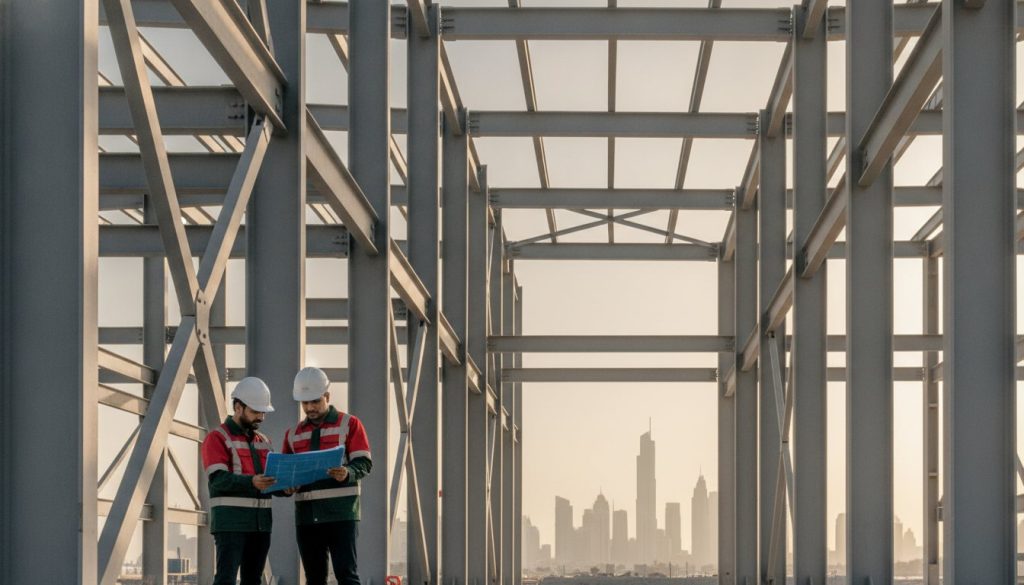
In the 2026 UAE industrial market, the difference between a project’s success and a costly delay often hinges on whether you view procurement as a simple transaction or a strategic technical partnership. You’re likely facing the pressure of fluctuating steel prices, with rebar benchmarks at AED 2,516 per tonne, alongside increasingly stringent national building code compliance requirements. It’s frustrating when material certification is unclear or when a lack of ready customization causes logistical bottlenecks that stall your timeline. Finding a reliable structural steel supplier UAE who understands these pressures is essential for maintaining operational excellence and securing long-term value.
This guide provides the expert insights you need to master these complexities by ensuring 100% compliance with national building codes and international standards. We’ll examine the technical requirements for material grades like S275 and S355, the logistical advantages of value-added services like cut-to-size processing, and the evolving regulatory landscape for the year ahead. By the end of this article, you’ll have a clear framework for selecting a partner that offers the precision, durability, and logistical efficiency required for the UAE’s most demanding infrastructure projects.
Key Takeaways
- Identify the technical and regulatory criteria for selecting a structural steel supplier UAE to ensure your project remains compliant with 2026 building codes.
- Understand the mechanical roles of long and flat products, such as MS beams and channels, to optimize material selection for heavy engineering.
- Learn how to verify material integrity using Mill Test Certificates and international standards like ASTM and EN to mitigate structural risks.
- Discover how utilizing integrated cut-to-size services and surface treatments can reduce on-site labor costs and accelerate your construction schedule.
- Gain a strategic overview of the 2026 UAE steel market to better manage price fluctuations and secure a stable national supply chain.
Navigating the Structural Steel Market in the UAE for 2026
The UAE industrial sector has entered a period of intense growth as we move through 2026, with steel consumption reaching new heights. This surge isn’t merely about volume; it’s about the sophisticated requirements of a nation modernizing its energy, logistics, and manufacturing sectors. For any major project, choosing a structural steel supplier UAE involves more than checking price lists. It requires an understanding of how these materials serve as the literal skeleton of the nation’s infrastructure. According to UAE building regulations, structural steel is defined as hot-rolled or cold-formed carbon steel products that meet specific load-bearing standards and chemical profiles for permanent installation in buildings and civil engineering works.
For a technical look at material properties, this Structural steel overview details the standard shapes and grades used globally. In the local market, the drive toward 2026 economic goals means that energy infrastructure, including massive desalination plants and renewable energy arrays, accounts for a significant portion of structural demand. Similarly, the expansion of the Etihad Rail network and regional logistics parks has created a continuous need for high-grade long products and hollow sections. These sectors require materials that can withstand the unique environmental pressures of the Gulf while meeting rigorous safety benchmarks.
The Shift Toward Integrated Steel Supply
The procurement landscape has changed significantly. Contractors no longer look for simple traders who only move material from point A to point B. Instead, there’s a clear move toward suppliers that offer integrated processing, such as cut-to-size and surface treatments. This shift is essential for meeting the compressed timelines of 2026 projects. Relying on a partner with national-scale logistics is far more effective than coordinating with small, city-specific traders in Dubai or Sharjah. A national partner ensures that material reaches remote sites in Abu Dhabi or the Northern Emirates with the same precision and quality as a central urban project.
Key Challenges in National Steel Procurement
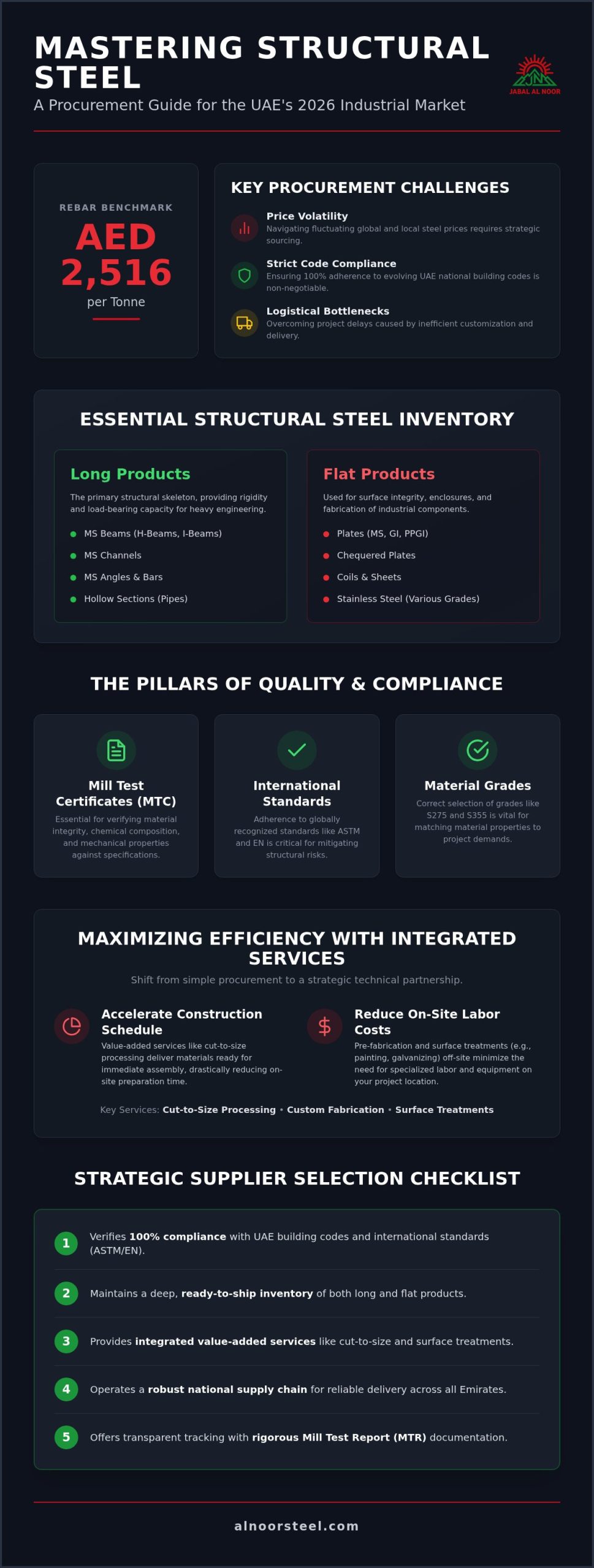
Managing a multi-phase project in the current market requires navigating significant supply chain volatility. While rebar prices have seen specific benchmarks like AED 2,516 per tonne in August 2026, structural sections often follow different global trends. Maintaining high-volume inventory is the only way to stabilize costs over long-term contracts. Procurement teams must also ensure that material quality remains consistent across diverse geographic sites. This consistency is only possible when a structural steel supplier UAE maintains rigorous mill test report (MTR) tracking and adheres strictly to international standards like ASTM or EN grades, ensuring every beam and channel meets the safety requirements of the UAE building code.
Essential Structural Steel Inventory: Long and Flat Products
Securing a consistent material flow for large-scale infrastructure requires a partner with a deep, ready-to-ship inventory of both long and flat products. In the context of heavy engineering, these two categories serve distinct but complementary roles. Long products typically form the primary structural skeleton of a project, providing the necessary rigidity and load-bearing capacity. Flat products, conversely, are utilized for surface integrity, enclosures, and the fabrication of heavy-duty industrial components. As Global structural steel market trends indicate a shift toward higher-grade alloys, a veteran structural steel supplier UAE must maintain a diverse range of sections to support complex engineering requirements.
The UAE market specifically demands materials that can withstand high ambient temperatures and, in many cases, corrosive coastal environments. This necessity has made specialized materials like GI, PPGI, and various grades of Stainless Steel standard requirements for modern procurement. Whether the project involves a high-rise in Dubai or an industrial warehouse in Abu Dhabi, the availability of MS Beams, Channels, and Angles remains the foundational requirement for any structural framework.
Long Products: Beams, Channels, and Bars
Long products are the workhorses of the construction industry. H-beams and I-beams, often referred to as Universal Beams and Universal Columns, are engineered to handle heavy vertical and horizontal loads. MS Channels and MS Angles provide the essential bracing and support for trusses and secondary framing systems. In modern UAE architecture, hollow sections; including square, rectangular, and circular profiles; have become increasingly popular. These sections offer a high strength-to-weight ratio and are frequently used in aesthetic structural designs like stadium canopies and airport terminals. For engineers seeking to understand the full range of SHS, RHS, and CHS profiles available from hollow section steel suppliers UAE, a detailed technical breakdown can help align profile selection with specific load and compliance requirements. For those managing complex structural frameworks, reviewing the technical specifications at JABAL AL NOOR Steel can help align material selection with project needs.
Flat Products and Special Steel Sheets
Flat products provide the necessary coverage and surface durability for industrial assets. GI (Galvanized Iron) and PPGI (Pre-Painted Galvanized Iron) sheets are critical for the UAE’s industrial roofing and cladding, offering superior corrosion resistance against the region’s humidity. For heavy-duty applications, MS plates and chequered plates are the standard for industrial flooring, platforms, and machinery bases where slip resistance and impact durability are paramount. In marine environments or chemical processing plants, stainless steel components are indispensable. These materials ensure long-term structural endurance where carbon steel might otherwise fail due to oxidation or chemical exposure.
Understanding Quality Standards and Material Compliance
Technical integrity serves as the non-negotiable cornerstone for every major industrial project across the Emirates. In a market where structural failures carry immense financial and safety risks, verifying the chemical and mechanical properties of your inventory is a primary responsibility. A reputable structural steel supplier UAE doesn’t just deliver material; they provide the technical documentation necessary to prove that every beam and column meets the project’s engineering specifications. The most critical document in this process is the Mill Test Certificate (MTC), which acts as a material passport, tracing the steel back to its specific heat number and confirming its chemical composition and tensile strength.
ASTM A36 defines carbon structural steel with a minimum yield strength of 36,000 psi (250 MPa) and a tensile strength range of 58,000 to 80,000 psi (400 to 550 MPa), establishing it as the standard grade for bolted or welded construction in UAE infrastructure. While ASTM A36 is widely used for general structural applications, projects requiring higher load-bearing capacities often turn to European grades. S235JR is frequently specified for secondary structures and light frameworks, whereas S355JR is the preferred choice for heavy-duty infrastructure, such as bridges and high-rise skeletons, due to its superior yield strength and durability under stress.
Comparing ASTM, EN, and JIS Standards
Contractors must distinguish between different international benchmarks to ensure structural safety. While ASTM A36 is the standard for carbon steel, ASTM A572 Grade 50 offers a high-strength, low-alloy alternative that allows for lighter structural designs without sacrificing integrity. In the UAE, European standards (EN 10025) are often the dominant framework, providing a clear hierarchy of grades like S235, S275, and S355. Japanese Industrial Standards (JIS), such as JIS G3101 (SS400), are also present in the market, particularly in specialized machinery or marine vessel fabrication. Selecting the correct grade requires a precise alignment with the engineer’s load-bearing calculations and the environmental conditions of the site.
Compliance with UAE National Safety Codes
Procurement strategies must align strictly with the UAE Fire and Life Safety Code of Practice to ensure that all structural components contribute to the building’s overall fire resistance. Third-party inspections from recognized bodies like Bureau Veritas or TUV are often mandatory to verify material authenticity before it arrives on-site. Sourcing from an established structural steel supplier UAE ensures that these compliance layers are already integrated into the supply chain. National trading entities provide an essential layer of accountability, ensuring that the steel isn’t only high-quality but also fully compliant with the rigorous safety benchmarks set by Dubai Municipality and other regional authorities.
Maximizing Project Efficiency with Custom Steel Processing
The difference between a basic stockist and a premium structural steel supplier UAE lies in the ability to provide materials that are ready for immediate assembly. Basic traders often leave the burden of fabrication to the contractor, which leads to increased on-site labor and potential errors. By opting for a partner that provides integrated processing, you can receive ready-to-install structural components that align perfectly with your architectural drawings. This approach significantly reduces project timelines, as it eliminates the need for heavy machinery and specialized labor at the construction site. Custom length steel beams are particularly valuable for complex engineering designs where standard mill lengths would result in excessive joints or material waste.
Receiving processed steel directly at the project location offers immense logistical advantages. It simplifies inventory management and reduces the risk of damage that often occurs during multiple handling stages. When beams are delivered at custom lengths, the crane time required for installation is minimized, and the structural integrity is often improved by reducing the number of splices needed. This level of service transforms the supply chain from a series of individual purchases into a streamlined flow of components tailored to the specific geometry of the build.
Cut-to-Size Customization and Precision
Precision cutting is achieved through industrial bandsaws and advanced plasma technology, ensuring that every MS beam or plate meets exact dimensional tolerances. These cut-to-size services allow engineers to optimize their budgets by only paying for the material they actually use while minimizing scrap on the job site. Industrial steel profiles require high engineering accuracy to ensure that connections and bolt holes align during the erection phase. This level of precision is difficult to maintain with portable tools, making off-site industrial processing a necessity for modern, large-scale projects.
Surface Treatments and Corrosion Protection
The humid and saline environment of the UAE necessitates rigorous surface preparation to prevent premature oxidation. Shot blasting is a critical industrial process that uses high-velocity abrasives to remove mill scale and rust, creating a clean profile for coating adhesion. Once cleaned, applying a high-quality primer extends the lifespan of structural steel significantly, protecting the core material during transport and site storage. For steel plates used in high-corrosion environments like desalination plants or coastal refineries, specialized treatments provide an essential barrier against chemical and atmospheric degradation. If you require materials that meet these exacting standards, you can view our full range of processing services to see how we support industrial durability.
Strategic Sourcing: Selecting a Reliable National Steel Partner
Selecting a structural steel supplier UAE for the year ahead involves evaluating more than just current stock levels. It’s about finding a partner that acts as a foundational pillar for your industrial operations. In 2026, the criteria for selection have evolved to prioritize technical proficiency and the ability to handle large-scale, multi-phase projects without logistical friction. Transparent communication regarding mill lead times and material certification is no longer an optional service; it’s a critical requirement for maintaining project schedules and ensuring ethical conduct throughout the procurement process.
Technical proficiency is especially vital when sourcing for high-stakes sectors like energy and large-scale manufacturing. A partner that understands the nuances of international grades and UAE building codes can prevent costly compliance errors before they reach the site. This level of expertise ensures that your supply chain remains resilient, even during periods of global market uncertainty. By focusing on long-term value rather than short-term price fluctuations, contractors can build a reliable framework for project success. We invite you to leverage JABAL AL NOOR’s extensive inventory and processing expertise to meet these demands with confidence.
The JABAL AL NOOR Advantage in the UAE
JABAL AL NOOR Steel is positioned as a veteran entity within the local industrial landscape. Our commitment to durability and high standards is reflected in an extensive inventory that spans MS beams, channels, and specialized hollow sections. Unlike localized traders who focus on specific city hubs like Dubai or Sharjah, our national distribution network reaches across all Emirates. This breadth of reach provides a seamless supply chain for infrastructure projects in remote locations, ensuring that logistical efficiency is maintained regardless of the site’s geography. We function as a knowledgeable guide, helping procurement teams navigate the specific pressures of heavy industry while ensuring every component meets the rigorous quality benchmarks we uphold.
Streamlining Your Steel Supply Chain
Initiating a bulk supply contract with a national stockist provides a level of price and supply stability that spot-buying cannot match. To begin this process, it’s essential to provide a comprehensive bill of quantities that includes specific grade requirements and processing needs. Requesting detailed quotes that include cut-to-size customization and surface treatments allows for a more accurate project budget and reduces the risk of on-site delays. By consolidating your procurement with a single, reliable entity, you reduce the administrative burden and ensure consistent material quality across your entire project portfolio. It’s the most effective way to manage the complexities of the 2026 market while maintaining operational excellence.
Partner with JABAL AL NOOR Steel for your 2026 structural requirements.
Securing Industrial Excellence in 2026
Success in the 2026 industrial landscape requires a focus on technical precision and supply chain resilience. We’ve explored how verifying Mill Test Certificates and selecting the correct material grades, such as S355JR or ASTM A36, forms the bedrock of structural integrity. By integrating value-added services like shot blasting and precision cutting, you don’t just source material; you optimize your entire construction timeline. This strategic approach minimizes on-site labor and ensures your project meets the most rigorous safety benchmarks.
Selecting an established structural steel supplier UAE ensures your project benefits from a national distribution network and a legacy of operational excellence. JABAL AL NOOR Steel maintains an extensive inventory of ASTM and EN grade structural steel, backed by decades of expertise in the UAE industrial sector. Our in-house cut-to-size and surface treatment facilities deliver precision components that meet exacting engineering standards. We provide the stability your high-stakes infrastructure requires.
Request a Technical Quote from JABAL AL NOOR Steel to secure a dependable partner for your next development. We look forward to supporting your vision with industrial stability and unwavering quality.
Frequently Asked Questions
What are the most common structural steel grades used in the UAE?
Structural steel in the UAE primarily adheres to European and American standards. Common grades include S275 and S355 under the EN 10025 standard, alongside ASTM A36 for general carbon steel applications. These grades are selected based on their yield strength and suitability for the region’s diverse infrastructure projects, ensuring every component meets the specific load-bearing requirements of the build.
How does cut-to-size customization benefit a large-scale construction project?
Cut-to-size services significantly reduce on-site labor costs and minimize material waste by delivering ready-to-install components. This precision ensures that structural beams and columns fit perfectly according to architectural drawings, which accelerates project timelines. It’s a critical service offered by a professional structural steel supplier UAE to enhance overall project efficiency and reduce the administrative burden of on-site fabrication.
What is the difference between MS beams and H-beams in structural engineering?
The primary difference lies in the flange width and load-bearing capacity. H-beams, often called Universal Columns or Beams, feature wider flanges that allow them to handle higher vertical loads and bending moments. MS beams, or I-beams, have narrower flanges and are generally lighter, making them suitable for secondary structures or shorter spans where weight and material volume are primary considerations.
Why is shot blasting and priming necessary for structural steel in the UAE?
These treatments are essential for protecting steel against the UAE’s high humidity and saline coastal air. Shot blasting removes mill scale and rust to create a clean surface profile, while priming provides an immediate barrier against oxidation. These processes ensure the long-term durability of the steel and provide a reliable foundation for final protective coatings applied after installation.
How can I verify the quality of steel products from a UAE supplier?
Quality verification requires reviewing the Mill Test Certificate (MTC) for every batch to confirm chemical and mechanical properties. You should also look for third-party inspection reports from recognized bodies like Bureau Veritas or TUV to ensure authenticity. Sourcing from an established structural steel supplier UAE guarantees that all materials meet the necessary national safety codes and international quality benchmarks.
What are the advantages of using hollow sections in industrial buildings?
Hollow sections, including square, rectangular, and circular profiles, offer an exceptional strength-to-weight ratio and high torsional resistance. This makes them ideal for large-span industrial buildings, warehouses, and aesthetic architectural features where structural efficiency is paramount. They’re also easier to maintain and coat due to their smooth surfaces, which helps reduce long-term maintenance costs in harsh industrial environments. Procurement teams sourcing these profiles can benefit from working with established hollow section steel suppliers in the UAE who maintain compliant inventory across SHS, RHS, and CHS profiles.
Does JABAL AL NOOR Steel provide national delivery for bulk orders?
JABAL AL NOOR Steel maintains a robust national distribution network capable of handling bulk orders across all seven Emirates. This logistical capability ensures that heavy structural products reach remote industrial zones or urban project sites with consistent reliability and timing. Our fleet is specifically equipped to transport long products and processed steel safely to ensure they arrive ready for immediate use.
What international standards do UAE steel stockists typically follow?
Stockists in the UAE typically follow ASTM, EN, and JIS standards to ensure global material compatibility. These international benchmarks ensure that the steel used in the region meets rigorous quality and safety requirements for load-bearing structures. Adherence to these standards is mandatory for projects overseen by Dubai Municipality and other regional regulatory authorities to maintain national building integrity.